


How Frontline Runs OL5 Maintenance Through Jira With Exadel ColleagueHow Frontline Runs OL5 Maintenance Through Jira With Exadel Colleague

Summary
Frontline Education's OL5 team now runs customer maintenance requests through Exadel Colleague.
- A Jira ticket starts the work.
- Colleague analyzes the repository, prepares a plan, waits for an engineer to approve it, then implements the change and prepares the pull request.
- Seven tickets have gone through the workflow so far, every one that has come in.



About Frontline Education
Frontline Education provides specialized administration software for K-12 leadership across human resources, business operations, student health management and student services.
This is the first paper in a three-part series. Whitepaper 2 covers Operational Excellence. Whitepaper 3 covers Implementation, Roadmap, and Cloud Deployment.

The Challenge
OL5 maintenance is a steady stream of customer-specific work: T-SQL changes, stored procedures, reports, version updates and the repository changes that come with them. The main constraint was the coordination repeated around every change.
For each request, the subject-matter engineer had to rebuild the context, find the right customer implementation, write a technical plan, document it in Jira, implement the change, update the version and changelog, prepare the pull request and validate the result. The team already used AI for planning, but in separate chat sessions. Plans, estimates and risks were often copied by hand between the chat, Jira, email and Git, and when a session ended, the reasoning behind a change often ended with it.
This is the first paper in a three-part series. Whitepaper 2 covers Operational Excellence. Whitepaper 3 covers Implementation, Roadmap, and Cloud Deployment.
The Solution
Exadel mapped the existing maintenance workflow and configured Colleague to fit it. Jira was already widely used in the process, so it became the main place where work starts and where decisions are recorded.
Here is what happens on each ticket now:

Phase 01
Trigger
The Jira ticket describes the request and triggers Colleague
Phase 02
Analyze
Colleague analyzes the repository and the relevant customer context, and separates maintenance defects from work that needs an estimate.
Phase 03
Plan
It prepares a plan the engineer can review: affected files, database objects, risks and, where needed, estimated effort.
Phase 04
Rewiew
The engineer reviews the plan. Colleague updates it from the pull-request feedback and records the approved approach in Jira.
Phase 05
Update
Nothing is implemented until the engineer approves. Then Colleague makes the agreed change, updates the changelog and version information, and prepares the implementation pull request.
Phase 06
Final
Final technical validation and QA stay with Frontline
What Changed on Every Ticket
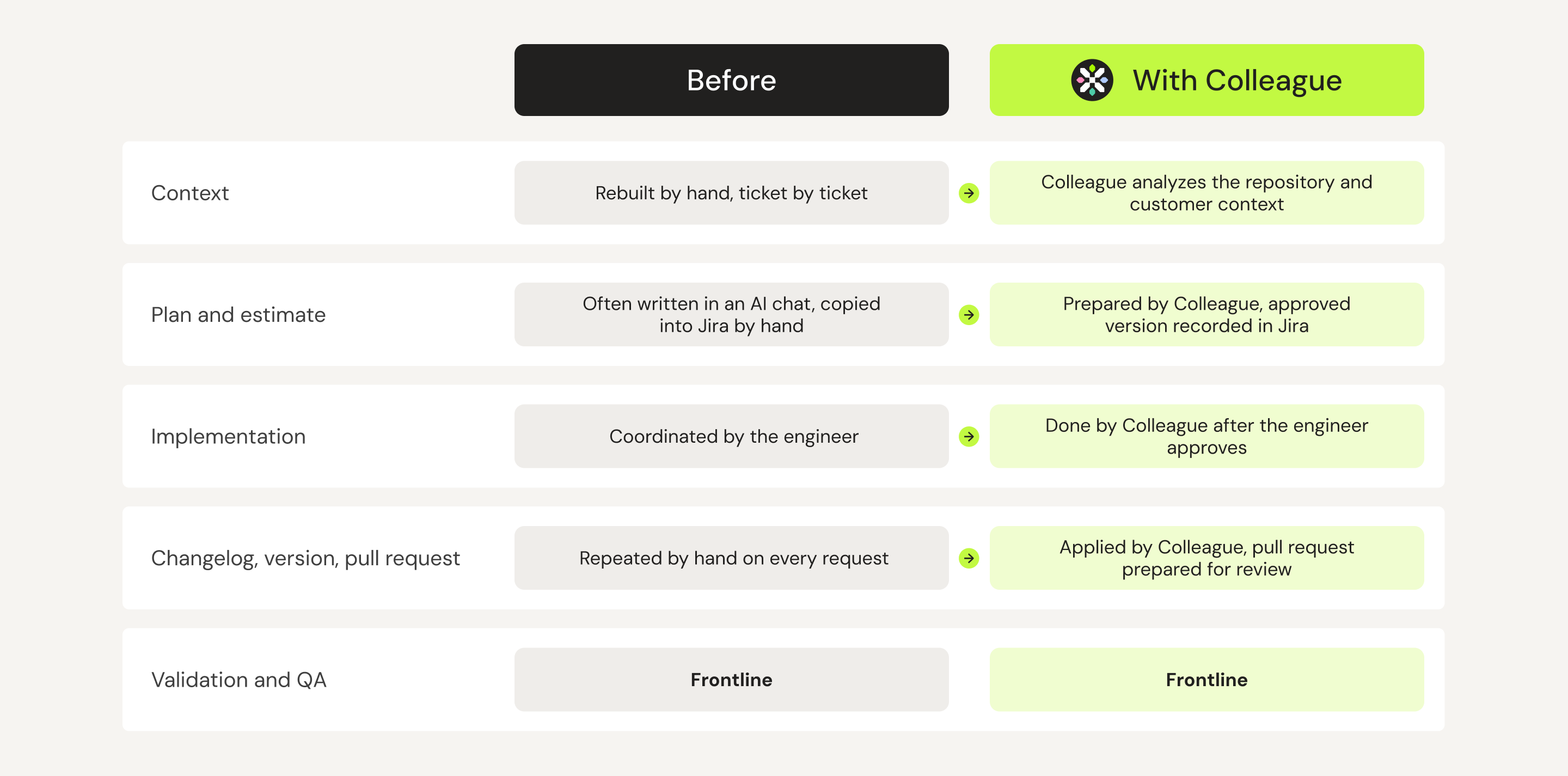
Engineers Approve Every Change
Colleague does not move from analysis to implementation on its own. The engineer reviews the plan and authorizes the work, and Frontline keeps final validation and QA. Defects and quote-based requests can follow the same technical workflow, and the approval gates handle the difference between them.
Results
Less coordination around each change
Colleague now handles moving information between tools, writing plans and estimates into Jira, carrying out the work once it is approved, the standard changelog and versioning steps, and the basic pull-request structure.
One repeatable workflow
No engineer has to start and manage a separate AI session for each request. Every ticket can follow the same steps, from analysis to review.
Engineering time goes to judgment
The engineer's role shifts from coordinating each step to mainly reviewing and deciding: assessing risk, checking technical quality, handling exceptions and confirming behavior.
The reasoning stays with the code
The approved plan lives with the ticket and the repository history. The next engineer on a similar request can see why a change was made and reuse earlier estimates.
What Comes Next
With the workflow standardized, each stage can run on the model that fits its complexity. Routine steps such as verification or repository navigation can use lighter models, and more capable models can be kept for implementation-heavy reasoning. At scale, that creates an opportunity to optimize engineering effort and token cost together.
Read how Frontline made Exadel Colleague part of its team
Talk to us about running your maintenance work through Exadel Colleague.
Case Studies
You may also be interested in...

Powering Exponential Growth by Modernizing and Optimizing Core Business Platforms on AWS















90% Failure Prediction Accuracy for Critical Equipment Powered by AI Predictive Maintenance




































Put Colleague on your own backlog
Bring a real sprint, a real repository, and the tickets nobody enjoys.