


How Frontline Made Exadel Colleague Part of Its Team How Frontline Made Exadel Colleague Part of Its Team

Summary
Frontline Education invited Exadel's proprietary asynchronous multi-agent delivery solution into their delivery team to resolve their backlog. Inside a month, the company's engineers were assigning tickets to Exadel Colleague after the morning stand-up and reviewing its pull requests within hours.

_2026-08-17_12-30-05%201.png)

About Frontline Education
Frontline Education provides specialized administration software designed to empower K-12 leadership across human resources, business operations, student health management, and student services. By delivering critical data and actionable insights, their platform allows institutions to shift focus toward strategic growth rather than reactive management.
This is the first paper in a three-part series. Whitepaper 2 covers Operational Excellence. Whitepaper 3 covers Implementation, Roadmap, and Cloud Deployment.
_2026-08-17_12-23-45%201.png)
The Challenge
Maintenance work on software still needs a person to carry every ticket, and a portfolio built by acquisition usually has so many tickets that it’s hard for any team to keep pace. Frontline's developers were not short of AI. They use coding assistants daily and have built their own agents for story decomposition, planning and code review. The gap was narrower and harder: someone still had to pick up the ticket, and quality assurance had become the place releases waited. However, even with utilizing AI, the backlog continued.
This is the first paper in a three-part series. Whitepaper 2 covers Operational Excellence. Whitepaper 3 covers Implementation, Roadmap, and Cloud Deployment.
The Solution
Exadel Colleague started working on two live repositories: the legacy stored-procedure layer, and a new .NET invoice ingestion service in active development.
There is no new interface to learn. Work stays in Jira and Git, and the ticket stays what it has always been: where work gets described, discussed and handed off. The change is that an agent is now one of the parties on it.
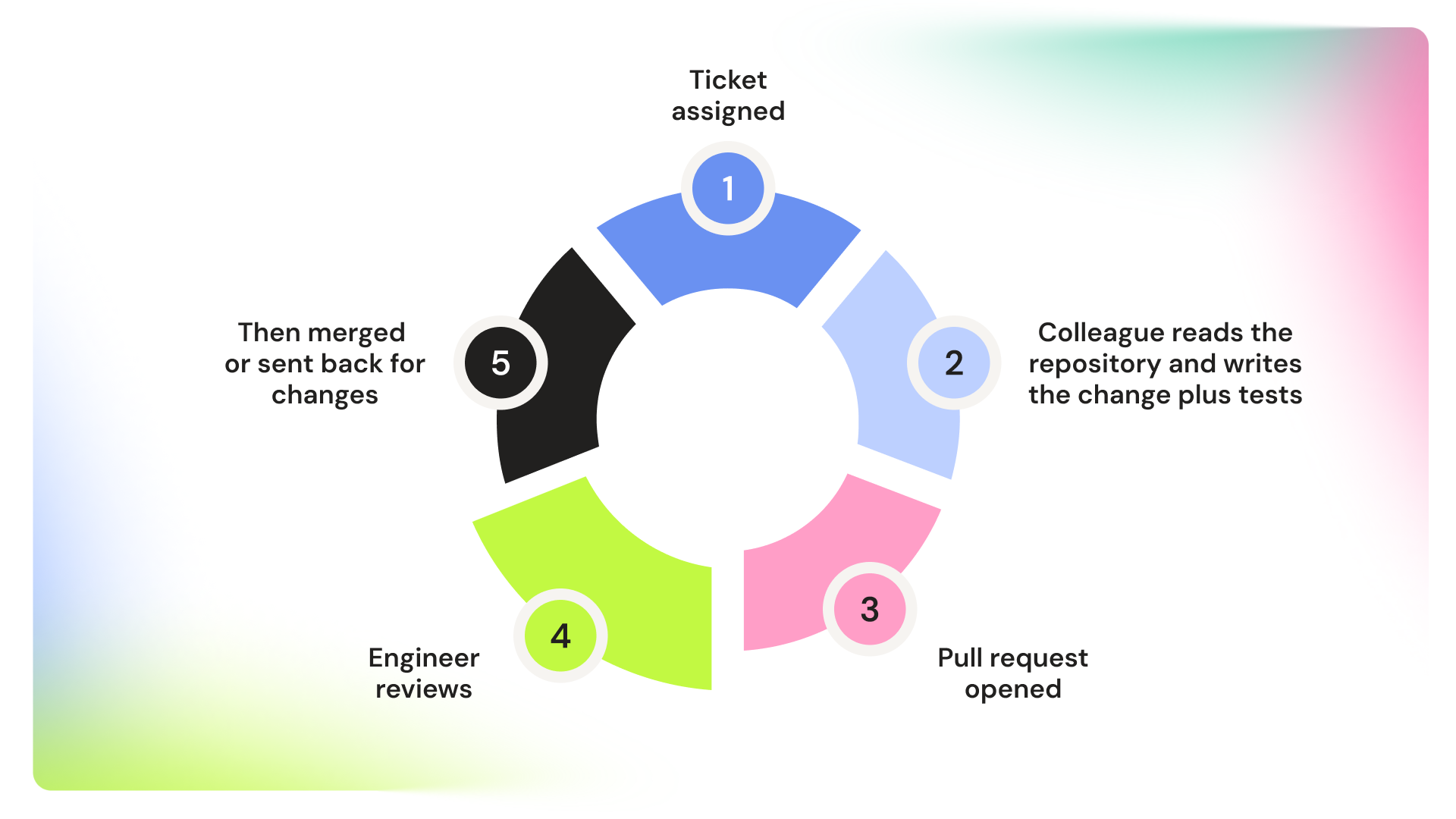
Assign a ticket to Exadel Colleague and it reads the repository, firms up the requirement, writes the tests, implements the change, and opens a pull request. When a ticket has gaps or ambiguities, Colleague asks the reporter for clarification on the ticket first, before spending time & tokens. Colleague utilizes the native comment features of Jira and Git to transparently explain its assumptions and decisions. An engineer reviews the pull request like any other: approve it and it merges, or request changes and Colleague reworks it against the latest version of the branch, answers each comment, and pushes an update for review.
Inside Colleague, three specialized agents work the ticket in sequence. A business analyst agent validates the story and breaks it into tasks. A testing agent writes the tests before any production code exists. A programming agent implements the change and runs those tests against its own work.
Results
Alexey Girzhadovich
Chief Enterprise AI and Solutions Officer

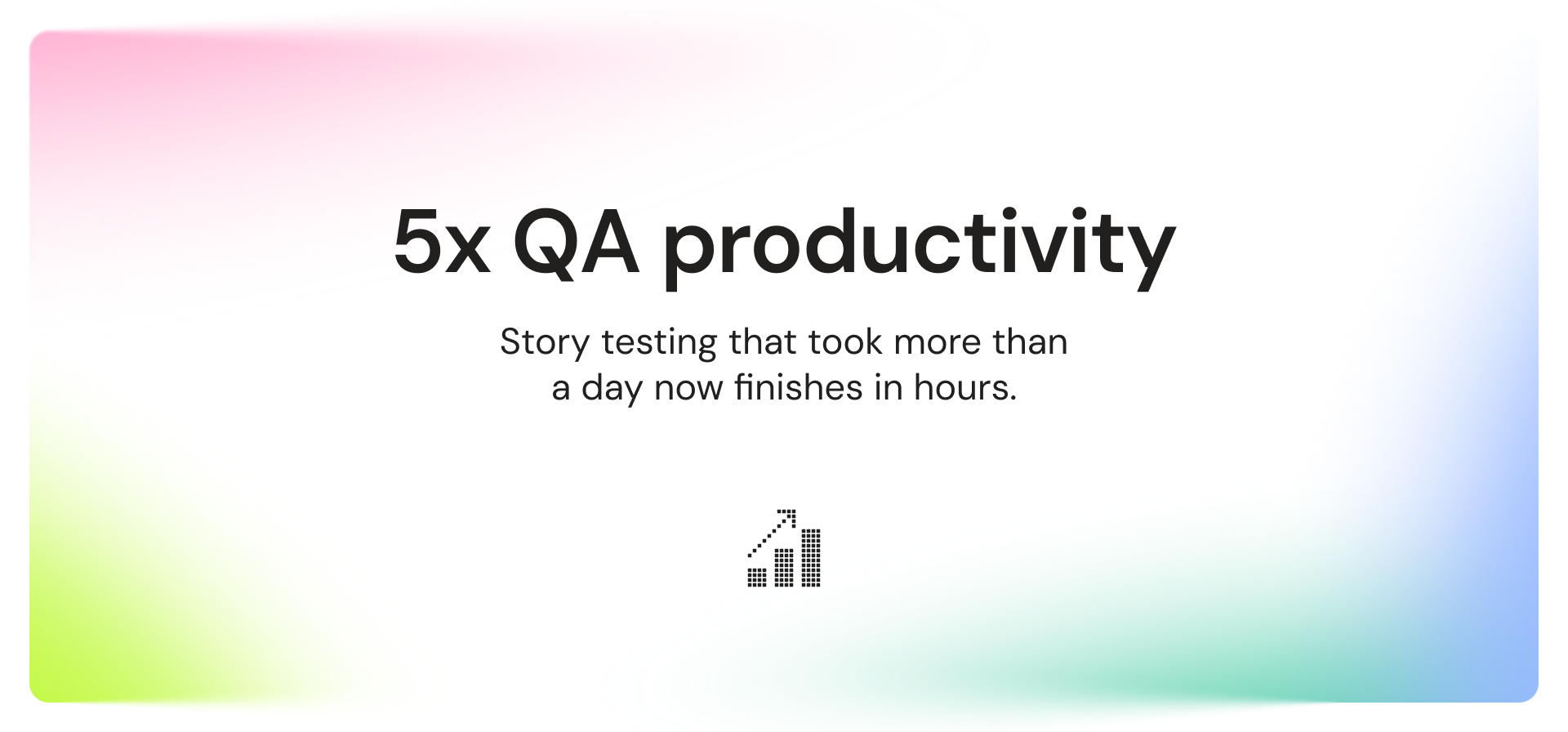
Story testing: more than a day, down to hours. Four user stories went through the Colleague testing workflow, and the QA engineer verified every result against her own manual run.
Alexey Girzhadovich
Chief Enterprise AI and Solutions Officer
95% of all runs came back correct, scored by the reviewing engineers on Frontline's own tickets.
Alexey Girzhadovich
Chief Enterprise AI and Solutions Officer
Coding standards held throughout. That was checked, not assumed.
Alexey Girzhadovich
Chief Enterprise AI and Solutions Officer
Usually less than 10 minutes of agent working time per ticket.
Alexey Girzhadovich
Chief Enterprise AI and Solutions Officer
Real backlog, live repositories. Every ticket came from Frontline's own backlog, in Frontline's own environment, on Frontline's own account.
By the end of the first phase, Exadel Colleague ran across dozens of tickets on seven live repositories(at the beginning it was 2), and Frontline's engineers merged its work into production code.
Colleague at work
To resolve a critical defect in the accounts payable module where payments were failing due to missing payee details, the issue was assigned to Exadel Colleague on a Friday afternoon. Within seven minutes, Colleague autonomously analyzed the codebase, implemented the fix, and generated a pull request. The reviewing engineer awarded the fix a 100% accuracy score and merged it directly into production.
The two capabilities that carried this project
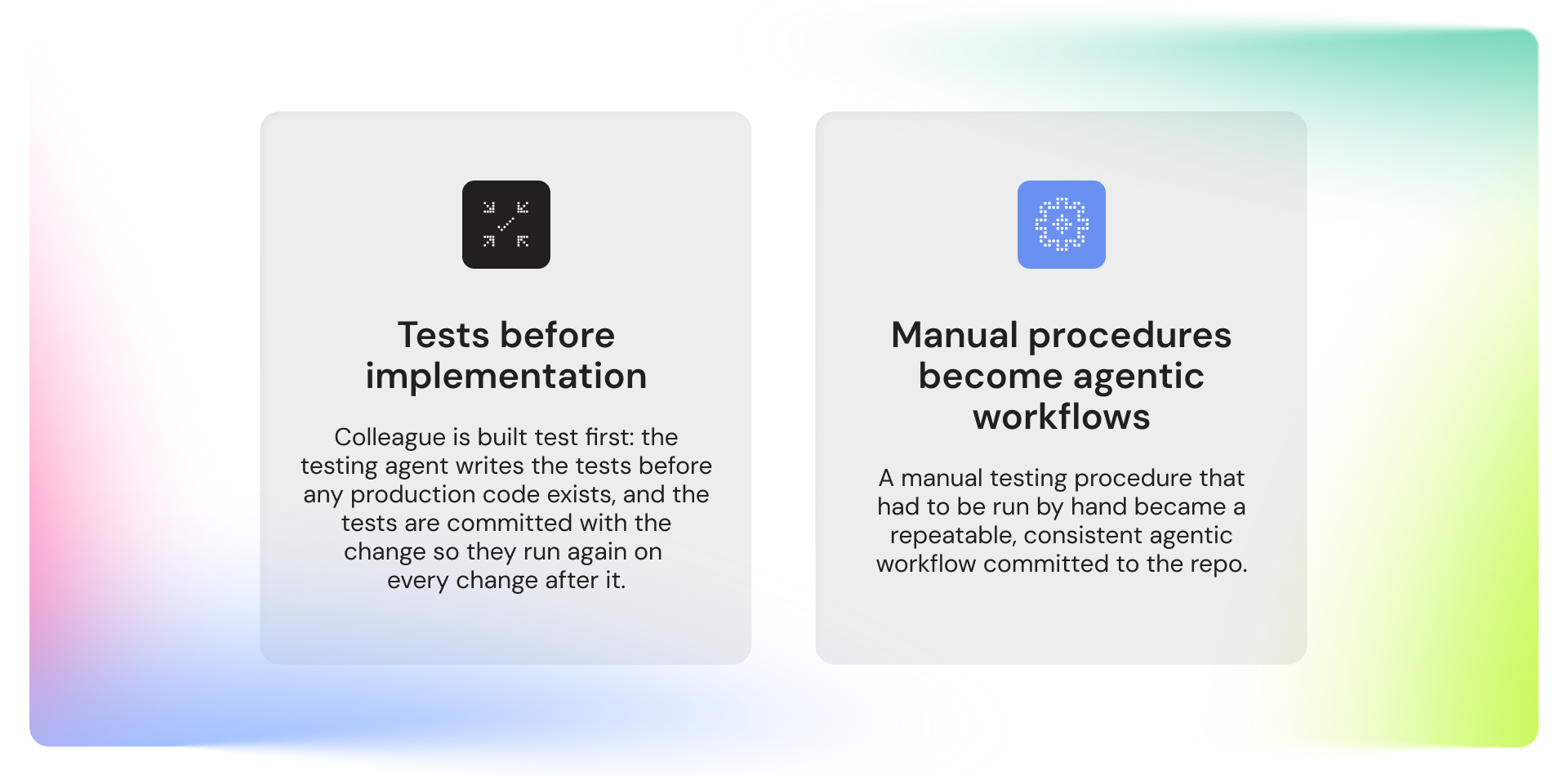
Tests before implementation.
Frontline's team was already strong on implementation, and quality assurance was where releases waited. Colleague is built test-first: the testing agent writes the tests before any production code exists, and the programming agent implements against them and runs them on its own work. The tests are committed with the change, so they run again on every change after it.
Manual procedures become agentic workflows.
Frontline's invoice testing ran as a manual Postman procedure that only one person could execute. Exadel Colleague turned it into a repeatable, consistent agentic workflow the whole team can run, and it lives with the code so it survives handovers.
How it runs
Alexey Girzhadovich
Chief Enterprise AI and Solutions Officer
Models
Model- and agent-agnostic, each task routes to the model that suits it.
Alexey Girzhadovich
Chief Enterprise AI and Solutions Officer
Environment
Your own private cloud or on-premise, on your own LLM provider keys. At Frontline that meant Anthropic's Claude models on Amazon Bedrock, in Frontline's own AWS environment and account.
Alexey Girzhadovich
Chief Enterprise AI and Solutions Officer
Tools
Jira, GitHub, GitLab and Azure DevOps, the issue tracking and repository systems you already have.
The first phase found the real constraint, and it was not the agentic delivery
The clearest pattern across the pilot was that output quality tracked one thing: how well the repository described itself. Where tickets and specification files matched the code as it stands, results were consistently strong. Where they described an architecture that a refactor had already replaced, Colleague inherited that drift.
Frontline's own engineers spotted it first:
Our ticket content had drifted from the work that had actually been done. A month ago we moved the consumer service out of a microservice repo into Dispatch, and the tickets never reflected that. Any other AI solution would have struggled with it, and it pushed us to tighten up how we document.
Frontline Engineer, ticket comment
That finding is worth more than the ticket count. Establishing repository context at onboarding was already how Colleague starts. What Frontline showed is that a single pass does not hold: the code and the business keep moving, and repository context has to move with them. The practice now is a recurring refresh that keeps context in step with both, plus a readiness check before any deployment.
What a Team needs in place to succeed with Agentic delivery
Alexey Girzhadovich
Chief Enterprise AI and Solutions Officer
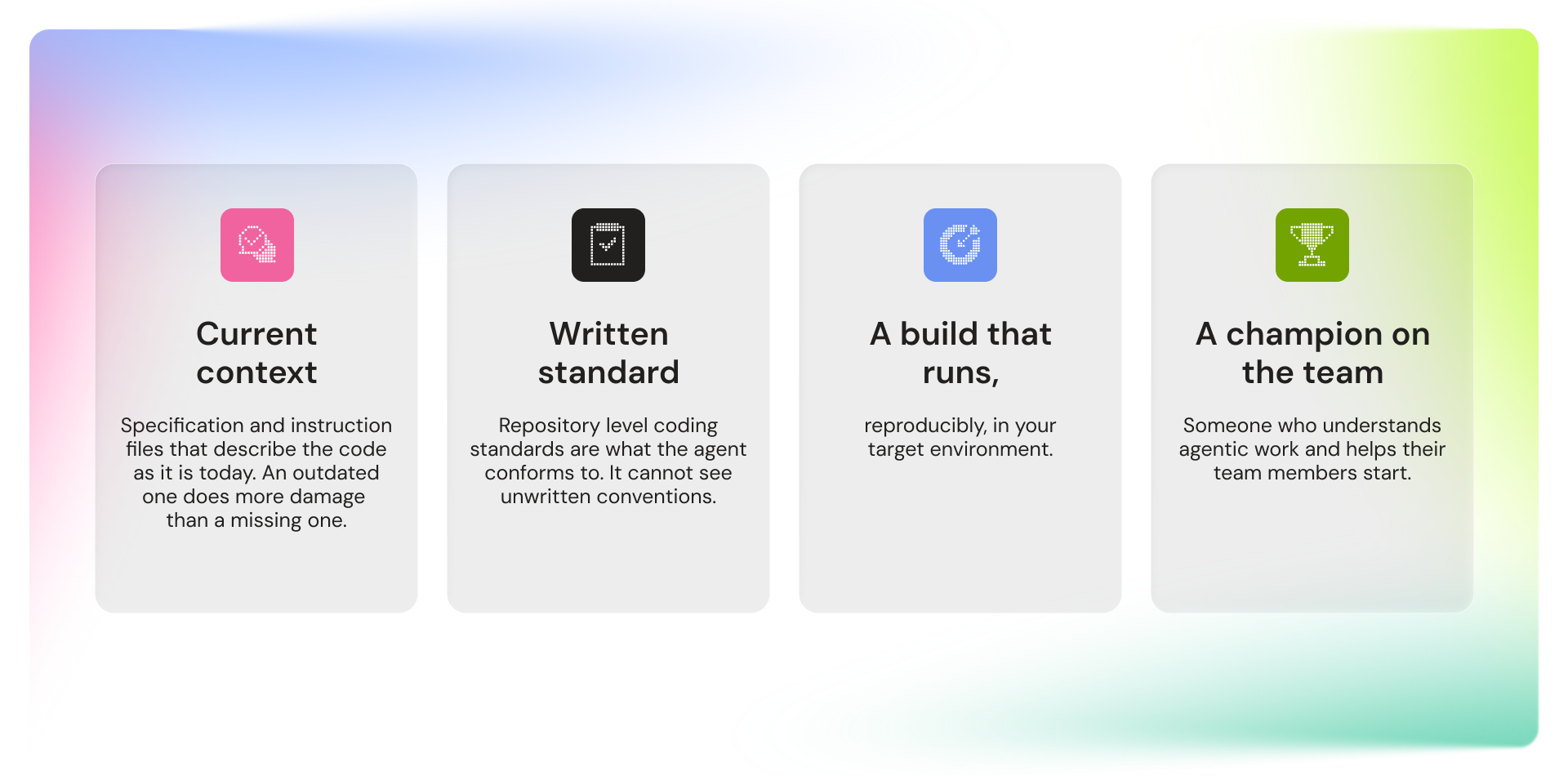
Current context. Specification and instruction files that describe the code as it is today. An outdated one does more damage than a missing one.
Alexey Girzhadovich
Chief Enterprise AI and Solutions Officer
Written standards. Repository-level coding standards are what the agent conforms to. It cannot see Unwritten conventions.
Alexey Girzhadovich
Chief Enterprise AI and Solutions Officer
A build that runs, reproducibly, in your target environment.
Alexey Girzhadovich
Chief Enterprise AI and Solutions Officer
A champion on the team. Someone who understands agentic work and helps their team members start. Frontline had one, and it is why the habit stuck.
Exadel can help you with all the above as a service or provide guides for a self-served experience.
Why Exadel Colleague works
Most AI coding agents hand the work back to a developer. Colleague works like another engineer on the team: it takes the assigned ticket, plans it, writes the tests before the code, implements it and submits a pull request for review.
Case Studies
You may also be interested in...














Put Colleague on your own backlog
Bring a real sprint, a real repository, and the tickets nobody enjoys.