
Tags
Share
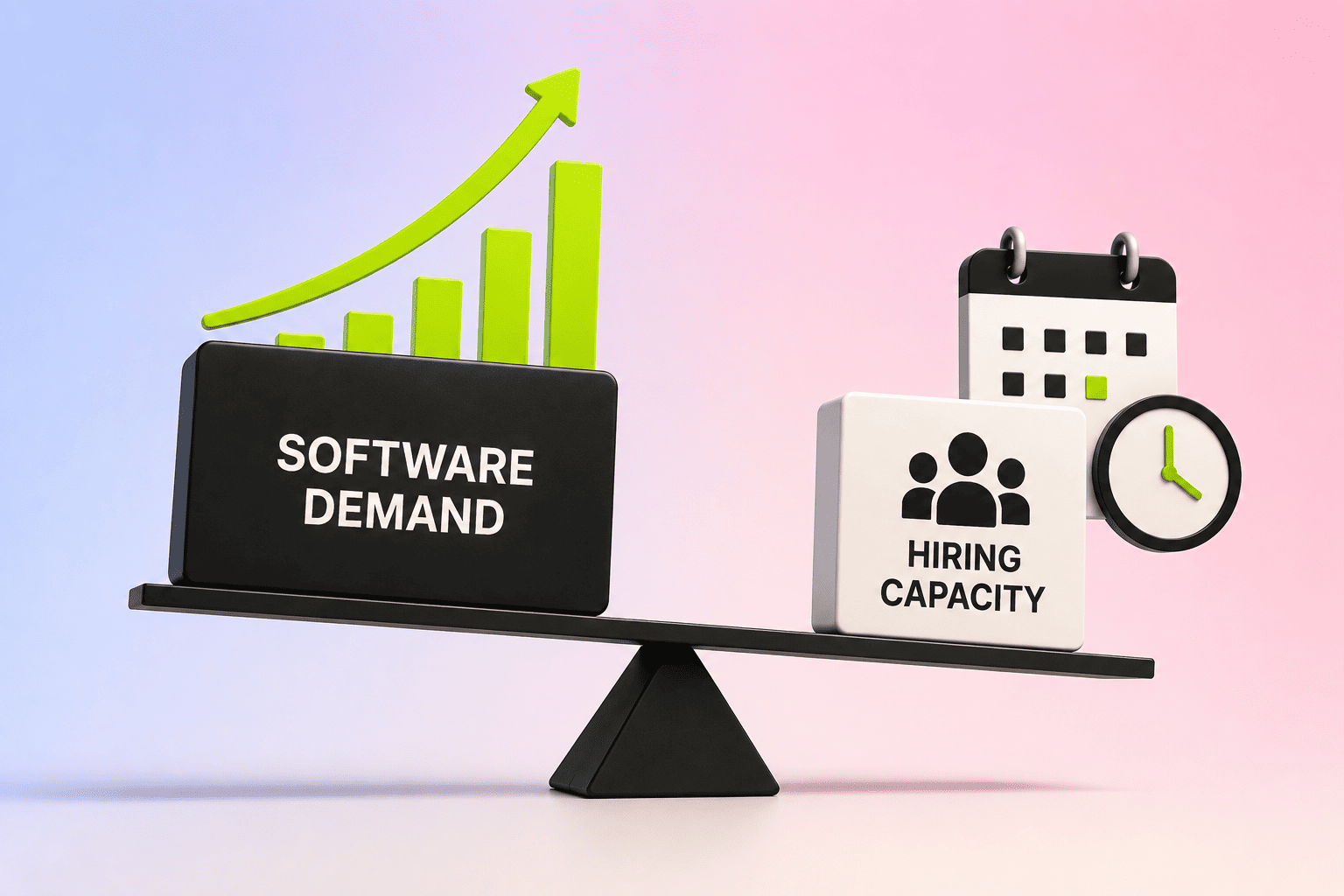
The new reality is that software demand is increasing faster than engineering teams can grow.
Across almost every industry, engineering organizations are being asked to modernize legacy systems, introduce AI capabilities, strengthen cybersecurity, migrate to the cloud and deliver new customer experiences—all at the same time. Yet hiring has become slower, and more expensive.
For Heads of Engineering and VPs of Engineering, this has become a serious recruitment challenge. Hiring remains essential, but often recruiting alone cannot keep pace with delivery expectations. Every delayed hire and every missed sprint compounds pressure across the engineering organization.
There is a pressing question that sits at the centre of modern software delivery: "How do we increase engineering capacity without increasing headcount at the same rate?"
McKinsey's research into AI-enabled software engineering shows that organizations are forced to explore new ways of improving engineering productivity as software demand continues to outpace traditional delivery models.
The insights in this article draw on Exadel's experience working with more than 2,000 engineers across the US, Europe, and LATAM, as well as production deployments with enterprise software teams.
We examine why software demand is outpacing hiring capacity, why AI tools alone are not enough, and how leading engineering teams are expanding engineering capacity without proportional headcount growth.
The Hiring Reality: Engineering Talent Gaps in 2026
Hiring has always been a vital part of engineering growth, but is now increasingly becoming a bottleneck. Businesses can easily approve budgets or prioritise initiatives within days. By comparison, expanding engineering capacity often takes months.
This mismatch is reshaping how engineering leaders think about software delivery.
Average Time-to-Hire: Three to Six Months Per Engineer
Recruiting experienced software engineers has become significantly more complex than simply filling a vacant role. Today's engineering teams need a host of skills: cloud expertise, architectural experience, security awareness, AI literacy and an understanding of increasingly sophisticated delivery environments. Finding candidates who combine those capabilities requires multiple interview stages, competitive offers and often lengthy notice periods.
Three to six months per engineer is now a realistic hiring timeline for experienced technical talent. At the same time, customer expectations and delivery commitments aren’t going away, and engineering backlogs continue to stack up.
The outcome is predictable: software demand accumulates faster than engineering capacity.
According to Gartner's research on AI-Augmented Software Engineering, many organizations are now complementing their recruitment strategies with AI-enabled engineering practices rather than relying exclusively on hiring.
Internal Requisitions Add Further Delay
External recruitment is only part of the challenge. Before most businesses can begin hiring, they have to go through internal approval processes, budget reviews, workforce planning and requisition approvals.
Engineering leaders often identify the need for additional capacity long before the organization is ready to approve another position. These internal delays extend the hiring cycle even further. Meanwhile, delivery expectations remain unchanged and the engineering team is expected to deliver more software with the same capacity. This is why many Heads of Engineering no longer see hiring as their main concern.
The real problem is the growing gap between software demand and available engineering capacity.
The Cost of a Missed Sprint Deadline vs. Additional Headcount
When engineering capacity falls behind demand, the real cost is far-reaching. Delayed sprint commitments have real knock-on effects: product launches slip, technical debt grows, and stakeholders start losing confidence in delivery forecasts.
Ironically, adding another engineer doesn’t immediately solve these problems. New hires need to be onboarded first and undergo knowledge transfer before they can meaningfully contribute to delivery.
In reality, the cost of a missed sprint often exceeds the short-term cost of additional headcount because delayed delivery has a simultaneous knock-on effect on multiple downstream initiatives. For engineering leaders, the objective is now to scale engineering capacity at the speed of business demand.
Why Individual AI Tools Do Not Solve Team Capacity
Tools such as GitHub Copilot and Claude Code help engineers write code faster, generate documentation, explain unfamiliar frameworks and automate repetitive tasks. For the individual developer, the productivity gains are very real.
However, engineering teams are discovering that increasing individual output does not automatically increase team capacity. Those are fundamentally different challenges.
Copilot and Claude Code Amplify Individual Output—They Do Not Cover Hiring Gaps
AI coding assistants make existing engineers more productive, but they don’t replace missing engineers. If a sprint depends on specialist knowledge that doesn’t exist within the team, faster code generation can’t compensate for that.
Similarly, AI cannot eliminate the need for architecture reviews, business validation, governance or cross-team coordination. Organizations soon discover that increasing developer productivity doesn’t necessarily increase engineering capacity. The constraint simply moves elsewhere in the delivery process.
What Happens When the Sprint Depends on a Resource That Is Absent?
Every engineering organization has critical dependencies. Let’s consider the role of a senior architect, a domain expert, a QA lead or a product owner. If one of these is unavailable, delivery slows regardless of how productive individual developers may be.
AI coding assistants can't attend architecture reviews, approve production releases or provide undocumented organizational context. The real bottleneck now is access to the expertise needed to keep software moving through the delivery pipeline.
That’s why hiring gaps continue to affect delivery, even where AI coding tools have been widely adopted.
PTO, Attrition and Delivery Spikes Are Structural—Not Solvable by Individual Tools
Engineering capacity constantly fluctuates. People take annual leave, unexpected attrition occurs, or there are temporary delivery spikes. These are the realities of running an engineering organization.
Many organizations now recognize that scaling engineering capacity requires an approach that addresses the engineering system as a whole rather than the productivity of individual contributors.
Three Approaches Engineering Leaders Use — and Their Limits
Engineering leaders have been trying to find solutions to their capacity constraints for years. Their approaches differ, but generally fall into one of three categories: increase the size of the team, bring in external help, or simply ask the existing teams to do more.
Each one of these approaches has its merit. Each one also introduces new constraints that become harder to manage as software demand continues to accelerate.
Staff Augmentation: Slow, Expensive and Difficult to Scale
The most common response to increasing demand is straightforward: hire more engineers. When recruitment can’t keep pace, teams often turn to staff augmentation. It provides access to experienced developers without adding to the permanent headcount and is still an effective way to increase capacity for specific initiatives.
However, staff augmentation is rarely immediate. Suitable engineers still need to be identified, interviewed and onboarded. As Atlassian's Teamwork Lab observes, high-performing teams combine AI with shared context, workflows, and ways of working, rather than relying on individual productivity gains alone. Any new team member must understand the product, architecture, engineering standards and delivery processes before they’re able to contribute effectively.
It also comes at a cost. Premium contractor rates increase delivery costs, while onboarding and knowledge transfer delay the point at which new engineers become fully productive. Perhaps most importantly, external engineers must integrate into the existing engineering culture. Engineering practices, product knowledge and ways of working all take time to absorb.
Ultimately, staff augmentation increases the number of available engineers without necessarily increasing the organization's ability to deliver software faster.
Contractor Networks: Faster Access but Greater IP and Compliance Risk
Some organizations find a way around recruitment delays by tapping into established contractor networks or delivery partners. This provides faster access to engineering talent and can be highly effective over the shorter term. However, that speed comes with new operational risks.
External contributors often require access to sensitive intellectual property and customer data. Meeting security and compliance obligations becomes more complex. Institutional knowledge often leaves with the contractor when the engagement ends. Engineering consistency also becomes harder to maintain when multiple external teams contribute to the same product. Thoughtworks similarly emphasizes that long-lived teams, shared ownership, and retained organizational knowledge are critical to sustainable software delivery.
Contractor networks provide faster access to engineering talent, but often make it harder to maintain quality, governance and long-term continuity.
Overtime and Reprioritisation: The Fastest Short-Term Fix
When additional hiring is not possible and external capacity is limited, engineering teams are forced to rely on the team they already have. That means reprioritizing projects, adjusting sprints, and asking engineers to put in longer hours.
Initially, this works because critical releases get delivered and the backlog stabilizes. But the problem is that this cannot be sustained. Overtime increases fatigue, while repeated reprioritization forces engineers to continually switch context. Google's 2024 DORA research found that unstable organizational priorities significantly increase burnout and reduce productivity, even in organizations with strong leadership and high-quality documentation.
High-performing engineers become prone to burnout and eventual attrition. And when they leave, valuable institutional knowledge goes out the door with them. Now you face even more pressing recruitment challenges. Ironically, the attempt to increase engineering capacity can ultimately reduce it.
For engineering leaders, this is perhaps the clearest indication that software demand is exceeding the capacity of the operating model itself.
The first three approaches all depend on one assumption: Engineering capacity increases by asking more from people. In response, leading teams are now asking a different question: What if engineering capacity could increase without requiring more people?
Overtime increases fatigue, while repeated reprioritization forces engineers to continually switch context. Google's 2024 DORA research found that unstable organizational priorities significantly increase burnout and reduce productivity, even in organizations with strong leadership and high-quality documentation.
The Fourth Approach: Agentic Capacity That Works When Your Team Cannot
The emergence of agentic software engineering introduces a fundamentally different model. Instead of treating AI as an assistant for individual developers, engineering organizations are approaching AI as an operational layer that increases engineering capacity across the delivery lifecycle. The motivation here is to ensure engineering work continues even when human capacity is constrained.
Redefining Engineering Capacity
While engineering teams operate within normal working hours, software demand doesn’t. The reality is that new requirements arrive around the clock, backlogs continue to grow and, with that, new production issues surface.
Modern engineering teams increasingly need delivery systems capable of making progress even when the engineering team is offline.
That is the idea behind 25/7 engineering coverage. Routine engineering activities continue outside traditional working hours under governed supervision, allowing engineers to begin the next day with meaningful work already completed. Instead of replacing engineers, agentic workflows extend the productive reach of engineering teams.
Exadel Colleague Works Overnight
Let’s consider a typical feature request.
Instead of waiting until the next morning for implementation to begin, an engineer assigns a governed task directly from Jira. The agent analyzes the requirements, generates the implementation, prepares supporting documentation and creates a pull request overnight.
When the engineering team begins work the following morning, the initial implementation is already available for review. The agent takes care of the routine work while the engineers remain responsible for architectural decisions, validation and approval.
This changes how engineering capacity is created. Instead of increasing headcount, teams increase their engineering output within the same amount of time.
What Live Pilots Tell Us About Engineering Capacity
The most compelling evidence comes from the production environments.
In one Exadel engagement with a global financial services client, six engineers used governed agentic workflows to process 130 engineering tickets during a hiring freeze. The result was 106 Human-Equivalent Hours (HEH) recovered, and the team continued delivering software without increasing its headcount.
This aligns with broader observations across enterprise engineering teams. When routine engineering tasks are delegated to governed agentic workflows, experienced engineers are freed up to solve higher-value engineering problems.
Depending on the workflow, teams have observed a 3- to 5-fold improvement in developer output while maintaining human oversight and engineering governance.
Faster code generation is always welcomed, but the real objective is to increase engineering capacity in a controlled, measurable and repeatable way.
How to Calculate the Business Case for Elastic Engineering Capacity
Engineering leaders rarely struggle to explain why additional capacity is needed. It’s much harder to demonstrate the measurable business value a new approach will deliver before a significant investment is made.
That conversation is a technical and a financial one. Leadership wants evidence that increased engineering capacity will improve software throughput and yield a measurable return compared with traditional hiring.
Human-Equivalent Hours Saved vs. Hiring Cost
Hiring another engineer has predictable costs: salary, benefits, recruitment fees, onboarding, and training. It also has a predictable timeline. Depending on the role, several months may pass before a new engineer is able to reach full productivity.
Human-Equivalent Hours (HEH) provide a different way of measuring engineering capacity. Instead of asking how many additional engineers are needed, organizations measure how many hours of engineering effort can be recovered by automating repeatable delivery activities.
For example, Exadel's Global Financial Services pilot recovered 106 Human-Equivalent Hours across 130 engineering tickets using a governed agentic workflow operated by a team of six engineers during a hiring freeze. That additional capacity was achieved without increasing headcount.
The comparison becomes straightforward. How many additional engineers would be required to recover the same amount of delivery capacity? How much would that recruitment effort cost and how long would it take?
Those are questions both engineering leadership and finance can definitively answer.
Make It a Finance-Friendly Conversation
Engineering leaders often discuss productivity in technical terms.
Finance leaders think differently. They want to understand the gain in operational efficiency, delivery predictability and ROI. That’s why engineering capacity should be framed using business outcomes rather than technology adoption. Instead of saying: "Our developers write code faster." the conversation becomes: "Our engineering organization can deliver significantly more software using the same team."
Across Exadel Colleague benchmark engagements, productivity improvements have typically ranged from 27% to 40%, depending on the workflow and implementation approach. The impact on delivery and hiring is even more impressive when considering that it’s achieved through governed engineering workflows rather than unsupervised automation.
Know Your ROI Before You Commit
One of the biggest concerns surrounding AI initiatives is uncertainty. Engineering leaders want to see the evidence before making long-term operational changes. That’s why the most successful implementations begin with measurement rather than assumptions.
A Phase 0 Assessment establishes a delivery baseline before any broader rollout takes place. It answers questions such as:
- Where are engineering teams losing the most time?
- Which delivery activities are repeatable enough for governed automation?
- How many Human-Equivalent Hours could realistically be recovered?
- Which workflows present the fastest opportunity for measurable improvement?
Instead of committing to a broad transformation programme, organizations begin with objective data. This data becomes the business case and also provides a benchmark against which future improvements can be measured.
Conclusion
The engineering capacity challenge is unlikely to disappear. Software demand continues to grow and hiring is more competitive than ever. Meanwhile, delivery expectations continue to accelerate. This puts engineering leaders before a choice. Continue expanding capacity through hiring or redesign how engineering capacity is created.
Staff augmentation, contractor networks, and overtime will continue to play an important role. But these solutions all depend on simply increasing the amount of human effort available.
Agentic engineering introduces a different possibility. The combination of experienced engineers and governed AI workflows makes it possible for businesses to expand engineering capacity without a proportional increase in headcount.
The result is a more resilient engineering operating model capable of responding to delivery spikes, hiring freezes, and growing product demand with greater confidence. For Heads of Engineering and VPs of Engineering, that may prove to be the more significant transformation.
Written by: Alexey Girzhadovich, Chief Enterprise AI and Solutions Officer
July, 2026
Discover elastic engineering capacity without linear headcount growth.
Book a demo.