
Tags
Share
Enterprise investment in artificial intelligence is no longer difficult to find. Measurable business impact is.
Organizations have launched pilots, licensed platforms, created innovation teams, and embedded AI tools into everyday work. Yet BCG’s 2025 research found that 60% of companies were still obtaining little or no material value from their AI investments. The technology may be available, but the path from experimentation to business performance remains incomplete.
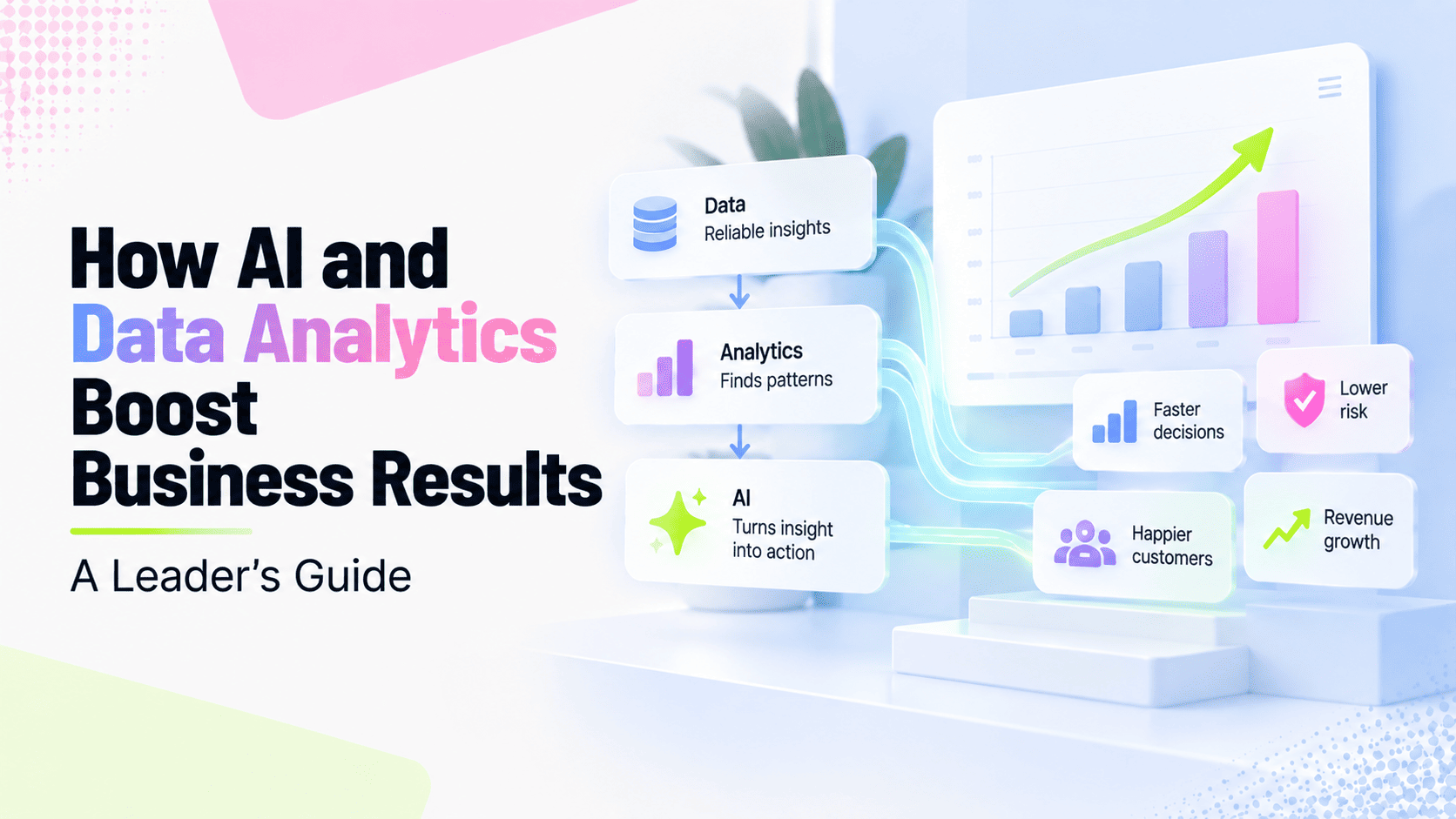
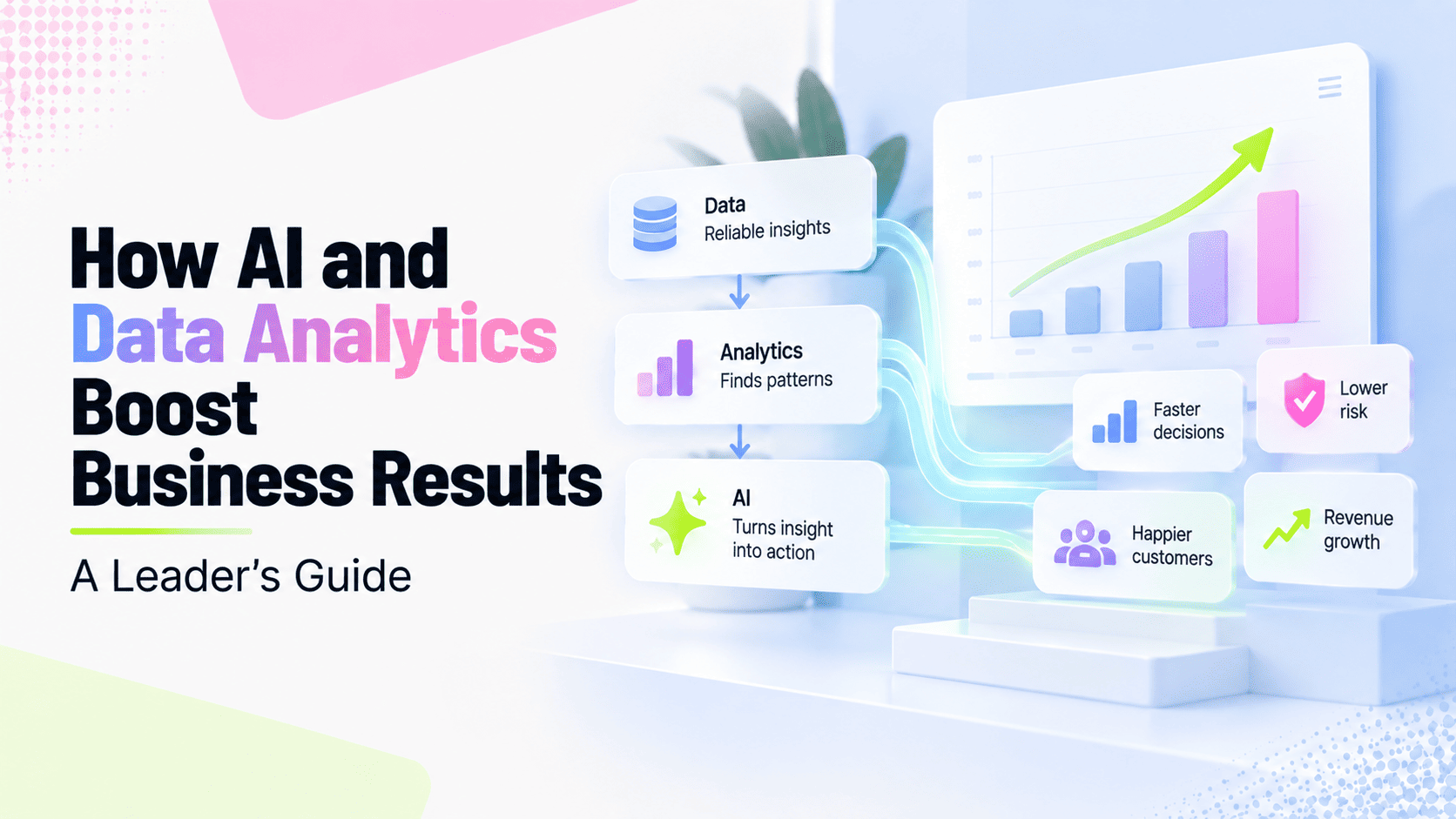
Understanding how AI and data analytics boost business results starts with recognizing that neither creates value in isolation. Data provides the evidence. Analytics reveals patterns. AI predicts, recommends, generates, or automates. Engineering connects those capabilities to the decisions and workflows where business outcomes are actually produced.
When that chain is complete, AI and data can help organizations make better decisions, operate more efficiently, reduce risk, strengthen customer relationships, and build new products and services. When any part of it is missing, even an impressive pilot can remain little more than an experiment.
The Gap Between AI Investment and Business Impact
The value gap is rarely caused by one inadequate model. It usually forms between several disconnected parts of the organization.
A business team may commission an AI pilot without defining the decision it should improve. Data may be fragmented across departments, cloud environments, spreadsheets, and legacy systems. Technical teams may build a working solution that never becomes part of the operating workflow. Leaders may approve investment without agreeing on a baseline against which success will be measured.
In each case, the AI itself may technically work. The surrounding organization is not ready to use it at scale.
Cisco’s 2025 AI Readiness Index illustrates the difference. The most AI-ready organizations were four times more likely to move pilots into production and 50% more likely to report measurable value. Their advantage extended beyond technology to strategy, infrastructure, data, governance, talent, and organizational readiness.
Organizations can be highly active with AI without being ready to scale it. Understanding the five stages of AI readiness can help leaders distinguish isolated experimentation from the capabilities needed to produce repeatable, enterprise-wide value.
This is why the most useful question is not, “Where can we deploy AI?” It is:
Which business decision, workflow, customer need, or operational constraint are we trying to improve—and what data, engineering, governance, and organizational change will that require?
That question shifts the conversation from AI adoption to business performance.
The Core Mechanism: How AI and Data Work Together
AI depends on data, but simply possessing large amounts of data is not enough. The data must be accessible, reliable, appropriately governed, and connected to a defined business purpose.
IBM’s 2025 CEO Study found that 68% of surveyed CEOs considered an integrated, enterprise-wide data architecture critical to cross-functional collaboration. Half also acknowledged that rapid technology investment had left their organizations with disconnected, piecemeal environments.
The distinction matters because an AI system can only work with what the organization makes available to it. Conflicting definitions, delayed pipelines, missing records, inaccessible systems, and weak ownership all reduce the reliability of the resulting analysis.
From Raw Data to Decision Intelligence
A useful AI and analytics capability usually follows a connected sequence:
- The organization identifies a decision or workflow it needs to improve.
- Relevant data is collected and integrated from internal and external sources.
- Data quality, ownership, security, and access rules are established.
- Analytics identifies patterns, relationships, and performance signals.
- AI generates predictions, recommendations, classifications, or automated actions.
- The output is embedded into the workflow used by employees, customers, or systems.
- Results are measured against agreed business indicators.
This is sometimes described as decision intelligence: the disciplined use of data, analytics, AI, business rules, and human judgment to improve how decisions are made.
The goal is not to remove people from every decision. It is to give them more timely evidence, surface patterns that would otherwise remain hidden, and automate lower-value steps where the risk and business case justify it.
Predictive vs. Prescriptive Analytics: What Is the Difference?
Predictive analytics estimates what is likely to happen. It may forecast demand, identify customers at risk of leaving, predict equipment failure, or estimate the likelihood of fraud.
Prescriptive analytics goes one step further. It recommends what the organization should do in response: adjust inventory, contact a customer, schedule maintenance, investigate a transaction, or change a price.
AI can strengthen both. But the value appears only when a prediction or recommendation reaches the person or system able to act on it.
AI and analytics create value only when trusted data can move through intelligence and into a decision or workflow that changes a measurable business outcome.


Your AI Partner
Turn AI readiness into a plan.
Assess your strategy, data, technology, talent, governance, and ROI before scaling AI.
5 Ways AI and Data Analytics Drive Measurable Business Results
1. Faster, Higher-Quality Decisions
Traditional business intelligence often tells leaders what has already happened. AI-enhanced analytics can help them understand why it happened, what may happen next, and which action is most likely to improve the outcome.
That does not mean replacing dashboards with an AI chatbot and expecting instant transformation. Organizations need consistent metrics, governed data, clear business terminology, and a way to validate the answers being produced.
McKinsey’s 2025 global survey found that AI high performers were nearly three times as likely as other organizations to fundamentally redesign workflows as part of their deployment. This suggests that meaningful value comes not from attaching AI to the edge of an existing process, but from reconsidering how information reaches the people making decisions.
In one anonymized telecommunications engagement, Exadel developed an AI-enabled business intelligence layer that brought vendor information, network transport metrics, internal documentation, and operational definitions into a shared environment. Business users could ask questions in natural language and receive answers grounded in the organization’s own terminology, key performance indicators, and business rules.
The result was faster access to decision-ready information, earlier visibility into anomalies and partner-performance changes, and daily adoption across operational teams.
2. Operational Efficiency at Scale
AI and analytics can improve efficiency by automating repetitive analysis, prioritizing work, predicting operational issues, and reducing the manual movement of data between systems.
The greatest benefits usually come from redesigning an end-to-end workflow rather than accelerating one isolated task. An automated classification model, for example, creates limited value if employees must still copy its output into another system, resolve avoidable data errors, or manually track what happens next.
PwC’s 2026 AI Jobs Barometer found that productivity growth was 40% higher among companies most exposed to AI than among those least exposed. This is an association rather than proof that AI alone caused the difference, but it indicates that organizations able to apply AI effectively are beginning to separate from slower adopters.
For a global accounting and tax organization, Exadel created a machine-learning solution that automated the preparation and categorization of large volumes of customer data. More than 1,000 separately controlled models were supported through centralized machine learning operations and governance.
The platform processed over four million classifications each month and saved more than 7,500 hours of manual effort monthly. Employees could spend less time preparing data and more time applying expertise to client work.
3. Revenue Growth Through Personalization and Predictive Demand
Revenue growth often depends on recognizing a customer need before the customer states it directly.
AI can analyze behavioral, transactional, demographic, and contextual data to identify likely churn, changing demand, relevant offers, or the next action most likely to improve engagement. The same principles can support personalized product recommendations, dynamic pricing, inventory allocation, and targeted customer service.
The key is relevance rather than volume. Sending more automated offers does not create a better customer experience. Recommendations must be based on reliable signals, presented at an appropriate moment, and evaluated against outcomes such as retention, conversion, average order value, or customer lifetime value.
For a global fitness technology platform, Exadel developed machine-learning models that identified users at increased risk of churn, estimated likely time-to-churn, and recommended relevant products and packages based on behavior and engagement signals. [is this case study on our website? If so, link it]
The models were incorporated into analytics and decision-support workflows used by marketing and product teams. This allowed the organization to intervene earlier, personalize engagement more consistently, and establish a scalable foundation for continuous optimization.
4. Risk Reduction and Compliance Automation
Risk management has traditionally depended on periodic reviews, rules-based controls, and labor-intensive examination of documents and transactions. AI and analytics can make this process more continuous.
Models can identify unusual activity, classify sensitive information, prioritize cases for human review, and monitor changes in risk indicators. Data lineage—the record of where data originated and how it has changed—can also help organizations demonstrate how information has been used.
These capabilities do not remove the need for compliance, legal, or risk professionals. In high-stakes settings, human accountability becomes more important, not less. AI should improve the speed and consistency with which relevant evidence is presented while preserving clear review and escalation processes.
Exadel supported the research division of a large technology company in building a data-management and privacy-governance program connected to European Digital Markets Act requirements. The engagement included reviewing and updating 46 million data objects, examining 100,000 models for inclusion in a complete inventory, and completing the privacy assessment in ten weeks. [is this case study on our website? If so, link it]
The outcome was not simply a policy document. The organization gained a structured operational model for governing how data was identified, assessed, and used.
5. Product and Service Innovation
Some of the most important returns from AI will not come from doing the same work faster. They will come from creating capabilities that were previously impractical.
A trusted data platform can become the basis for new analytical services. Generative AI can create new ways for customers to access specialist knowledge. Predictive models can become embedded product features. Enterprise AI platforms can allow multiple teams to develop new applications without rebuilding security, monitoring, and governance every time.
In one multi-year engagement, Exadel helped a global information-services provider design and build a shared enterprise AI platform. Previously isolated AI initiatives were brought onto a common architecture with self-service provisioning, reusable components, unified access to different model providers, and embedded monitoring, observability, and compliance controls.
The platform reduced duplicated implementation effort and supported faster development of AI applications across business lines. A clinical decision-support product used by millions of healthcare professionals was among the applications built on the shared foundation.
This is where data and AI move from operational support to strategic differentiation: the underlying capability becomes reusable, and each successful application makes the next one easier to deliver.
Across industries, enterprise AI value usually shows up in five areas: better decisions, greater efficiency, revenue growth, lower risk, and new products or services.
Where AI and Data Analytics Create Impact Across Industries
The mechanism is broadly consistent across sectors, but the decisions, risks, and outcomes vary.
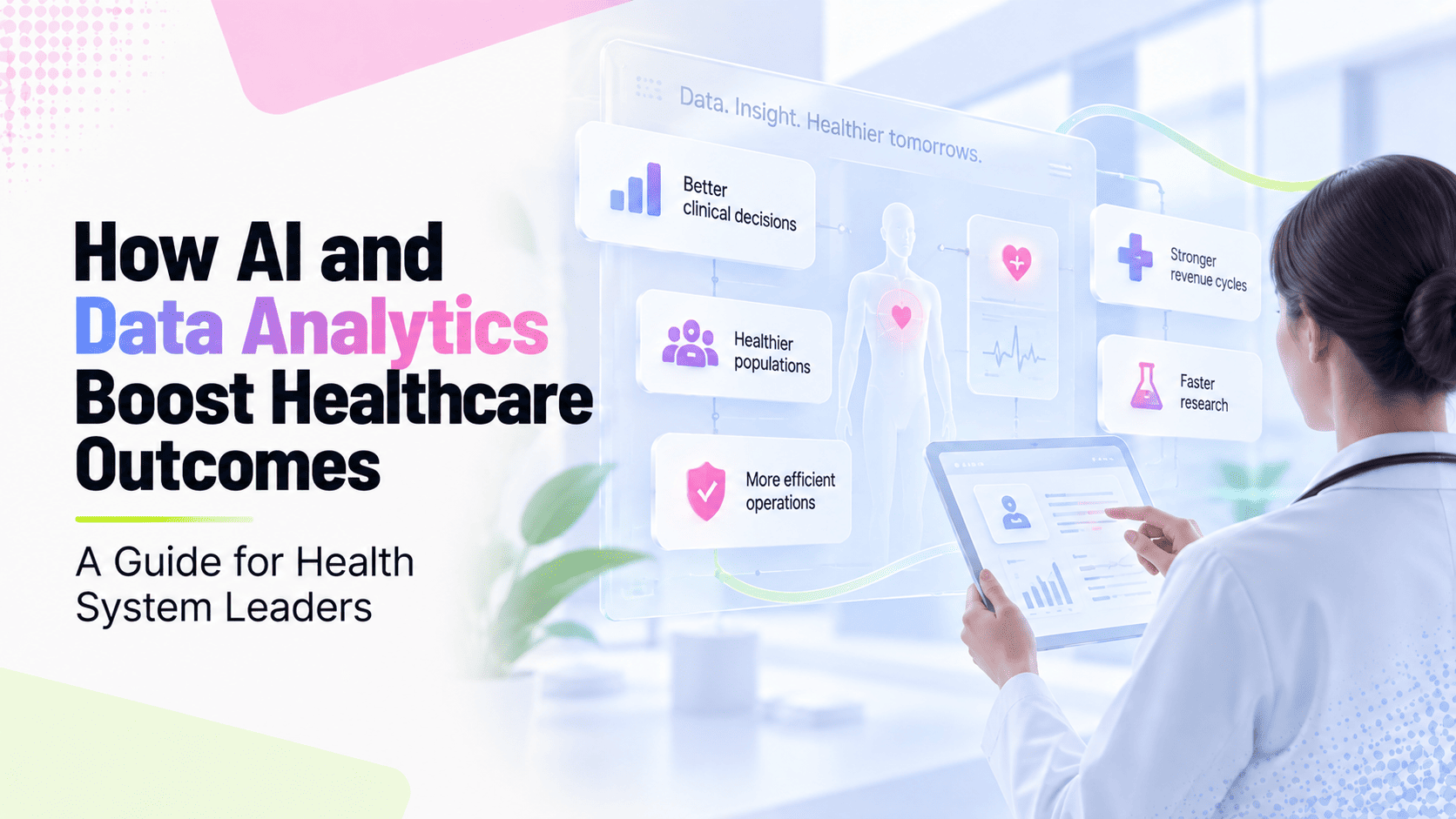
Healthcare organizations can combine clinical, operational, and patient data to support risk stratification, capacity planning, clinical decision support, medical asset management, and research. The opportunity is substantial, but so are the requirements around patient safety, interoperability, privacy, and responsible use.
Financial-services organizations use AI and analytics in fraud detection, anti-money-laundering reviews, claims processing, credit decisions, personalization, and regulatory reporting. Success depends on model governance, explainability, data lineage, and the continued involvement of risk and compliance teams.
Private equity firms can apply data and AI to due diligence, portfolio monitoring, pricing, working-capital improvement, and exit readiness. The central question is not whether a portfolio company possesses AI tools, but whether those capabilities improve EBITDA, strengthen the value-creation plan, or increase confidence at exit.
Media organizations use audience data, recommendation models, advertising analytics, content-performance forecasting, and real-time event streams to increase engagement and monetization. Consistent identity, metadata, rights information, and customer definitions are essential foundations.
Travel and transportation organizations can improve predictive maintenance, route and capacity planning, dynamic pricing, passenger experiences, and logistics visibility. Their challenge is often integrating highly varied data from vehicles, sensors, booking platforms, weather services, customer systems, and external partners.
Why AI Analytics Initiatives Fail—and How to Avoid It
The causes of failure are usually visible before the first model is trained.
No clear business question.
An organization starts with a technology or fashionable use case rather than a decision, constraint, or customer problem. Define the outcome first, including who will act on the output and how success will be measured.
Data quality is treated as a later problem.
A model cannot compensate reliably for missing, inconsistent, delayed, or poorly governed information. Assess data availability, ownership, quality, access, and lineage before committing to a production roadmap.
Data and business teams work in isolation.
Technical teams may understand the platform without understanding the operating context. Business teams may understand the decision without understanding the limitations of the data. Cross-functional ownership is required throughout discovery, design, validation, and deployment.
AI is treated as a technology project rather than a business change program.
People need to understand when to use the system, when not to trust it, how their responsibilities will change, and where human approval remains essential. Training, communication, incentives, and workflow redesign must be part of delivery. That makes enablement part of the implementation itself: client teams need the knowledge, practices, and confidence to operate, govern, and improve the capability after the initial delivery team steps back.
Measurement begins after launch.
Without an initial baseline, an organization cannot determine whether AI improved performance. Metrics should be selected before implementation and may include cost per transaction, cycle time, error rate, revenue conversion, churn, risk exposure, adoption, or time-to-decision.
The strongest AI programs establish a repeatable path from use-case selection to deployment and measurement. They learn from each implementation, reuse what works, and stop initiatives that cannot demonstrate a credible route to value.
AI initiatives usually stall at predictable points between the initial use case and production. Addressing those gaps early makes it much easier to turn experimentation into measurable business value.
Your AI Partner
Find Out What Is Holding Your AI Program Back.
Assess your strategy, data, technology, talent, governance, and ROI before further investment.
How Exadel Helps Enterprises Turn Data and AI into Business Outcomes
At Exadel, we approach data, analytics, and AI as one connected delivery journey that combines consulting, engineering services, and enablement.
We begin by identifying the business priorities, decisions, and workflows where better information or intelligent automation can create measurable value. We then assess whether the necessary data, architecture, governance, skills, and operating model are ready to support the use case. Our guide to running an AI readiness assessment explains how organizations can examine these connected dimensions and turn the findings into priorities and an actionable roadmap.
Our data engineering and analytics services help organizations build scalable pipelines, trusted data platforms, quality controls, governance, and analytics-ready information across cloud, hybrid, and on-premises environments.
Our AI engineering services take solutions from model development and integration into production through scalable pipelines, machine learning operations, monitoring, automation, and controls designed for real enterprise environments.
That engineering capability is supported by Exadel's partnerships with Cursor, Anthropic, and OpenAI, together with certified practitioners inside our organization. For clients, the value is not simply access to familiar technology names. It is working with specialists who bring current knowledge of leading AI technologies and implementation practices into architecture, model and platform decisions, production engineering, and enablement.
Technology choices still follow the requirements of the use case, including capability, cost, security, data governance, integration, deployment constraints, and the client's existing architecture.
Because our approach combines consulting, engineering services, and enablement, the roadmap does not end at a recommendation or even at deployment. We help clients design the foundation, build the system, integrate it into operations, establish governance, transfer practical knowledge to internal teams, and measure whether the intended business result has been achieved. The aim is both to deliver the capability and to strengthen the client's ability to operate and extend it.
Turn AI and Data Investment into Measurable Value
The distance between an AI pilot and a business result is filled with decisions about data, architecture, governance, engineering, workflows, and measurement. Addressing those dependencies now makes it easier to scale successful use cases—and easier to stop investing in those that cannot deliver value.
Exadel combines AI and data consulting, engineering, and enablement to help enterprises turn promising use cases into production capabilities and measurable outcomes.
Frequently Asked Questions
What is the relationship between AI and data analytics?
Data analytics examines information to identify patterns, explain performance, and support decisions. AI extends those capabilities by generating predictions, recommendations, classifications, content, or automated actions. Analytics may show that customer churn is increasing; AI can help identify which customers are most at risk and recommend an appropriate response. Both depend on reliable, accessible, and governed data. The strongest results occur when analytics and AI are connected to an operational workflow and measured against a defined business outcome.
How quickly can AI analytics deliver business results?
A focused use case can produce initial evidence within weeks or months, but enterprise-scale results usually take longer. Timing depends on data quality, integration complexity, regulatory requirements, workflow changes, and whether a working platform already exists. Organizations can improve speed by selecting a contained business problem, defining a baseline, confirming data readiness, and involving users early. A short proof of value should test both technical feasibility and business usefulness—not merely demonstrate that a model can generate an output.
What is the difference between business intelligence and AI analytics?
Business intelligence primarily describes what has happened through reports, dashboards, and performance metrics. AI analytics adds predictive and prescriptive capabilities: what is likely to happen, why it may happen, and what action could improve the outcome. The two should complement each other. Business intelligence creates visibility and shared definitions; AI helps organizations act earlier, personalize responses, identify anomalies, and automate selected decisions. Both still require governed data and clearly defined measures.
How do I measure the ROI of AI and data analytics?
Begin with the business process rather than the model. Establish the current cost, cycle time, error rate, revenue outcome, risk exposure, or customer measure before implementation. Then track both direct results—such as labor hours saved or increased conversion—and enabling indicators such as adoption, data quality, reliability, and time-to-decision. Include the full cost of data preparation, integration, infrastructure, governance, human review, maintenance, and change management. ROI should show whether the overall operating outcome improved, not simply whether the AI system performed accurately.
Before scaling an AI initiative, assess whether the business case, data, engineering, governance, ownership, and measurement model are strong enough to support production.
Written by: Devendra Sharma, Chief Data & Analytics Officer
September, 2026
Turn AI and data into business value.
Exadel combines consulting, engineering, and enablement to help turn enterprise data into production-ready AI and measurable outcomes.