
Tags
Share
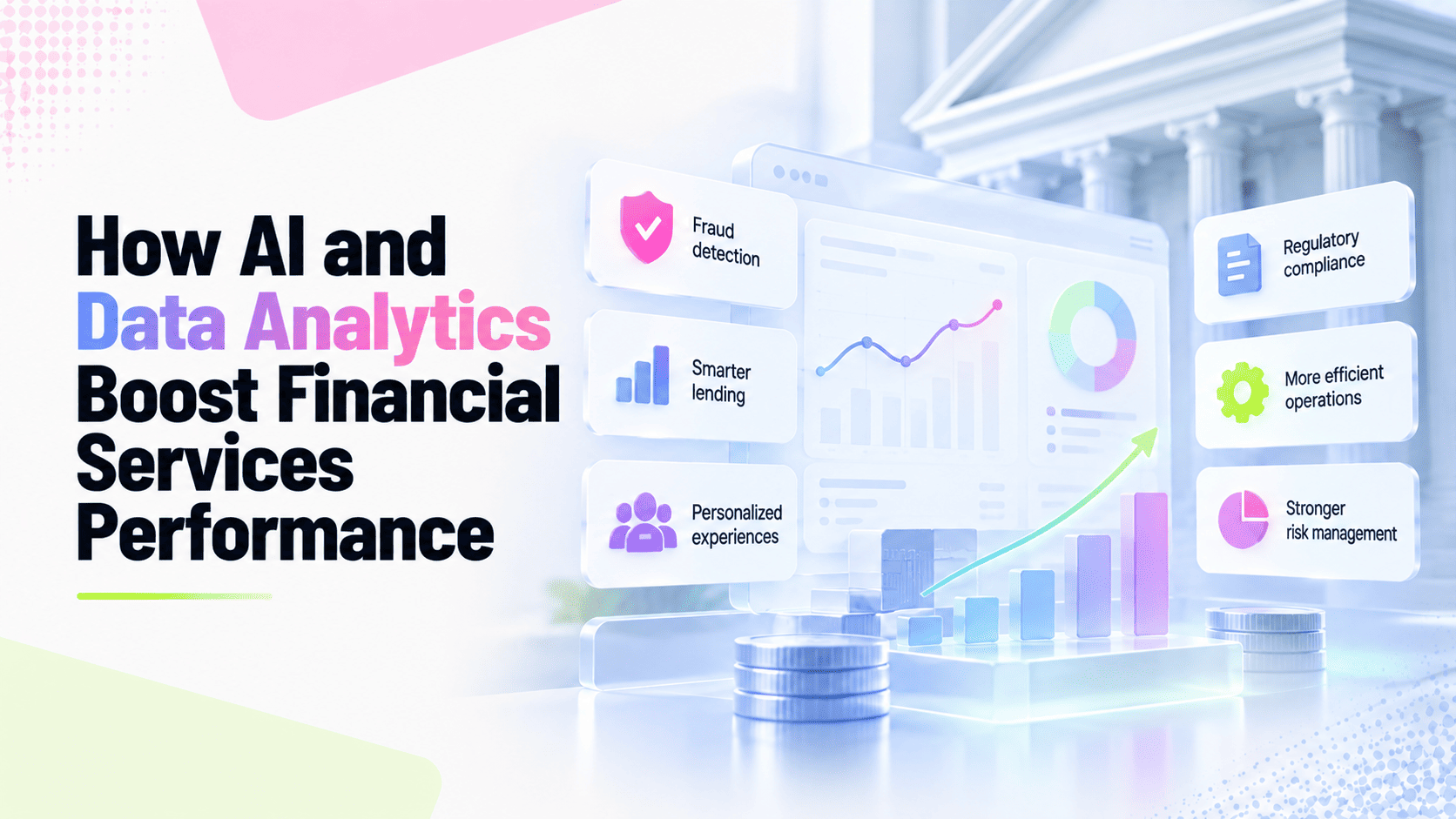
Financial institutions have spent decades building sophisticated models, risk systems, customer platforms, and data estates. They now have access to a much wider range of AI capabilities, from traditional machine learning and real-time analytics to generative and agentic systems.
Adoption is no longer the main question. Cambridge’s 2026 global study found that 81% of surveyed financial-services firms were adopting AI at some level, yet only 14% considered it transformational to their strategy and competitive advantage. More than half also found it difficult to measure the value of AI deployment.
The gap is not simply technical. It reflects the difficulty of connecting models, data, decisions, controls, and operating processes around a measurable result.
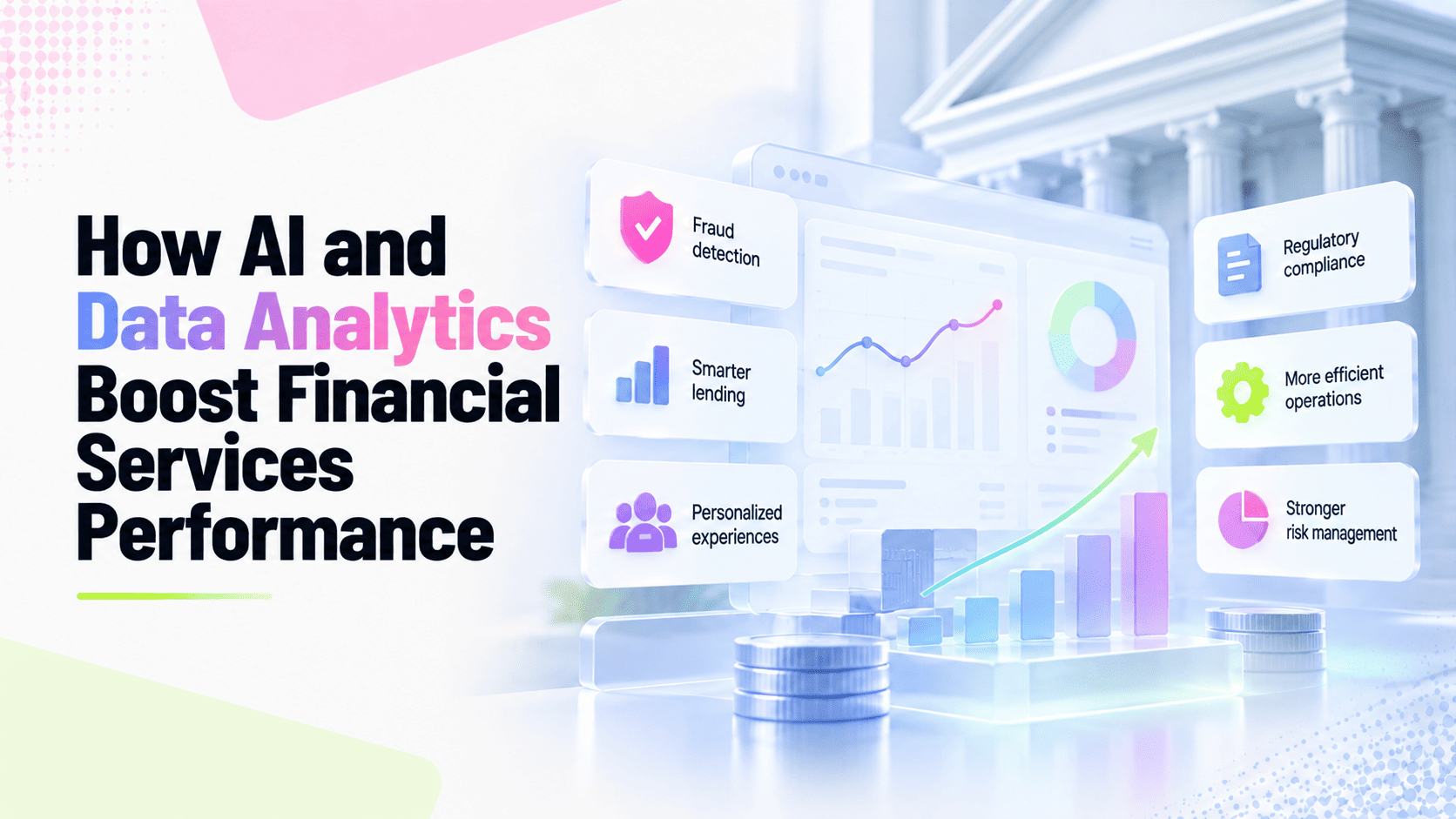
AI and data analytics can strengthen fraud detection, lending, claims, regulatory reporting, customer retention, and investment operations. But dependable value appears only when the organization can answer six questions:
- What financial, risk, operational, or customer outcome are we improving?
- Which data is required, and can it be trusted?
- How will the model or analytical system be tested?
- Where will its output enter the workflow?
- Who retains authority and accountability?
- How will performance, risk, and value be monitored after deployment?
That is the difference between an AI use case and an AI-enabled operating capability.
The Data Maturity Gap in Financial Services
Banks, insurers, asset managers, and fintechs are data-rich by design. Their information spans transactions, accounts, policies, claims, markets, customer interactions, risk systems, documents, and external providers.
Yet valuable data is frequently divided across legacy cores, acquired platforms, departmental warehouses, cloud environments, spreadsheets, and third-party services. Definitions may differ between finance, risk, compliance, operations, and product teams. A customer may appear under multiple identifiers. Historical data may reflect outdated products or policies. Lineage may be incomplete precisely where explainability and auditability matter most.
The Bank of England and FCA found that 75% of responding UK financial firms were already using AI in 2024. Fifty-five percent of reported use cases involved some automated decision-making, but only 2% were described as fully autonomous. Data privacy, quality, security, third-party dependencies, and model complexity were among the leading concerns.
This is an important distinction. Financial services is not moving directly from manual work to autonomous institutions. Most organizations are introducing AI selectively around existing decisions and controls. Their challenge is to make those systems accurate, explainable, resilient, and useful enough to earn a place in production.
The path from financial data to value depends on connecting trusted information, AI and analytics with controlled workflows and clearly measured outcomes.
Turning financial data into measurable value requires a connected path from governed information to a controlled decision and a clearly defined outcome.
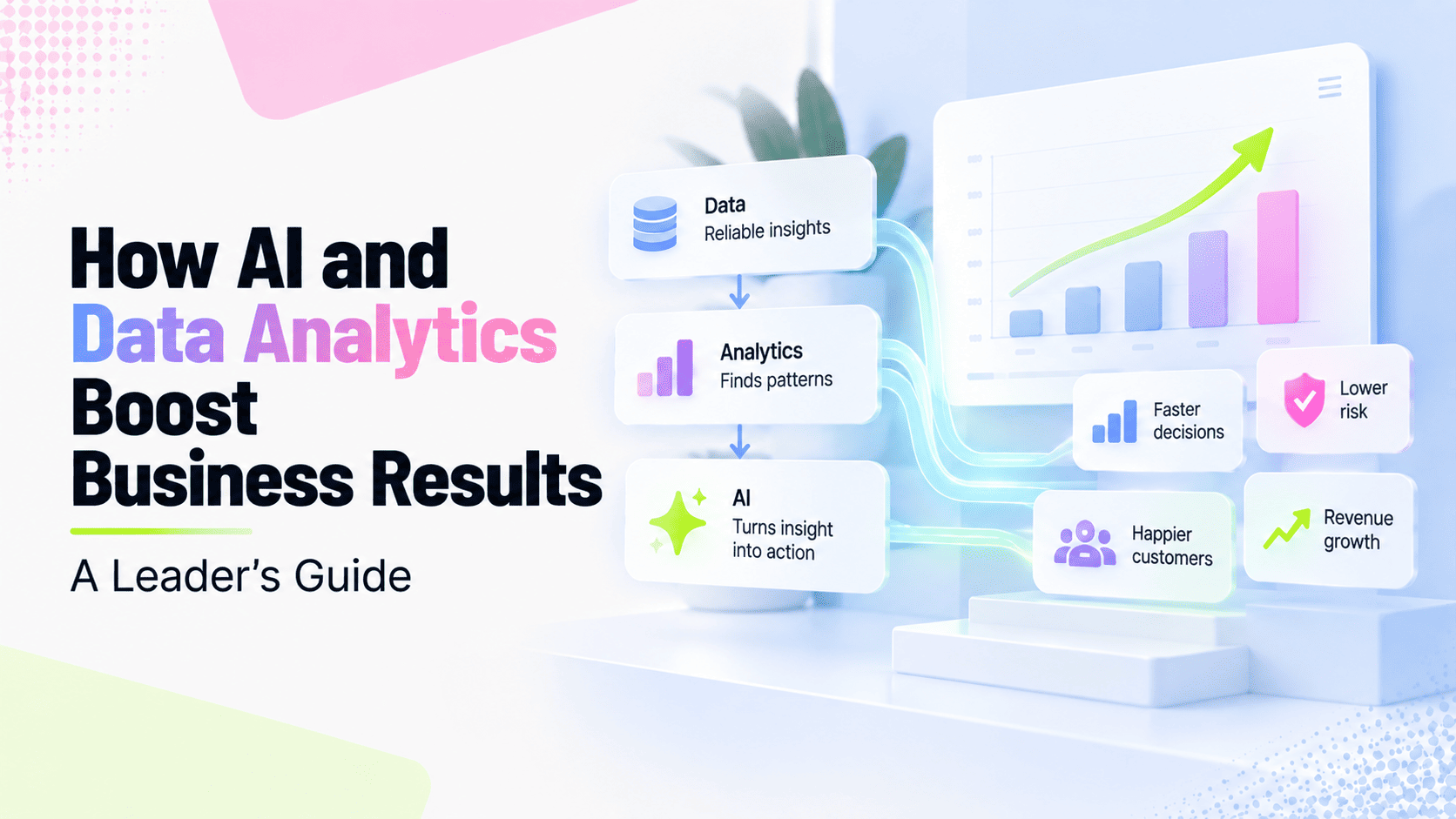
As we explain in how AI and data analytics boost business results, business impact depends on connecting trusted data and intelligence to the workflow where action occurs.


Your AI Partner
Build the data foundation for financial AI.
Exadel connects and governs financial data so AI can support timely, traceable decisions across the enterprise.
7 High-Impact AI and Analytics Applications in Financial Services
1. Fraud Detection and AML Pattern Recognition
Fraud and financial-crime teams must find a relatively small number of meaningful risks within enormous volumes of legitimate activity. Rules remain important, but they can generate large alert queues and may struggle to identify new patterns.
Machine learning can assess transaction behavior, device signals, counterparties, geography, account relationships, and previous investigations. Network analytics can reveal links among entities, while language models can support document review, name matching, and investigator research.
A 2025 Federal Reserve study compared several large language models with fuzzy-matching methods in a sanctions-screening task. Across realistic thresholds, the tested LLMs reduced false positives by 92% and increased detection rates by 11% relative to the strongest fuzzy-matching baseline. The models were also considerably slower, illustrating why production decisions must consider latency, cost, explainability, and workflow capacity alongside accuracy.
Success should therefore be measured through fraud losses, detection coverage, false-positive rates, alert-review time, investigator throughput, and the quality of escalations, not merely the number of alerts generated. Human investigators must remain able to review the evidence and challenge the system.
2. Credit Risk Scoring and Loan Underwriting
AI can combine traditional credit information with account activity, cash-flow patterns, documents, and other permitted data to support affordability checks, default-risk estimation, document review, and underwriting prioritization.
The opportunity is faster, more consistent analysis. The risk is that a model may reproduce historical bias, rely on unstable proxies, or produce a recommendation that customers and employees cannot meaningfully understand.
ECB analysis found that banks reporting stronger AI adoption for credit scoring also showed greater dispersion in new-loan pricing, consistent with more granular information being used in risk assessment. That does not establish that every decision became more accurate, equitable, or beneficial to customers. It makes subgroup testing, documentation, explainability, and continuing outcomes analysis more important.
Relevant measures include decision time, manual-review rates, default performance, pricing consistency, overrides, complaints, and performance across significant customer groups. The institution also needs to define when the model should inform a decision and when a person must intervene.
3. Algorithmic Trading and Portfolio Optimization
AI and analytics can support market research, signal generation, portfolio construction, scenario analysis, execution, surveillance, and risk management. They can process structured market data alongside news, filings, and other permitted sources at a speed no human team could match.
But faster analysis does not mean predictable returns. Financial relationships change, models can converge on similar strategies, and apparently stable patterns may disappear under stress. More autonomous systems can also behave in ways that are difficult to anticipate in fast-moving markets.
AI should therefore operate within defined mandates, exposure limits, testing standards, pre-trade controls, monitoring, and emergency intervention procedures. ESMA’s 2026 supervisory briefing highlights governance, testing, outsourcing, and pre-trade controls as central concerns in algorithmic trading under MiFID II.
Useful measures include execution quality, risk-adjusted performance, drawdowns, turnover, slippage, limit breaches, and behavior during stressed conditions. The strongest near-term application may often be improving the research, coding, surveillance, and decision-support work surrounding accountable investment professionals rather than handing over complete trading authority.
4. Regulatory Compliance and Reporting Automation
Financial institutions spend significant time gathering evidence, reconciling data, reviewing policies, investigating exceptions, and producing regulatory reports.
AI and analytics can classify documents, trace information across systems, identify anomalies, summarize regulatory change, test controls, and prioritize cases for review. Generative AI can help prepare drafts or explain data issues, provided every output remains connected to approved sources and accountable review.
The foundation is governed data with clear lineage. A figure in a regulatory report must be traceable through transformations to its source. A compliance recommendation must identify the evidence on which it relies.
Useful measures include reporting cycle time, reconciliation effort, data-quality exceptions, control-testing coverage, repeat findings, and time spent assembling audit evidence. Automation should not obscure responsibility: the regulated institution remains accountable for the report, decision, or filing. The BIS identifies data quality, accountability, governance, privacy, security, and supervisory access as recurring issues throughout the financial AI lifecycle.
5. Customer Lifetime Value and Churn Prediction
Banks and insurers can use transactions, product holdings, service interactions, complaints, digital behavior, and life-event signals to estimate attrition risk, customer value, or likely product need.
Deloitte’s 2025 EMEA model-risk research found that 53% of surveyed banks and 37% of insurers used AI in customer-experience models. Its analysis argues that future leaders will be distinguished less by adoption alone than by process redesign, governance, and change management.
The output might help a team decide whom to contact, which service problem to resolve first, or where a customer may benefit from a more suitable product. That is more useful than treating personalization as a higher volume of automated offers.
Relevant measures include retention, complaint resolution, response rates, cost to serve, product suitability, and long-term customer value. Institutions should also test whether recommendations create unfair exclusion, inappropriate pressure, or inconsistent treatment.
6. Claims Processing and Insurance Underwriting
Insurance workflows contain large amounts of structured and unstructured information: applications, policy records, adjuster notes, medical or repair documents, photographs, invoices, and third-party reports.
Computer vision and language models can extract information, identify missing documents, triage claims, estimate complexity, and surface fraud or subrogation opportunities. Predictive models can help prioritize underwriting review or support risk selection.
In one anonymized engagement, Exadel developed an AI-supported subrogation-identification capability that analyzed claims documents and image evidence, prioritized potential recovery opportunities, and retained human authority over final decisions. The case reported an approximately 10% improvement in subrogation-process effectiveness.
Useful measures include claim cycle time, recovery value, manual touches, leakage, customer experience, and underwriting performance. High-impact decisions still require clear rules for review, escalation, and override.
7. Real-Time Personalization and Next-Best Action
Real-time analytics can combine current context with account, transaction, channel, and service data to recommend the next most useful action. That might be a fraud confirmation, a fee warning, a savings prompt, a service intervention, or a relevant product conversation.
Recommendations should reflect customer need, consent, suitability, and the institution’s conduct obligations.
Organizations need streaming data, event-driven architecture, shared customer definitions, and consistent treatment across mobile, web, contact-center, and branch interactions. The Bank of England and FCA found that operations, retail banking, customer support, fraud, and regulatory compliance were among the areas in which financial institutions were already using or planning to use AI.
Measures may include response time, acceptance, digital completion, service resolution, retention, and customer satisfaction. Short-term conversion should not be the only measure where long-term suitability and trust are at stake.
Move financial AI into production.
Exadel engineers AI around the workflows, controls, and monitoring financial institutions need for dependable deployment.
Regulatory Considerations: AI Governance in Financial Services
Financial-services AI operates within overlapping requirements for models, markets, privacy, resilience, and accountability. The applicable framework depends on the institution, jurisdiction, intended use, level of automation, customer impact, and third-party involvement.
The level of validation, explainability, review, and governance should generally increase as AI moves closer to high-impact customer, credit, claims, investment, or compliance decisions.
A useful way to think about financial AI governance is as a risk continuum: the closer AI gets to consequential decisions, the stronger the controls, validation, and human oversight need to be.
U.S. Model-Risk Management: SR 26-2
In April 2026, the Federal Reserve, OCC, and FDIC replaced SR 11-7 with revised interagency guidance. Federal Reserve SR 26-2 emphasizes a risk-based approach tied to model purpose, exposure, and materiality.
It covers development, testing, validation, outcomes analysis, monitoring, inventories, documentation, effective challenge, governance, and third-party oversight.
The guidance formally applies to traditional statistical and quantitative models and non-generative, non-agentic AI. Generative and agentic AI are excluded from its scope because they are novel and rapidly evolving, although the agencies state that broader risk-management and governance practices should inform the controls applied to them.
EU AI Act
Under the EU AI Act, systems used to evaluate the creditworthiness of natural persons or establish credit scores are listed among potentially high-risk applications, with fraud-detection systems treated separately. AI used for individual risk assessment and pricing in life and health insurance is also included.
Classification still depends on intended purpose and operation. Certain narrow, procedural, preparatory, or human-reviewed applications may qualify for exceptions, while systems that profile natural persons remain high-risk.
Following the 2026 AI Omnibus, the main rules for Annex III high-risk systems are scheduled to apply from December 2, 2027. Requirements for AI embedded in regulated products are scheduled for August 2, 2028.
MiFID II, GDPR, and DORA
For investment advice, portfolio management, and algorithmic trading, existing MiFID II obligations remain relevant. ESMA’s 2026 supervisory briefing emphasizes governance, testing, outsourcing, and pre-trade controls for algorithmic trading.
Customer-facing AI may also engage GDPR requirements concerning profiling, transparency, and solely automated decisions producing legal or similarly significant effects. The Court of Justice’s SCHUFA judgment confirmed that a credit score may itself fall within Article 22 where a lender relies strongly on it when deciding whether to grant credit.
DORA has applied since January 17, 2025. It is relevant to the operational resilience and third-party technology dependencies surrounding AI-enabled financial services.
This is not legal or compliance advice. Institutions should assess individual systems with their model-risk, legal, compliance, data-protection, security, and operational-resilience teams.
Building an AI-Ready Data Infrastructure for Financial Services
AI performance depends on the data and operating environment around it.
The Bank for International Settlements notes that data underpins activities from onboarding and credit assessment to underwriting, fraud detection, AML surveillance, and risk management. Its 2026 review highlights expectations around quality, representativeness, privacy, security, accountability, and governance throughout the AI lifecycle.
An AI-ready financial data environment may require:
- Governed customer, account, policy, claims, and transaction data
- Real-time event streaming and APIs
- Consistent identifiers, reference data, and business definitions
- Metadata and end-to-end lineage
- Quality controls and observability
- Entitlement, privacy, and security controls
- Controlled access to third-party and alternative data
- Model inventories, evaluation pipelines, and monitoring
- Integration with legacy core and risk platforms
- Resilient deployment and recovery processes
This is where data engineering and analytics services become part of the business outcome. A model cannot produce dependable decisions when its inputs are delayed, differently defined, or impossible to trace. Exadel’s current service offering focuses on connecting, standardizing, governing, and operationalizing data for AI and analytics.
The operating capability around that infrastructure matters as much as the architecture itself. Data, model risk, engineering, security, compliance, and business teams need the knowledge and ownership to evaluate changes, investigate issues, and govern AI systems after they enter production.
How Exadel Supports AI and Analytics in Financial Services
At Exadel, we combine financial-services experience with data engineering, AI engineering, secure modernization, and production delivery through a model that brings consulting, engineering services, and client enablement together.
We help institutions prioritize use cases, build governed data and model pipelines, integrate AI with real workflows, and establish the testing, oversight, and monitoring required after launch. We also work alongside internal technology, risk, data, and business teams so that the practices required to operate and govern those capabilities do not remain solely with an external delivery partner.
That delivery capability is supported by Exadel’s partnerships with Cursor, Anthropic, and OpenAI, together with certified practitioners inside our organization. For financial-services clients, the value lies in bringing current knowledge of leading AI technologies and implementation practices into model and platform evaluation, architecture, engineering, governance, and enablement—not simply in the partnerships themselves.
Technology selection still needs to follow the requirements of the use case, including model capability, explainability, security, data location, latency, cost, regulatory obligations, third-party risk, integration, and the institution’s existing architecture.
For a leading U.S. pet medical insurer, Exadel migrated an organically developed machine-learning environment to a production-grade MLOps foundation. Automated training, validation, versioning, deployment, and shadow testing reduced prediction response time by 25%, lowered the response error rate by 2%, and reduced model deployment time to hours.
In another engagement for a global financial-services provider, Exadel used generative AI with senior database-engineering review to migrate more than 1,200 database artifacts. The approach approximately doubled throughput, made individual conversions two to three times faster, and shortened the overall project by around 28%.
These results came from combining automation with engineering judgment, controlled validation, and production integration—not from allowing a model to operate without accountability.
That reflects a broader principle in our delivery model: the people advising on how AI should be applied remain closely connected to the engineers responsible for making it work safely in the client’s production environment.
Explore Exadel’s Financial Services capabilities to see how we connect AI strategy, production engineering, governance, and client enablement around secure, scalable delivery.
Turn Financial-Services AI into a Governed Operating Capability
The financial-services opportunity is substantial, but adoption alone is not the result.
The institutions that create durable value will connect reliable data, tested models, resilient engineering, accountable workflows, and proportionate governance around clearly measured outcomes.
Exadel helps banks, insurers, asset managers, and fintechs move from promising AI use cases to dependable production capabilities.
Frequently Asked Questions
What Are the Biggest Barriers to AI Adoption in Financial Services?
The largest barriers are fragmented data, legacy-system integration, unclear model ownership, regulatory and privacy requirements, weak measurement, third-party dependencies, and difficulty moving successful pilots into production. Institutions may also lack the evaluation and monitoring capabilities required for generative or agentic systems.
A strong program begins with a defined outcome, assesses data and operating readiness, and establishes accountability before deployment. Cambridge’s 2026 study identifies data availability and quality, talent, legacy architecture, privacy, unreliable outputs, resilience, and human oversight among the sector’s continuing constraints and risks. (Cambridge Judge Business School)
How Should Financial Institutions Measure AI ROI?
Start with the process being changed. Establish the current loss rate, cycle time, manual effort, conversion, risk exposure, error rate, or customer outcome before implementation.
Then measure direct results alongside adoption, quality, reliability, and control indicators. Include the full cost of data preparation, integration, infrastructure, validation, human review, compliance, monitoring, and maintenance.
Model accuracy is important, but it is not the same as financial value.
Can AI Make Financial Decisions Without Human Review?
Some lower-risk tasks can be highly automated, but the appropriate level of human review depends on the decision, materiality, jurisdiction, customer impact, and model design.
Credit, claims, investment, fraud, and compliance decisions may require meaningful oversight, review rights, or escalation. Organizations should define whether AI informs, recommends, or executes; who can override it; and how decisions are documented and challenged.
Written by: Devendra Sharma, Chief Data & Analytics Officer
September, 2026
Your AI Partner
Turn financial AI into governed value.
Exadel combines financial-services expertise, engineering, governance, and enablement to move AI from use case to production.