
Tags
Share
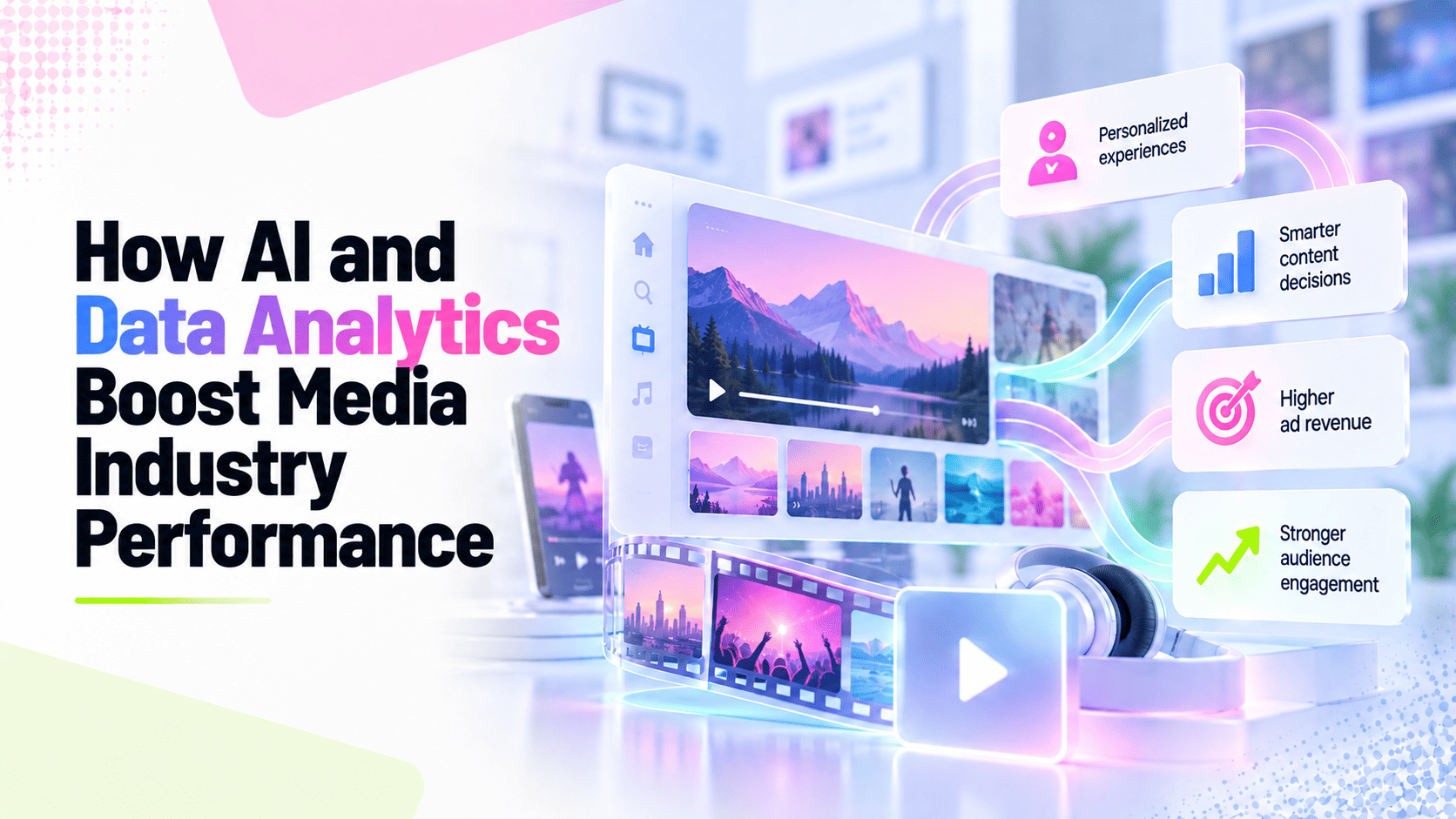
Media companies have never had more information about what audiences watch, read, listen to, search for, skip, share, and abandon. But that does not necessarily make decisions easier for them.
Audiences now move constantly between streaming platforms, social video, broadcasters, publishers, connected TVs, mobile devices, podcasts, and creator ecosystems. Ofcom’s 2026 Media Nations research found that UK viewers are now essentially as likely to turn to Netflix as the BBC first when deciding what to watch: 26% named Netflix and 25% the BBC, with the difference not statistically significant.
In that environment, collecting more audience data is not the competitive advantage. The advantage comes from converting audience, content, advertising, rights, and commercial data into useful decisions quickly enough to affect what happens next.
That might mean recommending the next program before a viewer leaves, reprioritizing advertising inventory while demand is still available, identifying a subscriber showing signs of churn, or discovering that an underused catalog asset has new commercial potential.
AI and data analytics create media value when trusted audience, content, rights, and commercial data can be converted quickly into better decisions about discovery, engagement, advertising, investment, and monetization—without losing control of privacy, intellectual property, or editorial responsibility.
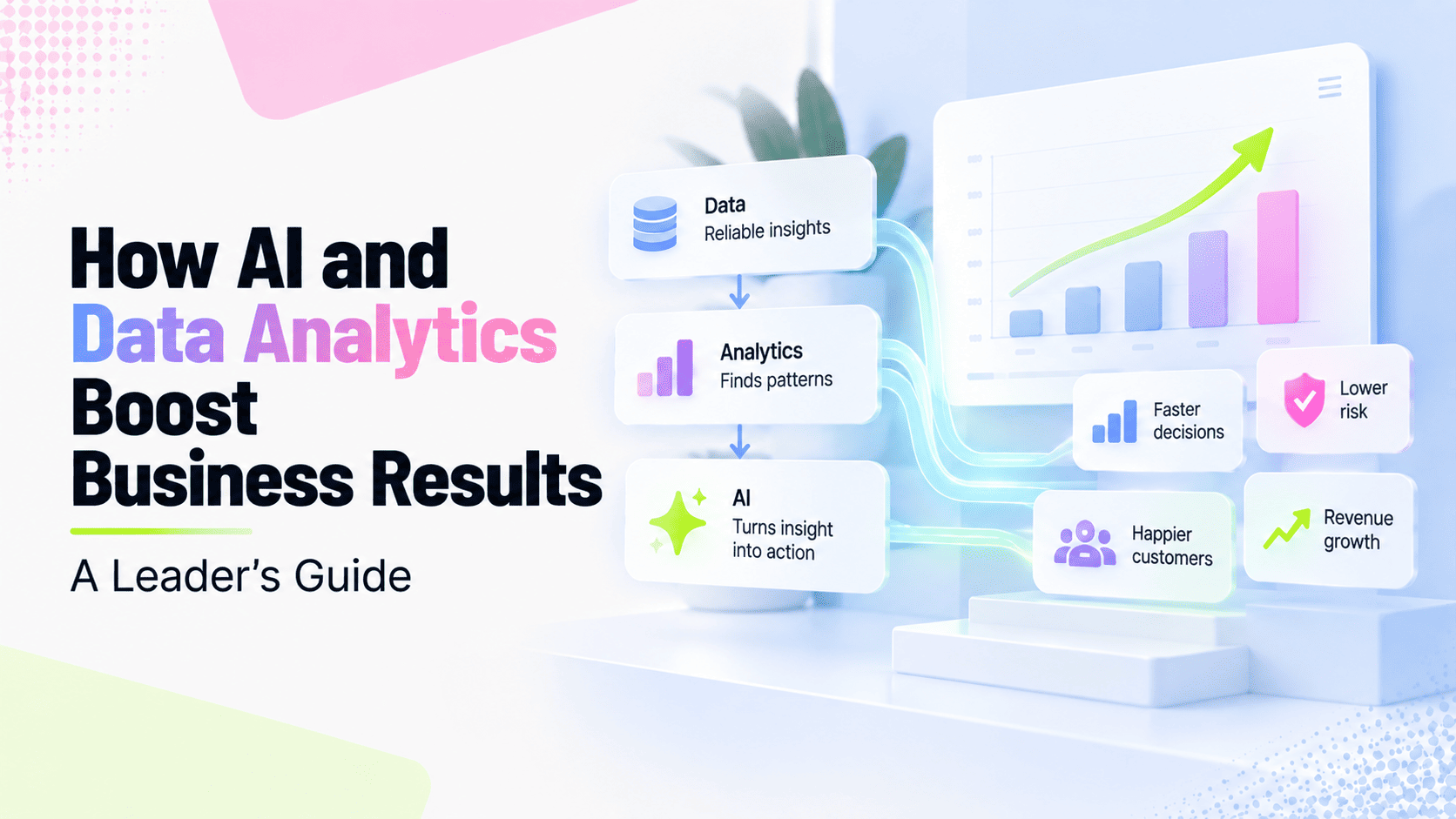
As we discuss in our broader guide to how AI and data analytics improve business results, the model or algorithm is only one part of the value chain. The outcome comes from connecting trusted data, analytics, workflow, and action.
The Competitive Pressure Driving AI Adoption in Media
The media market has become a competition not only for subscribers, but for attention.
Consumers face more content than they can realistically evaluate. Streaming platforms compete with broadcasters, social video, gaming, podcasts, creator content, and one another. At the same time, content production and acquisition remain expensive, advertisers expect stronger measurement, and subscription businesses have to justify their place in increasingly crowded household budgets.
The result is a simple commercial question:
Can the organization understand the audience well enough to make a better content, product, or advertising decision while the opportunity still exists?
AI makes that possible at a scale that traditional analysis cannot match. But the value does not begin with the model. It begins with whether behavioral, content, commercial, and contextual signals are available, trustworthy, and connected.
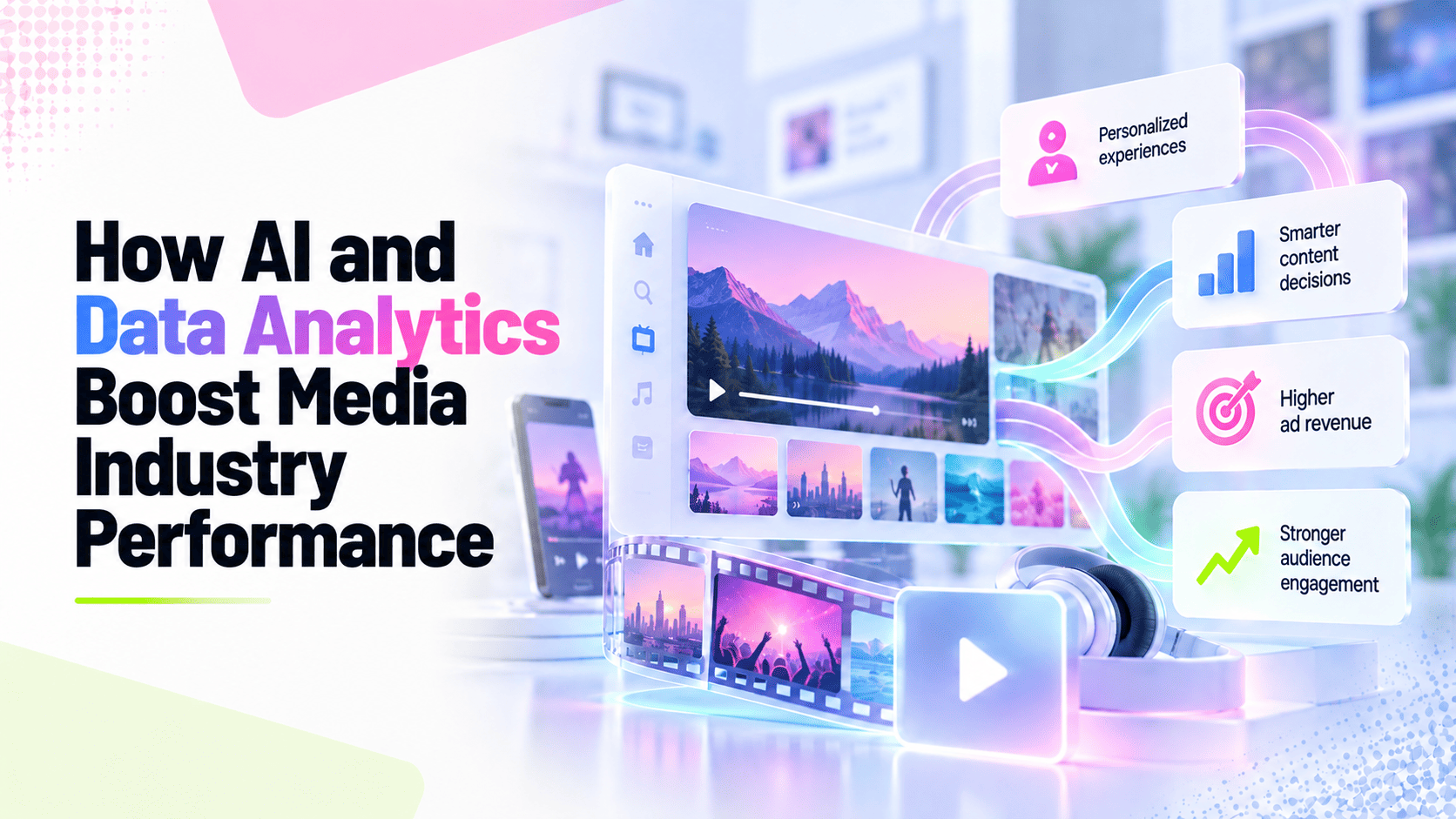
Audience, content, advertising, and commercial signals create value only when they can move through a connected path from trusted data to timely decisions.


Your AI Partner
Build smarter media experiences.
Exadel connects audience data, AI, and product engineering to help media companies improve discovery, engagement, and digital experiences.
6 Ways AI and Data Analytics Create Value in the Media Industry
1. Content Personalization and Recommendation Engines
Personalization is probably the most visible application of AI in media—and one of the most technically mature.
Recommendation systems can combine several types of information.
Collaborative signals identify patterns among users with similar behavior. Content-based methods use attributes such as genre, creator, subject, duration, actors, mood, or format. More sophisticated hybrid approaches combine those signals with context such as device, time, location, current session behavior, and recent consumption.
Netflix publicly explains that its recommendations draw on viewing history, behavior from members with similar tastes, information about titles themselves, and contextual factors such as device and time of day.
Spotify Research shows why even relatively small improvements can matter at platform scale. One generalized user-representation approach increased discoveries by 2.9% and item-to-stream conversion by 13% within one home recommendation surface.
But model accuracy is only part of the experience.
A recommendation needs to arrive in the correct interface at the right moment. It must also balance familiarity with discovery rather than optimizing one short-term engagement metric so aggressively that users are trapped in an increasingly narrow content loop.
In one Exadel engagement with a global streaming media company, our work supported sustainable Data Science and ML capabilities for personalized content and recommendations, including customer stitching and metadata extraction.
The underlying mechanism is important: personalization depends on being able to connect the user, the content, and the context before the recommendation system can make a useful decision.
2. Audience Segmentation and Behavioral Analytics
Traditional media segmentation relied heavily on broad demographics. Digital environments allow much more granular behavioral understanding.
Signals may include:
- Content viewed, read, or listened to
- Frequency and session duration
- Completion and abandonment
- Search behavior
- Device and channel
- Subscription status
- Acquisition source
- Advertising interaction
- Content affinity
- Churn indicators
AI can identify combinations of behavior that would be difficult to define manually and use them to support retention campaigns, programming, editorial strategy, product design, subscriber offers, and marketing.
But more behavioral information does not mean media companies should collect and infer without limits.
The Federal Trade Commission’s (FTC’s) investigation of major social and video-streaming platforms highlighted extensive collection, retention, targeted advertising, and use of personal information within automated systems. Its recommendations emphasized minimization, stronger retention controls, meaningful user protections, and better testing and monitoring of automated systems.
The more useful principle is therefore:
Collect and activate the data required for a defined customer or commercial purpose, with appropriate permissions, governance, and retention—not simply because the data exists.
3. Programmatic Advertising Optimization
Digital video is becoming an increasingly important part of the advertising economy. IAB expects U.S. digital-video advertising spend to surpass $80 billion in 2026, up 11% year over year, according to the IAB 2026 Digital Video Ad Spend & Strategy Report.
AI and analytics can improve decisions around:
- Audience forecasting
- Inventory availability
- Campaign scheduling
- Yield optimization
- Frequency
- Placement
- Advertiser forecasting
- Campaign measurement
This is an area where Exadel has direct delivery experience.
For a U.S.-based TV channel transforming advertising for online streaming, our team migrated 40TB of historical viewing-behavior data to the cloud and developed forecasting and automated scheduling for programming and advertising campaigns. The engagement also produced 100+ analytics dashboards and reports and an analytics-as-a-service capability that allowed external customers to forecast the impact of advertising investments.
The value chain is straightforward:
Viewing behavior → analytics and forecasting → programming/ad scheduling → audience and inventory decisions → monetization opportunity
The case was designed to maximize streaming audience sizes, commercial impressions, and advertising-revenue potential. We should not, however, equate that with a verified percentage increase in advertising revenue unless an approved measured result is available.
4. Content Performance Prediction
AI can also help media companies make better-informed decisions about which content to acquire, promote, release, or investigate further.
Potential signals include:
- Historic audience behavior
- Similar-title performance
- Genre and format
- Search activity
- Audience overlap
- Release timing
- Preview or trailer response
- Regional preferences
- Creator or talent history
- Social and promotional response
The resulting models may inform commissioning, acquisition, marketing allocation, scheduling, or content promotion.
But they should not be positioned as creative crystal balls.
A model can identify patterns and probabilities. It cannot guarantee that a movie will succeed, a series will become a cultural phenomenon, or a creative idea deserves investment.
The stronger operating model is decision support: analytics broaden the evidence available to commissioners, programmers, marketers, and editorial teams while those teams retain responsibility for creative and commercial judgment.
Relevant outcomes may include content utilization, campaign efficiency, engagement, subscriber acquisition and retention, and return on content investment.
5. Rights Management and Content Monetization Analytics
Media companies can possess enormous content libraries while still lacking a reliable view of what can actually be monetized.
Ownership alone does not necessarily confer every right to use an asset.
Rights may vary by:
- Territory
- Distribution channel
- Licensing period
- Language or version
- Talent or performer agreement
- Clip and promotional usage
- Derivative-work permissions
- Training or AI-related usage
Natural language processing and analytics can assist teams by extracting information from contracts, normalizing rights metadata, monitoring expiry windows, matching assets to usage, and identifying potential licensing or catalog opportunities.
The opportunity is not simply “AI finds old content.”
It is the ability to connect an asset’s commercial potential to the rights actually available to exploit it.
This distinction becomes particularly important when media organizations consider using proprietary or licensed archives for model training or fine-tuning. UK Government report on Copyright and Artificial Intelligence, for example, describes an evolving AI licensing market and emphasizes the continuing importance of rights and licensing around copyrighted training material.
6. Real-Time Streaming Data Infrastructure
The previous five applications depend on a less visible capability: moving data quickly enough for it to influence the decision.
A digital media platform can generate continuous event signals:
play, pause, skip, stop, search, click, scroll, ad impression, ad completion, buffering, subscription action, device change.
If those events arrive in a reporting environment several hours later, many of the decisions they could have improved are already over.
Modern streaming-data architectures can use technologies such as Kafka, Kinesis, or Flink to process events continuously rather than waiting for large scheduled batches. The appropriate platform depends on the workload, architecture, latency, scale, cost, and existing technology environment, but the business requirement is consistent: make fresh, contextual signals available while they can still affect an experience.
That may enable:
- Session-level recommendation changes
- Trending-content detection
- Quality-of-experience intervention
- Churn signals
- Ad decisioning
- Near-real-time audience measurement
Spotify Engineering Research explicitly connects modern recommendation capabilities to low-latency access to features and rapidly updated behavioral information.
Real-time media intelligence depends on turning live audience and content signals into usable decisions while the opportunity to act still exists.
Turn streaming data into action.
Exadel builds data platforms and pipelines that help media teams use fresh audience signals for faster, smarter decisions.
Data Architecture Challenges in Modern Media Organizations
The most sophisticated AI model will struggle if the organization cannot reliably connect the information around it.
Media data frequently spans:
- Streaming and playback telemetry
- Content management systems
- Subscriber and CRM platforms
- Advertising technology
- Rights systems
- Billing
- Digital analytics
- Content metadata
- Customer data platforms
- Marketing technology
- Third-party audience data
That creates several recurring problems.
Identity fragmentation: the same individual may look like several different users across connected TV, mobile, web, billing, and advertising systems.
Metadata inconsistency: the same content asset may have different classifications across production and distribution environments.
Latency: batch infrastructure can make insights arrive after the useful decision window.
Scale and cost: clicks, plays, impressions, telemetry, and content events accumulate extremely quickly.
Data quality and lineage: decision-makers need to understand where a metric or audience definition came from.
The limiting factor in media AI is therefore often not model availability. It is whether audience, content, advertising, and commercial data can be connected reliably enough—and quickly enough—to support the decision the model is intended to improve.
Our work with Nielsen illustrates the infrastructure side of that problem. Exadel helped create a unified Media Data Lake and refactored or created hundreds of AWS data pipelines. Pipeline execution that previously took hours was reduced to minutes, contributing to $100K+ in lower annual infrastructure costs, more than 1,000 hours of reduced pipeline execution time, and 100+ hours saved resolving data issues.
This is not a claim that Nielsen’s platform is a sub-second event-streaming system. It demonstrates something more fundamental: moving from slow, fragmented processing toward cleaner and dramatically faster cloud data delivery can establish the foundation on which advanced analytics and machine learning depend.
In another streaming-media engagement, Exadel developed a scalable metadata-management framework, identified key metadata properties and performance metrics for streaming assets, and created centralized reporting to monitor data quality and recommend fixes.
Sustaining those capabilities also requires clear ownership inside the media organization. Product, data, engineering, advertising, content, and rights teams need enough shared understanding to maintain definitions, investigate quality issues, evaluate changes, and keep AI-enabled workflows reliable as audience behavior and platforms evolve.
AI-Driven Content Production: Where the Opportunity Lies
Generative AI is creating another layer of opportunity across media production.
Potential applications include:
- Research and ideation
- Transcription
- Captioning
- Translation and localization
- Content tagging
- Metadata creation
- Archive discovery
- Promotional variants
- Summarization
- Authoring assistance
Exadel already has a public AI Content Assistant that works with Adobe Experience Manager and can generate or populate text, images, summaries, page layouts, and other publishing content.
But the more important media question is not simply “Can AI generate this?”
It is:
Do we have the rights to use the underlying material, can we establish provenance, and who remains accountable for the output?
Media companies need to consider copyright, licensing, training-data provenance, performer and creator agreements, attribution, synthetic media, brand safety, and editorial control.
The U.S. Copyright Office has concluded that AI-assisted work can still receive copyright protection where humans determine sufficient expressive elements, but simply providing prompts does not itself establish human authorship of the generated output.
At the same time, new transparency rules are already affecting media distributed in Europe. Article 50 of the EU AI Act has applied since August 2, 2026, introducing transparency obligations for specified AI-generated and manipulated content, including deepfakes and certain public-interest material.
The regulatory details depend on the type of system and content, so organizations should work through them with legal and rights teams rather than treating “AI-generated” as a single category.
Media AI governance has to protect two assets at the same time: the audience data that powers personalization and the intellectual property that gives content its value.
How Exadel Supports AI and Analytics in the Media Industry
At Exadel, we work across the layers that media AI depends on—digital products, cloud data platforms, analytics, machine learning, content systems, and production engineering—through a model that combines consulting, engineering services, and client enablement. Through our work with communication and media organizations, we help connect these capabilities to the audience, content, and commercial decisions they are intended to improve.
That delivery capability is supported by Exadel’s partnerships with Cursor, Anthropic, and OpenAI, together with certified practitioners inside our organization. For media clients, the value is not simply access to well-known AI technologies. It is working with specialists who can bring current implementation knowledge into model and platform evaluation, product engineering, content workflows, governance, and enablement while selecting technologies according to the requirements of the use case.
Those requirements may include latency and scale, integration with existing media platforms, cost, privacy, rights and provenance, security, deployment constraints, and the degree of editorial or human oversight required.
Our teams help media organizations:
- Connect fragmented audience and content data
- Modernize cloud and data platforms
- Build personalization and analytical capabilities
- Improve metadata and data quality
- Develop streaming and digital products
- Create advertising and audience analytics
- Integrate AI into existing workflows
- Establish governance, monitoring, and scalable production foundations
- Enable product, data, engineering, content, and commercial teams to operate and extend successful AI capabilities
The common thread across these engagements is that AI does not sit apart from the media platform. It becomes valuable when it is engineered into the products, data flows, and operational decisions audiences and commercial teams already use.
Because our consulting and engineering teams remain closely connected through delivery, recommendations about models, data architecture, product experience, governance, and integration stay grounded in what it will actually take to make the capability work in production.
Turn Media Data into Better Audience and Revenue Decisions
Better media AI is not simply about choosing a recommendation model or adding generative AI to a workflow.
It requires connected audience and content data, production-ready engineering, appropriate rights and privacy controls, and a clear understanding of which audience or commercial decision the capability should improve.
Exadel helps media organizations turn those foundations into scalable products and measurable business outcomes.
Frequently Asked Questions
How do streaming platforms use AI and data analytics?
Streaming platforms use AI and analytics to personalize recommendations, understand audience behavior, forecast demand, optimize advertising, detect churn signals, monitor viewing quality, and inform content strategy.
These capabilities typically combine viewing or listening behavior with content metadata, customer information, contextual signals, and experimentation data. The model itself is only part of the system: platforms also need reliable identity resolution, low-latency data infrastructure, feedback loops, and measurement to determine whether recommendations actually improve discovery, satisfaction, retention, or commercial outcomes.
What are the biggest data challenges for media companies?
The biggest challenges are usually fragmented identities, inconsistent content metadata, high-volume behavioral data, slow batch processing, data-quality gaps, and difficulty connecting audience, advertising, content, rights, and revenue information.
Privacy and rights constraints also influence what data can be used and for which purpose. Media organizations therefore need architectures that make data not only accessible, but trustworthy, governed, traceable, and available quickly enough for the decision the analytics system is intended to support.
How does AI improve advertising revenue for media companies?
AI can support advertising performance by improving audience forecasting, inventory planning, campaign scheduling, segmentation, placement, frequency management, and measurement.
The financial benefit does not come from introducing AI by itself. It comes when better forecasts or recommendations change a real advertising decision—for example, allocating inventory more effectively or helping advertisers understand likely campaign performance. Media companies should measure results such as commercial impressions, fill rate, yield, campaign performance, and revenue while also considering privacy, transparency, and audience experience.
Written by: Devendra Sharma, Chief Data & Analytics Officer
September, 2026
Turn media intelligence into value.
Exadel helps media organizations turn audience, content, and commercial data into scalable AI products and measurable outcomes.