
Tags
Share
Private equity has always been a race against time. Once an acquisition closes, operating partners and management teams have a finite hold period in which to execute the value creation plan (VCP), improve performance, strengthen the asset, and build a credible exit story.
AI and data analytics are increasingly becoming part of that playbook. In Alvarez & Marsal's 2026 North America Value Creation Report 73% of surveyed private equity investors, operating partners, and PE-backed executives said they expect AI to increase portfolio value over the next 12 months.
Expectation, however, is not the same as realized value. PwC’s 2026 research among 564 CEOs of PE-backed companies found that only 14% said AI had contributed to both higher revenues and lower costs. More than half reported no financial upside from AI as it currently stands.
That gap matters.
AI creates value in private equity not because a portfolio company adopts more tools, but because the sponsor and management team identify a measurable performance lever, establish the data and technology required to support it, embed the capability into real operating decisions, and capture the resulting benefit within the hold period.
The same principle applies more broadly across enterprise AI: value emerges when data, intelligence, workflows, and measurable outcomes are connected rather than treated as separate technology initiatives.
Why PE Firms Are Accelerating AI Adoption Across Their Portfolios
The economics of private equity are putting greater weight on operational improvement.
Firms cannot assume that favorable financing or multiple expansion will do the work of value creation. Portfolio companies need stronger revenue growth, margin discipline, cash generation, operational resilience, and scalable technology; and they often need to demonstrate progress quickly.
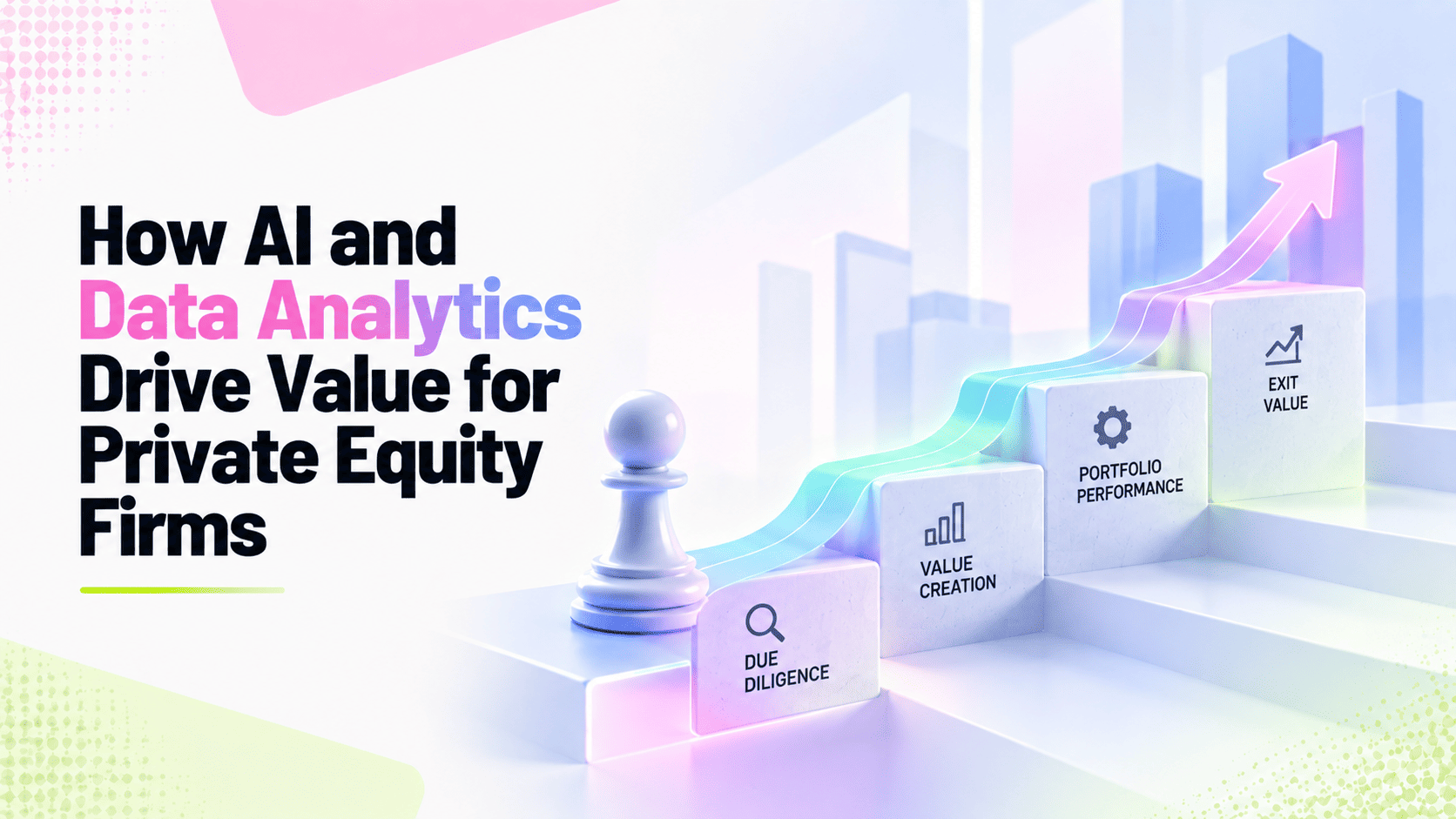
AI and data analytics can contribute at several points in the ownership lifecycle:
- Before acquisition: widening diligence coverage and surfacing technology, commercial, and operational risks.
- During the 100-day plan: establishing performance baselines and identifying high-value interventions.
- During the hold period: improving pricing, forecasting, customer retention, cost-to-serve, productivity, and working capital.
- Across the portfolio: giving operating partners more consistent visibility into performance and emerging risks.
- Ahead of exit: creating cleaner data, better reporting, documented operating improvements, and a technology estate buyers can assess with greater confidence.
The important question is therefore not, “Where can we add AI?”
It is:
Where can AI or analytics materially improve the investment thesis—and can that improvement be measured and captured before exit?


Your AI Partner
Exadel works with PE firms and portfolio companies from diligence and 100-day planning through modernization, value creation, and exit readiness.
The PE Value Creation Framework for AI and Data Analytics
A useful AI opportunity should connect directly to the VCP.
The pathway looks like this:
VCP priority → required data → AI or analytics capability → operational action → P&L or balance-sheet effect → enterprise-value contribution
For example, a pricing model is not valuable merely because its forecasts are accurate. It becomes valuable when commercial teams use those recommendations, discount discipline improves, gross margin changes, and the benefit can be measured against a baseline.
Likewise, an inventory model only contributes to the investment thesis if management can turn its predictions into lower stock levels, fewer shortages, reduced expediting costs, or improved cash conversion.
For operating partners, that means prioritizing AI opportunities using more than theoretical ROI. Useful criteria include:
- EBITDA or cash-flow potential
- Time to measurable value
- Data readiness
- Implementation complexity
- Business ownership
- Risk and governance requirements
- Ability to reuse the capability across portfolio companies
- Contribution to exit readiness
A technically sophisticated initiative with a three-year payback may be less attractive than a narrower intervention that can deliver measurable results inside the current hold period.
Connect AI to the value creation plan.
Exadel helps PE firms identify AI opportunities with measurable impact, realistic timelines, and the right data foundation.
For PE investors, the AI value chain only matters when each technical step can be traced to an operating result and ultimately back to the investment thesis.
5 High-Impact AI and Analytics Use Cases for PE Firms
1. AI-Enhanced Due Diligence and Deal Sourcing
Deal teams already work under intense time constraints. They may need to analyze thousands of documents, financial assumptions, contracts, customer records, market signals, and technology assets before an investment committee decision.
AI can increase the amount of material teams are able to examine.
KPMG’s 2026 Global M&A Outlook, based on 700 corporate and private-equity dealmakers, found that 56% were using AI in due diligence and valuation and 53% in deal sourcing and strategy.
Language models can help classify and summarize data-room documents, compare contracts, identify inconsistencies, and surface areas requiring deeper review. AI-assisted engineering tools can help teams examine code, architecture, security, technical debt, and integration complexity.
The goal is not to replace commercial, financial, legal, or technical diligence. It is to let specialists examine more evidence and focus their attention where the investment thesis is most exposed.
That includes asking a question that conventional diligence increasingly needs to address:
Is AI an opportunity for this target, or a threat to its current business model?
A company may have substantial upside from automation and new AI-enabled products. Another may depend on pricing, labor economics, proprietary knowledge, or product features that AI could erode.
Exadel applies an engineering-first approach to technology diligence. The people assessing architecture, code quality, scalability, cybersecurity, data, and modernization requirements are connected to the engineering teams that understand what remediation or transformation will actually require after the deal closes, rather than relying solely on management documentation.
2. Portfolio Company Performance Monitoring
Operating partners need to know where intervention can create the greatest value.
That sounds straightforward until a portfolio consists of companies using different ERP systems, CRM platforms, financial calendars, KPI definitions, data warehouses, and reporting processes. Add-on acquisitions increase the complexity further.
A portfolio analytics capability can consolidate financial and operational indicators such as:
- Revenue and gross margin
- Pipeline and sales conversion
- Customer retention
- Workforce and capacity
- Cash flow and working capital
- Operational throughput
- VCP milestones
AI and predictive analytics can then help identify anomalies, deteriorating trends, forecast gaps, or areas where management attention may be required.
The point is not to create a larger dashboard.
The value lies in earlier visibility followed by faster management action.
Useful measures might include forecast accuracy, reporting-cycle time, speed of identifying KPI variance, progress against the VCP, and the effectiveness of resulting operating interventions.
3. Operational Benchmarking and EBITDA Improvement
This is where AI can connect most directly to the economics of the deal.
Potential value levers include:
Pricing optimization. Analytics can reveal discount leakage, customer willingness to pay, price-volume trade-offs, and inconsistent commercial behavior.
Demand forecasting. Better predictions can improve workforce planning, inventory decisions, production capacity, and procurement.
Cost-to-serve analytics. Combining customer, product, service, and operational data can reveal accounts or channels that generate revenue but destroy margin.
Sales effectiveness. AI can improve lead prioritization, account planning, churn identification, and next-best actions.
Process automation. Document processing, service operations, finance workflows, and other repetitive activities may be redesigned so that growth requires less incremental manual effort.
The crucial discipline is to follow the impact through to the P&L.
For a PE-owned fintech company serving the fitness industry, Exadel combined platform modernization, operational automation, revenue-cycle management, and advanced analytics around the company’s PE-driven growth objectives. The resulting platform supports more than one million transactions each day, and its customers reported a 5% increase in revenue collection during the first 90 days of use.
That is the kind of result a value creation plan can track: not an abstract increase in “AI maturity,” but better revenue capture, operational scalability, and management visibility
Your AI Partner
Have a portfolio AI opportunity but need to determine whether it can deliver measurable value?
4. Supply Chain and Working Capital Optimization
For portfolio companies with physical products, manufacturing, distribution, or complex procurement, AI and analytics can also improve the balance sheet.
Relevant applications include:
- Inventory and demand forecasting
- Supplier-risk identification
- Procurement analytics
- Production and capacity planning
- Stockout and excess-stock prediction
- Accounts-receivable prioritization
- Payment-pattern analysis
- Cash-conversion-cycle monitoring
For PE investors, these are not simply “supply-chain AI” use cases.
The value mechanism is financial: less cash tied up in excess inventory, fewer emergency shipments, lower procurement leakage, improved availability, faster collections, and more predictable cash conversion.
The temptation is to automate quickly. But poor master data, inconsistent product identifiers, incomplete supplier records, and fragmented ERP environments can undermine sophisticated models.
That is why foundational data work often belongs in the VCP alongside the AI initiative itself.
5. Exit Readiness: Data Assets as Value Drivers
AI can also affect how a portfolio company presents itself to its next owner.
A buyer conducting diligence wants confidence that reported performance can be reproduced and understood. That becomes harder when KPI definitions are inconsistent, data lineage is weak, technology is highly customized, or AI capabilities exist only as undocumented experiments.
A stronger exit position may include:
- Consistent historical KPI definitions
- Reliable revenue and margin data
- Traceable analytical models
- Documented automation and AI systems
- Clear data ownership and governance
- Scalable technology capable of supporting add-on acquisitions
- Evidence that operating improvements are repeatable
- Visibility into AI operating costs and third-party dependencies
McKinsey’s 2026 analysis of 471 PE-backed companies found an association between deeper AI integration and higher revenue efficiency and valuation multiples. That does not establish that AI caused the valuation difference. But it suggests that there may be a meaningful distinction between businesses using AI for isolated productivity tasks and those embedding it into products, operating models, and growth strategies.
Exadel’s internal PE material also describes a portfolio-company modernization in which legacy B2B systems were replaced with a cloud-native platform, improving reliability, scalability, integration, and operating costs. The internal case states that the transformation helped position the business for the sponsor’s highest-ever exit.
The wording matters. Technology did not single-handedly produce the exit valuation. It helped create a more scalable, lower-friction, and easier-to-assess asset.
Common Data Challenges in PE Portfolio Companies
Private equity portfolios create a distinctive data problem.
A conventional enterprise can standardize systems over many years. A PE sponsor may instead own several independent businesses at different maturity levels, while each portfolio company may itself contain systems inherited through add-on acquisitions.
BCG’s 2026 survey, ‘Private Equity’s Future Is Digital First and AI Powered’,of senior PE investors found that only 15% of portfolio companies were viewed as having “very mature” IT capabilities.
Typical challenges include:
- Multiple ERPs and CRMs after add-on acquisitions
- Inconsistent customer and product identifiers
- Different definitions of revenue, margin, churn, or utilization
- Manual spreadsheet-based operational reporting
- Limited data lineage
- Fragile point-to-point integrations
- Small internal data-engineering teams
- Different security and regulatory requirements across portfolio companies
In one confidential Exadel engagement with an investment-research company, advanced analytics had become difficult because data was spread across legacy applications and distributed transactional and analytical databases. The work included a consolidated data model, cloud migration, and integration of data from multiple acquired companies. The resulting enterprise data platform became a centralized source of truth for analytics, while database wait times were reduced by 20%.
This illustrates an important point for PE operating partners: sometimes the best first AI investment is not a model. It is creating the data foundation that makes dependable AI possible.
Building AI Capability Across a Portfolio: The Operating Model Question
Should a private equity firm centralize AI capability, or should each portfolio company build independently?
There is no universal answer.
A very large portfolio company may have the scale and specialist teams to build substantial internal capability. A smaller PortCo may benefit much more from shared expertise, reusable patterns, and sponsor-level support.
Our view at Exadel is that a federated model often provides the best balance. A federated model lets the sponsor provide shared AI expertise, standards, and reusable capability while keeping business ownership and execution inside the portfolio company.
At the PE level
Sponsors can establish:
- AI and data governance principles
- Reusable training and enablement for portfolio-company teams
- Common assessment methods
- Technology and architecture standards
- Requirement-driven model, platform, and vendor evaluation frameworks
- Reusable accelerators
- Portfolio KPI definitions
- Shared specialist expertise
- Cross-portfolio learning
At the portfolio-company level
Management retains responsibility for:
- The business outcome
- Local data and systems
- Workflow integration
- Adoption and process change
- Decision authority
- Performance monitoring
- Regulatory and customer impact
This avoids two extremes: every PortCo independently recreating the same capability, or the sponsor attempting to impose a technology stack that does not fit local operating realities.
Exadel’s approach also creates a practical route to enablement. Shared expertise, implementation patterns, training, and governance frameworks can be developed at portfolio level while individual management teams retain the knowledge and ownership required to operate AI within their own business.
Governance also has to work at two levels
PE firms handle highly sensitive information, including virtual data-room documents, forecasts, acquisition plans, customer data, technology assets, and potentially material nonpublic information. Approved AI environments therefore need clear controls around access, retention, security, source traceability, and third-party data use.
Investment accountability also remains human. A convincing AI-generated summary should not become the evidentiary basis for an investment-committee decision without validation against its underlying sources.
For U.S. investment advisers, the SEC’s fiscal 2026 examination priorities specifically include the accuracy of representations about AI capabilities and whether firms have adequate policies and procedures to monitor and supervise AI use. [
The SEC has also previously brought enforcement actions against investment advisers for false or misleading statements about their use of AI—making “AI-washing” a genuine disclosure concern rather than merely a marketing issue.
For portfolio companies operating in the EU, risk must be assessed at the individual use-case level. Under the EU AI Act, particular applications in areas such as employment, worker management, creditworthiness, and life and health insurance can fall within the high-risk framework. Classification depends on intended purpose rather than the simple fact that AI is being used.
A fund-level AI policy is therefore useful, but it cannot replace sector-, jurisdiction-, and use-case-specific governance within individual portfolio companies.
How Exadel Supports PE Firms and Their Portfolio Companies
At Exadel, we work across the PE lifecycle, from technology diligence and 100-day planning to modernization, AI implementation, data engineering, and exit readiness.
Our role is not simply to identify AI opportunities. We combine consulting, engineering services, and enablement to translate them into production capabilities that fit the investment thesis, operating timetable, and capabilities of the portfolio company that will ultimately own them.
That can involve:
- Identifying high-value AI and analytics opportunities
- Assessing technical and data readiness
- Consolidating fragmented data after acquisitions
- Modernizing legacy applications and platforms
- Building AI-enabled products and workflows
- Implementing reusable data and AI foundations
- Establishing monitoring and governance
- Supporting rapid post-close execution
- Preparing technology and data assets for future diligence
- Enable portfolio-company teams to operate, govern, and extend successful AI capabilities
That delivery model is supported by Exadel’s partnerships with Cursor, Anthropic, and OpenAI, together with certified practitioners inside our organization. For PE firms and portfolio companies, the value is not simply access to partner technologies. It is being able to draw on specialists with current AI implementation expertise when evaluating platforms, accelerating delivery, establishing reusable practices, and enabling internal teams. Technology choices still need to follow the requirements of each portfolio company rather than imposing the same stack across every asset.
The discipline is the same whether the objective is revenue growth, margin improvement, working-capital efficiency, or a stronger exit story:
Start with the value lever. Build the required foundation. Put the capability into the workflow. Enable the team that will own it. Measure what changed.
Turn Portfolio AI into Measurable Value Creation
Private equity firms do not need more disconnected AI experiments. They need initiatives that can survive the same scrutiny as any other component of the value creation plan.
That means connecting AI and data investment to measurable performance, assigning business ownership, building the right technical foundation, and establishing whether the benefit can be realized inside the hold period.
Exadel helps PE firms and portfolio companies move from AI opportunity identification to engineering, implementation, enablement, and measurable operating impact.
Frequently Asked Questions
How are private equity firms using AI?
Private equity firms are using AI across deal sourcing, due diligence, portfolio monitoring, commercial improvement, operations, and portfolio-company transformation.
During diligence, AI can help teams examine larger volumes of documents, code, market information, and operational data. During the hold period, portfolio companies may use AI for pricing, forecasting, customer retention, automation, procurement, and working-capital management. At the portfolio level, analytics can improve visibility into performance and value creation plan milestones.
The most useful applications are tied to a specific investment thesis rather than deployed simply because the technology is available.
What data analytics capabilities should PE portfolio companies have?
The required capabilities depend on the business, but most portfolio companies benefit from reliable core data, consistent business definitions, scalable integration, data-quality controls, appropriate governance, and reporting that connects financial and operational performance.
More mature environments may add real-time analytics, predictive models, machine learning, generative AI, or AI-enabled applications.
PortCos do not all need identical platforms. What matters is having data that management can trust and an architecture capable of supporting the value creation priorities relevant to that business.
How can AI improve EBITDA at a portfolio company?
AI can contribute to EBITDA when it changes a measurable revenue or cost driver.
Examples include improving price realization, reducing churn, lowering cost to serve, increasing sales productivity, automating manual work, improving demand forecasts, or reducing procurement leakage.
The financial impact should be measured against a baseline and include implementation, infrastructure, human-review, and operating costs. A more accurate model is not automatically an EBITDA improvement: management must act on its output and the resulting business process must perform better.
Turn portfolio AI into measurable value.
Exadel helps PE firms and portfolio companies move from AI opportunity to engineering, implementation, and measurable operating impact.