
Tags
Share
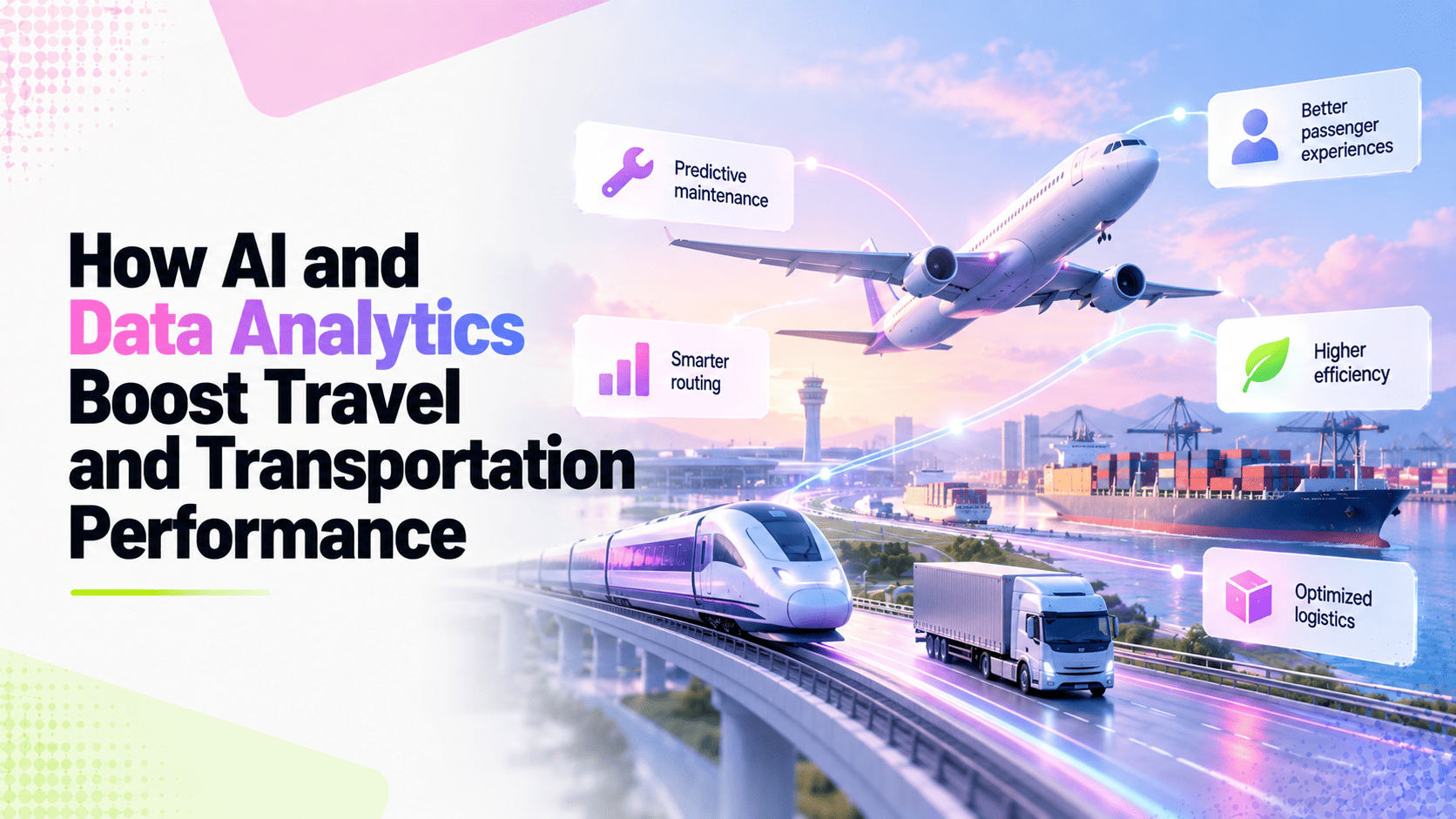
Every journey creates data.
Aircraft and vehicles generate sensor and maintenance signals. Booking systems capture demand and pricing information. Logistics platforms track freight and inventory. Weather, traffic, ports, airports, and road networks constantly change the conditions operators must navigate.
The opportunity for AI and data analytics is therefore substantial. But travel and transportation companies do not create value simply by collecting more data or deploying more models.
Value appears when an organization can turn those signals into a timely operational decision: maintain an asset before it fails, adjust capacity before demand shifts, reroute a shipment around a disruption, offer a traveler something relevant, or identify a safety risk before it becomes an incident.
That is the travel and transportation application of the broader principle we explore in our guide to how AI and data analytics boost business results: data, intelligence, workflow, and action need to operate as one connected system.
Why Travel and Transportation Generates (and Wastes) Enormous Data
Travel and transportation is not short of information. The difficulty is that the information is extraordinarily varied.
A single operation may depend on data from:
- Aircraft, vehicle, vessel, or equipment sensors
- GPS and telematics
- Maintenance and asset-management systems
- Global distribution systems and booking platforms
- Hotel property-management systems
- Transportation and warehouse-management systems
- Traffic and road networks
- Weather services
- Airport, rail, and port systems
- Fuel and energy feeds
- Customer, loyalty, and payment platforms
- Partner and supplier systems
- Safety and compliance records
Some of that data arrives continuously. Some is transactional. Some is geospatial. Some lives in documents. Some comes from equipment operating at the edge of a network, while other information may remain trapped inside decades-old operational systems.
That creates both a timing and integration problem. Yesterday’s vehicle-health data cannot prevent today’s breakdown. A route recommendation based on outdated traffic or weather may already be useless. A demand forecast has limited value if it cannot influence capacity or pricing while there is still time to act.
The central data challenge in travel and transportation is therefore often heterogeneity rather than volume alone: connecting different data types, systems, identifiers, ownership models, and update speeds into a sufficiently trusted view of what is happening.
Turning transport data into operational value requires a connected path from live signals and trusted information to decisions that can still change the journey.


Your AI Partner
Connect fragmented transport data.
Exadel builds data platforms and pipelines that help transportation teams turn diverse operational signals into usable intelligence.
6 Ways AI and Data Analytics Transform Travel and Transportation Operations
1. Predictive Maintenance for Fleets, Aircraft, and Infrastructure
Predictive maintenance is one of the most mature applications of AI in transportation because the value mechanism is concrete: detect deterioration early enough to prevent an avoidable failure.
Connected vehicles, aircraft, rail assets, warehouse equipment, and infrastructure can generate information about vibration, temperature, pressure, electrical behavior, engine performance, braking, battery condition, operating hours, and fault events.
AI and analytics can use those signals in several ways.
Anomaly detection identifies behavior that differs from the asset’s normal operating pattern. Predictive models can estimate the probability of failure or the asset’s remaining useful life (RUL): how long a component is expected to operate before maintenance or replacement becomes necessary.
The prediction then has to reach the maintenance process. Teams need to decide when an intervention is justified, whether parts and engineers will be available, and how work can be scheduled with the least disruption to operations.
Deloitte’s 2025 fleet-digitization roadmap cites industry estimates indicating that predictive analytics using real-time diagnostics and historical data can reduce fleet downtime by up to 25% and maintenance costs by 12–30%. These are potential ranges rather than guaranteed outcomes for every fleet, and the achievable result depends heavily on asset condition, sensor coverage, maintenance practice, and implementation quality.
Useful performance measures include unplanned downtime, asset availability, maintenance cost, mean time between failures, service interruptions, emergency repairs, and schedule adherence.
The model should support maintenance expertise, not obscure it. Engineers still need the evidence required to understand an alert, challenge it where necessary, and determine the appropriate intervention.
Predictive maintenance creates value when equipment signals move through a complete loop from early detection to a maintenance action—and then back into the model as new operational evidence.
2. Dynamic Pricing and Revenue Management
Travel demand changes continuously.
Airlines, hotels, rental providers, mobility services, and other travel businesses make decisions around finite capacity that may lose much of its value once the departure date, hotel night, or service window has passed.
AI can improve demand forecasting by combining historical bookings with current shopping behavior, available inventory, seasonality, events, competitive conditions, cancellations, customer context, and other permitted signals.
Pricing is only one possible output. The same capability can inform inventory, bundles, upgrades, ancillary services, or when capacity should be protected for expected future demand.
Airline retailing illustrates the shift. IATA’s Dynamic Offers framework describes the industry moving beyond static fare classes toward dynamically created offers that combine continuous pricing and dynamic bundling in response to shopping context and market conditions.
AI does not remove commercial judgment. Revenue teams still need to account for strategy, exceptional events, market positioning, customer treatment, and relevant consumer and pricing requirements.
Useful measures include yield, load factor or occupancy, revenue per available unit, conversion, ancillary revenue, forecast accuracy, and cancellation behavior.
3. Route Optimization and Capacity Planning
Transportation decisions involve constraints that change while assets are already moving.
Traffic develops. Weather changes. Ports become congested. Drivers approach working-time limits. Flights face airspace restrictions. A warehouse fills unexpectedly. A customer changes a delivery window.
AI-enabled optimization can combine those changing signals with vehicle capacity, network schedules, fuel or energy costs, service-level commitments, inventory, and demand to recommend a better operational response.
That might mean changing a delivery sequence, reallocating a vehicle, adjusting a flight plan, consolidating loads, repositioning capacity, or rerouting freight around a disruption.
Exadel has explored this problem in a public AI-powered logistics proof of concept for a client operating a large international infrastructure network. The system combined information from mapping platforms, weather, transport modes, port congestion, storage capacity, and other operational sources to compare rerouting scenarios according to time, cost, and carbon impact. Importantly, it presented the trade-offs to an accountable human operator rather than simply executing every recommendation automatically.
The most relevant measures vary by operation but may include on-time performance, empty miles, dwell time, capacity utilization, fuel use, delivery cost, missed connections, and service-level performance.
4. Passenger and Customer Experience Personalization
Transportation performance is operational, but the customer experiences the consequences.
A delayed flight, missing bag, changed rail platform, unavailable vehicle, or interrupted shipment creates uncertainty. The most useful AI-enabled customer experience may therefore be less about promoting another product and more about understanding what the person needs at that moment.
Travel organizations can combine booking history, loyalty information, live journey status, preferences, service interactions, and permitted contextual signals to support:
- Relevant offers and upgrades
- Personalized journey information
- Disruption notifications
- Rebooking options
- Customer-service prioritization
- Loyalty interventions
- Baggage or shipment updates
- Digital assistance throughout a journey
IATA’s 2025 Global Passenger Survey, based on more than 10,000 responses across over 200 countries, found that 78% of passengers wanted to use a smartphone combining functions such as a digital wallet, digital passport, and loyalty cards across the journey. The wider finding is that travelers increasingly expect digital information and services to move with them between touchpoints.
That requires joined-up customer data, but it also requires appropriate consent, privacy, cybersecurity, and identity controls.
Relevant outcomes include customer satisfaction, digital completion, rebooking time, service-resolution time, retention, loyalty engagement, and ancillary conversion.
5. Supply Chain Visibility and Logistics Intelligence
A shipment can cross carriers, warehouses, ports, customs processes, and national borders before reaching its destination.
Each participant may hold a partial view.
Analytics can connect transportation-management systems, warehouse platforms, carrier feeds, tracking devices, inventory information, orders, customs data, weather, port conditions, and external risk information to build a more usable picture of the movement.
AI can then help predict delays, estimate arrival times, identify unusual patterns, forecast capacity constraints, or prioritize exceptions requiring intervention.
DHL’s Logistics Trend Radar identifies advanced analytics, computer vision, and other AI capabilities as increasingly important to supply-chain visibility and decision-making, including forecasting, route planning, asset tracking, and disruption management.
Again, visibility is not the final outcome.
A warning that a shipment will arrive late matters only if someone can change inventory allocation, inform the customer, select another carrier, adjust production, or reroute the goods.
6. Safety, Compliance, and Risk Analytics
Transportation is an environment in which some AI decisions have direct physical consequences.
Telematics, incident records, maintenance histories, route information, weather, vehicle condition, driver behavior, operational logs, and inspection data can help organizations identify emerging risks.
Analytics may support:
- Maintenance-risk prioritization
- Driver-behavior analysis
- Route and weather risk
- Infrastructure inspection
- Incident-pattern analysis
- Compliance monitoring
- Safety reporting
- Operational anomaly detection
The closer an AI system moves toward a safety-critical decision, the stronger its validation, monitoring, explainability, escalation, and human oversight should generally become.
A high-performing prediction is not sufficient if operators cannot understand when to trust it, when to challenge it, or what action they are authorized to take.
That makes enablement part of the operating model. Maintenance teams, dispatchers, safety specialists, engineering teams, and managers need enough understanding of the AI-enabled workflow to use its outputs appropriately and recognize when something is wrong.
Move transport AI into operations.
Exadel engineers AI capabilities around the workflows, controls, and production systems where operational decisions actually happen.
The Data Architecture Challenge in Travel and Transportation
The six use cases above depend on a common technical problem: bringing extremely different forms of information together without losing the timing, context, security, or quality required for the decision.
A modern transportation data architecture may need to combine:
- IoT and edge data
- Real-time event streaming
- APIs and partner integrations
- Geospatial information
- Time-series sensor data
- Transactional booking and payment data
- Customer and identity data
- Documents and unstructured information
- Operational master data
- Historical analytical datasets
The architecture may therefore include edge processing, streaming ingestion, APIs, cloud or hybrid data platforms, data-quality and observability controls, geospatial processing, standardized business entities, and analytical or machine-learning layers.
There is no single stack appropriate to every operator.
An airline, rail network, hotel group, mobility provider, freight carrier, and port may have very different latency, resilience, security, deployment, and integration requirements.
The common requirement is to build a sufficiently connected and trustworthy data foundation so that analytics can reach operational systems while the result still matters.
Exadel’s Data Engineering & Analytics services focus on integrating, standardizing, governing, and operationalizing enterprise data across complex environments.
The technology alone is also insufficient. Operations, engineering, data, safety, commercial, and customer teams need clear ownership of the definitions, workflows, exceptions, and decisions that sit on top of the platform.
The travel and transportation data challenge is not simply storing more information; it is connecting different data types and speeds into an intelligence layer that operational systems can actually use.
AI and Sustainability: Reducing Emissions Through Data
Many of the same decisions that improve transportation efficiency can also reduce environmental impact.
Better routing can reduce unnecessary distance. Improved capacity utilization can reduce empty movement. Predictive maintenance can help equipment operate efficiently. Flight and vehicle data can identify excess fuel consumption. Better forecasts can improve load planning and asset allocation.
The World Economic Forum’s Intelligent Transport, Greener Future analysis, developed with McKinsey, estimates that AI-supported route optimization and asset management could reduce freight-transport emissions by up to 7%, while additional benefits may come from improving capacity utilization and shifting freight toward lower-carbon modes. Those figures represent modeled potential rather than a guaranteed result for an individual operator.
For airlines, high-resolution operational data can likewise reveal inefficiencies in routing, holding, aircraft weight, flight profiles, and fuel use. IATA emphasizes that granular performance data is essential for identifying and validating fuel-efficiency improvements.
This is where we should be precise about Exadel’s role.
We are not claiming that deploying an Exadel AI system automatically creates a sustainability result. We build the data, analytics, and engineering foundations that can allow transportation organizations to identify, implement, measure, and report operational improvements.
That distinction matters because sustainability gains need the same discipline as financial ones: a baseline, a measurable intervention, reliable data, and evidence of what actually changed.
How Exadel Supports AI and Analytics in Travel and Transportation
At Exadel, we work across the travel and transportation technology stack—from operational data platforms and digital products to AI engineering, systems integration, modernization, and analytics.
Through our Travel & Transport capabilities, we support airlines, mobility providers, freight carriers, logistics networks, rail operators, and other organizations that need to modernize without disrupting mission-critical operations.
Our delivery model combines consulting, engineering services, and client enablement. We can help determine where AI is likely to create value, engineer the data and production capability required to deliver it, and work with internal teams so the knowledge required to operate and extend the solution does not remain solely with an external partner.
Our teams can help organizations:
- Prioritize AI use cases around measurable operational outcomes
- Integrate IoT, operational, customer, booking, and third-party data
- Build real-time and event-driven data architectures
- Develop predictive and optimization capabilities
- Modernize legacy travel and transportation platforms
- Integrate AI into maintenance, logistics, commercial, and customer workflows
- Establish monitoring, governance, security, and human oversight
- Enable internal data, engineering, and operational teams to own successful capabilities
That engineering capability is also supported by Exadel’s partnerships with Cursor, Anthropic, and OpenAI, together with certified practitioners inside our organization.
The client value is not the partner names themselves. It is having specialists who can bring current AI implementation knowledge into architecture, model and platform evaluation, engineering, governance, and enablement.
Technology selection still follows the requirements of the use case. In travel and transportation, those requirements may include real-time performance, edge deployment, resilience, security, data location, cost, integration with legacy operational platforms, and the level of human or safety oversight required.
Because our consulting and engineering teams remain closely connected through delivery, recommendations are grounded in what it will actually take to make the capability work in production.
Turn Transportation Data into Operational Performance
Travel and transportation organizations already generate many of the signals required to improve operations. The harder task is connecting them reliably enough to influence maintenance, routing, capacity, pricing, customer experience, logistics, and safety while there is still time to act.
The strongest AI programs therefore begin with the operational outcome, build the data foundation required to support it, integrate intelligence into the workflow, enable the people who will own it, and measure what changed.
Frequently Asked Questions
How is AI used in the travel industry?
AI is used across travel for demand forecasting, dynamic pricing, personalization, disruption management, customer service, predictive maintenance, route planning, and operational optimization. Airlines and hospitality companies can combine booking, availability, customer, operational, and external data to predict demand or provide more relevant services. Transportation operators can use sensor and location information to improve maintenance and scheduling. The value depends on connecting the AI output to a real workflow rather than treating the model as a standalone capability.
What are the biggest data challenges in transportation?
The biggest transportation data challenge is often heterogeneity. Operators may need to combine sensor and telematics streams, booking systems, logistics platforms, geospatial information, weather, traffic, maintenance records, customer data, and external partners. Those sources differ in format, quality, identifiers, ownership, and latency. Successful analytics therefore requires integration, shared definitions, quality monitoring, lineage, appropriate governance, and an architecture capable of moving time-sensitive information quickly enough for the operational decision it supports.
How does AI improve predictive maintenance for fleets?
AI improves predictive maintenance by analyzing current and historical equipment data to identify abnormal behavior and estimate when a component may fail. Sensors may monitor temperature, vibration, pressure, electrical behavior, engine performance, or other condition indicators. Anomaly-detection and remaining-useful-life models can then help maintenance teams prioritize inspections or interventions before an unexpected breakdown. The business benefit comes when those predictions are integrated with maintenance schedules, spare-parts planning, engineering expertise, and asset-availability requirements.
Written by: Devendra Sharma, Chief Data & Analytics Officer
September, 2026
Turn transport intelligence into action.
Exadel helps turn complex transport data into production-ready AI and measurable outcomes.mes.