
Tags
Share
Healthcare organizations do not lack data. They generate it continuously through electronic health records, diagnostic imaging, laboratory systems, claims, pharmacies, connected devices, clinical research, and everyday hospital operations.
The difficulty is turning that information into timely, dependable action.
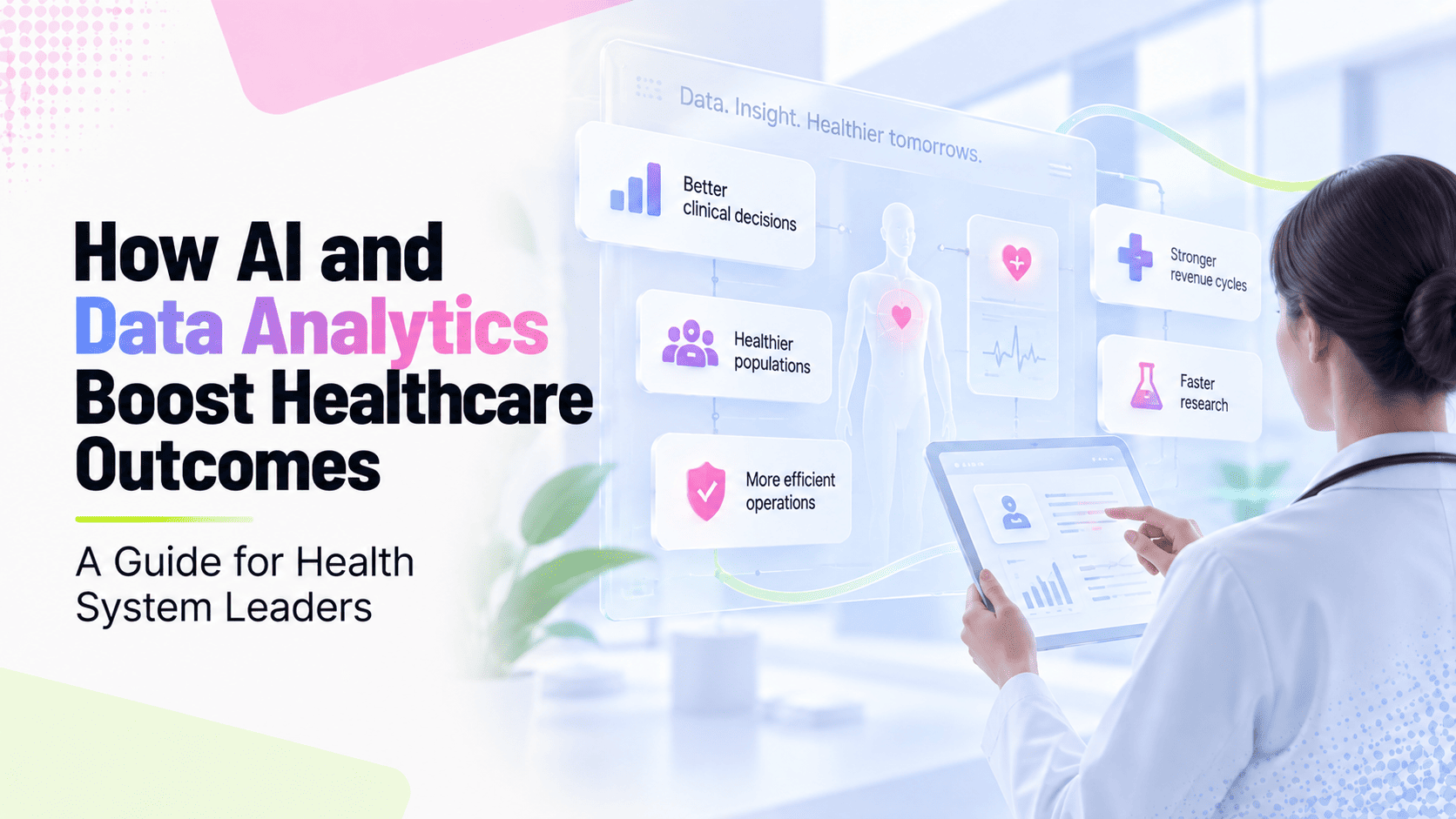
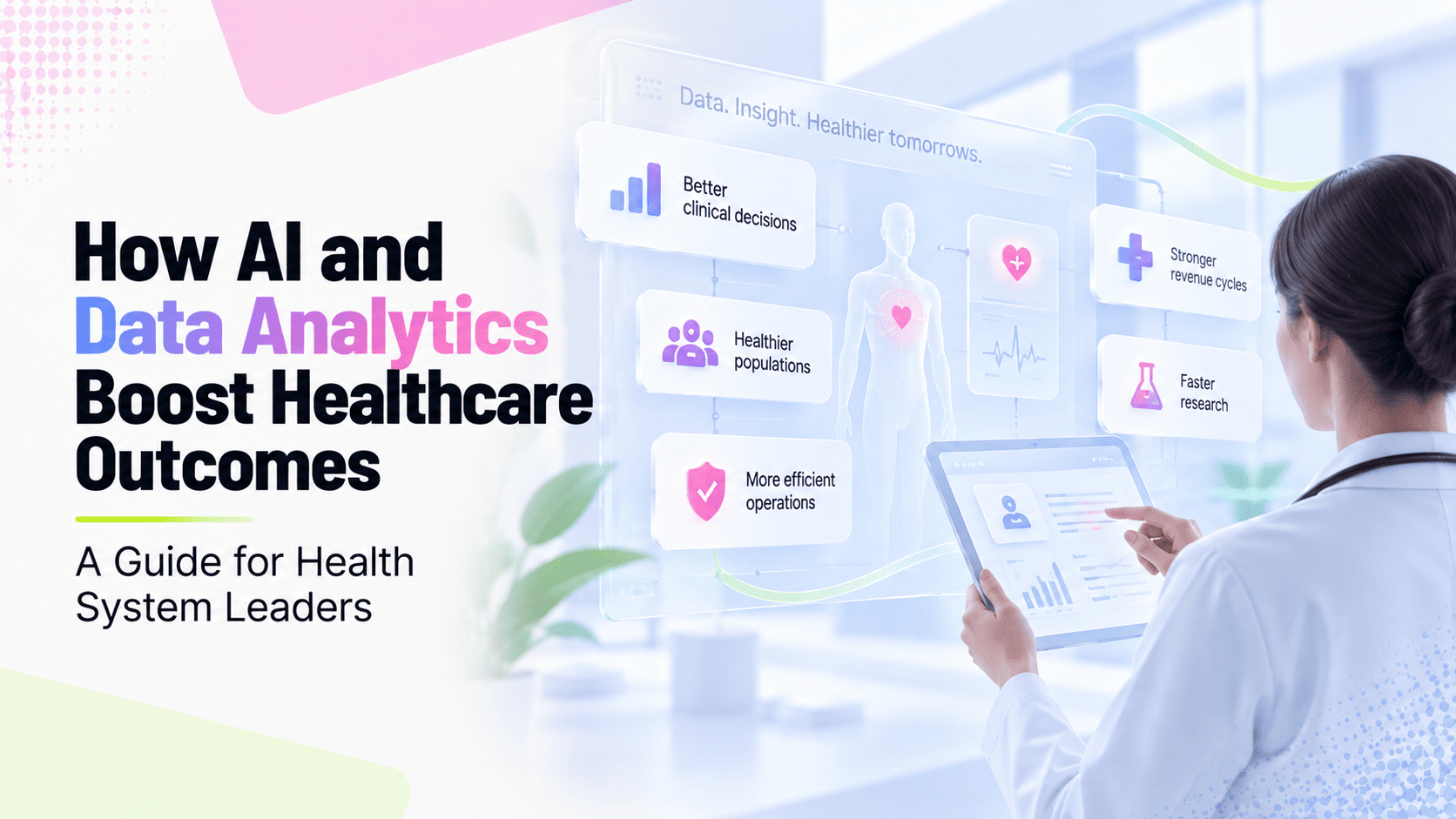
AI and data analytics can support better clinical decisions, identify patient risk earlier, reduce administrative burden, improve capacity planning, strengthen revenue-cycle performance, and accelerate research. But these outcomes do not come from deploying a model in isolation. They depend on reliable data, healthcare-specific engineering, workflow integration, clinical or operational validation, and clearly assigned human responsibility.
This is the healthcare application of a broader principle explored in our guide to how AI and data analytics boost business results. Value only truly appears when trusted data and intelligent analysis reach the people and systems able to act on them.
Healthcare raises the standard further. A faster administrative process may deliver meaningful operational value. An AI system that influences diagnosis, prioritization, or treatment may require much more demanding evidence, oversight, and regulatory review.
The Data Challenge at the Heart of Healthcare AI
A health system may hold a rich longitudinal record of a patient’s care while still being unable to assemble a complete, timely picture when it matters.
Relevant information may be spread across:
- Electronic health records
- Laboratory information systems
- Radiology and imaging platforms
- Pharmacy systems
- Claims and billing applications
- Bed-management and workforce systems
- Patient-monitoring devices
- Research repositories and genomic datasets
- External providers, payers, and public-health organizations
These sources do not always use the same identifiers, formats, terminology, or update schedules. One organization may define a measure differently across departments. An imaging report may be stored as unstructured text. Device data may arrive continuously while claims data appears much later. Privacy rules may restrict how datasets can be combined or reused.
Interoperability has improved, but it remains incomplete. In 2024, approximately nine in ten U.S. hospitals enabled patients to access health information through an application programming interface, or API. Seven in ten reported using standards-based APIs such as Fast Healthcare Interoperability Resources (usually known as FHIR) for patient access, while much exchange with third-party clinical and administrative systems still relied on non-standard methods.
The central challenge is therefore not simply collecting more information. It is making the right data available, understandable, secure, and usable for a defined clinical, operational, financial, or research purpose.
Healthcare AI creates value when fragmented clinical, operational, and research data can move through a trusted foundation into decisions and workflows that improve outcomes.


Your AI Partner
Prepare healthcare data for AI.
Exadel connects and governs healthcare data so AI can support reliable clinical, operational, and research workflows.
6 Ways AI and Data Analytics Improve Healthcare Outcomes
1. Clinical Decision Support and Diagnostic Accuracy
AI-enabled clinical decision support can analyze medical histories, test results, imaging, symptoms, and clinical guidance to help professionals identify patterns or options that might otherwise require extensive manual review.
These systems may support image interpretation, medication review, differential diagnosis, or the prioritization of cases requiring closer attention. The goal should generally be to strengthen professional judgment—not conceal or replace it.
The data requirement depends on the intended use. A diagnostic-imaging system may require representative, accurately labeled images from different devices and patient populations. A clinical knowledge assistant may require current, approved medical evidence and patient-specific information presented with clear provenance.
Success should be measured beyond technical model accuracy. Relevant measures may include time to interpretation, sensitivity and specificity, false-alert rates, clinician acceptance, changes in treatment decisions, and—where the evidence supports it—patient outcomes.
The closer a system moves toward diagnosis or treatment, the more important independent clinical validation, human review, explainability, and post-deployment monitoring become.
2. Predictive Analytics for Patient Risk Stratification
Predictive models can combine clinical observations, laboratory results, medication history, comorbidities, prior utilization, and real-time monitoring data to identify patients at increased risk of deterioration, readmission, or another adverse event.
The model’s prediction is only the beginning. The alert must reach an appropriate care team early enough to change what happens next, with thresholds and escalation procedures designed to avoid unmanageable alert fatigue.
A hospital study published in JAMA Internal Medicine evaluated an AI-enabled deterioration alert linked to a collaborative nurse-and-physician response. Among patients around the alert threshold, the intervention was associated with a 10.4-percentage-point reduction in a composite measure that included rapid-response activation, intensive-care transfer, or cardiopulmonary arrest. The single-center observational design means the result should not automatically be generalized to every hospital, but it demonstrates the importance of joining prediction to a defined clinical workflow.
Appropriate outcome measures include time to intervention, escalation rates, avoidable transfers, readmissions, adverse events, and the clinical usefulness of alerts—not simply the model’s performance in a retrospective dataset.
3. Operational Efficiency: Scheduling, Staffing, and Capacity
AI in healthcare analytics can help forecast patient volumes, predict appointment cancellations, optimize staff allocation, improve bed management, and reduce time spent on repetitive documentation or data entry.
These applications usually depend on operational data rather than highly sensitive diagnostic inference: appointment histories, workforce schedules, admission and discharge patterns, documentation workflows, service demand, and facility or equipment information.
Administrative AI may still require security, governance, and human review, but it generally carries a different clinical risk profile from software influencing diagnosis or treatment.
In a 2025 multicenter study involving 263 physicians and advanced-practice practitioners, reported burnout fell from 51.9% to 38.8% after 30 days of ambient AI-scribe use. Participants also reported improvements in documentation burden, attention to patients, and after-hours work. Because the study used a pre/post quality-improvement design and included self-reported outcomes, it shows an association rather than proving that the technology alone caused every improvement.
Exadel has also developed an AI-powered hospital asset-management module that uses computer vision and optical character recognition to extract serial numbers, expiration dates, and other information from equipment labels. The solution converts label images into structured data and integrates it with existing asset workflows, reducing manual capture and improving equipment visibility.
Operational success might be measured through documentation time, patient throughput, utilization, waiting times, overtime, cancellation rates, asset-processing time, or capacity released for higher-value care.
4. Revenue-Cycle Optimization and Claims Processing
Revenue-cycle processes depend on large volumes of clinical and administrative information moving accurately between providers, payers, coding teams, and financial systems.
AI and analytics can support:
- Documentation and coding review
- Eligibility and authorization workflows
- Claim validation
- Denial prediction
- Underpayment detection
- Prioritization of accounts for follow-up
- Identification of anomalous or potentially fraudulent activity
The data foundation typically includes claims histories, contracts, billing codes, clinical documentation, authorization records, payment patterns, and denial reasons. Systems must also preserve an auditable relationship between the recommendation and the underlying record.
The most useful measures are concrete: denial rates, first-pass acceptance, days in accounts receivable, cost to collect, staff time per claim, recovered revenue, and the proportion of cases requiring manual correction.
This is an area where organizations should resist confusing automation volume with value. A system that processes claims faster but creates more rework, unexplained denials, or compliance risk has not improved the revenue cycle.
5. Population Health Management
Population-health analytics looks beyond a single encounter to identify patterns across communities and patient groups.
Health systems and payers can combine clinical records, claims, medication history, utilization, demographics, geography, and carefully governed information about social and environmental factors to identify:
- Gaps in preventive care
- Groups at increased risk of chronic-disease complications
- Unequal access or outcomes
- Likely avoidable admissions
- Communities requiring targeted outreach
- Variation in treatment and service use
AI can help segment populations, forecast demand, prioritize care-management resources, and personalize outreach. However, historical data can reflect unequal access, underdiagnosis, or other structural biases. A model may reproduce those patterns unless teams test representativeness and evaluate performance across relevant groups.
Measures should reflect the program’s purpose: screening completion, medication adherence, avoidable utilization, engagement, time to follow-up, disease-control measures, or changes in disparities. Model accuracy is an enabling measure, not the final population-health outcome.
6. Drug Discovery and Clinical-Trial Acceleration
Life-sciences organizations can apply AI and analytics to genomic data, molecular information, medical literature, imaging, real-world evidence, trial records, and laboratory results.
Potential applications include target identification, molecule screening, biomarker discovery, protocol design, site selection, patient matching, safety monitoring, and analysis of research data.
Yet a technically successful prediction does not guarantee an improved research outcome. A 2025 randomized trial involving 20,707 oncology patients used AI to identify disease progression and notify physicians about genomically matched clinical trials. The notifications did not significantly increase trial enrollment, demonstrating that eligibility, access, timing, workflow, clinician judgment, and patient choice still influence the final result.
Exadel worked with a bioinformatics organization to build an Azure-based analytics and AI platform for cancer research. Automated pipelines collected diverse data from remote clinics, while FHIR and Digital Imaging and Communications in Medicine—DICOM—supported healthcare-data exchange and imaging. The platform processed more than 10 petabytes of data and saved over 1,000 hours through DevOps automation, providing researchers with on-demand analytics for oncology discovery and precision medicine.
For research applications, useful measures may include time spent preparing data, analysis cycle time, viable candidates identified, recruitment and retention, protocol amendments, time to trial activation, and ultimately evidence of scientific or clinical value.
Navigating HIPAA, Interoperability, and Responsible AI in Healthcare
Healthcare AI requirements depend on the system’s intended use, the data it processes, the organizations involved, and the jurisdictions in which it operates. Privacy, interoperability, clinical validation, medical-device oversight, and responsible-AI governance are connected, but they are not the same obligation.
The level of validation and oversight should generally increase as an AI system moves closer to decisions that directly affect patient care.
Healthcare AI does not carry the same level of risk in every use case; validation, governance, and human oversight should increase as AI moves closer to consequential clinical decisions.
HIPAA and protected health information
In the United States, the HIPAA Security Rule requires covered entities and business associates to use administrative, physical, and technical safeguards to protect electronic protected health information. Organizations should determine whether an AI, cloud, or technology provider receives, maintains, or transmits protected information on their behalf and whether a Business Associate Agreement is required.
HIPAA does not provide a universal product certification. Compliance depends on the organization, use case, contracts, safeguards, access, data flows, and risk-management practices.
FHIR and interoperability
FHIR is an HL7 standard for exchanging healthcare information through modular resources and APIs. The current published base specification is FHIR R5, although many existing U.S. implementations and certification requirements remain based on R4 and specific implementation guides.
Using FHIR does not by itself solve identity matching, terminology differences, incomplete records, or inconsistent clinical meaning. Those issues still require normalization, governance, testing, and agreement about how data will be interpreted.
FDA oversight
Not every healthcare AI application is a medical device. The FDA’s 2026 final guidance explains that some clinical decision-support functions may meet criteria excluding them from the definition of a device, while other software functions remain subject to medical-device oversight depending on their function and intended use.
Organizations developing or deploying clinical software should determine the relevant pathway with qualified regulatory and legal specialists rather than assuming that all healthcare AI—or none of it—falls under FDA oversight.
EU AI Act and responsible AI
The EU AI Act uses a risk-based framework. AI-based medical software can qualify as high-risk when it is a regulated product or safety component meeting the relevant criteria, but not every administrative or analytical healthcare application belongs in that category. The Act is now being applied through a staged implementation timeline, with requirements varying according to the system type.
The World Health Organization’s guidance on large multimodal models also emphasizes responsibilities across developers, healthcare organizations, professionals, and public authorities. Responsible deployment should consider safety, transparency, representativeness, privacy, accountability, human autonomy, and ongoing evaluation—not only pre-launch technical testing.
These are considerations to address with clinical, legal, compliance, security, privacy, and regulatory teams. They are not a substitute for jurisdiction-specific professional advice.
Building an AI-Ready Data Foundation for Healthcare
Healthcare AI should begin with a defined decision or workflow, followed by an assessment of the data required to support it.
A dependable foundation may include:
- Integration across EHR, laboratory, imaging, claims, pharmacy, and device systems
- Clinical-data normalization and terminology mapping
- FHIR APIs and other interfaces
- Batch and real-time data pipelines
- Secure cloud, data-lake, or lakehouse architecture
- Patient and provider identity management
- Metadata and lineage
- Data-quality monitoring
- Role-based access and audit trails
- De-identification or controlled research environments
- MLOps capabilities for deployment, monitoring, and model updates
This is where healthcare data engineering becomes part of the outcome rather than a preliminary technical exercise. Exadel’s Data Engineering & Analytics services focus on connecting, cleaning, standardizing, governing, and operationalizing enterprise information so it can support analytics and AI.
The architecture should also reflect the level of risk. An administrative forecasting model, a research analytics tool, and a diagnostic-support application should not automatically share identical validation or approval processes.
The same principle applies to organizational capability: clinical, technical, data, security, and governance teams need enough shared understanding to operate and oversee each use case appropriately once it moves into production.
How Exadel Supports AI and Data Analytics in Healthcare
At Exadel, we bring together healthcare domain understanding, data-platform engineering, AI engineering, application development, governance, and production delivery through a model that combines consulting, engineering services, and client enablement.
Our healthcare and pharma work includes clinical and research data platforms, predictive systems, intelligent automation, patient and provider experiences, interoperability, and regulated enterprise environments.
That delivery capability is supported by Exadel’s partnerships with Cursor, Anthropic, and OpenAI, together with certified practitioners inside our organization. For healthcare clients, the value is not the partnerships themselves, but access to practitioners who can bring current AI technology and implementation expertise into architecture, engineering, governance, and enablement while still selecting technologies according to the clinical, operational, security, regulatory, and data requirements of the use case.
We help organizations:
- Select use cases against value, feasibility, data readiness, and risk
- Integrate and govern healthcare data
- Build scalable analytics and AI platforms
- Design models and applications around real workflows
- Establish testing, human oversight, observability, and auditability
- Move successful capabilities from controlled environments into production
- Enable internal clinical, technical, data, and governance teams to operate and extend AI capabilities responsibly
For a global life-sciences organization, for example, Exadel created a predictive-maintenance system that analyzes electrical and operational signals from laboratory equipment. Integrated alerts support earlier maintenance, spare-parts planning, and repair coordination, reducing the risk of unexpected downtime and sample damage.
Our AI engineering services are designed to carry solutions beyond experimentation into secure, integrated, monitored enterprise use. Because the same teams are involved in translating requirements into working systems, recommendations about data, models, integration, validation, and governance remain connected to the realities of implementation.
Organizations uncertain about whether their data, technology, governance, people, and operating model can support that journey can also begin with an AI Readiness & Maturity Assessment.
Build Healthcare AI Around the Outcome—not the Model
Healthcare organizations have no shortage of promising AI use cases. The more important question is whether the required data, workflow, safeguards, evidence, and ownership exist to produce a dependable result.
Exadel helps healthcare and life-sciences organizations connect data engineering, AI implementation, responsible production delivery, and client enablement around measurable clinical, operational, financial, and research priorities.
Build healthcare AI around the outcome.
Exadel connects healthcare data, AI engineering, governance, and production delivery to help turn promising use cases into capabilities.
Frequently Asked Questions
What are the biggest barriers to AI adoption in healthcare?
The biggest barriers are fragmented data, limited interoperability, variable data quality, privacy and security requirements, insufficient clinical validation, unclear ownership, and difficulty integrating AI into established workflows. Healthcare organizations must also distinguish administrative applications from systems influencing clinical decisions, because the level of evidence, oversight, and regulation may differ substantially. A strong program begins with a defined outcome, assesses the data and operating environment, and establishes how clinicians, administrators, technology teams, and compliance functions will share responsibility.
How does AI improve clinical decision-making?
AI can support clinical decision-making by identifying patterns across patient histories, test results, images, monitoring data, and medical knowledge. It may flag deterioration risk, prioritize cases, summarize information, or present potential options. The output should reach clinicians within the existing workflow and provide enough context for informed review. Performance should be evaluated in the intended patient population and setting. Model accuracy alone is insufficient: healthcare organizations should also assess alert burden, clinical usefulness, safety, adoption, and whether the system changes decisions or outcomes appropriately.
Is AI in healthcare safe and compliant with HIPAA?
AI can be used safely and in accordance with HIPAA, but neither safety nor compliance is automatic. Organizations must examine the intended use, the information processed, access controls, vendors and subcontractors, security safeguards, contracts, validation, monitoring, and human oversight. Some providers handling protected health information may be business associates requiring appropriate agreements. Certain clinical software may also fall under FDA or other medical-device rules. Healthcare organizations should review each use case with qualified privacy, security, clinical, legal, and regulatory specialists.
Written by: Devendra Sharma, Chief Data & Analytics Officer
September, 2026
Turn healthcare AI potential into practice.
Talk to Exadel about the data, engineering, governance, and enablement needed to move your healthcare AI initiative forward.