
Tags
Share
What Is Happening in Enterprise Codebases Right Now
It hasn’t taken long for AI coding tools to evolve from experimental assistants into a practical engineering capability. Today they generate production code, write tests, explain unfamiliar codebases, and implement features in a fraction of the time previously required. For most engineering leaders, the question of whether AI can accelerate software development has been settled. It’s clearly demonstrated that it can.
The more important question is what happens next. Many enterprise engineering teams are about to face a technical debt reckoning because AI is producing software faster than engineering systems can absorb.
The Warning Signs Are Already Here
Recent research from GitClear points to a more complex picture. AI-assisted development is associated with a 30 to 41% increase in code churn: code that is rewritten, moved, or deleted shortly after it is created. The issue isn’t simply that AI is generating more code, but that more of this code requires modification before it becomes stable. Code churn is more than a measure of developer activity. Every rewrite, revision, or discarded implementation creates additional work across the software delivery lifecycle, from code review and testing to architectural validation and long-term maintenance. At enterprise scale, those costs rarely appear all at once. They accumulate gradually as engineering teams spend increasing amounts of time revisiting recent work instead of delivering new capability.
In our work with enterprise engineering teams, we’ve seen the same pattern play out repeatedly. Coding accelerates almost overnight, but before long review, testing, architectural oversight, and maintenance become the new bottlenecks.
That shift reflects the reality of enterprise software delivery. Writing code is only one stage of a much larger engineering system that includes requirements, architecture, security, testing, governance, and release management. AI is accelerating one part of that system faster than the others are evolving.
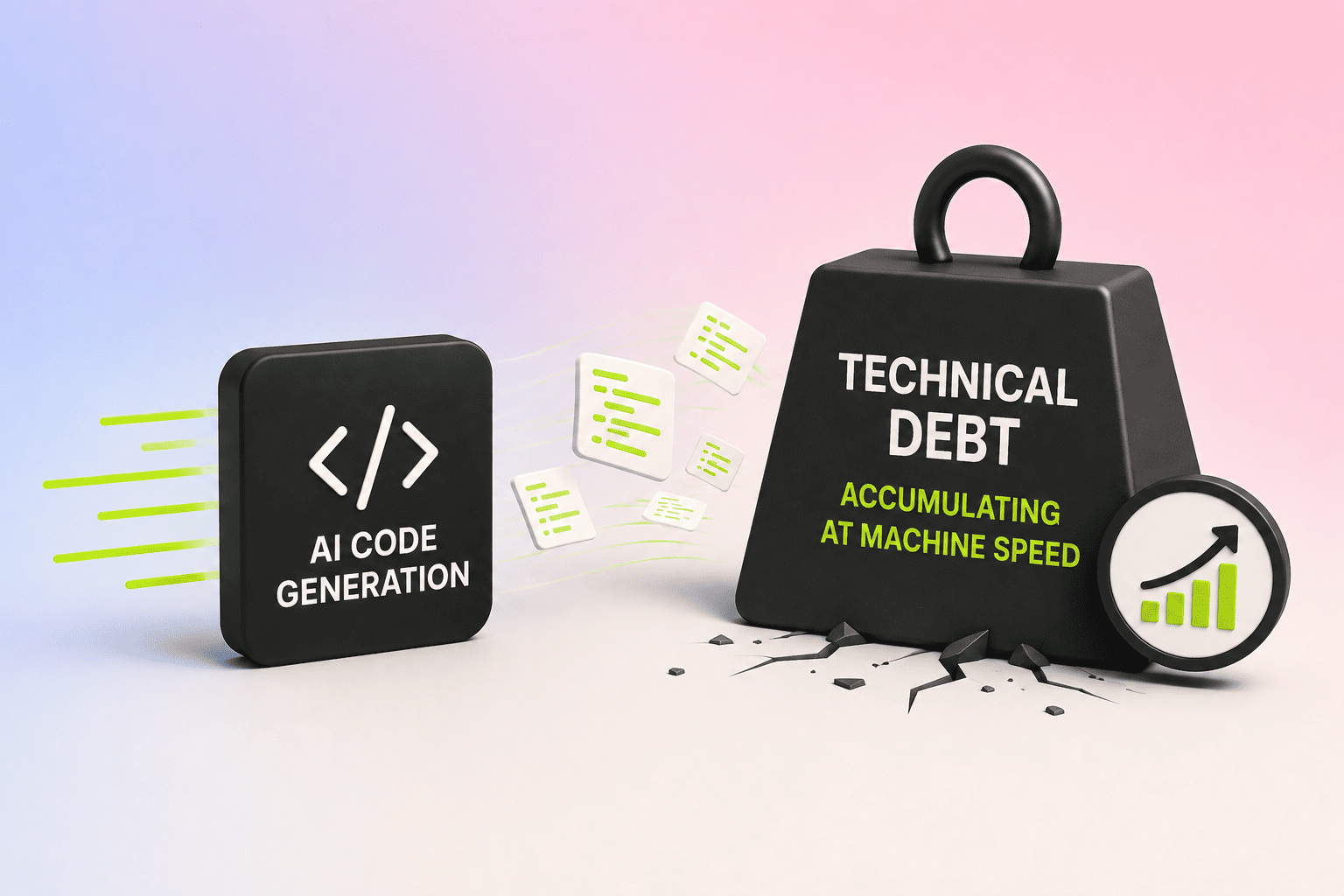
The challenge is absorbing that increase in output without allowing technical debt to accumulate at machine speed.
Why This Is Structural, Not a Skills Problem
It would be easy to conclude that AI-generated technical debt is simply the result of inexperienced developers or immature prompting techniques. That explanation is appealing because it suggests the problem can be solved through better training or more capable coding models. In practice, enterprise engineering organizations are discovering that the issue runs much deeper.
AI doesn't replace the software delivery lifecycle. It accelerates it.
The Bottlenecks Simply Shift Elsewhere
Every improvement in code generation increases the volume of work flowing into downstream engineering activities. More code means more reviews, more testing, more security validation, more architectural decisions, and more long-term maintenance. Unless those disciplines evolve at the same pace, the bottlenecks simply shift from implementation to the rest of the delivery process.
This is why technical debt behaves much like financial debt. The initial cost often appears manageable, but every unnecessary rewrite, architectural shortcut, or poorly governed implementation creates a future obligation. As AI speeds up software development, those obligations accumulate faster than engineering teams can repay them. The problem doesn’t lie with any individual change. It’s the cumulative effect of thousands of changes moving through the organization every week.
None of these activities scale automatically simply because code generation becomes faster. Security reviews still require judgment. Architectural decisions still require experience. Test failures still need investigation, and production releases still depend on coordinated engineering practices. Accelerating implementation without strengthening these surrounding disciplines simply moves the constraint from one part of the delivery system to another.
Strengthen the System, Not the Tool
The organizations getting this right are not slowing their AI adoption. They are strengthening the engineering system around it so that quality, architectural consistency, and governance can keep pace. This enables their teams to scale AI safely across multiple products and engineering groups.
The lesson here is straightforward. AI exposes the strengths and weaknesses that already exist within enterprise software delivery. If an organization has disciplined engineering practices, it gets far more value out of autonomous coding. If not, it simply accumulates technical debt faster.
The Three Things Organizations That Avoid This Problem Have In Common
They treat AI as part of the software delivery system
High-performing engineering organizations don't view autonomous coding as another developer productivity tool. They treat it as one capability within a governed software delivery lifecycle. Requirements, architecture, testing, security, deployment, and governance remain interconnected. AI accelerates implementation, but it operates within engineering processes designed to produce reliable, maintainable software.
They govern before they scale
Successful organizations resist the temptation to expand AI adoption before establishing clear engineering standards. They recognize that AI scales engineering practices—good and bad alike. Therefore, they define how AI-generated code is reviewed, tested, approved, and audited before rolling it out across multiple teams. Governance is not introduced to restrict AI, but to provide the consistency and confidence needed to scale its use responsibly. Code review also evolves, shifting from syntax toward AI-generated code quality, architectural consistency, and long-term maintainability.
They measure engineering outcomes, not AI adoption
Many organizations are still preoccupied with activity-based metrics such as AI usage, prompt volumes, or the number of developers using coding assistants. Those measures reveal little about engineering performance. More meaningful indicators include delivery predictability, AI-generated code quality, maintainability, lead time, and the ability to increase engineering capacity without compromising long-term sustainability. The objective is not simply faster code generation. It is a healthier software delivery system.
A team producing twice as much code but also twice as many defects or architectural inconsistencies hasn’t become more productive. Sustainable engineering performance is measured by predictable delivery, maintainable software, and the ability to continue scaling without accumulating operational friction.
The direction of travel is clear: autonomous coding is rapidly becoming a standard engineering capability. The competitive advantage comes from how effectively that capability is governed, integrated, and sustained across the enterprise.
Conclusion
The AI coding debate has focused almost entirely on speed. The next phase will be about sustainability. Engineering leaders will increasingly be judged on whether the software their teams produce remains reliable, maintainable, and economically viable over time.
GitClear's findings should be viewed in that context. They’re not an argument against AI-assisted software development, but an early indication that engineering practices must evolve as quickly as the technology itself. Those who continue to measure success by coding velocity alone may yet discover that today's productivity gains become tomorrow's maintenance burden.
Governance, architecture, testing, and software delivery discipline need to keep pace with AI's accelerating capabilities. That’s how organizations prevent technical debt from compounding at machine speed.
Written by: Alexey Girzhadovich, Chief Enterprise AI and Solutions Officer
July, 2026
Scale AI-generated code without scaling technical debt.
See how Exadel Colleague brings governance, testing, and engineering discipline into AI-powered software delivery.