
Tags
Share
What Devin AI Does: An Honest Overview
Over the past year, autonomous coding has evolved from an intriguing demonstration into a practical engineering capability. Devin is one of the clearest examples of this shift: a tool that can analyze requirements, navigate unfamiliar codebases, write production code, execute tests, and iterate towards a solution with remarkably little human intervention. It’s no longer a question whether autonomous coding works. It clearly does.
This leaves us with another question. Is autonomous coding alone enough for enterprise software delivery?
Watching an aircraft take off, it's easy to think the pilot is doing all the work. In reality, every successful flight depends on an invisible system of coordination: flight plans, clearances, air traffic control, runway sequencing, weather systems, ground operations, and maintenance. The larger the airport, the more essential that coordination becomes.
Autonomous coding agents are much the same. Impressive as they are, the challenge isn't getting one agent to write code. It's coordinating hundreds of autonomous activities safely inside an enterprise software delivery system.
Where Individual Autonomous Agents Fall Short for Enterprise Teams
The previous section established that autonomous coding has become a practical reality. Tools like Devin demonstrate just how much of the software implementation process AI can now perform independently.
The challenge for enterprise engineering teams lies elsewhere.
The broader view of enterprise software delivery described by Martin Fowler extends well beyond writing code. Every change forms part of a much larger delivery system designed to ensure the software being built is the right software, built to agreed standards, thoroughly tested, compliant with internal policies, and safe to release into production.
This distinction is easy to overlook because autonomous coding agents naturally operate from a well-defined objective. Give the agent a clear task and it can often produce an impressive result with very little human intervention.
Enterprise engineering teams hardly ever have that luxury. As autonomous coding becomes more widespread, many engineering leaders are also questioning whether AI-generated code can be introduced at speed without increasing long-term maintenance costs. We explore that question in more detail in our companion article, Vibe Coding & Technical Debt.
A prompt captures an individual's intent. A business requirement captures the organization's intent. The distinction between the two becomes increasingly important as software projects grow in complexity.
A developer can often achieve impressive results by asking an autonomous coding agent to implement a feature or resolve a defect. Enterprise software delivery, however, rarely revolves around a single task. Multiple teams, stakeholders, architects, testers, security specialists, and product owners all contribute to the same product over a period of months or even years. The original prompt disappears, but the business requirement remains.
Requirements create a shared source of truth that survives changing priorities, new team members as well as multiple implementation cycles. They define what should be built, why it matters to the business and how success will be measured. For autonomous agents to operate consistently across an enterprise, they need that same governed context rather than a series of isolated prompts.
Before development begins, business requirements must be understood, refined, prioritised, and translated into user stories. Architectural decisions determine how new functionality fits within existing platforms. Security, compliance, and engineering standards establish the constraints every implementation must satisfy. Increasingly, many organizations also expect development to begin with tests rather than code. This ensures that functionality is validated before implementation starts.
Development itself is only one stage of the workflow. As Atlassian’s latest research confirms, lasting productivity gains come from improving how teams work together, and not by simply making individuals faster. Work is planned and tracked through platforms such as Jira. Code passes through automated quality gates, security scanning, peer review, and release approvals before it reaches production. Every decision needs to be traceable, every change auditable, and every deployment repeatable.
None of these activities diminish the value of autonomous coding. They simply reflect the reality that enterprise software delivery is a coordinated business process rather than a standalone engineering task.
Returning to the airport analogy, a modern aircraft can fly extraordinary distances with sophisticated automation. Yet no airport would attempt to coordinate hundreds of flights by focusing on the aircraft alone. Flight plans, runway sequencing, air traffic control, maintenance, ground operations, weather systems, and safety procedures all exist to ensure that thousands of independent activities function as a single, reliable system.
Enterprise software delivery follows the same principle. Autonomous coding agents may become increasingly capable, but enterprise engineering depends on the systems that coordinate, govern, and connect every stage of software delivery.
Autonomous coding solves for capability. Enterprise software delivery depends on coordination.
The Governance Gap: What Enterprise SDLC Requires
If autonomous coding answers the question "Who writes the code?", governance answers a far more important one:
How does the organization ensure that autonomous work contributes safely, consistently, and predictably to the business?
This is where enterprise software delivery fundamentally differs from individual software development.
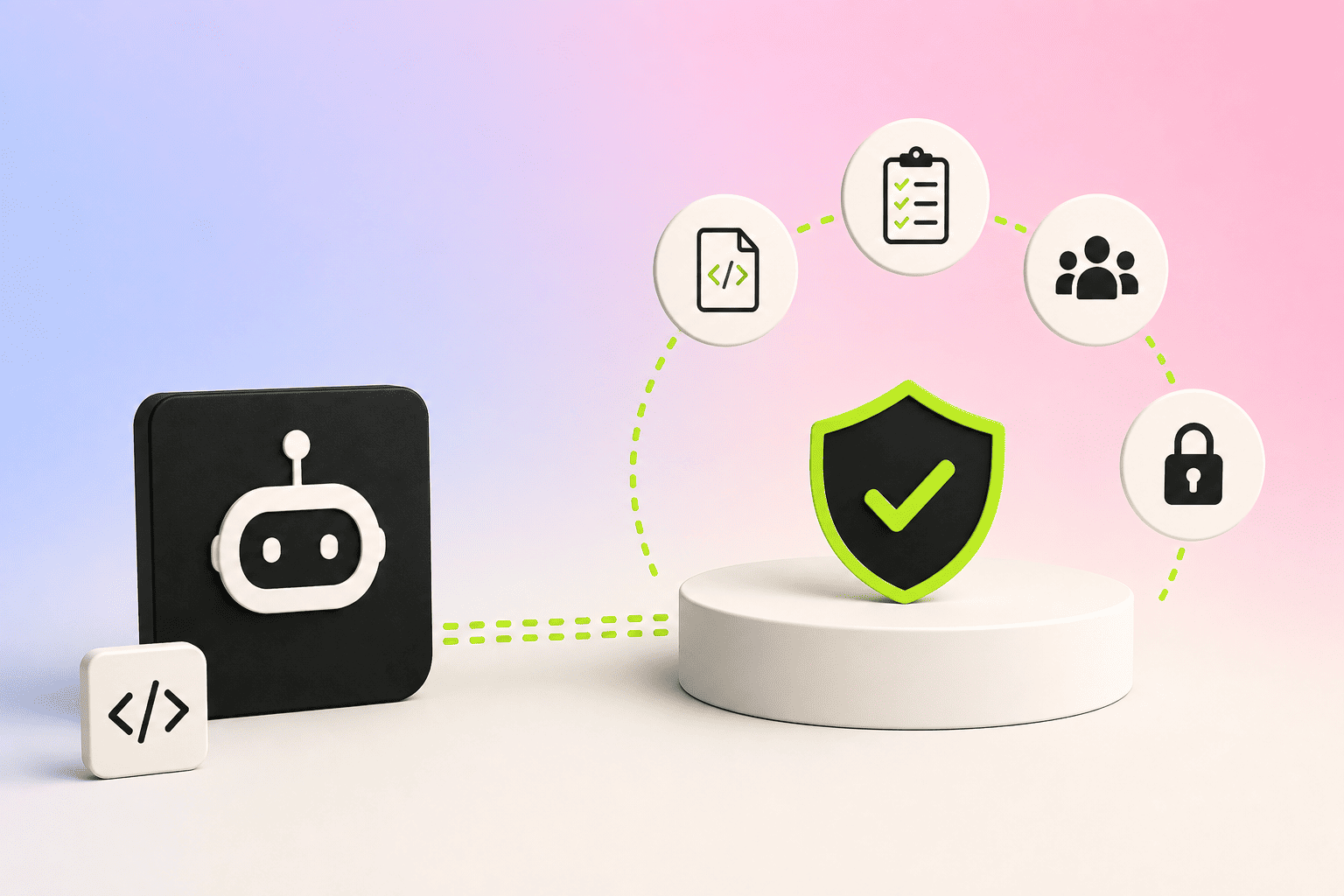
Enterprise SDLC isn't designed simply to produce code. It's intended to produce software that satisfies business requirements, complies with internal policies, passes quality and security standards, and can be released with confidence. Every change must fit within a delivery process that is repeatable, observable, and auditable.
Governance provides the framework that makes this possible.
It begins before a single line of code is written. Business requirements are reviewed and approved. User stories are prioritized. Architectural standards establish how new functionality should be implemented. Security policies, compliance requirements, and engineering standards define the constraints within which autonomous agents operate.
During implementation, governance ensures that development follows an agreed engineering workflow. Increasingly, that means requirements-first development supported by test-driven development (TDD), where success is measured not simply by generating code, but by producing software that satisfies defined acceptance criteria. Work progresses through managed delivery platforms such as Jira, allowing every task, decision, and approval to remain visible throughout the software lifecycle.
Test-driven development becomes even more valuable when autonomous agents are writing production code. Defining expected behaviour before implementation creates objective guardrails that AI-generated code must satisfy. We explore this approach in TDD-First AI Code Generation.
From Individual Agents to Coordinated Agentic Workflows
Enterprise software delivery is unlikely to be transformed by a single, all-purpose engineering agent. Instead, organizations are increasingly exploring coordinated groups of specialist agents, each responsible for a different stage of the delivery lifecycle.
One agent may analyze requirements and refine user stories. Another may generate tests. Others may implement functionality, review code, validate security policies, or prepare deployment artefacts. Working together, these specialist agents can accelerate delivery while remaining focused on clearly defined responsibilities.
This approach also strengthens governance. Rather than giving one autonomous agent unrestricted authority, organizations can apply different controls, permissions, and approval requirements to different stages of the workflow. The result is an engineering system that combines greater autonomy with greater operational oversight.
Governance Preserves Engineering Knowledge
As autonomous agents become part of everyday software delivery, governance serves another important purpose: preserving engineering knowledge over time. Enterprise software doesn’t exist as a series of isolated coding tasks. It evolves over years through hundreds of enhancements, bug fixes, architectural decisions, and changing business priorities.
Without a governed delivery process, much of that context remains locked inside tickets, emails, meeting notes, or the memories of individual engineers. When people move on, valuable knowledge often disappears with them.
Governed software delivery creates a persistent record of how and why decisions were made. Requirements, acceptance criteria, architectural rationale, testing strategies, approvals, and deployment history become part of the engineering lifecycle rather than isolated project artefacts. This gives both engineers and autonomous agents access to the context needed to make consistent decisions as products continue to evolve.
The result is far more than having better documentation. It is greater continuity. Instead of repeatedly rediscovering previous decisions, engineering teams build upon an accumulated body of organizational knowledge that improves consistency, reduces risk, and accelerates future delivery.
Once implementation is complete, governance continues through automated quality gates, security validation, code review, release approvals, and audit trails. These controls aren't there to slow development. They're what allow enterprise engineering teams to move quickly without sacrificing quality, compliance, or accountability.
Returning to the airport analogy, the aircraft isn't the system—the airport is. Pilots don't decide which runway to use, when to depart, how to sequence arrivals, or how to respond to changing conditions. Those decisions belong to air traffic control because every flight affects every other flight operating within the same airspace.
Enterprise software delivery works the same way. Autonomous coding agents may independently complete individual engineering tasks, but governance coordinates how those tasks move safely through the wider delivery system. It ensures that hundreds of autonomous activities contribute to a single engineering outcome rather than becoming hundreds of independent engineering decisions.
For enterprise leaders, this is the real distinction between autonomous coding and enterprise agentic software delivery. The challenge is no longer whether AI can generate production-ready code. It is whether autonomous work can operate within a delivery system that remains secure, compliant, observable, and trusted as adoption scales.
Comparison: Individual Agents vs. Team-Level Agentic SDLC
Autonomous coding agents and enterprise agentic SDLC platforms solve different problems.
An individual coding agent is designed to help a developer complete engineering tasks with minimal supervision. An enterprise SDLC platform is designed to help engineering organizations to consistently deliver safe software at scale.
Comparing them directly on coding ability misses the point. The more useful comparison is how each supports the broader software delivery lifecycle.
Completes individual engineering tasks autonomously.
Orchestrates the end-to-end software delivery lifecycle.
Prompt or developer instruction.
Approved business requirements and prioritized user stories.
Code-first.
Requirements-first with TDD and governed engineering practices.
Limited to developer tooling.
Native integration across Jira, Git, CI/CD, testing, approvals, and release management.
Focused on task execution.
Built-in governance, auditability, policy enforcement, and compliance controls.
Typically platform- or model-specific.
Supports cloud, private cloud, on-premises, BYOK, and model-agnostic deployments.
Individual developers.
Enterprise engineering teams, architects, delivery managers, and engineering leadership.
Accelerates coding.
Scales trusted, repeatable software delivery across the enterprise.
This distinction explains why enterprise engineering leaders increasingly evaluate autonomous coding differently from individual developers.
A developer naturally asks: Can this help me write better code?
An engineering leader asks: Can this become part of our software delivery system?
Those are fundamentally different evaluation criteria.
This distinction reflects a broader shift in how enterprise engineering leaders evaluate AI. Individual developers naturally focus on coding capability and productivity. Enterprise leaders must also consider governance, integration, security, auditability, and how autonomous work fits within the broader software delivery lifecycle.
Autonomous coding is becoming an essential capability. Sustainable enterprise software delivery depends on the governed system that connects that capability to the rest of the engineering organization.
What to Look For When Evaluating Enterprise-Grade Agentic SDLC
As autonomous coding continues to mature, the question for enterprise engineering leaders is no longer whether AI should become part of software delivery. It is how to introduce autonomous capabilities without compromising quality, governance, or operational control.
Rather than focusing exclusively on coding performance, organizations should evaluate how well a platform supports the entire software delivery lifecycle.
When assessing enterprise-grade agentic SDLC platforms, consider the following questions:
Does it begin with business requirements rather than prompts?
Enterprise software delivery starts with approved business objectives, user stories, and acceptance criteria. AI should operate from governed requirements rather than relying solely on developer prompts.
Does it support governed engineering practices such as TDD?
The platform should integrate naturally with established engineering disciplines, including test-driven development, code review, quality gates, and automated validation, ensuring AI contributes to software quality rather than simply increasing output.
Does it integrate with the tools your teams already use?
Enterprise AI should fit into existing engineering workflows, including Jira, Git, CI/CD pipelines, testing frameworks, and release management processes, without requiring teams to adopt an entirely new way of working.
Can it operate within your governance and security model?
Look for support for auditability, policy enforcement, approval workflows, role-based access, and compliance controls. These capabilities become increasingly important as autonomous agents assume greater responsibility within the SDLC.
Does it provide deployment flexibility?
Enterprise requirements vary considerably. The platform should support cloud, private cloud, on-premises deployments, bring-your-own-key (BYOK), and model-agnostic architectures that allow organizations to choose the AI models that best meet their security, regulatory, and commercial requirements.
Will it scale beyond individual productivity?
McKinsey's research suggests that the highest-performing organizations create value by redesigning how software is built instead of simply adopting AI tools. Enterprise AI should therefore improve the performance of the engineering organization— and not just individual developers. The objective is repeatable software delivery, predictable engineering outcomes, and greater organizational capacity.
Look Beyond Demonstrations
Demonstrations are designed to showcase what an autonomous coding agent can achieve under controlled conditions. Enterprise engineering leaders face a different challenge. They need to understand how autonomous capabilities perform when integrated into existing delivery processes, governance frameworks, security controls, and release workflows.
The most important questions are often operational rather than technical. How does the platform handle changing requirements? Can engineering decisions be audited months later? Does it integrate with established delivery practices without creating additional operational complexity? Can it scale consistently across multiple teams rather than a handful of early adopters?
These questions shift the evaluation away from individual features and toward the operational capabilities required to deliver software at enterprise scale. Autonomous coding is fast becoming a common feature, and it offers the greatest advantage to those that build governed software delivery systems around it.
Product demonstrations rarely reveal how autonomous delivery performs inside a real engineering organization. Look for evidence from production deployments, measurable engineering outcomes, and customer implementations.


Your AI Partner
One such example is our work.
We helped a global information services provider unify AI adoption through a standardized, governed enterprise platform.
Conclusion
The emergence of autonomous coding agents marks one of the most significant advances in software engineering in decades. Capabilities that recently seemed experimental are rapidly becoming part of everyday development.
Yet enterprise software delivery has always been about more than writing code.
Returning to the airport analogy, a single aircraft can complete a journey on its own. An international airport, however, succeeds because hundreds of aircraft operate within a coordinated system of scheduling, safety, routing, and control. The aircraft are remarkable feats of engineering themselves, but it is the system that enables them to operate safely and efficiently together.
Enterprise AI is following the same trajectory.
The organizations that succeed won't necessarily be those with the most capable autonomous coding agents. Their success will depend on how well they integrate those capabilities into governed software delivery systems that remain secure, observable, compliant, and trusted as adoption scales.
The future of software engineering isn't simply autonomous coding.
It's governed autonomous software delivery.
Written by: Alexey Girzhadovich, Chief Enterprise AI and Solutions Officer
July, 2026
Explore Exadel Colleague.
See how it builds governance into every stage of the software delivery lifecycle.