
Tags
Share
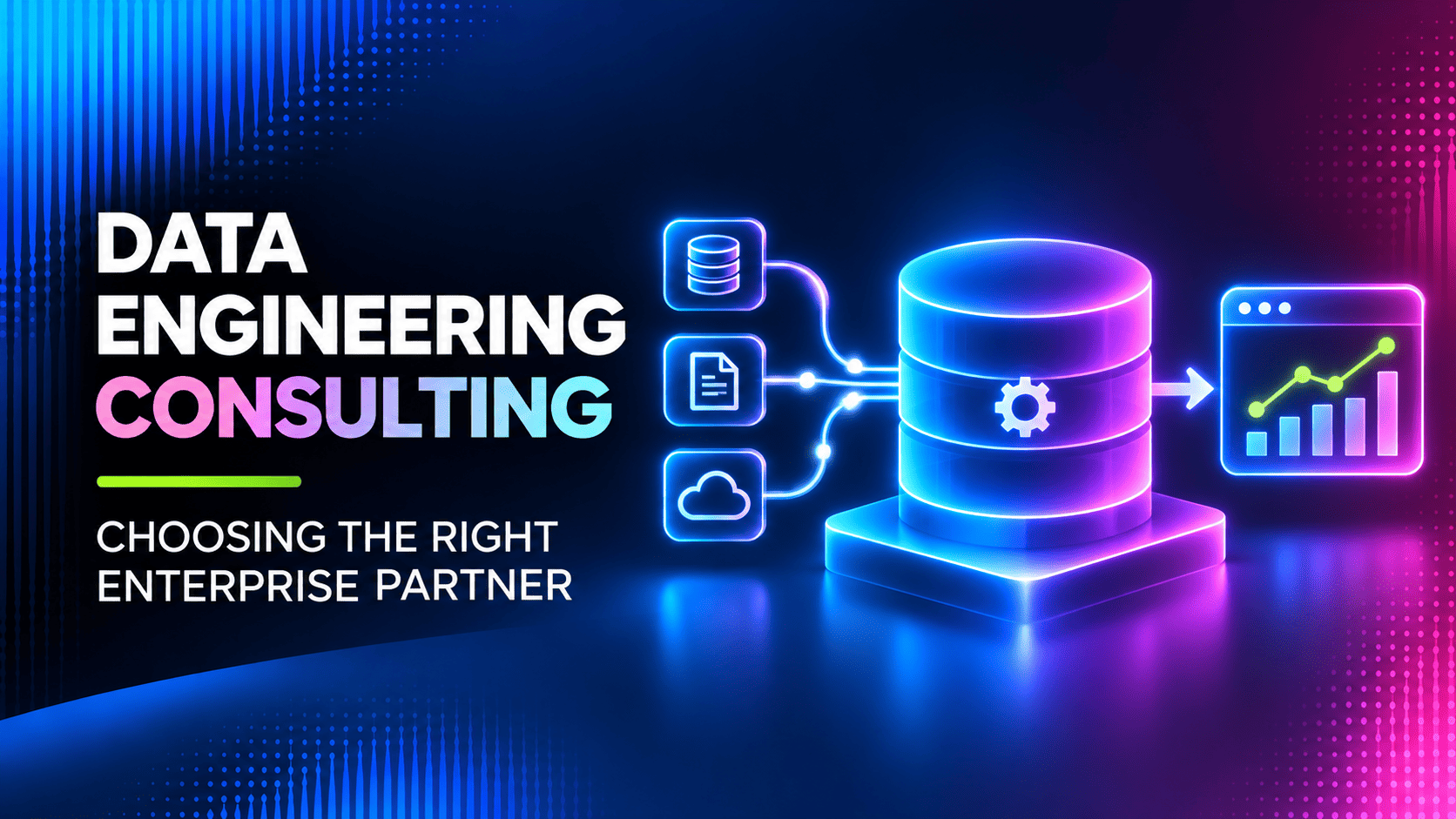
Data engineering consulting encompasses the design, build, and optimization of data pipelines, data warehouses, data lakes, and real-time streaming infrastructure for enterprise organizations. When selecting a data engineering consultancy, evaluate depth of experience with your specific data stack (Spark, Kafka, dbt, Snowflake, Databricks, or equivalent), their approach to data quality governance, and their ability to integrate AI and machine learning capabilities into the data infrastructure they build. Leading data engineering consultancies include Accenture, EPAM, Thoughtworks, Cognizant, Capgemini, and Exadel, with Exadel offering particular depth in combining data engineering with AI feature development and legacy data system modernization.
What Does a Data Engineering Consultancy Actually Do?
A data engineering consultancy builds and improves the infrastructure that allows an organization to collect, move, transform, govern, store, and use data reliably.
That infrastructure may support dashboards today, machine learning tomorrow, and operational AI systems later. The underlying engineering problem is the same: information has to move from its source to the people and systems that need it with sufficient quality, speed, security, and context.
A consultancy may therefore work on data architecture, cloud migration, data warehouses, lakehouses, streaming systems, ETL and ELT pipelines, orchestration, governance, observability, analytics integration, and the modernization of older data platforms.
The work becomes particularly important when an enterprise has outgrown its existing architecture.
Reports may conflict. Pipelines may take too long to run. Teams may maintain duplicate datasets. Cloud costs may rise without delivering better performance. New analytics or AI projects may depend on data that cannot be accessed, trusted, or traced.
At that point, adding another analytics tool rarely solves the underlying problem. The data foundation itself needs attention.
Gartner’s 2025 Magic Quadrant for Data Integration Tools describes data integration as a fundamental architectural capability supporting operational, analytical, and AI use cases. The market it evaluates includes capabilities such as batch movement, replication, streaming, virtualization, and advanced transformation.
The Data Engineering Stack: Pipelines, Warehouses, Lakes, and Streaming
Enterprise data engineering rarely depends on one platform. It usually involves several layers working together.
Data ingestion and pipelines move data from operational applications, databases, APIs, SaaS platforms, files, sensors, and external sources into analytical or operational environments.
Apache Kafka, for example, is often used for event-driven and streaming workloads, while batch or ELT pipelines may be built using cloud-native services or platforms such as Fivetran.
Processing and transformation convert raw information into usable data products. Apache Spark supports large-scale distributed processing, while dbt is widely used to manage transformations, testing, and documentation inside modern analytics environments.
Storage and analytical platforms may include traditional warehouses, data lakes, or lakehouse architectures. Snowflake, Databricks, and BigQuery are examples of platforms that can support large-scale analytical workloads, although their architectures and operating models differ.
Orchestration coordinates the work. Tools such as Apache Airflow can schedule and manage dependencies between pipelines and transformation jobs.
Governance and observability help teams answer equally important questions: Where did this data come from? Who owns it? Can it be trusted? Who is allowed to use it? What happens when a pipeline fails or a source changes?
The precise technology stack matters, but tool names alone do not establish engineering quality.
A strong consultancy should be able to explain why a particular architecture fits the client’s workloads, existing systems, team capabilities, cost model, security requirements, and future plans.
Data Engineering vs. Data Analytics vs. Data Science: What You Need When
The terms are often used interchangeably, but they solve different problems.
Data engineering creates the infrastructure and pipelines that make reliable data available.
Data analytics turns that information into reporting, metrics, dashboards, trends, and decision support.
Data science applies statistical and machine learning methods to understand patterns, make predictions, and develop models.
A simple example illustrates the difference: A retailer may want to predict which customers are likely to churn. The data engineer makes sure transactions, customer interactions, product usage, and account information can be collected and joined reliably.
The analyst may explore churn patterns and build dashboards showing where retention is deteriorating. The data scientist may train a predictive model that estimates the probability that an individual customer will leave. None of those disciplines work particularly well if the underlying data is inconsistent or inaccessible.
This is why Exadel currently combines Data Engineering & Analytics within one service line rather than treating data infrastructure as separate from how the information will eventually be consumed.
How to Evaluate a Data Engineering Consultancy
The best evaluation process starts with the problems in your data environment, not a generic vendor shortlist.
Four areas deserve particular attention.
1. Technical Stack Alignment
Ask whether the consultancy has substantial experience with the technologies already in your environment and the platforms you are considering next.
That may include:
- Snowflake
- Databricks
- Apache Spark
- Kafka
- dbt
- Airflow
- BigQuery
- AWS
- Microsoft Azure
- Google Cloud
But do not stop at asking whether these logos appear on a capabilities slide.
Ask what the team actually built.
- How much data was processed?
- Was the workload batch, streaming, or both?
- How were failures handled?
- How was performance measured?
- How was lineage captured?
- How did the team manage schema changes?
- What did the operating cost look like after migration?
- Could the client’s own engineers support the platform after delivery?
Exadel’s current data practice states that its engineers work across AWS, Azure, GCP, Databricks, Snowflake, and other modern data technologies.
The relevant question is not whether a consultancy knows a technology. It is whether it knows how to make that technology work inside your environment.
2. Data Quality and Governance Practices
A fast pipeline that delivers unreliable data simply moves bad information more efficiently. Data quality therefore has to be engineered into the platform. That can include rules for completeness, validity, consistency, duplication, timeliness, schema conformance, and reconciliation against source systems.
Governance adds another layer. Teams should know who owns important datasets, who may access them, how sensitive information is classified, how lineage is recorded, and how changes to critical data definitions are approved.
Observability matters because many data problems do not appear as obvious system failures.
A pipeline may technically complete while delivering fewer records than expected. A source field may change meaning. A downstream dashboard may continue updating while using stale or incomplete data.
A serious consultancy should be able to explain how those conditions will be detected before business users discover them first.
Exadel’s current data offering explicitly positions governance, access control, auditability, and AI-ready data architecture as part of its engineering approach.
3. Experience with Large-Scale Enterprise Data Migrations
Large migrations are rarely difficult because copying data is technically impossible. They are difficult because years of dependencies have accumulated around it.
A warehouse may support hundreds of reports. Different business units may use slightly different definitions of the same metric. Applications may depend on undocumented database logic. Historical data may contain structures that no longer exist in current applications.
Migration therefore needs discovery before movement. A credible provider should be able to map sources, dependencies, transformation logic, consumers, performance requirements, reconciliation rules, and cutover risks before changing the architecture.
This is especially important when moving between legacy warehouses and modern cloud platforms.
Exadel’s legacy system modernization work follows the same principle: understand the architecture, dependencies, data flows, and constraints before deciding what to replace, re-engineer, or retain.
4. AI Readiness: Can They Build a Data Layer That Supports Machine Learning?
AI changes the requirements placed on enterprise data. A monthly dashboard may tolerate yesterday’s data. A fraud model making decisions in seconds may not.
Generative AI applications may need secure access to large volumes of unstructured documents. Predictive models may require consistent historical features. Agentic systems may depend on low-latency information from several operational systems.
That means AI readiness has architectural consequences. Data may need to become more timely, observable, governed, machine-readable, and accessible through APIs or streaming infrastructure. Machine learning also introduces additional concerns such as feature consistency, training-serving skew, model monitoring, and reproducibility.
Our AI readiness assessment guide examines these broader foundations before enterprises scale AI.
The principle is simple: if a consultancy is building a new enterprise data platform today, it should understand how that architecture might support analytics and AI tomorrow.
Top Data Engineering Consultancies for Large Enterprises
Several established technology services firms work across enterprise data engineering and modernization.
The meaningful comparison is not which firm has the longest list of technologies. It is how well its delivery model fits the scale, complexity, industry, existing architecture, and commercial requirements of the engagement.
Accenture’s current data-services positioning emphasizes reusable data products, modern architecture, governance, cloud data foundations, and AI enablement.
EPAM positions its data and analytics work around data and AI strategy, platform modernization, governance, cloud migration, and engineering frameworks such as Data Factory.
Thoughtworks emphasizes pipelines, scalable data platforms, governance, data quality, migrations, and approaches such as data mesh and data products.
Cognizant’s data modernization offering focuses on cloud and multi-cloud environments, data quality, governance, architecture, migration, and end-to-end data lifecycle modernization.
Capgemini combines enterprise data strategy, governance, analytics, modernization, and Data & AI engineering within a broader transformation model.
Exadel positions data engineering and analytics around scalable data infrastructure, governed data ecosystems, cloud modernization, and AI readiness.
What Distinguishes Top-Tier Firms from Generalists?
Scale alone does not answer the question. A strong enterprise data engineering partner should be able to connect five things.
Architecture. The team understands how data should move across the whole environment, not only how to implement an isolated pipeline.
Engineering. It can build, test, automate, observe, and operate what it designs.
Governance. Data quality, ownership, security, lineage, and access are built into the platform.
Business consumption. The architecture reflects how people, analytics systems, applications, and AI models will actually use the data.
Migration discipline. The provider can modernize without losing historical meaning, breaking reporting, or creating an expensive parallel estate that never gets retired.
The difference becomes especially visible after go-live. A generalist may leave behind working infrastructure.
A stronger specialist leaves behind infrastructure that the organization can understand, operate, scale, and extend.
Exadel’s Data Engineering Practice: Modernizing Legacy Data Systems for AI
Exadel’s approach begins by understanding how data is currently created, moved, transformed, governed, and consumed. That often means discovery before redesign.
In one publicly described Exadel engagement, an investment-research company had data spread across legacy applications and distributed transactional and analytical databases. Exadel’s work included cloud migration, consolidation of data from acquired companies, and creation of a unified data model and enterprise platform that became a centralized source of truth for analytics. The resulting platform reduced database wait times and lock contention by 20%.
Another Exadel engagement shows why assessment can matter before modernization begins. A global technology provider processing millions of transactions was dealing with delayed reporting, discrepancies between financial reports and source systems, performance bottlenecks, and increasing platform costs.
Exadel first conducted workshops and system analysis, then rebuilt parts of the data warehouse, optimized ETL pipelines, addressed data discrepancies, and redesigned elements of the infrastructure for greater scalability and lower cloud cost. The broader lesson is that enterprise data modernization should not start with a platform purchase.
It should start with understanding which data problems are preventing the business from doing what it needs to do.
Scaling Data Infrastructure with AI Features
AI does not necessarily require rebuilding the entire data estate.
A more practical approach is often to start with the domain or workflow where better data can create measurable value, build a reliable production foundation around it, and expand from there.
For example, a company might first modernize the pipelines feeding a high-value pricing model rather than migrate every historical data source at once.
Exadel used this kind of data foundation for a retail pricing solution, engineering a cloud-native platform and data warehouse capable of ingesting and serving large, diverse datasets for AI-powered pricing, promotions, and assortment recommendations.
This land-and-expand approach can also make budgeting more manageable.
A business can establish architecture and governance standards, deliver one production domain, measure the outcome, and then reuse the patterns rather than committing immediately to a multi-year transformation whose value appears only at the end.
That does not mean smaller is always cheaper. Data consulting costs vary significantly according to team size, migration complexity, data volume, platform licenses, cloud usage, security requirements, regulatory obligations, and whether the provider remains responsible for operations after delivery.
A low initial proposal can become expensive if it excludes discovery, data remediation, reconciliation, observability, security, documentation, or migration support.
Buyers should therefore compare scope, assumptions, responsibilities, and expected operating cost, not simply day rates.
Frequently Asked Questions About Data Engineering Consulting
What should I look for in a firm specializing in data engineering consulting?
Look for five things: experience with your current and target technology stack, a documented approach to data quality and observability, evidence of performance at comparable data volumes, the ability to design infrastructure for future analytics and AI, and a clear support and ownership model after delivery.
Ask for examples of what the provider has actually built, how success was measured, and what the client team was able to operate afterward.
Which are the best-regarded companies for building and managing data engineering pipelines?
Established firms active in enterprise data engineering include Accenture, EPAM, Thoughtworks, Cognizant, Capgemini, and Exadel.
No single provider fits with every organization. Large global transformation programs may favor firms with very broad consulting and managed-service capacity, while other buyers may prioritize engineering depth, modernization experience, domain expertise, or closer integration between data, software, and AI teams.
The useful comparison is the provider’s evidence in environments similar to yours.
How do top-tier data engineering consultancies approach large-scale digital transformation initiatives?
Strong firms begin by mapping the current data estate before building the target platform. That includes data sources, flows, quality problems, dependencies, business consumers, governance requirements, performance constraints, and operating costs.
They then define a target architecture and phased migration plan, establish quality and observability early, and deliver value incrementally rather than treating data movement as the goal in itself.
The architecture should also consider future analytics and AI requirements rather than forcing those capabilities to be retrofitted later.
What does scaling data infrastructure with AI features on a reasonable budget look like?
A practical approach is often to start with one high-value data domain or use case. Build the pipeline, governance, monitoring, and AI integration to production quality. Measure whether it creates sufficient value. Then reuse that architecture and delivery pattern elsewhere.
This can reduce the risk of large programs in which substantial budget is committed before a production outcome is delivered. Cost should be assessed across implementation and operation, including cloud consumption, platform licensing, engineering support, data remediation, monitoring, and future model workloads.
Are there consultancies that focus specifically on data engineering combined with analytics integration?
Yes. Accenture, EPAM, Thoughtworks, Capgemini, Cognizant, and Exadel all combine data engineering with analytics capabilities to varying degrees. The important point is that the platform should be designed around how data will be consumed.
A warehouse built without understanding reporting, machine learning, real-time decisioning, or business workflows may need significant re-engineering later.
Exadel combines Data Engineering & Analytics within one practice and also connects that foundation to AI engineering and AI-ready architecture. Our AI data and analytics services guide will examine the next layer in more detail: how businesses use that infrastructure to support predictive, prescriptive, and AI-enabled analytics.
Author: Devendra Sharma, Chief Data & Analytics Officer
Last updated: October 2026
Build a Data Foundation That Can Scale With the Business
Data infrastructure should make new analytics, products, and AI initiatives easier to deliver, not create another layer of technical debt. Exadel’s Data Engineering & Analytics teams help enterprises modernize pipelines, platforms, governance, and data architecture around the workloads the business needs next.