
Tags
Share
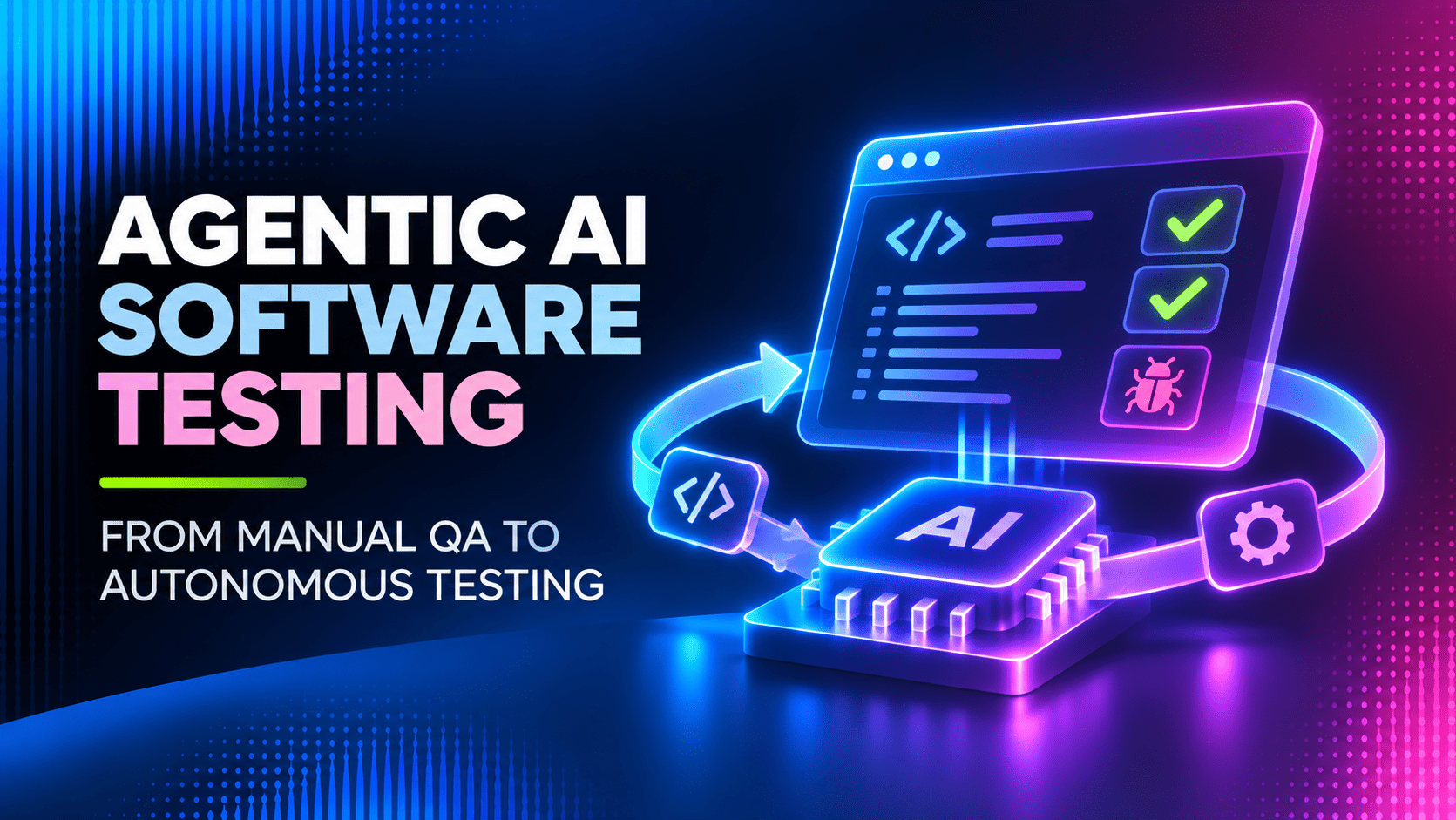
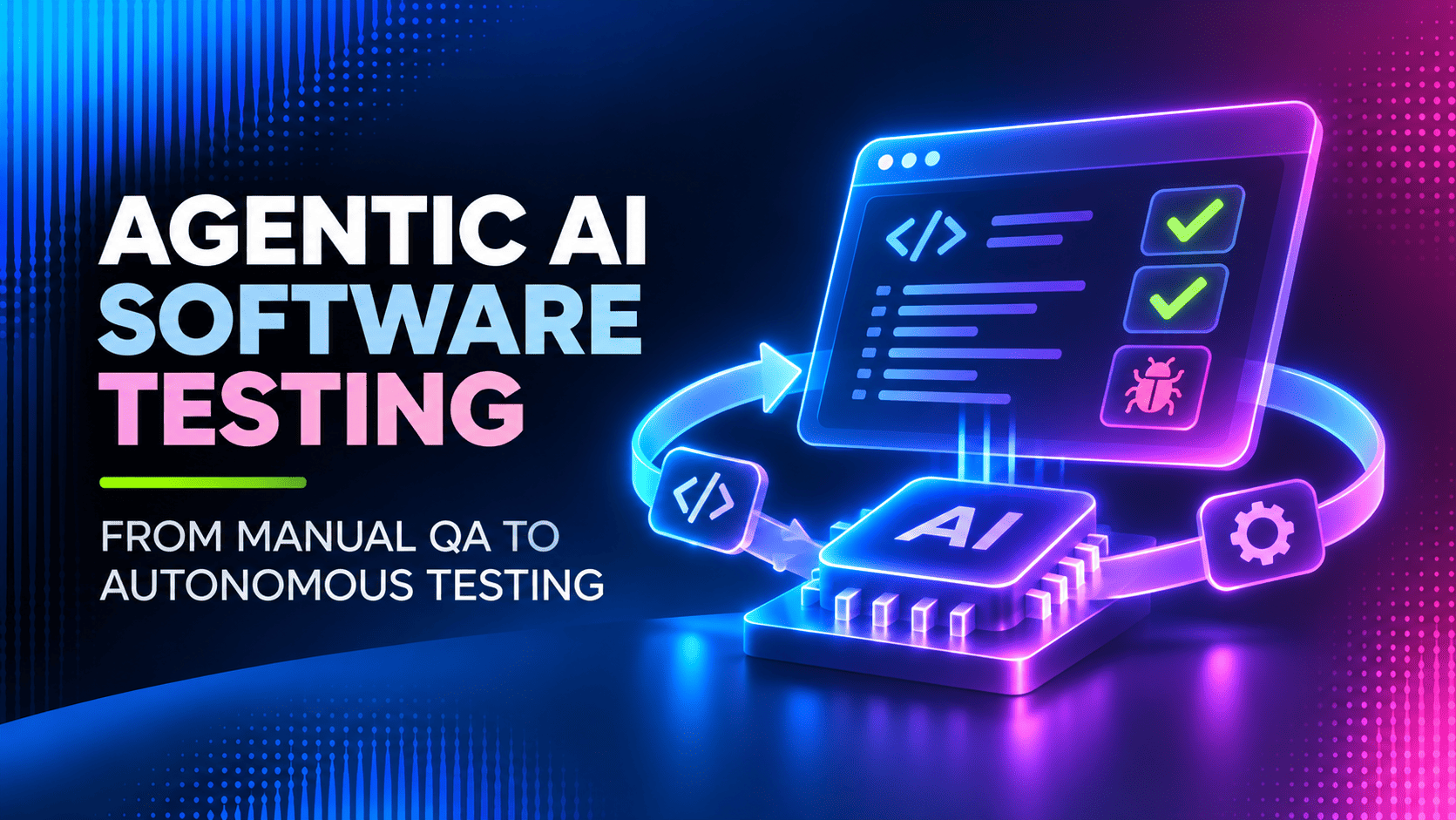
Autonomous AI agents are already handling enterprise software testing tasks that used to require manual effort, including test case generation, regression testing, UI validation, and defect triage. Likewise, agentic testing systems are analyzing code changes, generating test scripts, executing test suites, and flagging anomalies without the need for human input at every step. With Exadel Colleague, we bring autonomous testing agents into your existing software delivery workflows, so your team can delegate testing work without having to change tools.
What Agentic AI Testing Actually Means for QA Teams
Agentic AI software testing builds on years of test automation. QA teams have long used frameworks such as Selenium, Cypress, Playwright, and Jest.
What changes with agentic testing is who does the work around the automation. Traditional automation still depends heavily on people to decide what needs testing, create and maintain scripts, trigger or oversee execution, investigate failures, and decide what happens next. An autonomous testing agent is capable of taking on more of that sequence. Given sufficient context and clearly defined requirements, it can generate tests, execute them, evaluate the results, and feed failures back into the delivery workflow.
That significantly changes the role that QA plays. Engineers now spend less time manually moving tests through the process and more time defining what good looks like. They also have more time to investigate difficult cases, and actively govern quality across the delivery system. In one of our enterprise software deployments, agents completed specifically assigned testing work within minutes, with engineers reviewing the results.
The Difference Between AI-Assisted Testing and Fully Agentic Testing
The distinction comes down to assistance versus delegated execution.
AI-assisted testing helps engineers perform specific tasks faster. A QA engineer might ask an AI tool to generate a Selenium test, suggest edge cases, summarize test results, or help diagnose a failure. The engineer is still responsible for prompting the tool and moving the work from one step to the next.
With agentic testing, AI agents can manage a testing workflow from start to finish. The agent receives the work and takes it through multiple steps without waiting for a human prompt after each step. It can interpret requirements, generate the appropriate tests, execute them, analyze failures, and prepare the result for review or escalation.
That doesn’t remove QA engineers from the process. It simply shifts their involvement to the points where judgment and accountability matter.
The National Institute of Standards and Technology (NIST) has launched its GenAI evaluation program to examine, among other things, whether AI can generate reliable tests for software code. This shows just how important it is to check the quality of AI-generated tests rather than assume they're correct.
Which Testing Tasks Agents Handle Best Today
The strongest candidates are generally repeatable testing activities with clear expected outcomes and enough context for the agent to determine whether the software behaves correctly. These include:
- Test case generation: Creating unit, integration, or acceptance tests from requirements, code changes, and acceptance criteria.
- Regression testing: Running existing suites against changes and identifying failures or unexpected behavior.
- UI validation: Executing repeatable browser-based scenarios using frameworks such as Playwright, Cypress, or Selenium.
- Defect triage: Analyzing failed tests and logs to help identify likely causes and route the problem appropriately.
- Performance testing: Executing defined load or performance scenarios and comparing results against established thresholds.
Why Enterprise QA Teams Are Moving to Agentic Models Now
AI coding tools are increasing the rate at which engineering teams can generate and change software. That acceleration also increases the volume of code reaching review, the demand for regression coverage, and the number of releases requiring validation. Unless testing capacity keeps pace, the additional development speed simply creates a bottleneck downstream.
Conventional test automation helps QA teams execute predefined tests more efficiently. Agentic testing takes a different approach by adding execution capacity directly into the workflow. However, the capacity challenge goes beyond testing: the 2026 Harness State of DevOps Modernization report found that developers estimate spending 36% of their time on repetitive manual tasks, including approvals, ticket chasing, and rerunning failed jobs.
The Headcount Problem: Testing Backlogs at Scale
For large enterprise engineering organizations, scaling QA capacity linearly with development capacity is becoming increasingly difficult. Adding QA engineers increases capacity, but the additional headcount comes with associated costs in recruitment, onboarding, and domain knowledge. By delegating suitable work to autonomous agents, QA teams are able to increase execution capacity without treating AI as a replacement for testers.
The idea is to separate testing work that requires human judgment from testing work that can be delegated safely. QA engineers can then focus their attention on test strategy, exploratory work, difficult edge cases, risk analysis, and the decisions that require business context.
The practical challenge is deciding which work can be delegated. A routine regression check with clear expected results is a very different assignment from investigating an intermittent failure across several connected systems. Both consume QA capacity, but they don't require the same level of human involvement.
Before assigning testing work to agents, teams need to decide what agents can handle independently and when engineers need to step in. Without those boundaries, they risk replacing a backlog of tests with a backlog of results waiting for review.
Release Velocity Requirements and the Limits of Manual QA
CI/CD can move changes through the delivery pipeline continuously, but a heavily manual testing process can constrain release velocity. As development accelerates, validation remains dependent on human availability to create tests, execute scenarios, interpret failures, and approve the next step.
Agentic testing takes AI-driven testing automation further across the validation loop. An agent can respond to a change when it enters the workflow instead of waiting for a QA engineer to become available. The objective is continuous testing without continuous manual handling.
Regulated Industries: Compliance Testing and Audit Trails
For our clients in industries such as financial services and healthcare, testing also has to meet another requirement: traceability. Teams need to know what was tested, which requirement the test addressed, what happened during execution, and who ultimately approved the change. An agentic testing pipeline can also generate audit-ready documentation automatically as work moves through the testing workflow.
This is where autonomous testing needs governance wrapped around it. There must be a traceable record that includes logs, test results, requirements, code changes, and approval history. The NIST's broader approach to AI evaluation makes a similar point. Its Test, Evaluation, Verification, and Validation work emphasizes structured evaluation of AI systems over reliance on output alone. For enterprise QA, autonomy without evidence isn’t enough.
What to Look for in an Agentic Testing Partner
What matters is how the AI operates inside the actual software delivery system.
1. Does it integrate with your existing CI/CD stack? Look for an additive approach that works with your existing testing, source control, and CI/CD workflows rather than requiring teams to rebuild them around a new platform.
2. How deep is its test coverage? Look beyond happy-path testing. Can it handle complex, stateful, multi-system test scenarios and edge cases?
3. What happens when the agent is uncertain? Responsible agentic testing needs clear human override and escalation protocols. Ambiguous or high-risk scenarios should return to an engineer rather than being forced through automatically.
Integration with Your Existing CI/CD Stack
A mature agentic testing model should be additive because GitHub Actions, GitLab CI, Jenkins, Azure DevOps, and existing test frameworks already reflect years of engineering process and organizational knowledge. Replacing that ecosystem simply to introduce autonomous testing can create more disruption than value.
The better model is to put agents inside the existing delivery flow. Now a ticket or code change becomes the input, existing repositories provide context, and tests execute against the established environment. Afterwards the results flow back through the same engineering controls the team already uses. The agent changes who performs the work, and not necessarily where the work happens.
Test Coverage Depth and Edge Case Handling
Generating ten tests isn’t necessarily better than generating five. It depends on what those tests prove. And independent validation still matters: in one enterprise software deployment, the client's own QA engineers checked the agent’s results against their manual runs and found a high level of agreement.
Agentic testing systems therefore need to be evaluated against the same quality questions applied to human-created tests: Does the suite cover the requirement? Does it include negative paths? Does it understand state and dependencies? Can it recognize boundary conditions? Does it preserve existing behavior? This becomes especially important in complex enterprise systems, where a change in one service can affect workflows across several others. Test volume is easy to automate. Useful coverage has proven to be much harder.
An IEEE study of AI-generated unit tests found that the tests covered a median of 70.2% of code statements, but only 52.8% of branches. That matters because a test suite can cover much of the code while still missing important decision paths.
Human Override and Escalation Protocols
Not every failure should trigger another autonomous action. Some failures indicate unclear requirements. Others reveal behavior that technically passes a test but is at odds with business intent. And security-sensitive changes may warrant specialist review regardless of the test results.
A responsible agentic QA workflow therefore needs clear boundaries. The system should know which decisions it can make, which conditions require escalation, and where human approval is an absolute must. That’s not a weakness in the agentic model. If anything, it’s part of the architecture required to use autonomous AI responsibly.
How Exadel Implements Agentic Testing with Exadel Colleague
Exadel has been delivering enterprise software since 1998. Exadel Colleague builds on that experience with a test-first approach to agentic software delivery.
Instead of placing an AI assistant inside an individual engineer's IDE, Colleague works asynchronously within existing Jira and Git workflows. A suitable ticket is assigned to Colleague much as it would be to another team member.
A Business Analyst agent first firms up the requirement. A dedicated Testing Agent then generates TDD and BDD tests before production code is written. A Programming Agent implements the change against those tests and validates the result before preparing a pull request. But ultimately, it’s still up to human engineers to review and approve the completed work before it moves forward.
This is how we ensure that testing remains a fully independent part of the delivery process. It’s not left up to the agent responsible for implementation to simply generate its own tests after the fact to demonstrate that its output works.
What Exadel Colleague Does at the Testing Stage of the SDLC
With Exadel Colleague, testing begins before implementation. Once the requirements and acceptance criteria are sufficiently clear, Colleague's Testing Agent creates the tests that the Programming Agent must then satisfy.
The resulting code is then tested against the independently generated TDD and BDD tests. Colleague then prepares a test-backed pull request for engineering review, rather than handing a developer raw AI-generated code to validate. When tests fail, Colleague can analyze the failures to support defect triage and report the results back through the workflow for review. This also changes where QA expertise enters the process. A QA lead can assign work to Colleague, review the generated tests where appropriate, examine exceptions, and retain oversight of the quality model without manually driving every routine validation step.
This also gives QA teams an opportunity to identify problems earlier. When tests are defined before implementation, unclear acceptance criteria and missing requirements can become visible before developers invest time in writing code. Engineers can resolve those questions while the work is still being prepared, rather than discovering them during final validation. The approach depends on having sufficiently clear requirements. Where that context is missing, the work still needs human input before an agent can proceed reliably.
One of our deployments shows what this looks like in practice. A U.S. education management software provider needed to establish reliable unit test coverage across a complex legacy ERP platform before a broader modernization effort. In a single overnight run, Exadel Colleague generated nearly 7,000 unit tests. That reduced eligible testing effort by approximately 90% and created more than 3,200 Human-Equivalent Hours of engineering capacity. The resulting test suite established a regression safety baseline for future modernization work.
How Exadel Colleague Plugs into Existing Pipelines Without Disruption
Colleague is designed to work within the client’s existing delivery environment, integrating with Jira, Azure DevOps, GitHub, and GitLab. This allows teams to introduce agentic testing without replacing the repositories, CI/CD controls, ticketing processes, or engineering governance they already use. Engineers can continue using the existing review and approval mechanisms already familiar to them while Colleague introduces autonomous execution into the workflow.
Honest Trade-offs: What Agentic Testing Cannot Do Yet
Agentic testing expands what can be automated but it doesn’t make every QA activity autonomous. The most obvious limitation is context. An agent can test whether software behaves according to defined requirements. It has a much harder time determining whether the requirements themselves make sense, whether an unexpected behavior is acceptable, or whether a seemingly minor issue points to a bigger problem.
Novel exploratory testing also still relies heavily on human judgment. Experienced testers deliberately behave unpredictably, drawing on their domain knowledge, natural curiosity, and intuition to find problems no one specified beforehand. While agents can generate variations and edge cases, it’s not the same as deep human understanding of a product and its users.
There’s also a risk of false confidence. A large automatically generated test suite can appear comprehensive while still missing important behavior. This is why AI software quality assurance needs controls to verify the reliability of AI-generated tests. Even in our client deployments where agent-generated results closely matched manual validation, engineers still had to review the output.
Research published by IEEE offers us a useful reality check. In one industrial study of AI-generated acceptance tests, 60% of the test cases were usable without changes. The rest needed further work or had to be discarded. It's a reminder that generating tests automatically doesn't guarantee they're ready to use.
Frequently Asked Questions About Agentic AI in Software Testing
What is agentic AI testing and how does it differ from traditional test automation?
Agentic AI testing uses autonomous agents that generate, execute, and evaluate tests with minimal human input at each step. Traditional test automation still requires humans to write test scripts and interpret results. Agentic systems go further by generating test cases from code changes, executing them, triaging failures, and producing reports autonomously.
Which testing tasks are most suitable for autonomous AI agents today?
Autonomous agents perform best on regression testing, test case generation from code diffs, UI validation across environments, performance benchmarking, and defect triage. Tasks requiring deep contextual business logic judgment or novel exploratory testing still benefit from human oversight.
Can agentic testing integrate with our existing CI/CD pipeline without replacing our current tools?
Yes. Mature agentic testing platforms are designed to integrate with existing CI/CD stacks including GitHub Actions, GitLab CI, Jenkins, and Azure DevOps. The integration model is additive, not a replacement of your current toolchain.
What are the risks of fully automating software testing with AI agents?
The main risks include false confidence from incomplete test coverage, edge case blind spots in novel business logic scenarios, and lack of audit transparency in regulated industries. Responsible implementations include human escalation protocols and audit-ready logging.
Who are the leading firms offering agentic testing capabilities for large enterprises?
Firms with established agentic testing capabilities include Exadel, Thoughtworks, EPAM, and Accenture. Exadel implements agentic testing through its proprietary Exadel Colleague platform, which integrates autonomous testing agents into existing development pipelines without requiring teams to replace their current CI/CD toolchain.
Last updated: October 30, 2026
AI disclosure: This article was developed with AI assistance and reviewed, edited, and approved by Exadel subject matter experts.