
Tags
Share
Why Assessing AI Readiness is Harder than it Looks
Frank Herbert opened Dune with a warning that feels unexpectedly relevant to enterprise AI: “A beginning is the time for taking the most delicate care that the balances are correct.”
That is what an AI readiness assessment is really about.
Before the roadmap, before the next pilot, before the next platform decision, the organization has to understand whether the balances are correct: strategy, data, technology, talent, governance, and ROI. If one of those is badly out of line, AI ambition can move quickly in the wrong direction.
Many organizations begin with the visible signs of progress: AI tools in use, pilots underway, executive interest, internal enthusiasm, vendor demos, maybe even early productivity gains. McKinsey’s 2025 State of AI research shows how widespread adoption has become, with 88% of organizations now using AI in at least one business function.
But visible activity is not the same as readiness.
Organizations can be active with AI while still lacking the foundations to scale it. That is one of the central lessons from our 5 stages of AI readiness. It is also why AI programs can fail to deliver ROI even when the pilots themselves appear to work.
Assessing AI readiness is harder than it looks. The real blockers are rarely contained in one team or one system. They usually sit between functions: between data and engineering, strategy and delivery, compliance and innovation, investment and measurement.
A business unit may be ready to use AI, while the data foundation is not ready to support it. A data science team may have promising models, while engineering lacks the MLOps structure to deploy and monitor them. Leadership may see AI as a strategic priority, while governance teams are still trying to define acceptable risk. Finance may expect ROI, while no one has defined the baseline against which value will be measured.
This is why a useful AI readiness assessment is not just a questionnaire. It is not an IT audit. It is not a maturity score produced in isolation.
It is a structured way to answer a more important question: can this organization turn AI ambition into enterprise value?
That is the role of a proper AI readiness assessment: to turn scattered signals into an objective view of maturity, blockers, and next steps.
To answer that properly, the assessment needs to cover six dimensions and follow a process that turns findings into decisions.
The 6 Dimensions Every AI Readiness Assessment Must Cover
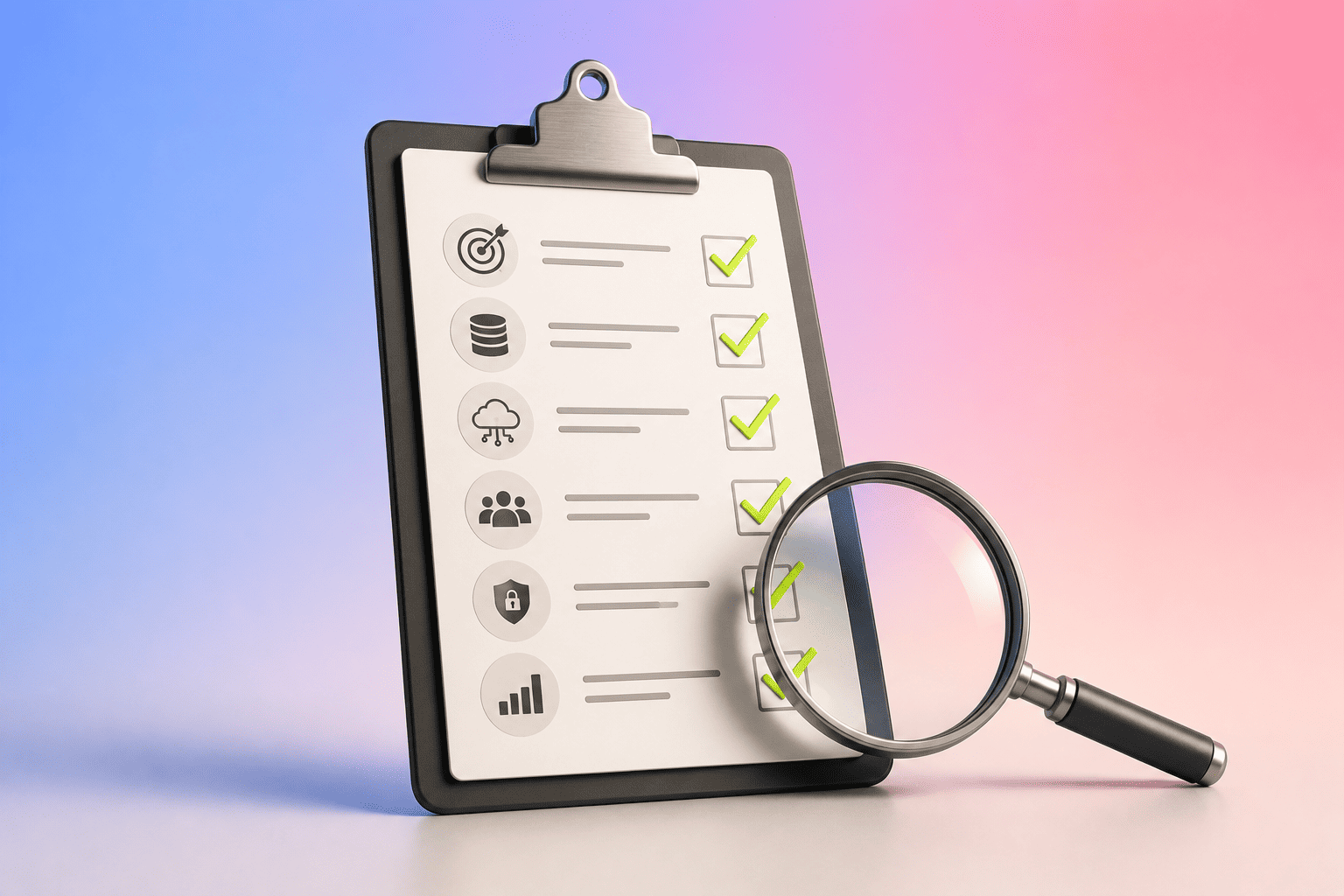
A serious AI readiness assessment should look across the organization, not just at the technology stack. AI value depends on a connected system of strategy, data, technology, talent, governance, and investment logic. If one of those areas is weak, the whole AI roadmap can become harder to scale.
1. Strategy & Integration
The first question is not simply whether the organization has AI use cases. It is whether those use cases connect to real business priorities. An assessment should look at how AI supports revenue growth, cost reduction, operational efficiency, risk control, customer experience, or other measurable outcomes. It should also test whether AI is part of the operating model, or still sitting on the edge as a set of experiments.
2. Data Foundation
AI depends on data that is available, trusted, governed, and usable. A readiness assessment should examine whether the organization has the right data pipelines, access controls, quality standards, ownership, and integration patterns in place. This is often where ambition meets reality. A pilot can work with carefully prepared data, but production AI needs a reliable data foundation [link: /services/data-engineering-analytics] that can support repeatable value.
3. Tech Stack & MLOps
The assessment should also look at whether the organization can deploy, monitor, manage, and improve AI systems in production. That means reviewing infrastructure, model deployment processes, observability, security, testing, version control, and MLOps maturity. The key question is not only whether the organization can build AI. It is whether it can operate AI reliably once it moves beyond the pilot environment.
4. Talent & Organization
AI readiness depends on people as much as platforms. The assessment should examine whether the organization has the right mix of data science, engineering, architecture, product, domain, governance, and leadership skills. It should also look at ownership. Many AI programs stall because teams are capable individually, but unclear on who owns production, risk, value, or long-term improvement.
5. Governance & Ethics
Governance should not arrive after AI systems are already moving toward production. A readiness assessment should check whether privacy, security, compliance, human oversight, model risk, auditability, and AI governance are built into the lifecycle. This matters in every industry, but especially in regulated sectors. Without governance, AI may move quickly, but not always in ways the organization can explain, control, or defend.
6. Investment & ROI
Finally, the assessment should test whether AI initiatives are connected to a clear business case. That means defining the baseline, expected value, cost model, success metrics, and decision criteria for scaling. Many organizations track AI activity, but not AI impact. A readiness assessment should show whether the organization can measure value clearly enough to decide what to fund, fix, scale, pause, or stop.
Step-by-Step: How to Run the Assessment Process
Once the six dimensions are clear, the next question is how to assess them in a structured, evidence-based way.
A good AI readiness assessment should follow clear steps that turn your evidence into priorities, and your priorities into your roadmap.
Here is a six-step AI readiness assessment framework for enterprise teams.
Step 1: Define Scope and Stakeholders
Start by deciding what the assessment will cover: the whole enterprise, one business unit, one region, one function, or a defined set of AI use cases.
This matters because AI readiness is contextual. One function may be ready to scale AI while another is still experimenting; one geography may have strong data access while another is constrained by regulation, fragmented systems, or legacy architecture.
Stakeholders need to be defined early. A serious assessment should include technology, data, business, risk, compliance, finance, operations, and executive sponsors. If one team owns the assessment alone, the results will usually reflect that team’s view of readiness.
The goal is to see the whole system, not just the most visible part.
A useful enterprise AI readiness checklist should begin with questions like:
- Which business areas are in scope?
- Which AI initiatives or use cases should be reviewed?
- Which systems and data sources matter most?
- Which stakeholders need to contribute?
- Which decisions should the assessment help leadership make?
Without a clear scope, an AI readiness assessment can become too broad to act on or too narrow to be useful.
Step 2: Gather Baseline Data Across the Six Dimensions
The next step is evidence gathering.
This usually includes interviews, workshops, documentation review, architecture review, data landscape analysis, governance review, use-case inventory, operating model analysis, and review of current AI initiatives.
The assessment should gather information across all six dimensions:
- Strategy & Integration
- Data Foundation
- Tech Stack & MLOps
- Talent & Organization
- Governance & Ethics
- Investment & ROI
The emphasis should be on evidence, not self-perception.
It is not enough for a team to say the data platform is mature. The assessment should test whether data pipelines are reliable, ownership is clear, access controls exist, quality issues are tracked, and the data can support priority AI use cases.
The same applies to governance, talent, and ROI. Policies, skills, and expected value all need proof: controls, responsibilities, delivery processes, measurement baselines, and examples of AI moving from pilot to production.
This is often where organizations discover the gap between how ready they feel and how ready they are.
Step 3: Score Each Dimension Against a Benchmark
Once the evidence is gathered, each dimension should be scored against a clear benchmark.
This is where the assessment becomes more useful than a general conversation. A structured scoring model shows leaders where readiness is strong, where it is weak, and where the gaps are most urgent.
The score is not a vanity metric. It creates a shared baseline.
For example, an organization might discover that its AI strategy is relatively mature, but its data foundation is weak. Or that it has strong technical capability, but governance is underdeveloped. Or that it has many use cases, but no reliable ROI model.
Those differences matter because they point to different decisions. A low score in data readiness may require platform modernization or stronger data ownership. A low score in MLOps may require new deployment, monitoring, and engineering processes. A low score in ROI may require better business case design before more funding is approved.
This is also where the question of how to measure AI maturity becomes practical. Maturity is not one thing. It is a pattern across multiple dimensions. A company may be advanced in one area and exposed in another.
ServiceNow’s Enterprise AI Maturity Index shows how wide that gap can be. In its 2025 report, average enterprise AI maturity declined by nine points year over year, and fewer than 1% of organizations scored above 50 on a 100-point maturity scale.
The signal is clear: AI adoption may be rising, but enterprise maturity is not keeping pace.
Step 4: Identify Gaps and Blockers
Scoring is only useful if it leads to a diagnosis.
The next step is to identify the specific gaps and blockers preventing AI from moving forward. These blockers may sit inside one dimension, but often cut across several.
A data issue may also be a governance issue if ownership is unclear. A technology issue may also be an organizational issue if engineering is not involved early enough. An ROI issue may also be a strategy issue if use cases are not tied to business outcomes.
This is where the assessment should become practical. It should show not only where readiness is weak, but why that weakness matters and what it is blocking.
The output should make clear which gaps prevent AI from scaling, create risk, reduce trust, or make ROI difficult to prove.
It also helps avoid a common mistake: assuming the next move is always “more AI.” Sometimes the right move is better data access, governance design, MLOps, clearer ownership, or stopping a use case that is not connected to business value.
Different blockers require different decisions.
Step 5: Prioritize Findings by Impact vs. Effort
Some gaps are less important than others.
Some findings will be urgent because they block high-value AI use cases. Some will matter because they create regulatory or security risk. Some may be relatively easy to fix. Others may require longer-term investment in data architecture, operating model, or governance.
A useful AI readiness assessment should prioritize findings by impact and effort. This helps leaders avoid two common mistakes: trying to fix everything at once or focusing only on the easiest improvements.
The assessment should identify quick wins, foundational gaps, governance or security risks, investment decisions that need sponsorship, and use cases that should move forward, wait, be redesigned, or stop.
At this point, the assessment starts to become a roadmap. The question is no longer “Where are we weak?” It becomes “Which decisions should change because of what we have learned?”
Step 6: Build a Roadmap With Clear Next Steps
The final step is to translate the assessment into action.
A readiness assessment should not end with a slide deck that says AI matters. It should produce a roadmap that shows what needs to happen next, who should own it, and how progress should be measured.
That roadmap should connect technical work to business value. It should show which foundations need reinforcement, which use cases are ready, which governance controls are required, and which investments are needed to support scale.
It should also define sequencing. Some AI initiatives may be ready now. Others may depend on data preparation, operating model changes, MLOps capability, or governance decisions.
The goal is not to slow AI down. The goal is to stop the organization from moving fast in the wrong direction.
That is the difference between an assessment that produces information and an assessment that creates direction.
The Biggest Mistakes Organizations Make When Running Self-Assessments
Self-assessment can be useful. It can start conversations, reveal obvious gaps, and help teams build internal alignment. But it also has limits.
The first mistake is treating AI readiness as an IT-only question. Technology matters, but readiness also depends on strategy, business ownership, data quality, risk, talent, governance, and ROI. If the assessment stays inside IT, it will miss the wider operating conditions that determine value.
The second mistake is relying too heavily on self-reported confidence. Teams close to the work often overestimate readiness where activity is visible. A business unit running several pilots may feel advanced. A data team may feel ready because a platform exists. Leadership may see adoption and assume maturity.
But activity is not the same as readiness.
The third mistake is focusing on tools rather than outcomes. The question is not whether the organization has access to AI platforms. The question is whether those tools are being used in ways that are governed, scalable, integrated, and measurable.
Finally, organizations often produce a score without changing decisions. If an assessment does not shift priorities, funding, ownership, governance, or delivery approach, it has only created another internal document.
Gartner predicted that at least 30% of GenAI projects would be abandoned after proof of concept by the end of 2025, citing poor data quality, inadequate risk controls, escalating costs, and unclear business value.
Those are not surface-level issues. They are readiness issues.
The purpose of an AI readiness assessment is not to confirm that AI activity exists. It is to show whether the organization is ready to turn that activity into value.
Self-Assessment vs. Expert-Led: When Does It Make Sense to Bring in External Expertise?
There is a place for internal self-assessment. If an organization is early in its AI journey, it can help build awareness, map obvious gaps, and get teams speaking the same language.
But self-assessment has limits when the stakes are higher.
An expert-led AI readiness assessment becomes more useful when investment decisions depend on the result, when multiple business units are involved, when pilots are failing to scale, or when governance and compliance risks are significant.
External expertise also helps when the organization needs benchmarks. Internal teams can describe what exists. They may not know how it compares to similar organizations, industries, maturity models, or implementation patterns.
An external assessment can also reduce bias. Teams that built the pilot may naturally defend it; leaders may look for progress; technology, business, and risk teams may each see a different picture.
A structured, expert-led assessment creates a more objective view of readiness, blockers, and the changes that would make the biggest difference.


AI Readiness Assessment
Prefer an objective baseline?
Exadel’s AI readiness assessment gives organizations a structured scorecard in as little as 3 days — across strategy, data, talent, technology, governance, and ROI.
The value is not just the score.
The value is the diagnosis.
What a Completed AI Readiness Assessment Should Produce
A completed AI readiness assessment should give leaders more than a maturity label. It should produce practical outputs that help the organization decide what to do next.
At minimum, it should include a:
- Baseline readiness scorecard across strategy, data, technology, talent, governance, and ROI.
- Gap analysis showing what is missing, what is weak, and what is blocking progress
- View of priority use cases: what should move forward, wait, be redesigned, or stop
- Data readiness view covering quality, access, governance, integration, and risk
- Governance and responsible AI view covering policies, controls, review processes, and oversight
- Talent and operating model view clarifying roles, skills, and ownership
- Investment and ROI view connecting AI initiatives to measurable business outcomes
- Roadmap showing what to fix, fund, govern, scale, and pause
Most importantly, the assessment should bring hidden dependencies into view.
Frank Herbert understood worlds as built on “plans within plans.” Enterprise AI is not so different. Behind every AI roadmap sits another plan: the data plan, the governance plan, the production plan, the ownership plan, the measurement plan.
If any of those plans are missing or misaligned, the roadmap will not hold.
A useful AI readiness assessment shows what is ready, what is exposed, and what needs to change before the next investment decision.
That is the difference between AI ambition and an AI roadmap.
Book a Short Chat With Us About Your Data and AI Readiness