Tags
Share
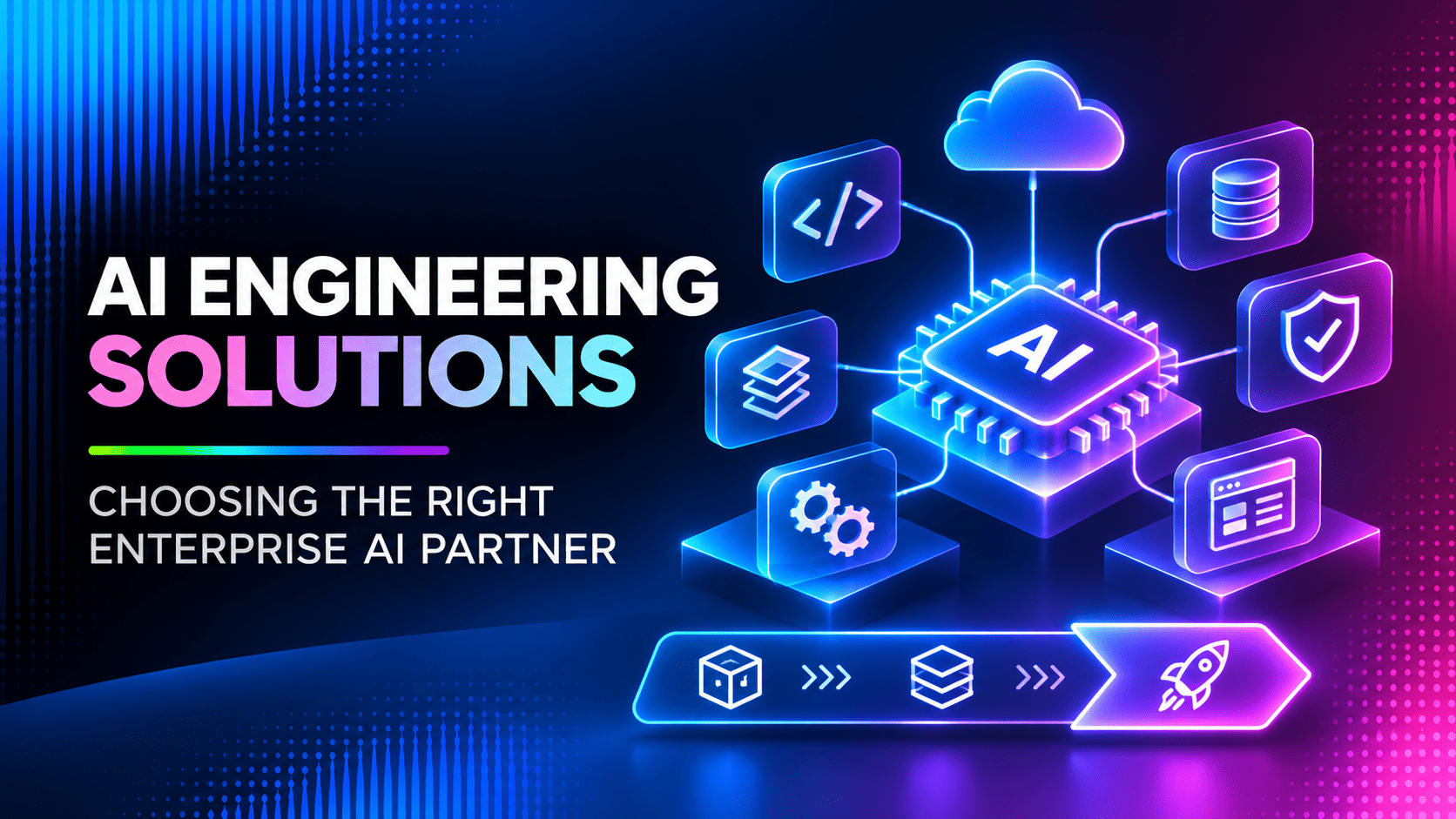
AI engineering solutions encompass the design, development, deployment, and ongoing management of AI-powered software systems. Evaluation of AI engineering partners should focus on four criteria: (1) depth of experience with your specific AI technology stack (ML frameworks, LLM integration, MLOps tooling), (2) a documented approach to responsible development practices including model governance and bias testing, (3) ability to integrate AI capabilities into existing enterprise systems rather than requiring full rebuilds, and (4) a track record at comparable project scale and complexity. Firms active in enterprise AI engineering include Accenture, EPAM, Thoughtworks, Capgemini, and Exadel.
What Do AI Engineering Solutions Actually Cover?
AI engineering begins where an AI idea has to become a dependable software system.
A model that performs well in a notebook or proof of concept is only one component. Enterprise AI also needs data pipelines, applications and APIs, deployment infrastructure, security, testing, monitoring, governance, human controls, cost management, and a way to update the system as models, data and business requirements change.
That is why AI engineering is increasingly becoming a distinct enterprise discipline. Gartner describes AI engineering as bringing together capabilities across data, models, generative AI systems, agents and application delivery so organizations can move beyond fragmented pilots toward production deployment and business value.
The engineering challenge is not simply to make an AI system intelligent enough.
It is to make it useful, testable, observable, secure, maintainable and economical inside the environment where the business actually operates.
The Difference Between AI Engineering, Data Science, and AI Consulting
These disciplines overlap, but they solve different parts of the problem.
AI consulting typically starts with the business decision: where can AI create value, which use cases should be prioritized, what risks need to be managed, and what operating model or investment is required?
Data science focuses more directly on extracting value from data. That can include exploration, statistical analysis, feature engineering, predictive modelling, experimentation, model training and evaluation.
AI engineering turns those models and AI capabilities into production systems.
That work may include APIs, data and model pipelines, retrieval-augmented generation, LLM integration, agent orchestration, application development, MLOps, monitoring, cloud infrastructure, security, testing and connection to existing enterprise systems.
The distinction matters when choosing a partner. An organization that already knows which use case it wants to build may need deep engineering rather than another strategy exercise. Another may require both.
The strongest engagements create a clear route from business requirement to production operation rather than losing context between consulting, data science and implementation.
Core Capabilities in Enterprise AI Engineering
A complete enterprise AI engineering capability typically includes several connected disciplines.
Model and AI application engineering. Teams need to select, build, fine-tune or integrate the appropriate models and then engineer the surrounding application rather than treating the model as the finished product.
Data engineering. Models depend on trusted, accessible and governed data. Pipelines, retrieval systems, embeddings, data quality, lineage and permissions are therefore part of AI engineering.
Exadel’s Data Engineering & Analytics capabilities support the data foundations needed for production AI systems.
MLOps and LLMOps. Deployment, versioning, evaluation, monitoring, rollback, model refresh and operational controls turn an AI experiment into something that can be managed over time.
Enterprise integration. AI outputs need to connect to applications, workflows, APIs, identity systems, databases and user experiences already used by the business.
Responsible AI and governance. Production systems need mechanisms for transparency, risk assessment, human oversight, monitoring, access control and accountability.
Post-launch optimization. Model performance, latency, cost, user behaviour and business outcomes change after deployment. Mature AI engineering therefore continues after go-live.
Exadel’s current AI Engineering service covers model pipelines, MLOps, real-world integration, governance and post-launch optimization, with an explicit focus on taking AI into production rather than stopping at the pilot stage.
What to Look for in an AI Engineering Partner
The right provider is not necessarily the firm with the longest list of AI technologies. A better question is whether the provider can engineer a dependable solution around the requirements and constraints that matter in your environment.
Technology Stack Alignment
Start with the system you actually need to build.
A partner should be able to explain its experience with the relevant combination of models, frameworks, cloud environment, databases, vector stores, APIs, orchestration tools, MLOps platforms and enterprise applications.
The exact technology choices may change quickly. What matters more is whether the engineering team understands the trade-offs behind them.
Ask questions such as:
- Why would you use this model rather than an alternative?
- How would you evaluate model quality for our use case?
- How will you control latency and inference cost?
- How will the system connect to our existing data?
- What happens if we change model provider?
- How are prompts, models, data and application releases versioned?
- How will the solution be monitored after launch?
Technology alignment should not mean forcing every client onto the provider’s preferred platform.
It should mean being able to make defensible engineering choices within the client’s architecture and constraints.
Responsible Development Practices
Responsible AI needs to become part of engineering, not an approval exercise added shortly before release.
A serious provider should be able to explain how it evaluates model behaviour, documents intended use, monitors risks, tests for harmful failure modes, establishes human-review points, controls data access, and handles changes after deployment.
The NIST AI Risk Management Framework provides a widely used voluntary structure for incorporating trustworthiness into AI design, development, deployment and evaluation.
For systems affected by European regulation, the EU AI Act provides a risk-based legal framework that can create different obligations depending on how the AI system is used.
Documentation matters too. Model cards were proposed as a structured way to document intended uses, evaluation conditions and performance characteristics rather than presenting a model as suitable for every context.
Bias and fairness testing should also be concrete. Tooling such as Fairlearn can help teams assess disparities across groups and evaluate mitigation approaches, although fairness cannot be reduced to a single software metric.
These examples do not mean that every project should use every framework or tool. They illustrate the level of specificity a provider should be able to discuss.
IEEE Xplore work on engineering trustworthy AI systems in production similarly emphasizes monitoring, drift, governance, explainability and auditability beyond basic model-accuracy measures.
Scalability: From Pilot to Production
Many AI systems become harder, not easier, once the pilot succeeds.
More users mean higher inference volume. More data means greater pipeline complexity. More workflows mean more integration points. Models change. Costs fluctuate. Regulatory exposure may increase. Monitoring becomes more important because failures are no longer confined to a test environment.
An AI engineering partner should therefore design for production questions early:
- How will the system scale?
- What is the acceptable latency?
- How will cost be measured?
- What happens when an upstream data source changes?
- How are new model versions tested?
- Can a deployment be rolled back?
- Who is alerted when quality deteriorates?
- What happens when a user encounters an edge case the model was never designed to handle?
Gartner’s 2026 AI engineering research explicitly frames the challenge as moving from experimentation toward enterprise scale across data, models, GenAI, agents and application delivery.
The provider should be able to answer those questions before scale makes them expensive.
Integration with Existing Enterprise Systems
Most enterprise AI is not greenfield. It must work with the applications, databases, workflows, security controls and business processes already in place.
That means evaluating APIs, data availability, event flows, identity and access management, enterprise architecture, latency, user interfaces and operational dependencies.
A partner that proposes rebuilding large parts of the existing estate before AI can begin should be able to explain why.
In many cases, integration is the better path. Existing systems can remain authoritative while selected AI capabilities are introduced around or within them.
That is particularly important where the current platform contains years of domain logic that would be expensive or risky to recreate.
Our AI readiness assessment guide examines many of these foundational constraints before organizations commit to scaling AI.
How AI Engineering Firms Approach Legacy System Modernization with AI
AI engineering and enterprise software modernization increasingly overlap.
Older software estates often contain the information and business logic AI initiatives need, but they may also have fragmented data, weak APIs, limited test coverage, obsolete frameworks or poor documentation.
AI can help engineering teams understand and change these environments faster.
Potential uses include code analysis, documentation generation, dependency discovery, test creation, repetitive refactoring, framework upgrades, database conversion and requirements reconstruction.
But legacy systems are precisely where uncontrolled automation can create serious risk.
Code that appears redundant may encode an undocumented business rule. A change that passes basic tests may still alter behaviour relied on by another system. AI-generated code therefore needs the same or stronger verification, traceability and review as human-produced changes.
Exadel’s legacy system modernization approach begins by understanding architecture, data flows, dependencies and constraints before deciding what should change.
Using AI to Accelerate Code Refactoring and Testing
Testing is especially important because AI-assisted modernization works best when teams can establish what the existing system is supposed to do.
Exadel Colleague can support suitable engineering tasks through governed agentic workflows in which AI works on defined tickets and engineers retain review and approval responsibility.
Our Agentic SDLC guide explains this delivery model in more detail.
In a modernization-readiness use case, Exadel Colleague generated nearly 7,000 unit tests to establish a behavioural baseline before wider modernization. Exadel reports that the work reduced eligible testing effort by about 90% and generated more than 3,200 Human-Equivalent Hours. The figure applies to the testing activity itself, not to an entire modernization program.
AI-assisted modernization can also extend beyond application code. For a global financial-services provider, Exadel used generative AI with senior database-engineering validation to migrate more than 1,200 stored procedures, views and functions. The engagement produced approximately 2x migration throughput, individual conversions that were two to three times faster depending on complexity, and an approximately 28% reduction in overall project duration.
In both examples, the useful pattern is the same: automate suitable work while keeping engineering controls around validation, review and production decisions.
Comparing Top AI Engineering Firms for Enterprise Projects
Enterprise buyers have a wide range of potential AI engineering partners. Accenture, EPAM, Thoughtworks, Capgemini and Exadel all operate in this market, but their public offerings reflect different organizational scale, engineering heritage, platforms and delivery models.
The right choice depends on the problem being solved rather than on a universal ranking.
Accenture
Accenture positions AI as part of a broad enterprise reinvention model spanning strategy, data, technology, workforce and business operations.
Its current generative AI offering emphasizes value-led transformation, data readiness, responsible AI and enterprise-wide scaling. Accenture also operates a network of GenAI studios designed to take organizations from experimentation into larger transformation programs.
This breadth may suit organizations looking for AI engineering as one part of a much larger consulting and operating-model transformation.
EPAM Systems
EPAM combines software-engineering scale with a growing range of AI-native delivery frameworks and platforms.
Its AI 360 framework is positioned as a vendor-agnostic route from use-case prioritization and readiness through to production-ready AI, while its current OpenAI and Anthropic partnerships emphasize integration of models into existing enterprise applications, data and workflows with security and governance requirements in mind.
Its engineering heritage and current AI-native development investments make EPAM relevant where organizations need substantial engineering capacity alongside enterprise AI implementation.
Thoughtworks
Thoughtworks positions its enterprise AI work around software engineering, modernization, data foundations, agentic AI and governance.
Its current enterprise AI offering includes AI/works for AI-enabled software delivery and Agent/works for governance, alongside work in data modernization, AI infrastructure, strategy and production deployment.
This makes Thoughtworks particularly relevant to buyers evaluating AI alongside broader software engineering and modernization change.
Exadel
Exadel’s AI engineering positioning is deliberately engineering-led: model pipelines, MLOps, enterprise integration, cloud-native architecture, governance and post-launch optimization.
It also connects AI engineering with data engineering, legacy modernization and AI-enabled product development rather than treating production AI as a separate specialist layer.
For organizations building AI directly into software products, Exadel’s AI-Enabled Product Engineering service extends that model across product strategy, engineering, validation and secure launch.
Exadel Colleague provides another practical expression of the same engineering approach by applying governed AI agents within software-delivery workflows rather than treating agentic development solely as an advisory concept.
The relevant buyer question is therefore not whether one provider is universally stronger.
It is which operating model, engineering depth, industry experience and delivery scale fit the work that needs to be done.
Exadel’s AI Engineering Approach: From Proof of Concept to Production
Exadel’s AI engineering model begins with a practical assumption: a technically impressive pilot has limited enterprise value if it cannot survive production.
That means production requirements need to influence architecture from the beginning.
A typical engagement may move through use-case and requirements validation, data and architecture assessment, model or AI-system engineering, integration, evaluation, deployment, MLOps and post-launch optimization.
The sequence varies by project, but four principles remain important.
Build around the business workflow. AI output has to connect to a real process, product or decision rather than exist as an isolated model.
Engineer the surrounding system. Data, APIs, applications, security, observability and operations are as important as model selection.
Validate continuously. Performance, risk, cost and user behaviour need to be tested before and after deployment.
Keep ownership clear. AI can automate work, but production responsibility still needs named human owners.
A current Exadel insurance engagement provides a useful example. A technology provider serving insurers, automotive companies and repairers wanted to improve the manual process of identifying claims where another party might be liable for reimbursement.
Exadel engineered an AI-powered Intelligent Document Processing application using NLP and machine-learning models, including BERT and DistilBERT, with computer vision added to analyse relevant visual information. The solution also involved quality engineering, MLOps, cloud and AI platform work, and model-selection decisions.
The published results report a 10%+ improvement in subrogation efficiency, more than 2,700 hours of manual effort saved each month, and more than 9,000 documents processed monthly.
This example also illustrates why AI engineering is broader than model development. The value came from connecting document processing, machine learning, computer vision, MLOps and business workflow around a measurable operational result.
That is the standard buyers should expect from an AI engineering engagement.
Frequently Asked Questions About AI Engineering Solutions
What are the most effective ways to find an AI engineering partner for product development?
Start by defining the technical and business problem clearly: what the AI capability needs to do, which systems it must integrate with, the expected user and transaction scale, and the governance or regulatory constraints.
Then evaluate providers against relevant production case studies, engineering depth, data capability, MLOps practices, integration experience and responsible-development processes.
A scoped proof of value can also be useful before a larger commitment, particularly where model quality, data readiness or integration complexity remains uncertain.
Which AI development agencies offer the best support for enterprise system modernization?
For AI-enabled modernization, look for firms that combine AI engineering with legacy software, data and integration expertise.
Accenture, EPAM, Thoughtworks, Capgemini and Exadel all operate across AI and enterprise modernization in different forms. The important question is whether the provider can understand existing system behaviour, establish sufficient testing, integrate with the current environment, and determine where AI can accelerate work without increasing migration risk.
Exadel combines AI engineering with legacy modernization and governed agentic software-delivery capabilities.
How can I find AI engineering firms that help scale data infrastructure?
Look for providers with experience in data pipelines, cloud data platforms, real-time and batch processing, data quality, governance, observability and MLOps.
Ask how they have handled data volumes and processing patterns comparable to yours and how the resulting platform supports model training, inference, monitoring and future AI use cases.
An AI engineering partner should be able to explain the data foundation required for the AI system rather than treating data preparation as someone else’s problem.
Our data engineering consulting guide covers these selection criteria in more depth.
How do I compare AI engineering service providers for data-driven digital transformation?
Compare providers on evidence of production deployment at comparable scale, data-engineering depth, MLOps maturity, enterprise-integration experience, model governance, responsible-AI practices and commercial transparency.
Also examine what happens after the pilot. Who operates the system? How is it monitored? How are model or data changes validated? How are costs measured? What knowledge remains with your internal team?
The strongest proposal is not necessarily the one with the fastest prototype. It is the one that makes the path to reliable production clear.
What should a custom AI software development engagement include?
A complete engagement typically includes requirements and use-case validation, data assessment, architecture and pipeline design, model or AI-system development, integration with existing applications and workflows, testing and evaluation, security and governance controls, production deployment, monitoring and ongoing optimization.
For higher-risk use cases, it may also require bias and fairness assessment, explainability, human-review workflows, detailed model documentation, regulatory analysis and formal approval gates.
Any engagement should make clear which of those responsibilities belong to the AI engineering partner and which remain with internal client teams.
Move AI from Pilot to Production
The real engineering challenge begins after an AI idea proves it can work. Exadel’s AI Engineering teams connect models, data, applications, governance and MLOps to build AI systems that can operate reliably inside the enterprise.