
Tags
Share
Enterprise AI often appears to have a model problem when what it really has is a data problem.
Let me explain. Teams can select a capable model, build a convincing proof of concept, and still struggle when they try to put it into production. The underlying information may be incomplete, differently defined across business units, inaccessible at the required speed, poorly governed, or impossible to trace back to its source.
Gartner found that 63% of organizations either did not have, or were unsure whether they had, the right data-management practices for AI. Gartner also predicted that through 2026, organizations would abandon 60% of AI projects unsupported by AI-ready data.
That is the problem AI data consulting is designed to address.
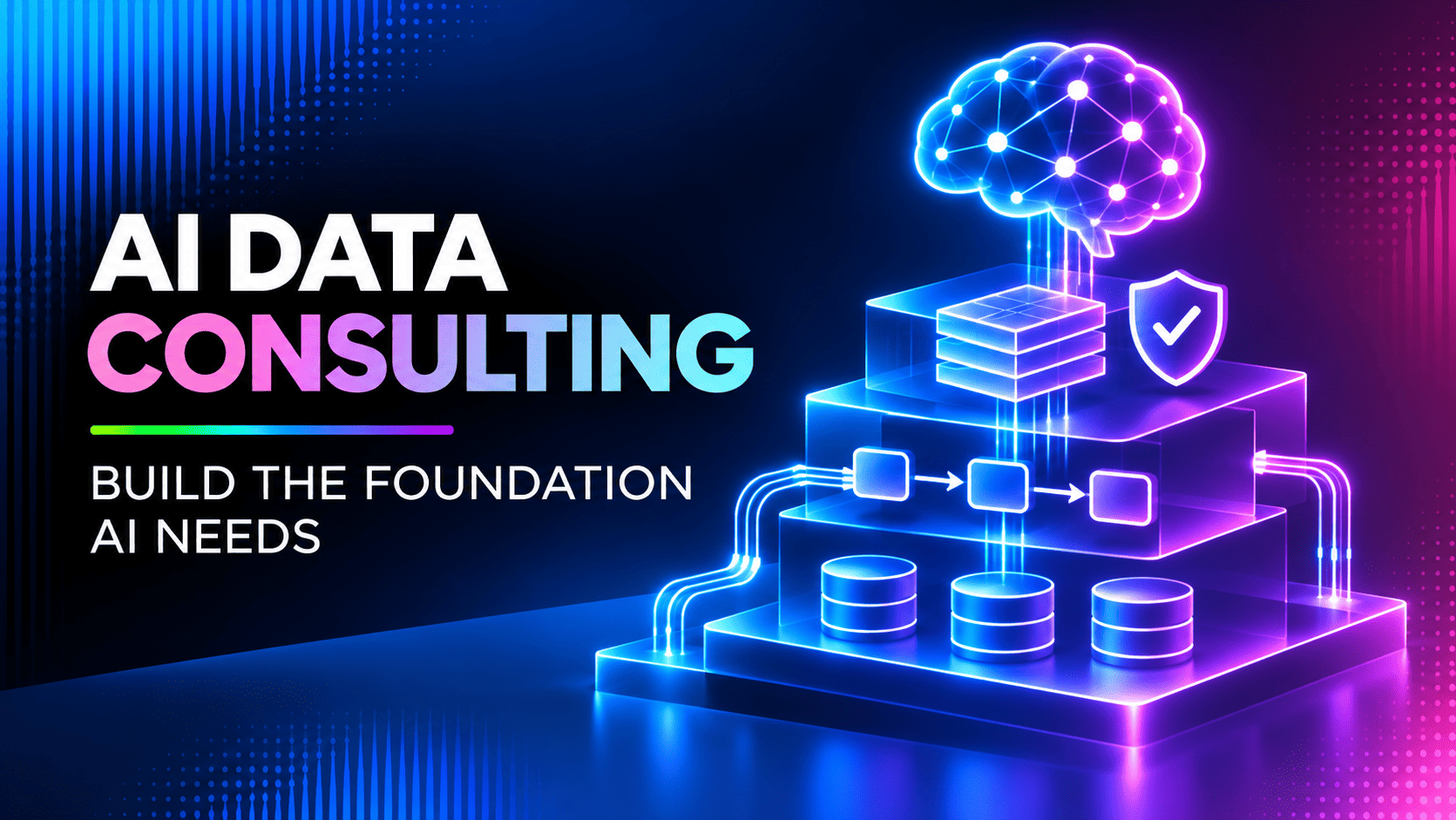
AI data consulting evaluates whether an organization’s data architecture, pipelines, quality, governance, access, and operating practices can support the AI capabilities it intends to build. It then turns those findings into a practical modernization plan—and, where required, into the engineering work needed to make that plan real.
The distinction matters because an enterprise does not need “perfect data” before it can use AI. It needs data that is fit for the particular use case: sufficiently reliable, timely, governed, understandable, and accessible for the decision or workflow the AI system is expected to improve.
Why Most AI Initiatives Fail Before They Start
The first AI prototype can hide a surprising amount of data debt.
A development team may manually assemble a clean dataset for a pilot. Documents may be selected carefully. Missing values may be repaired by hand. Data scientists may know which table contains the authoritative field even though the wider organization does not.
Production removes those conveniences.
The system must now work continuously against live enterprise information. New records arrive. Schemas change. Documents are revised. Access permissions differ. Business definitions conflict. Source systems go offline. Sensitive information enters the pipeline. The model still needs sufficiently current and trustworthy context every time it is used.
McKinsey & Company’s 2026 analysis of AI data readiness found that only 7% of companies had fully scaled AI across their organizations and that more than two-thirds of high-performing companies identified data as the primary obstacle to enabling AI. Its central argument is that structured and unstructured information need to become part of a governed, traceable, and reusable foundation rather than being prepared separately for each new AI application.
This is why treating data modernization and AI implementation as unrelated programs is increasingly difficult.
A customer-service assistant needs trustworthy customer, product, policy, and interaction data. A predictive-maintenance model needs sufficiently current equipment and sensor data. An enterprise agent may need permissioned access to documents, transactional systems, APIs, metadata, and business definitions.
The model sits at the end of that dependency chain.
AI-ready data is not a separate technical prerequisite: it is the foundation that connects enterprise information to trustworthy AI decisions and actions.


Your AI Partner
Find what is blocking your AI data.
Assess the pipelines, architecture, quality, and governance gaps that could prevent AI from scaling.
What AI Data Consulting Covers
AI data consulting goes further than deciding where information should be stored. It examines whether the data environment can reliably support training, retrieval, inference, evaluation, monitoring, and operational AI workflows.
Data Readiness Assessment
A data-readiness assessment begins with the AI use cases the organization actually intends to pursue.
Typical questions include:
- Is the required data available?
- Which source is authoritative?
- Is it sufficiently complete and representative?
- Can it be accessed at the required latency?
- Are definitions consistent between systems?
- Can sensitive information be identified and controlled?
- Is lineage available from source to AI output?
- Are quality issues measured and owned?
- Can unstructured information be processed reliably?
- Can the current platform scale within acceptable cost constraints?
The result should not simply be a maturity score.
A useful assessment identifies which gaps materially affect the priority use cases, which can be tolerated initially, which require remediation, and what sequence of changes will create the fastest credible route to production.
In one Exadel engagement with a global fitness-technology provider, the work began with a four-week data-platform assessment covering architecture, data layers, integrations, analytics, cost, governance, security, and stakeholder needs. The output included quick-win recommendations, a North Star architecture, and a phased modernization roadmap. Subsequent work addressed source inventories and lineage, ETL optimization, data-model consolidation, migration toward Databricks, and the refactoring of more than 30 BI reports.
Data Architecture Design for AI Workloads
Traditional enterprise architecture often optimized data for reports, dashboards, and historical analysis. AI expands this requirement somewhat.
A modern architecture may need to support:
- Structured transactional data
- Documents and other unstructured content
- Images, audio, or video
- Streaming events
- Feature data for machine-learning models
- Embeddings for semantic retrieval
- Vector search
- Metadata and business semantics
- Retrieval-augmented generation, or RAG
- Agent access to governed enterprise data and tools
- Evaluation and monitoring data
The architecture should begin with these requirements rather than with a preferred product.
For some organizations, a lakehouse architecture may provide the right combination of scalable object storage, processing, governance, and analytical access. Others may use cloud data warehouses, federated architectures, specialized operational stores, or a combination.
The point is not to standardize every enterprise on the same architecture. It is to ensure that storage, access, latency, governance, security, and cost match the workload.
Data Pipeline Modernization
AI makes stale and unreliable pipelines more visible.
A nightly batch pipeline may be perfectly adequate for a weekly executive report and completely inappropriate for an application that needs to react to a customer, transaction, machine, or market event within seconds.
AI-ready pipeline modernization can involve:
- Moving from fragile point-to-point ETL toward reusable ingestion patterns
- Supporting event streaming where latency matters
- Automating transformations and validation
- Separating raw, curated, and consumption-ready data
- Creating reusable data products
- Adding orchestration and dependency management
- Improving failure recovery
- Versioning transformations
- Introducing CI/CD practices
- Monitoring freshness, volume, schema, and quality
dbt Labs similarly distinguishes AI-oriented pipelines from static analytics pipelines, noting that AI systems increasingly require diverse ingestion, automated processing, quality controls, and real-time or near-real-time data rather than pipelines designed only around batch reporting.
The correct modernization target still depends on the use case. Not every pipeline needs to become real time.
Governance, Quality, and Observability
AI raises the consequences of bad data because an error can propagate directly into a recommendation, generated answer, automated workflow, or customer interaction.
That makes governance operational rather than documentary.
An AI-ready environment needs answers to questions such as:
- Who owns this data?
- What does this field mean?
- Where did it come from?
- Who is allowed to use it?
- What transformations have been applied?
- How fresh is it?
- What quality threshold must it meet?
- Which AI applications depend on it?
- What happens when it changes?
- Can an AI output be traced back to its sources?
Observability adds the ability to monitor whether pipelines and data are behaving as expected: freshness, volume, schema, lineage, errors, anomalies, and downstream impact.
For AI applications, that control increasingly needs to extend beyond structured tables into documents, embeddings, retrieval indexes, metadata, prompts, evaluation datasets, and other assets that shape model behavior.
Signs Your Data Infrastructure Isn’t Ready for AI
The following warning signs frequently appear before an AI initiative stalls.
1. Different teams disagree about the same metric
Sales, finance, operations, and product teams maintain different definitions of the customer, revenue, churn, inventory, or another core concept.
Consequence: AI receives inconsistent business meaning even when the underlying records are technically correct.
2. Data still moves through manual spreadsheets
Critical information is exported, modified, reconciled, or uploaded by hand.
Consequence: the AI workflow cannot operate reliably or at the speed required without depending on undocumented human intervention.
3. No one can trace data back to its source
Teams know which table or document they use, but not how the value was created or transformed.
Consequence: errors are difficult to investigate and AI outputs become harder to explain or audit.
4. Data quality is discovered by the user
There are few automated checks for catching missing values, duplicates, unexpected schema changes, freshness, or invalid business rules.
Consequence: downstream AI systems may consume faulty information before anyone realizes something changed.
5. Batch timing does not match the AI use case
A pipeline updates daily while the model is expected to respond to events in minutes or seconds.
Consequence: technically accurate AI is acting on information that is already obsolete.
6. Unstructured information has no governance model
Documents, email, transcripts, images, PDFs, and knowledge repositories are being indexed for generative AI without consistent permissions, versioning, metadata, or retention rules.
Consequence: retrieval systems can return outdated, inappropriate, or poorly traceable context.
7. Every AI team builds its own data pipeline
Individual pilots create their own connectors, transformations, vector indexes, and definitions.
Consequence: the organization multiplies cost, inconsistency, governance risk, and technical debt as AI adoption grows.
8. Platform cost cannot be connected to business demand
Teams know the cloud bill is increasing but cannot identify which pipelines, queries, workloads, models, or business applications are responsible.
Consequence: AI scaling becomes economically unpredictable.
Data readiness problems often show up long before a model fails; these warning signs reveal where an AI program is carrying hidden infrastructure risk.
The AI-Ready Data Stack: What It Looks Like in 2026
There is no universal “AI stack,” but several capabilities increasingly appear in enterprise architectures.
Storage and processing
Lakehouse platforms and modern cloud warehouses can provide scalable storage and compute while supporting structured, semi-structured, and unstructured information.
Options commonly encountered include platforms such as Databricks and Snowflake, together with cloud-native services across AWS, Azure, and Google Cloud.
Ingestion and streaming
Batch ingestion remains appropriate for many workloads. Event-driven AI may also require technologies such as Apache Kafka, Apache Flink, or cloud-native streaming services.
Transformation and semantic consistency
Tools such as dbt, Spark, and SQL-based transformation frameworks help convert raw data into consistent, tested, reusable assets.
A semantic layer can also establish shared definitions that analytics applications and AI systems can use consistently.
Feature and model data
Predictive machine-learning applications may require reusable feature pipelines or feature stores so that training and production inference use consistently defined inputs.
Vector and retrieval layers
Generative AI introduces new infrastructure for retrieving relevant unstructured information.
Vector databases and native vector-search capabilities can support semantic retrieval, while hybrid search may combine vector similarity with keywords and metadata filters.
But a vector database does not make enterprise content trustworthy by itself. Source permissions, metadata, versioning, lineage, quality, and lifecycle management remain essential.
Governance, catalog, quality, and observability
Catalogs, lineage systems, automated testing, access controls, data contracts, quality monitoring, and observability increasingly sit across the architecture rather than being added at the end.
Databricks' current reference architectures similarly treat structured and unstructured sources, ingestion, transformation, governance, AI serving, and analytics as connected layers rather than separate environments.
The architecture should therefore be requirement-driven.
The right question is not:
Which modern data platform should we buy?
It is:
Which architecture allows this organization’s priority AI workloads to access the right data, at the right quality and speed, with the required governance and economics?
Build the data foundation AI needs.
Exadel connects data architecture, pipelines, governance, and engineering to create platforms that can support AI in production.
How AI Data Consulting Differs from Traditional Data Consulting
Traditional data consulting and AI data consulting overlap substantially. Both may address architecture, integration, cloud platforms, governance, quality, and analytics.
The difference lies in what the data environment ultimately has to support.
That does not make traditional data engineering obsolete.
It means the definition of a usable data product is becoming broader. The same customer, product, contract, asset, policy, or transaction may now need to be understood by dashboards, predictive models, generative applications, and agents.
The underlying semantics have to survive all of them.
What to Expect from an AI Data Consulting Engagement
A strong engagement should move from diagnosis to an executable target state.
1. Define the AI demand
Identify the priority AI use cases and what each one requires from data: sources, quality, latency, access, retention, governance, and scale.
2. Assess the current environment
Review architecture, systems, pipelines, data quality, metadata, lineage, ownership, security, costs, skills, and operational processes.
3. Identify blockers by business impact
Separate issues that genuinely prevent the priority use cases from lower-priority technical debt.
Not every problem needs to be solved before the first AI deployment.
4. Design the target architecture
Define the required ingestion, storage, transformation, retrieval, governance, observability, and AI-consumption layers.
5. Build a sequenced roadmap
Prioritize quick wins, foundational remediation, modernization, and larger architecture changes according to dependency, risk, value, and effort.
6. Engineer and validate
The roadmap should connect directly to implementation.
This is where consulting without delivery can become problematic: recommendations that look reasonable in an architecture deck may behave very differently once engineers encounter real schemas, dependencies, performance constraints, security controls, or legacy systems.
7. Enable the internal team
AI data consulting should not leave the client permanently dependent on the consultancy.
Data architects, engineers, platform owners, governance teams, and AI developers need to understand the patterns, controls, ownership model, and operating practices they will inherit.
Enablement may include paired engineering, reference architectures, reusable templates, governance patterns, documentation, workshops, and knowledge transfer carried out alongside implementation rather than postponed until handover.
How Exadel’s Data Engineering Practice Supports AI Delivery
At Exadel, we treat data consulting, engineering services, and enablement as connected parts of the same delivery model.
Our Data Engineering & Analytics services span data assessment, cloud-native architecture, warehouse and lakehouse development, ETL/ELT modernization, real-time pipelines, data quality, governance, and analytics infrastructure.
Our public Data Engineering practice describes certified engineers across AWS, Azure, GCP, Databricks, Snowflake, and other ecosystems, alongside architectures designed specifically to support data science, machine learning, and generative AI.
That ecosystem depth is increasingly important, but the value to the client is not the collection of badges or partner logos.
It is the ability to make better-informed architecture decisions, understand the capabilities and constraints of the technologies being considered, and carry those choices through into implementation.
The same principle applies to Exadel’s wider AI partnerships with Cursor, Anthropic, and OpenAI, and to certified practitioners working with those technologies. They give our teams additional practical knowledge of the AI systems that will ultimately consume the data foundation.
Technology choice remains driven by the workload. A client may need Snowflake, Databricks, a cloud-native combination, open technologies, specialized vector infrastructure, or an architecture that preserves significant parts of an existing estate.
We do not start by forcing the data problem onto a preferred platform.
We start with what the AI use case requires.
That is also where our engineering-first delivery model matters. The people shaping the data strategy remain connected to the people responsible for making the architecture, pipelines, integrations, controls, and operating model work in practice.
Exadel has publicly demonstrated that relationship in AI-enabled data-platform work. For a real-time retail-pricing solution, for example, our team designed and engineered a modern cloud-native data foundation capable of piping, storing, and serving large, varied datasets for AI-powered pricing, promotion, and assortment applications.
The objective of AI data consulting should therefore not be another architecture diagram.
It should be a data environment the organization can trust, operate, extend, and use to deliver AI repeatedly.
Frequently Asked Questions
What is AI data consulting?
AI data consulting helps organizations prepare their data architecture, pipelines, governance, and operating practices for artificial intelligence.
An engagement typically assesses whether the required data is available, reliable, timely, secure, traceable, and accessible for priority AI use cases. It may then define a target architecture and modernization roadmap covering integration, lakehouse or warehouse platforms, streaming, data quality, unstructured data, vector retrieval, governance, and observability. Unlike a purely advisory exercise, a strong AI data consulting engagement should also establish how recommendations will move into engineering and how the client team will ultimately operate the environment.
How long does a data readiness assessment take?
A focused data-readiness assessment may take several weeks, while a broader enterprise assessment can take longer depending on scope and complexity.
Timing depends on the number of systems, business units, use cases, data domains, regulatory requirements, and stakeholders involved. A useful assessment should be long enough to examine real evidence rather than relying only on questionnaires, but focused enough to produce actionable priorities quickly. Exadel’s own data-assessment engagements can begin with architecture, pipeline, quality, governance, and business-requirement analysis before moving into a sequenced modernization roadmap.
Do I need a data lakehouse before deploying AI?
No. A lakehouse can be useful for many AI workloads, but it is not a universal prerequisite for enterprise AI.
The architecture should follow the use case. Some organizations can support AI effectively with an existing cloud data warehouse, operational databases, APIs, object storage, or federated access. Others benefit from a lakehouse because they need to combine large structured and unstructured datasets, machine learning, streaming, and governance in one environment. The decision should consider workload type, latency, scale, security, skills, cost, existing technology, and the amount of modernization required—not whether a particular architecture is fashionable.
What is the difference between data consulting and AI data consulting?
Traditional data consulting primarily prepares information for analytics, reporting, integration, and enterprise decision-making; AI data consulting extends those disciplines to the requirements of AI workloads.
That may mean handling more unstructured data, supporting training and inference pipelines, creating feature or retrieval layers, reducing latency, managing embeddings and vector search, and expanding governance to cover provenance, AI access, model dependencies, and data drift. The two disciplines share the same foundations—quality, integration, architecture, governance, and ownership—but AI changes how quickly and directly data can influence automated outputs and actions.
Make your data ready for AI.
Exadel helps turn fragmented data environments into governed foundations for production AI.