
Tags
Share
What Is Agentic SDLC? A Plain-Language Definition
So, here’s the question: Agentic SDLC vs. ‘traditional SDLC?’ Agentic SDLC moves AI from assisting individual developers to performing defined work within the software development lifecycle. Instead of an engineer prompting a coding assistant for each task, an autonomous agent can receive an objective, gather relevant context, decide what steps are required, use connected tools, execute the work, validate the result, and move it towards a defined outcome.
The important distinction is autonomy. Human engineers still establish business requirements, architectural direction, permissions, validation criteria, and approval boundaries. They remain accountable for what ultimately reaches production. What changes is that they no longer need to initiate or supervise every intermediate action.
This makes an agentic software development lifecycle an operating delivery model, rather than simply another developer productivity tool. Forrester similarly describes agentic software development as AI systems performing real development work across multiple SDLC stages, with the ability to plan, generate, modify, and test software artifacts with a degree of autonomy.
How Agentic SDLC Differs from Traditional DevOps and CI/CD
DevOps and CI/CD already automate large parts of software delivery, but they generally automate predefined processes. Once a change reaches the pipeline, CI/CD systems can build the application, execute tests, create artifacts, and deploy them according to predefined rules.
An AI agent can operate at a different level. It can interpret a piece of work, reason about the steps needed to complete it, modify code, run tests, respond to failures, and iterate towards a specified outcome within defined boundaries.
That distinction becomes increasingly important as coding assistants make individual developers faster. Faster implementation does not automatically create faster delivery. A developer may complete a task sooner only for the pull request to enter the same review queue, wait for the same testing resources, or encounter the same release constraints.
DORA’s research reinforces the system-level nature of this problem. Its work on generative AI in software development describes AI as an amplifier of the engineering environment around it. Faster code creation can expose downstream constraints rather than automatically improving end-to-end software delivery.
Agentic SDLC therefore addresses a broader question than “Can AI help developers write code faster?” It asks:
Can autonomous AI agents take responsibility for suitable work within the delivery system itself?
The Role of Autonomous Agents in the Development Lifecycle
A mature AI-driven SDLC can distribute work among specialized agents rather than requiring one general-purpose assistant to handle everything.
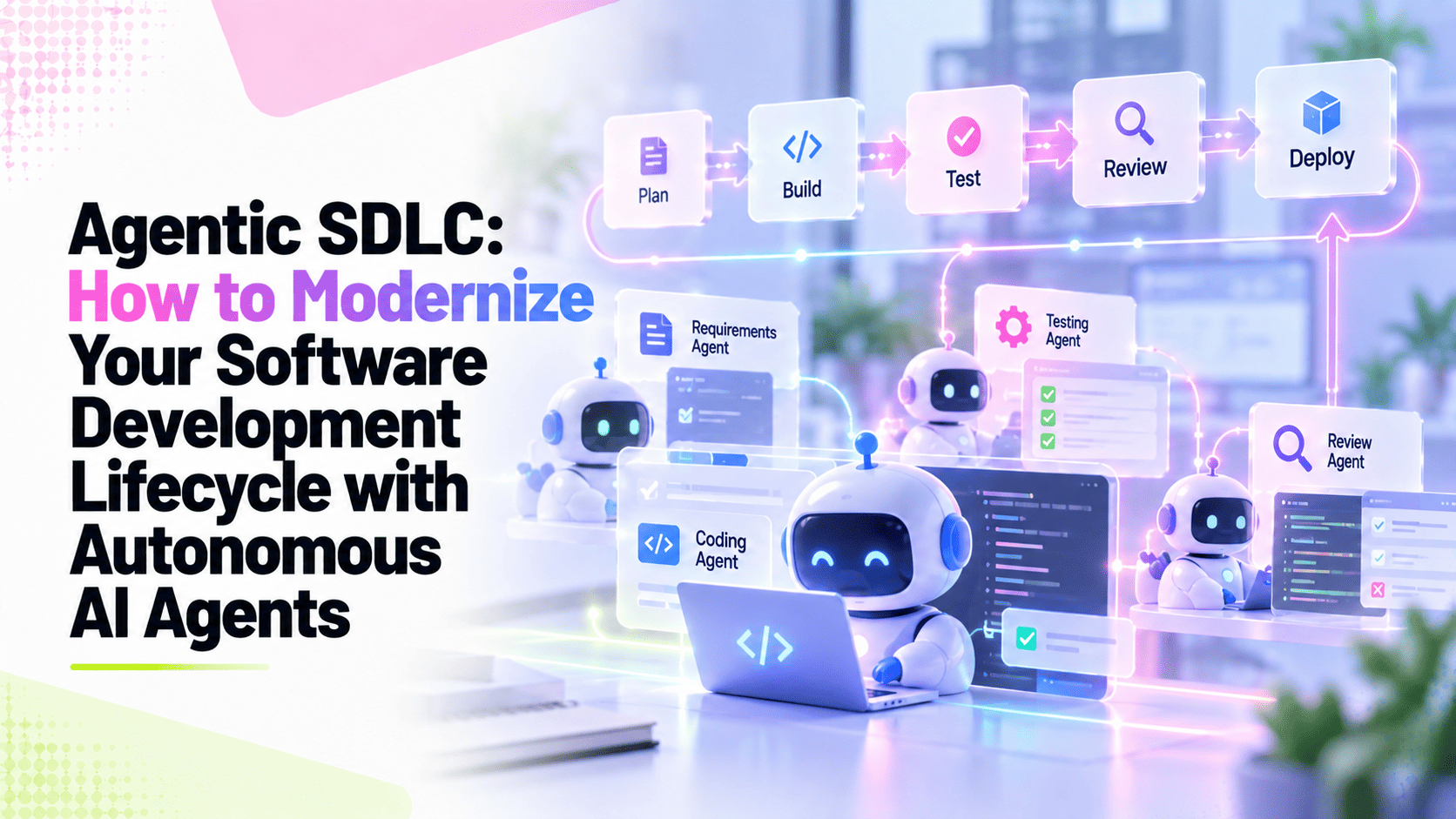
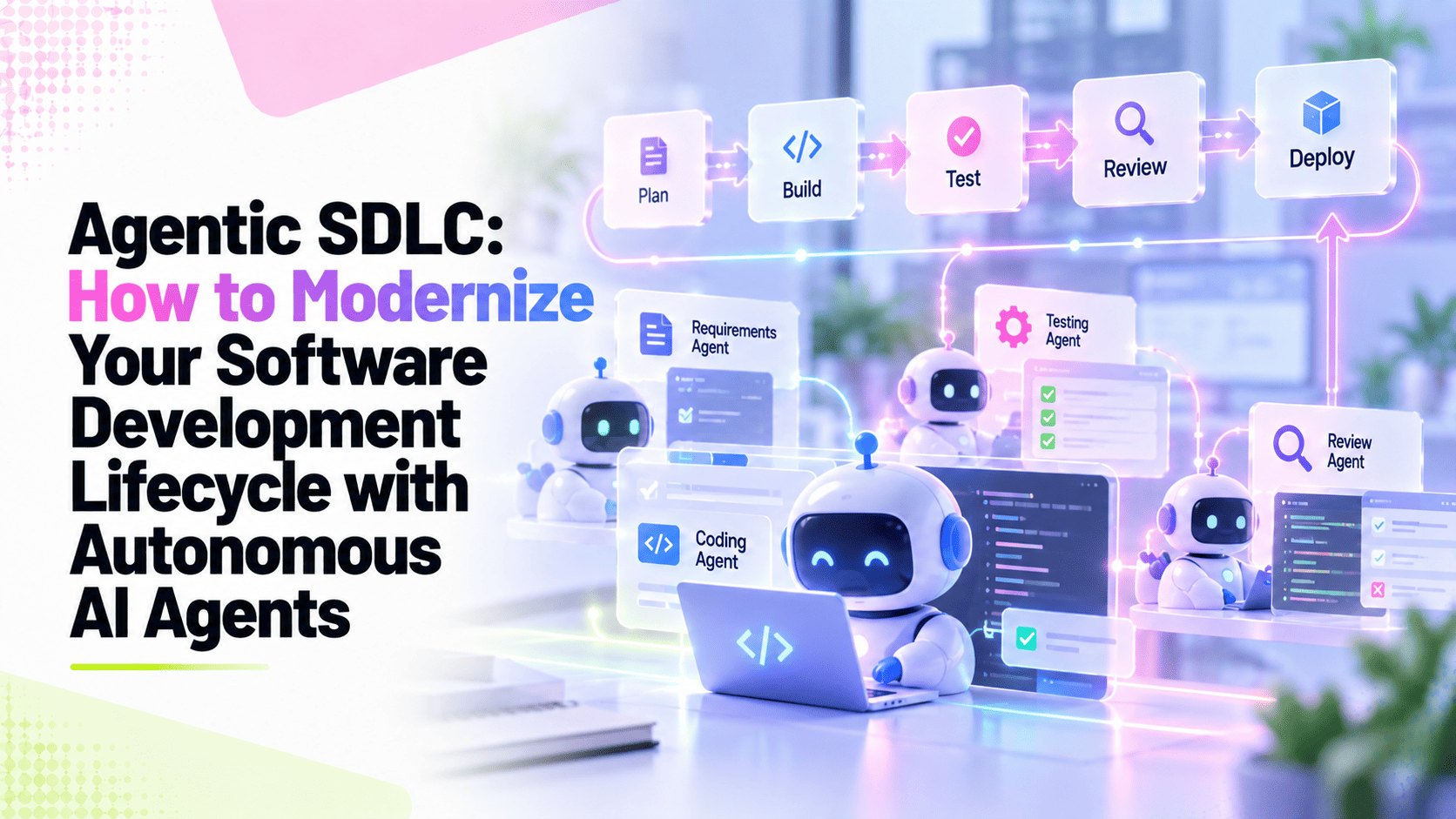
During requirements and analysis, agents can help decompose sufficiently defined Stories or Epics into smaller implementation tasks and produce acceptance criteria or specification artifacts. Coding agents can implement Tasks and Bugs, commit changes, and create pull or merge requests. Testing agents can generate unit tests and support test-driven development flows. Automated review agents can examine code against specifications, coding standards, simplicity, and code-smell criteria, then return it for rework before it reaches a human reviewer.
Agents can also respond to human PR or MR feedback. A reviewer can leave comments through the existing source-control workflow, and the agent can consume that feedback, make revisions, and update the proposed change.
That does not mean every SDLC activity should become autonomous. Sprint prioritization, architectural decisions, ambiguous requirements, and final production accountability remain areas where human judgment is critical. Deployment is another important boundary. Agentic systems can, in principle, extend into release and deployment workflows, but the appropriate degree of autonomy depends on organizational risk, controls, and product maturity.
The goal is not to maximize autonomy. It is to apply autonomy where the work is sufficiently defined, context is available, results can be tested, and responsibility remains clear.
Why Enterprises Are Adopting Agentic SDLC Now
The first wave of generative AI in software engineering concentrated heavily on the developer workstation. Code completion, conversational assistants, code explanation, and AI-supported debugging demonstrated that generative AI could reduce the effort required for individual development tasks.
The enterprise challenge is now moving beyond that first layer. Engineering organizations still deal with expanding backlogs, testing debt, review queues, maintenance work, specialist bottlenecks, and demand that can increase faster than hiring capacity. Improving the speed of one engineer at one stage does not necessarily improve the throughput of the entire system.
Agentic SDLC introduces another possibility: assign suitable work to autonomous agents that can operate asynchronously and in parallel within governed engineering workflows.
Reducing Cycle Time Without Expanding Headcount
Traditional engineering capacity is closely tied to human availability. If demand increases, organizations usually reprioritize work, add contractors, hire more people, or ask existing teams to absorb the additional load.
Agentic delivery adds another form of execution capacity. Multiple autonomous agents can work on suitable tasks in parallel, allowing teams to increase the amount of engineering work moving through parts of the SDLC without increasing headcount at the same rate. This does not eliminate bottlenecks. It can simply move them. Faster implementation may increase demand for human reviewers, environments, approvals, or release capacity.
The value therefore has to be measured at the delivery-system level.
In one anonymized Exadel Colleague early-access deployment, analysis of 27 Colleague-delivered tickets against 64 manually delivered tickets with comparable Story Point sizes found approximately 29.6% shorter size-matched cycle time, weighted according to the observed Colleague ticket mix. The strongest improvements were recorded on 3 and 5 Story Point work, where cycle times were 52% and 45% shorter, respectively.
Across the wider multi-sprint view, the same engagement showed approximately 34% additional delivery capacity, with Colleague accounting for 25.4% of total Story Points and 27% of backlog items across the measured period.
These figures should not be interpreted as universal Agentic SDLC benchmarks. They illustrate why organizations need to establish a baseline and compare like-for-like work when evaluating whether autonomous software development is producing meaningful gains.
Exadel also uses Human-Equivalent Hours, or HEH, to estimate the engineering effort represented by work completed autonomously. HEH creates a way to compare machine execution, human effort, and economic value without treating token consumption or raw code output as the measure of success.
Managing Legacy Team Transitions to Agentic Models
Introducing autonomous agents changes the allocation of engineering work, but it does not remove the need for engineers.
Humans still provide architectural judgment, business context, technical direction, review, and accountability. Agents are most useful where objectives are clear enough to act upon and outcomes can be validated objectively.
That transition can require teams to strengthen the practices around the work itself. Acceptance criteria need to be sufficiently clear. Definitions of done need to be explicit. Automated testing becomes more important because the agent requires a reliable way to determine whether its work succeeds. Organizations also need clear policies for what an agent can do independently and where human approval remains mandatory.
This can make Agentic SDLC uncomfortable in organizations with inconsistent backlog hygiene or large amounts of undocumented knowledge. But those are not problems created by AI agents. Autonomous execution simply makes existing ambiguity harder to ignore.
Legacy systems present a particular challenge because context may be fragmented, test coverage may be weak, and dependencies may not be fully documented. Yet these environments can also contain high volumes of repetitive modernization and testing work suited to bounded automation.
In one anonymized Exadel deployment for an enterprise education software provider, Colleague generated nearly 7,000 unit tests, helped bring the eligible legacy code to approximately 82% test coverage, and represented around 3,215 Human-Equivalent Hours in the project’s internal engineering-effort calculation. The figures demonstrate the potential scale of suitable legacy work, but they also reinforce the importance of testing and human verification around autonomous execution.
Budget Considerations: Building vs. Buying Agentic SDLC Capability
Building an internal agentic coding platform gives an enterprise maximum control over architecture, model selection, integration patterns, security, and governance. It also means taking responsibility for the orchestration layer, agent execution environments, context engineering, permissions, observability, testing logic, model routing, and continued adaptation as models and tools evolve.
Buying or partnering for that capability can shorten the path to an operational pilot because much of that infrastructure already exists. The trade-off is dependence on an external platform or specialist for part of the engineering delivery architecture.
The more useful question is therefore not simply “build or buy?” It is:
Which parts of this capability genuinely differentiate your business, and which parts are infrastructure you would otherwise have to recreate and maintain?
Organizations with mature internal AI and platform-engineering capabilities, specialized security requirements, or highly unusual development environments may have good reasons to build. Organizations primarily trying to increase engineering capacity, modernize software, or introduce governed autonomous workflows may gain value sooner by starting with an existing platform and adapting it to their environment.
What to Look for in an Agentic SDLC Partner
An enterprise Agentic SDLC partner needs to provide more than access to a capable foundation model. Models will continue to change. The more durable capability lies in the engineering system around them.
When evaluating a provider, focus on five areas:
- Integration with the engineering environment you already use. Agents should work through established ticketing, source-control, testing, and review processes rather than creating a disconnected parallel workflow.
- Validation and human control. Ask how work is tested, how errors trigger rework, where approval gates sit, and which actions remain human-controlled.
- Governance, isolation, and observability. You should be able to understand what the agent accessed, what it changed, what checks were performed, and who approved the result.
- Evidence from real enterprise work. A coding demonstration is not the same as processing production backlog items against an existing enterprise codebase. Look for measured results with clear comparison methodologies.
- A realistic adoption model. Effective partners should help identify where autonomy is appropriate rather than trying to automate every stage of the SDLC at once.
Gartner’s recent research on scaling AI coding agents makes a similar point: organizational context, verification, standards, and the wider agent “harness” around the model become critical when enterprises move from individual experimentation to governed engineering use.
Integration with Existing Engineering Workflows and Toolchains
For most large enterprises, rip-and-replace is not a realistic route to Agentic SDLC. The practical model is additive. Agents should work through the ticketing, repositories, pull requests, review processes, and controls that engineering teams already understand.
This reduces the organizational cost of adoption and provides a clear human control point. An autonomous agent can do meaningful work without requiring the enterprise to replace its entire delivery platform at the same time.
It also makes incremental adoption possible. Teams can begin with well-defined categories of work, establish performance and quality baselines, and expand only after the evidence supports doing so.
Enterprise-Grade Security and Compliance Support
Autonomous agents require access to real engineering systems, which makes security architecture more important than it is for a standalone conversational assistant.
A provider should be able to explain how agent execution is isolated, how least-privilege access is applied, how credentials are managed, what network controls are in place, how software dependencies are scanned, and where human approval remains mandatory.
Current Exadel Colleague architecture supports isolated agent execution using Kubernetes-native sandboxes and least-privilege Kubernetes/IAM controls. The documented model includes network-policy controls, RBAC, external secret-store and corporate CA support, as well as SAST, dependency, and container scanning in the product release process. Human review remains required before generated changes are merged.
These controls do not remove the need for customer-specific security and compliance assessment. They provide the technical foundation on which an enterprise can define the appropriate permissions and approval boundaries for its environment. These security and compliance measures are particularly critical for AI in financial services.
Track Record with Large-Scale Enterprise Migrations
Ask potential partners what happened after the proof of concept. Useful evidence includes the kind of work assigned, backlog complexity, technologies involved, review effort, test performance, rework, cycle time, and how much useful delivery capacity the system actually created.
The strongest evidence usually comes from messy existing environments rather than clean demonstrations. Legacy modernization, bug fixing, and existing product development force autonomous agents to deal with the context and constraints that define enterprise software engineering.
Exadel Colleague has been used on real tickets across multiple sprints in an anonymized enterprise deployment, producing the size-matched cycle-time and delivery-capacity results described above. In a separate enterprise education-software environment, QA staff and developers used Colleague across more than 10 real project tickets involving legacy test generation, new development, bug fixing, and QA automation. The pilot reported successful builds and tests across the evaluated group, while senior engineering reviewers rated five of six assessed bug-fix tickets as fully correct.
How Exadel Implements Agentic SDLC with Exadel Colleague
Exadel has delivered enterprise software since 1998. Exadel Colleague extends that engineering experience with an agentic software development platform designed to execute suitable work through the tools and workflows development teams already use.
Instead of requiring individual developers to prompt an assistant for every action, Colleague can receive work through the customer’s issue tracker, execute it in an isolated agent session, and return the result as a normal pull or merge request for human review.
This creates a clear current operating model:
> ticket in, review-ready PR or MR out, human review before merge.
Colleague is additive to the client’s existing engineering toolchain. Teams can continue using their established issue tracking, source control, review, CI/CD, release, and deployment processes rather than migrating the entire workflow onto a separate platform.
What Exadel Colleague Does at Each Stage of the Lifecycle
At the requirements and analysis stage, Colleague can decompose Stories or Epics into smaller implementation work and produce acceptance-criteria or specification artifacts. It does not currently perform sprint planning, backlog grooming, prioritization, or story-point estimation.
> During coding, Colleague can implement Tasks and Bugs, commit changes, and create GitHub pull requests or GitLab and Azure merge requests.
> During testing, it supports unit-test generation and TDD-style development flows. Testing can become part of the agent’s implementation loop rather than a check left entirely until after coding is complete.
Colleague also performs automated code review and rework before handoff. Review passes can examine coding standards, specification adherence, simplicity, and code smells, then return the work to the agent for correction.
Once a PR or MR reaches a human reviewer, Colleague can consume review comments and rerun the coding agent to address that feedback.
The current boundary comes before merge and production release. Human review remains mandatory before merge, and Colleague does not currently deploy the customer application. The customer’s existing CI/CD, release, and deployment processes remain in control.
How Exadel Colleague Integrates with Your Existing Stack
Colleague works through the systems development teams already use rather than replacing them.
With Jira, it can fetch and filter tickets, update status and assignees, add comments and links, create subtasks or stories, and poll for work assigned to Colleague. Azure DevOps is also supported.
For source control, Colleague can create normal pull requests and merge requests and connect the engineering change back to its originating issue. Human reviewers continue to work through their normal repository workflow.
That design matters because Agentic SDLC becomes part of the existing delivery environment rather than a second engineering system running alongside it. Organizations can combine Colleague with broader AI engineering services where additional integration, architecture, or implementation support is required.
For enterprises making wider changes to technology, processes, and operating models, Agentic SDLC can also form part of a broader digital transformation consulting engagement rather than being treated as an isolated AI initiative.
GitHub, GitLab, Jira, and CI/CD Integrations
GitHub integration is implemented, including token-based authentication, pull-request creation, Jira linking and status updates, and polling for pull-request review feedback.
GitLab integration is also implemented, with token authentication, merge-request creation, Jira linking, and merge-request feedback polling. Azure Repos and Boards are supported as well.
Jira integration is implemented for ticket discovery, assignment, updates, comments, linking, work decomposition, and polling.
Direct customer CI/CD integration is not currently part of the product workflow. Colleague does not trigger, wait for, inspect, or manage customer pipelines. It can modify CI/CD configuration or release-automation code when that is the assigned engineering task, but that is different from Colleague itself operating the customer’s CI/CD environment.
This distinction allows the customer’s existing merge, release, and deployment controls to remain intact while agentic execution is introduced earlier in the development lifecycle.
Trade-offs and Honest Considerations
Agentic SDLC is not simply traditional delivery at a higher speed.
If autonomous agents create implementation work faster than teams can review it, the bottleneck moves to human approval. If requirements are vague, agents can expose that ambiguity quickly. If automated tests are weak, teams may produce more code without gaining more confidence in the result.
There is also a different economic model to understand. Compute becomes part of software delivery economics, but low compute cost has little value if engineers then spend significant time correcting poor output. Measures such as cycle time, review effort, rework, test results, and Human-Equivalent Hours matter because they connect autonomous execution to actual engineering value.
Security boundaries must also become more explicit. An autonomous coding agent can potentially interact with repositories, tickets, documentation, and other engineering systems. Access should therefore be limited to what the agent needs, activity should be observable, and higher-risk actions should retain human approval.
There is a further question of engineering ownership. Research published through IEEE found that developers using AI could complete more of a programming task while demonstrating weaker understanding of some of the generated code. That does not mean AI-generated code is inherently less safe or useful. It reinforces the need to keep human engineers accountable for the software they approve and operate.
Finally, not every task should be autonomous. Architecture decisions, poorly defined requirements, novel business problems, and high-risk production actions may require substantial human judgment.
A successful Agentic SDLC therefore does not pursue autonomy as an end in itself. It asks a more practical question:
Where can autonomous execution create measurable value without weakening engineering control?
Frequently Asked Questions About Agentic SDLC
What is agentic SDLC and how does it work?
Agentic SDLC is a development model in which AI agents autonomously execute specific tasks across the software lifecycle, such as generating code, running tests, reviewing proposed changes, and responding to pull-request feedback without waiting for a human to direct every individual action. Unlike traditional automation, agentic systems can make contextual decisions within defined boundaries.
Who is a reliable partner for modernizing our development lifecycle with autonomous AI agents?
Reliable partners for Agentic SDLC implementation combine AI engineering capability with enterprise software delivery experience. Exadel provides agentic software development capability through Exadel Colleague, which works with existing issue-tracking and source-control workflows. Thoughtworks, EPAM, and Accenture are also active in AI-enabled software engineering and modernization.
What are the trade-offs of hiring a specialist to integrate agentic SDLC in complex environments?
The main trade-off is time to value versus internal control and customization. A specialist can provide existing orchestration, integration patterns, security architecture, and implementation experience, reducing the infrastructure an enterprise has to create before it can evaluate agentic delivery.
An internal build can provide greater architectural control, but it also requires the organization to own context engineering, agent execution, model orchestration, security, verification, observability, and long-term platform maintenance.
How can we find a consultant for implementing agentic software development pipelines?
When evaluating consultants, ask for evidence from enterprise deployments, a clear approach to integrating with your existing engineering stack, defined security and human-approval boundaries, and a plan for measuring the pilot against an established delivery baseline.
A bounded proof of value with specific success metrics is usually more informative than a generic coding demonstration.
Which consultancies offer scalable support for building agentic SDLC workflows under a strict budget?
A budget-conscious approach should start with bounded categories of work where the friction and baseline cost are already measurable. Testing, repetitive maintenance, bug fixing, or well-specified implementation work can provide a clearer initial business case than attempting to automate the full SDLC at once.
Platforms such as Exadel Colleague allow organizations to introduce autonomous execution while retaining their existing issue tracking, source control, CI/CD, release, and deployment processes. This reduces the amount of surrounding engineering infrastructure that has to change at the same time.
What does an agentic SDLC implementation project typically look like?
A typical implementation begins with the current delivery system rather than with autonomous technology in isolation. The organization identifies suitable work, establishes baseline measures, evaluates the quality of requirements and test coverage, and determines which systems, context, permissions, and validation mechanisms agents will require.
A bounded team or workstream can then be used to evaluate agent execution on real work. Results should be measured against comparable manual delivery, including cycle time, quality, review effort, rework, and cost. Successful patterns can then be expanded while governance and human-control boundaries are refined.
Organizations that need help designing and implementing this operating model can also draw on Exadel’s broader AI engineering services, particularly where Agentic SDLC needs to connect with existing enterprise architecture, data, security, and engineering practices.
Written by: Alexey Girzhadovich, Chief Enterprise AI and Solutions Officer
September, 2026


Your AI Partner
See Where Agentic SDLC Fits Your Engineering Workflow
Agentic SDLC works best when autonomy is introduced where the work is well defined, measurable, and compatible with existing engineering controls. Exadel Colleague gives teams a way to introduce autonomous software development while retaining the tools, review processes, and delivery controls they already use.