
Tags
Share
The conversation most organisations are having about AI and digital experience is the wrong one. They are asking how to produce more content, how to optimize for AI search, how to make sure their brand shows up when someone types a question into ChatGPT or Perplexity. These are reasonable questions. They are just not the first ones worth asking.
Before content strategy, before AI search optimization, before any of the tactics that are currently dominating the industry conversation, there are harder, less comfortable questions sitting underneath: Is your content architecture built for machines, not just people? Does your organisation even know which version of a fact is the true one? Can your brand survive being taken out of its own context and still read as credible?
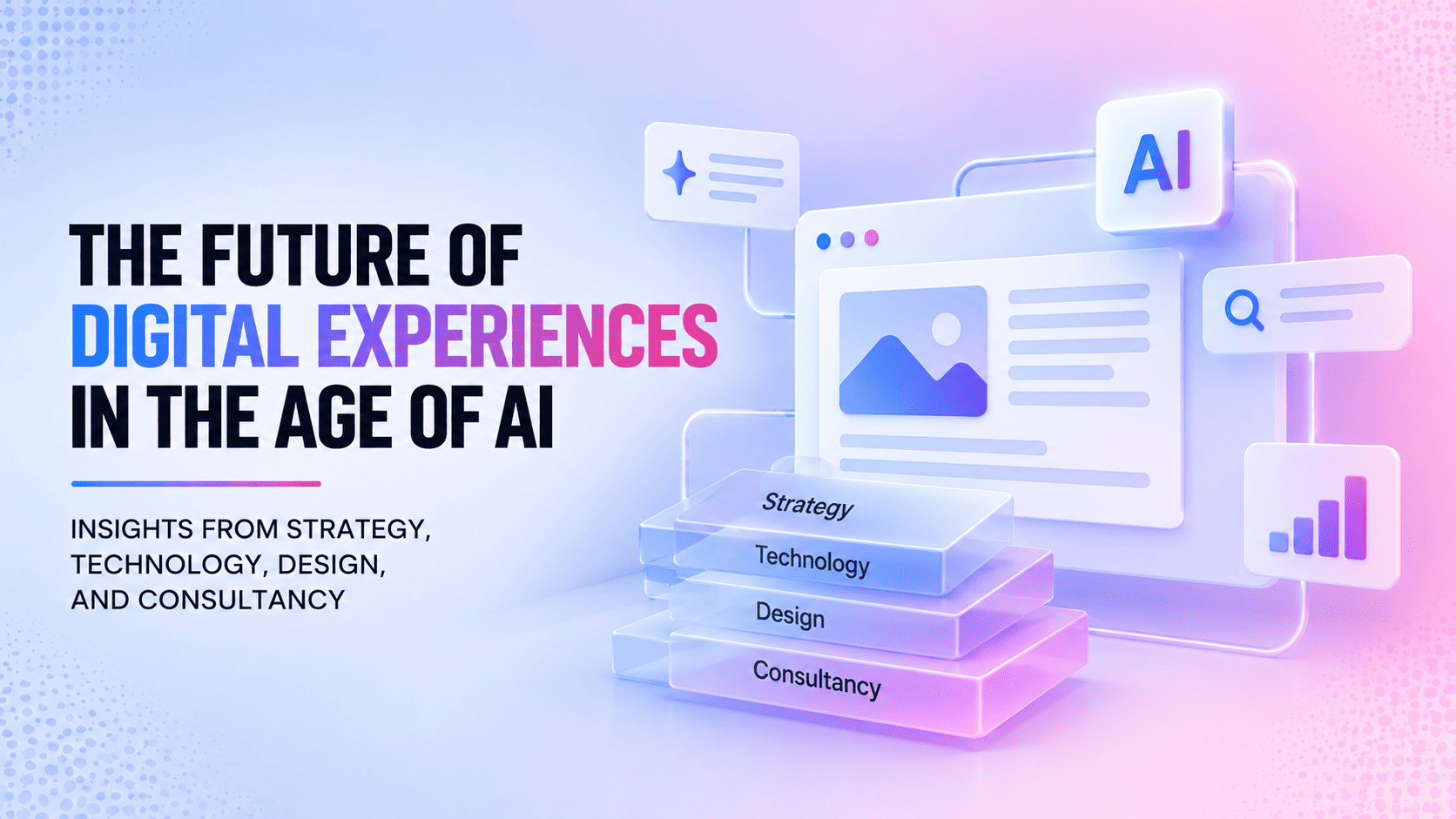
The five contributors in this piece - across strategy, technology, design, and consultancy - share a single point of view: the organisations that get digital experience right in the next few years will be the ones who fix the foundations first, not the ones with the sharpest content calendar.
This is what that actually means, discipline by discipline.
Everyone Is Racing to Fix Content. The Real Fix Starts with the Foundations.
By Leigh Gammons, Managing Director & SVP, Tangent, an Exadel Company
The argument the industry wants to have
Over the next year, most of the industry is going to have an argument about content. How much to produce, how to optimise it in an increasingly AI-first world, whether the old digital playbooks still apply. It is an understandable argument to want to have. It is also, I think, the wrong one to have first.
Underneath every one of those content questions is a harder, less comfortable one: does the system the content sits on top of actually deserve to be trusted?
The questions nobody is asking yet
Is there one governed source of truth behind what a brand is claiming, or a dozen versions scattered across regions, departments, and platforms that happen to mostly agree? Is the experience designed to hold up when it shows up somewhere you did not build and cannot control? Does anyone in the organisation actually have the authority to say which version of a fact is the right one?
Those are not content questions. They are architecture questions, design questions, and operating model questions, and they have to be answered first, because no amount of good writing can fix a broken foundation underneath it.
What agencies actually need to offer right now
We have spent the last few months building our point of view on this, which we are calling "Clicks to Context." The agencies and consultancies who serve clients well over the next few years will be the ones who can genuinely operate across strategy, technology, design, and consultancy at once, not just the ones with the sharpest content calendar or snippet strategy.
No one can yet guarantee a brand gets cited by an AI system, nor is that the end of the journey. Earned, third-party sources currently carry more weight than anything a brand publishes about itself, and the infrastructure behind structured knowledge and machine-readable standards is real but still early.
What we can offer instead is getting the architecture, governance, and experience right now, so that whatever comes next, our clients are not rebuilding the foundations under pressure.
The Systems Problem Nobody Is Pricing In
By Nadine Clarke, Chief Strategy Officer, Tangent, an Exadel Company
The reflex response to AI search
I have sat in a number of client meetings recently where, at some point, someone on the other side of the table gets told that AI search is coming for their traffic. The instinct is to respond with more content - a bigger publishing plan, a refreshed content calendar, FAQs on as many pages as possible.
Almost nobody asks the harder question first: does the system underneath that content actually work?
The audience your website was never built for
Right now, most brand content lives in containers built for a human clicking through a browser - pages, carousels, PDF brochures, navigation trees designed to guide someone from homepage to product to contact form. That architecture made sense when the only thing reading your website was a person, or a search engine ranking pages against keywords.
That is no longer the only audience. Increasingly, the thing reading your website is a model deciding, in real time, whether to trust you enough to cite you in an answer someone else is reading. It does not care about your navigation. It does not experience your homepage. It is pulling a fact out of context and deciding whether that fact is accurate, current, and worth repeating.
Why better content alone is not enough
Most enterprise content was not built to be extracted. It was built to be browsed. You can hire the best writers in the industry to produce content for this new world, and it may not be enough on its own - not if the underlying knowledge is duplicated across a dozen systems that were never built to talk to each other.
I want to be careful here, because the industry conversation around this has a habit of overstating itself. Websites are not disappearing. They remain the place people go to transact, to experience a brand properly, to read something with full context around it. What is changing is more precise than "websites are dead": the website stops being the only place your truth lives, and becomes one place among several where it gets rendered.
The one question that starts the real project
That is a genuinely different problem to solve, and it is not a content problem - or at least not first. It is a systems problem. Before you spend more on writing better or more content, someone needs to answer a much more boring question: where does the one true version of any given fact about your brand actually live, and can every system that needs it get to it reliably?
Most organisations we talk to cannot answer that in one sentence. That is usually where the real project starts. The brands that address the architecture first tend to be the ones who can spend on content with confidence it is built on solid ground. The ones that do not may get away with it for a while, but they are more likely to find, sooner or later, that better copy alone does not fix a broken foundation.
Your Website Was Built Around Pages. AI Agents Need Knowledge.
By Łukasz Mądrzak-Wecke, Head of AI, Tangent, an Exadel Company
How agents actually read your content
Enterprise websites were built for people. The CMS assembles a page, navigation and search help someone find it, and the visitor uses branding, layout, and surrounding content to work out what it means and whether to trust it.
Agents do not use a website in quite the same way. They may browse a page, retrieve a fragment, or query an API - but the page is rarely the destination. It is evidence used to answer a question, compare options, or complete a task.
Most enterprise platforms - Optimizely, Adobe, Sitecore, Salesforce, SAP - can now expose content through an API. But that does not make the content agent-ready.
Why an API is not the same as agent-readiness
The problem is that most enterprise content was never structured as knowledge. It was structured as landing pages, campaign pages, articles, PDFs, and regional variants - often written and managed separately. An API simply gives a machine faster access to the same duplication, gaps, and contradictions.
An API over page-shaped content is still page-shaped content.
For an agent to use an organisation as a reliable source, it needs more than access. It needs four things specifically:
- Entity clarity: It should be obvious who the organisation is, what it offers, and how its products, services, locations, people, and policies relate. Years of campaigns, acquisitions, and regional variation often make this surprisingly hard to establish.
- Canonical truth: If a product page, support article, PDF, and regional site give different answers, which one should the agent trust? Important claims need a clear owner, scope, and status.
- Useful paths: Human navigation is organised around menus and page hierarchies. An agent needs relationships: which policy applies to which market, which product replaces another, what evidence supports a claim, and where to look next.
- Capabilities: Agents increasingly need to do something with the information. Comparing options, checking eligibility, configuring a product, or requesting a quote all require clear rules and interfaces - not another page of copy.
Why llms.txt has not moved the needle
This is why llms.txt has so far made little practical difference. It offers agents a curated map of a website, but most implementations point to the same pages they could already find. If the underlying content has not been organised around meaning, the map adds very little. The evidence that it improves citation in consumer AI search is thin, and Google has confirmed it is not needed for AI Overviews or AI Mode.
The real work: content as organisational knowledge
The format is secondary. The real work is restructuring content as organisational knowledge rather than material for assembling pages. The website can still render that knowledge for people, while agents get the context and routes they need to use it reliably.
Your CMS might have an API now. Until the content behind it has been architected for meaning, your organisation is not agent-ready.
Designing for the Version of Your Brand You Cannot Control
By Rich Trigg, Chief Design Officer, Tangent, an Exadel Company
When your design toolkit disappears
Every design decision we make for a website assumes something: that the person looking at it arrived with context. They clicked a link. They can see your logo, your colour palette, and the layout choices that took months to get right. All of that does quiet, constant work to build trust before a single word of copy has been read.
That craft disappears the moment your content turns up inside someone else's interface. A chat window has no colour system, no typographic hierarchy, no photography, no motion - none of the tools normally used to make a brand feel considered. Sitting next to a competitor's answer to the same question, with all of that stripped away, there may be nothing left to signal "this is us, and you can trust it" beyond the answer itself.
That is a genuinely new design problem, and the industry has not fully admitted it yet.
Tone as a design material
We have spent two decades getting very good at designing how someone navigates a brand: the journey from homepage to decision. The problem in front of us now is different in kind, not just in degree. It is designing how a brand survives being taken out of its own context entirely, and still reads as credible, still reads as us, when none of the usual visual tools are available.
If colour and layout are not available, voice has to do more of the work of signalling who you are. That is usually treated as a copy problem. It is a design problem too, because it needs to be specified, governed, and applied consistently enough to survive being lifted out and dropped somewhere else.
But even tone may not always survive intact. An AI assistant may summarise, translate, or rewrite an answer in its own voice. That makes the behaviour behind the words just as important: how the brand explains uncertainty, responds to vulnerable customers, makes recommendations, and knows when to hand over to a person.
Provenance as a trust signal
A named author, visible credentials, a clear source, and a date of review are becoming meaningful trust signals in their own right - not just nice-to-haves. Clear authorship and evidence do not automatically make something trustworthy. But their absence makes trust much harder to establish, particularly when information is being pulled apart, recombined, and presented somewhere else.
Designing how authorship is presented - and making sure it travels with the content rather than staying stranded on a page - is now part of the design brief.
Designing the fragment, not just the ideal path
Most design systems assume a considered journey: someone arrives on the homepage and moves through a sequence of pages and components. We now need to design deliberately for the fragment - the isolated answer, recommendation, or action that appears in a form we did not build and cannot fully control. That means defining the minimum information, context, and evidence needed for it to remain useful and trustworthy.
Making design systems machine-readable
Design systems have traditionally helped internal teams represent the brand consistently. Their next role may be to help other systems do the same. That requires more than a static set of guidelines or a Figma library. It means making parts of the system machine-readable: design tokens, approved components, content structures, usage rules, and clear connections to trusted services and sources.
The aim is not to force every external interface to look like the website. A brand appearing inside an assistant, partner platform, or in-car interface may need to adapt to the conventions of that environment. Consistency will not always mean looking identical.
The design challenge is to define the boundaries: what must remain exact, what can adapt to the interface, what needs clear attribution, and what another system should never be allowed to invent.
The brands that do this well will not control every surface they appear within. But they will have far more control over what survives when those surfaces change.
Who Actually Owns a Fact About Your Brand?
By James Scott-Flanagan, Head of Consultancy, Tangent, an Exadel Company
A question worth testing inside your own organisation
Here is a question worth asking inside your own organisation, and watching how long it takes anyone to answer confidently: when a single fact about your brand - a claim, a spec, a policy - gets used on your website, inside a chatbot, and in an AI-generated search result, who owns it?
In most organisations, the honest answer is nobody, or everybody, which functionally amounts to the same problem. Marketing owns the website copy. Legal owns the disclaimers. Product owns the spec sheet. Complexity multiplies the moment you add markets or brands that maintain their own versions of all three - usually with small, accumulated drift between them that nobody has had reason to reconcile.
Why content supply chains are not solving this
More mature organisations have spent significant time defining their content supply chain, which helps establish ownership, content standards, and approvals along the ideation-to-publish process. Up until now, even the most mature content supply chains have ensured content is delivered to a predefined end container. Content lives in a set place - the website homepage, say - or has approved variants where it can be updated and used in another form. These variants are still largely rigid.
The challenge facing even the best content supply chains now is this: how do you design for fluid experiences?
Ownership is clear when each team owns their respective end containers. That stops being true the moment content starts getting pulled out of its container and reassembled somewhere else. A model does not know or care which department wrote which version. It just finds the ones that exist, and if they disagree, either picks one arbitrarily or discounts all of them for looking unreliable.
Three questions to answer before any content programme starts
This is why we think the operating model question is more urgent, and harder, than the content question. It does not get solved by rewriting pages. A few questions worth working through before any content programme begins:
- Who has actual authority to approve a single piece of brand knowledge - not a page, a fact - and is that authority written down anywhere or just assumed?
- How often does a piece of knowledge get reviewed, and what triggers a review: a product change, a legal update, a rebrand, or does it just sit until someone happens to notice it is wrong?
- What happens when three departments each believe they own the same fact - and how does legal or regulatory get brought into the picture?
Why the cost of skipping this is rising
Most organisations have not had this conversation yet, because until now the cost of not having it was low. Contradictions stayed contained inside departmental silos, and where collaboration was required, content supply chains helped confirm ownership. That cost is rising quickly.
The organisations that have this conversation early - uncomfortable as it is - will be able to move fast on the content and technology side with confidence in what they are building on. The ones that skip it will end up rebuilding the same governance model reactively, after the first embarrassing contradiction gets surfaced publicly by a system they do not control.
Governance is as much a structural problem as the architecture and design questions this piece raises, and like them, it has to be solved before the content conversation starts, not after.
Conclusion: Five Disciplines, One Shared Argument
The pattern across all five perspectives
These five contributors work across strategy, technology, design, and consultancy. Their day-to-day problems are different. Their tools are different. Their clients' questions are different. And yet they have each arrived at a version of the same conclusion from their own direction:
The organisations spending the most energy on AI-era content right now are mostly solving the wrong problem. Not because the content does not matter - it does - but because the content is sitting on top of foundations that were never designed to hold up in a world where machines extract, reassemble, and judge your brand's trustworthiness in real time.
What the organisations getting this right are doing differently
They are asking architecture questions before content questions. They are auditing where their single source of truth actually lives. They are designing for the fragment as deliberately as they design for the ideal page journey. They are having the uncomfortable governance conversations about who owns a fact before they spend more money producing more of them.
None of this is especially glamorous work. It does not make for a punchy slide about AI transformation. But it is the work that makes everything else - the content, the search optimisation, the AI visibility - actually reliable.
Where to go from here
If any of the arguments in this piece have surfaced a question you cannot easily answer about your own organisation - about your content architecture, your governance model, your readiness for agent-first experiences - that is a useful place to start.
The conversation does not have to be complicated. It just has to happen before the content does.


Your DX Partner
Explore how we approach Digital Experiences.