Tags
Share
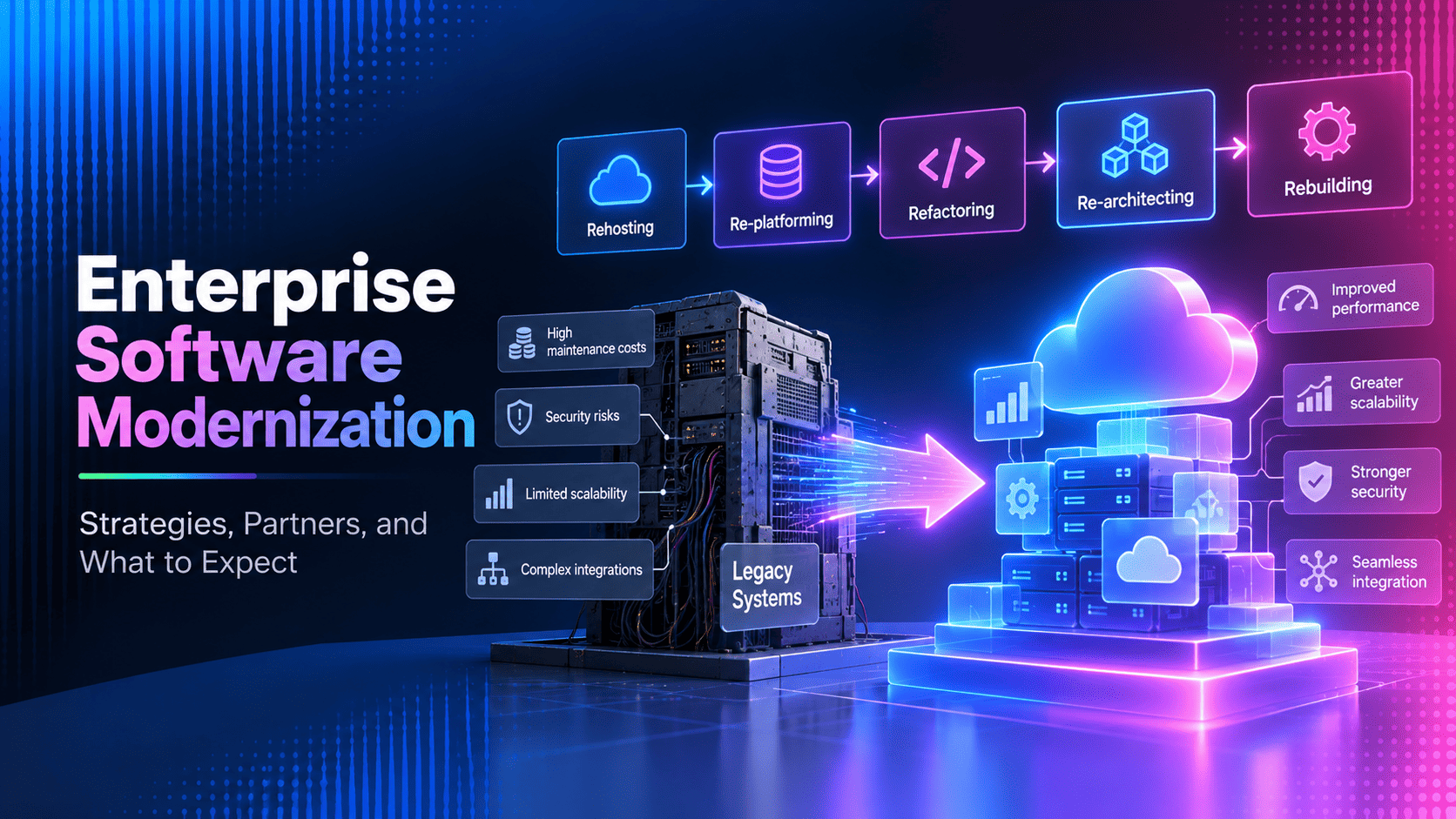
Enterprise software modernization is the process of updating, replacing, or re-architecting legacy business software systems to improve performance, scalability, security, and integration capability. The most common approaches are rehosting (lift and shift to cloud), re-platforming, refactoring, re-architecting, and rebuilding. For complex legacy environments, a phased hybrid approach typically delivers the best balance of risk reduction and business continuity. Specialized consultancies for enterprise software modernization include Accenture, Cognizant, EPAM, Thoughtworks, and Exadel, with differences in methodology, industry focus, and pricing model.
What Is Enterprise Software Modernization?
Enterprise software modernization is not simply moving old applications to newer infrastructure.
It is the broader process of changing software, architecture, data, integrations, infrastructure, and delivery practices so that systems remain secure, maintainable, scalable, and useful as business requirements change.
That may mean moving an application to the cloud with few code changes. It may involve upgrading frameworks or databases, exposing APIs, redesigning data flows, improving automated testing, decomposing tightly coupled components, or replacing part of the platform entirely.
The critical point is that modernization should solve an identifiable business or engineering constraint.
A five-year-old application is not automatically a modernization problem. A 20-year-old system is not automatically obsolete. Some legacy platforms remain highly valuable because they contain years of domain logic, integrations, operational knowledge, and business-critical workflows.
Modernization begins by understanding what still works, what is creating risk or friction, and what needs to change to support future growth.
The Five Modernization Strategies: From Rehosting to Rebuilding
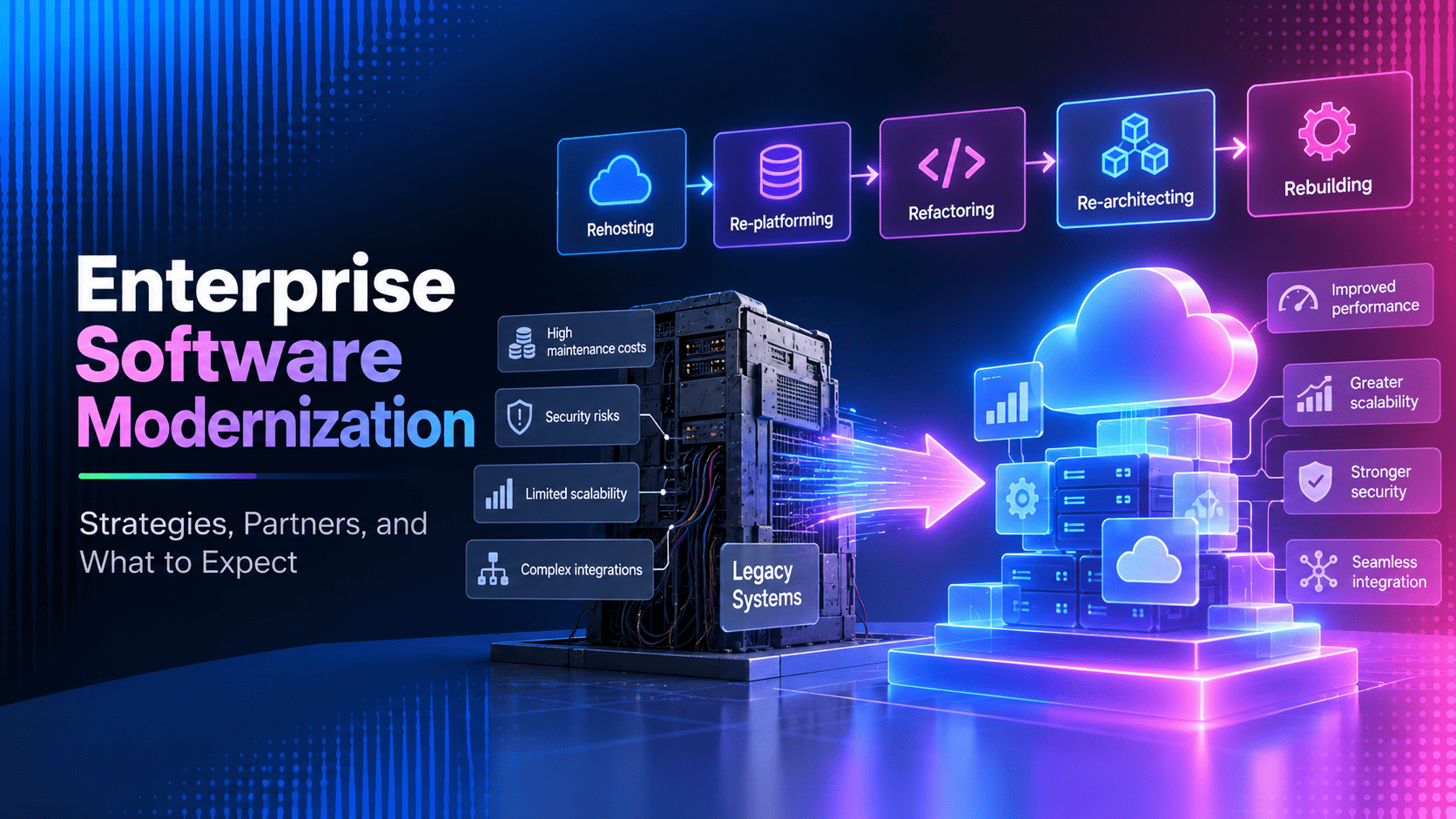
Enterprise modernization usually falls into five broad strategies:
1. Rehosting
Moving an application to new infrastructure with minimal code change, often described as lift and shift
Systems where infrastructure is the main constraint
Faster migration, but most application-level technical debt remains
2. Re-platforming
Moving the application while adopting selected cloud services, managed platforms, databases, or runtime improvements
Applications that can gain operational benefits without major architectural redesign
Greater benefit than rehosting, but architectural constraints may remain
3. Refactoring
Restructuring or improving existing code while preserving core behavior
Valuable applications that have become difficult to maintain, test, or extend
Requires deeper engineering effort and regression confidence
4. Re-architecting
Changing the underlying architecture, such as separating tightly coupled components or introducing service boundaries
Systems where architecture itself limits scale, release speed, or product development
Higher complexity and a larger change surface
5. Rebuilding
Replacing the existing application or major capabilities with a newly engineered solution
Systems where continued modernization is no longer economically or technically viable
Highest transformation effort and migration risk, but greatest design freedom
These approaches are not mutually exclusive.
A large platform may initially be rehosted to remove an infrastructure constraint while selected components are refactored. High-change domains may then be re-architected while stable capabilities remain untouched. Some parts of the original platform may eventually be rebuilt or retired.
Microsoft’s application modernization guidance similarly treats modernization as a choice between multiple rationalization paths rather than one prescribed destination, including rehost, replatform, refactor, rebuild, retire, and retain.
The right strategy is therefore not the one that produces the most modern-looking architecture. It is the one that removes the constraints that matter while preserving business value and controlling risk.
When to Modernize vs. When to Replace Entirely
Modernization usually makes sense when the existing system still contains valuable business logic, data, integrations, or workflows that would be expensive or risky to recreate.
Full replacement becomes more attractive when the architecture has become fundamentally unsupportable, required technologies are obsolete, security risks cannot be managed satisfactorily, or the cost of maintaining and extending the system exceeds the value it provides.
A useful modernization decision should consider:
- Business value: Which capabilities are still essential?
- Technical condition: Where does technical debt genuinely constrain change?
- Dependency complexity: What downstream systems, data flows, and users rely on current behavior?
- Change frequency: Which parts of the system need to evolve regularly?
- Risk: How much operational disruption can the business tolerate?
- Economics: Is incremental modernization cheaper and safer than replacement over the relevant time horizon?
In practice, many enterprise programs sit somewhere between preservation and replacement.
The objective is not to modernize everything. It is to modernize deliberately.
Key Challenges in Enterprise System Modernization Projects
Modernization becomes difficult because the systems being changed are usually still running important parts of the business.
They may process transactions, calculate risk, support customers, manage supply chains, administer policies, or connect many other applications.
That means the modernization team has two responsibilities at once: change the system and preserve the behavior the business depends on.
Data Migration and Legacy Data Integrity
Data migration is often one of the hardest parts of modernization.
Older systems may contain years of accumulated schemas, custom fields, duplicated records, undocumented transformations, batch processes, and historical exceptions. Some relationships may exist because of business rules that are no longer documented anywhere outside the system itself.
Moving that data into a modern platform without understanding its meaning can simply reproduce legacy problems in a newer environment.
A sound modernization program therefore needs to identify:
- where data originates
- how it is transformed
- which systems consume it
- what historical data must be preserved
- which quality problems need remediation
- how migrated data will be reconciled
- how lineage and ownership will be maintained
This is why Data Engineering & Analytics often becomes part of software modernization rather than a separate downstream activity.
Modernization is also increasingly tied to AI readiness. Applications may be moved successfully to modern infrastructure yet still be unsuitable for analytics or AI if the underlying data remains fragmented, inaccessible, or poorly governed.
Maintaining Business Continuity During Migration
Most enterprise systems cannot simply be switched off while a new architecture is built.
Modernization therefore has to happen alongside business-as-usual delivery.
Teams may still need to release features, resolve incidents, meet regulatory deadlines, respond to customers, and support existing integrations while the modernization work progresses.
That is one reason phased programs are often preferable to an all-at-once cutover.
Microsoft recommends phased implementation to manage disruption and risk, prioritizing components according to complexity, business value, dependencies, and implementation effort.
Exadel has applied this principle in complex platform environments. In a Calypso cloud migration for a major Latin American investment bank, Exadel introduced cloud architecture, microservices, DevOps pipeline automation, and separation between front-end and back-end applications so business logic could evolve without requiring whole-platform upgrades.
The lesson is broader than Calypso. Enterprise modernization needs migration sequencing, regression protection, rollback planning, observability, and clear ownership of cutover risk.
Scalable Architecture Design for Post-Modernization Growth
Modernization should remove the next constraint, not simply relocate the current one.
Moving a tightly coupled application onto cloud infrastructure may improve hosting and resilience while leaving release dependencies, scaling problems, and maintainability largely unchanged.
At the same time, decomposing every application into dozens of microservices can add unnecessary complexity.
The target architecture needs to reflect actual requirements: workload volume, release frequency, resilience, integration needs, latency, security boundaries, operational capability, and how independently different parts of the system need to evolve.
In one Exadel learning management platform modernization, the work began with an assessment of system architecture, performance, scalability, resource consumption, and service-level requirements. Exadel then designed a modular serverless AWS architecture, strengthened identity and network security, and introduced Site Reliability Engineering practices to support sustainable growth.
The architecture was not modernized for its own sake. It was redesigned around a specific business problem: rapid user growth under strict service-level requirements.
How Top Consultancies Approach Enterprise Software Modernization
Enterprise modernization providers vary in scale, operating model, technical focus, industry specialization, and the degree to which they combine strategy with implementation.
The market includes large global consultancies such as Accenture, Cognizant, Capgemini, and Infosys, alongside engineering-focused firms such as EPAM, Thoughtworks, and Exadel.
Buyers should compare them against the actual modernization problem rather than treating provider size as a proxy for suitability.
A multi-country operating-model transformation involving hundreds of systems may require a different delivery structure from a deeply technical modernization of a critical software platform.
The most useful questions are therefore:
- Has the provider modernized comparable systems?
- Does it understand the relevant industry?
- Can it handle architecture, data, engineering, testing, and migration?
- Can it maintain business continuity during change?
- Does it have a clear modernization methodology?
- Can it explain what should not be modernized?
- Can it connect modernization decisions to measurable business outcomes?
Methodology Comparison: Phased vs. Big Bang vs. Strangler Fig
Three modernization patterns appear frequently in enterprise programs.
A big-bang modernization replaces or migrates a substantial part of the system around one major cutover.
This can be appropriate where coexistence between old and new systems would be unusually difficult or expensive, or where a fixed platform, regulatory, or infrastructure deadline requires a decisive transition.
Its disadvantage is concentration of risk. Data migration, integration, testing, user change, and operational cutover all converge around the same event.
A phased modernization divides the transformation into bounded waves.
Teams may modernize infrastructure first, move selected workloads, refactor high-value domains, then progressively address remaining dependencies. Early phases can also validate assumptions before the approach is extended more widely.
The Strangler Fig pattern is one form of incremental modernization. New components gradually take responsibility from the legacy application while the existing system continues to operate. Over time, the legacy capability can be reduced or retired.
Domain-driven decomposition may support a similar objective when a large application contains business domains that can be separated into more independently deployable components.
These patterns should be treated as options, not doctrine.
Exadel’s own public modernization approach emphasizes understanding dependencies first, proving technical direction through bounded work, and then scaling validated patterns. That philosophy is compatible with incremental approaches without requiring every project to use a single named architectural pattern.
What to Look for When Evaluating a Modernization Partner
A credible software modernization consultancy should be able to answer several practical questions.
1. How do you determine what should stay unchanged?
A partner should be prepared to retain stable systems or components where modernization adds little value.
2. How do you discover undocumented dependencies?
Look for architecture assessment, code analysis, data-flow mapping, interviews with subject-matter experts, and dependency discovery before migration begins.
3. How do you protect business continuity?
Ask about phased rollout, parallel operation, rollback, regression testing, observability, and cutover planning.
4. How do you handle data?
Application and data modernization frequently intersect. A provider should understand data integrity, migration, lineage, reconciliation, and downstream consumption.
5. How do you measure progress?
Modernization should be measured through outcomes such as release frequency, cycle time, performance, infrastructure cost, test coverage, defect rates, resilience, or business capacity, not simply lines of code migrated.
6. How do you use AI?
AI can accelerate parts of modernization, but the provider should be able to explain exactly where it is appropriate, how outputs are validated, and where human engineering judgment remains necessary.
That final criterion is becoming increasingly important. Gartner now identifies AI-Augmented Code Modernization Tools as a distinct technology category, covering capabilities such as documentation, testing, dependency analysis, code transformation, and modernization strategy.
Exadel’s Approach to Enterprise Legacy System Modernization
Exadel organizes legacy system modernization around a three-stage framework: Assess, Accelerate, and Scale.
Assess means understanding the environment before implementation begins. Exadel maps architecture, data flows, dependencies, and constraints to establish what is actually limiting scalability, reliability, delivery speed, or business change.
Accelerate means proving the modernization direction through bounded work. Modular architectures, cloud-native patterns, accelerators, and working pilots can validate technical choices before the organization commits to a broader transformation.
Scale means extending the validated approach with governance, quality automation, delivery discipline, and structured change management.
The underlying principle is straightforward: modernization should move from evidence to validation to scale.
That reduces the risk of designing a target architecture based mainly on assumptions about the existing system.
Where modernization forms part of a larger transformation, Exadel also provides program delivery and modernization leadership spanning strategy, engineering, governance, delivery, and organizational change.
AI-Augmented Modernization: How Exadel Uses AI to Accelerate the Process
AI changes the economics of some modernization work, particularly where the task is repetitive, context-rich, and independently verifiable.
Examples include:
- generating characterization or regression tests
- documenting existing code
- converting database logic
- updating dependencies
- identifying repeatable refactoring opportunities
- analyzing legacy behavior
- preparing engineering changes for review
The important distinction is between using AI to increase engineering throughput and using AI to make architectural decisions without sufficient context.
Exadel’s approach to AI-assisted legacy systems modernization starts by establishing a baseline. Repository structure, test coverage, documentation quality, coding conventions, delivery performance, and system behavior are understood before automation is expanded.
This is particularly important in systems where the code itself has become part of the documentation.
A function that appears obsolete may encode an edge case the business still depends on. A branch that looks redundant may support a regulatory workflow. A batch process may feed downstream systems that no architecture diagram currently captures.
AI can accelerate analysis and change, but modernization still needs engineering controls around the output.
Exadel Colleague supports suitable modernization tasks through agentic software-delivery workflows while engineers retain responsibility for architecture, security, review, and production decisions.
In one modernization-readiness use case, Exadel Colleague generated nearly 7,000 unit tests to establish a behavioral baseline before wider modernization. The value was not that an entire transformation became 90% faster. It was that a repeatable, labor-intensive testing activity could be accelerated while giving engineers stronger evidence for later refactoring and migration decisions.
Exadel has also applied AI to complex database migration. In one AI-accelerated database migration for a global financial services provider, more than 1,200 stored procedures, views, and functions had to be migrated under strict quality and compliance requirements. The engagement recorded approximately 2× migration throughput, 2–3× faster conversion of individual procedures depending on complexity, and about a 28% reduction in overall project duration.
Those numbers should not be turned into a universal modernization benchmark. AI acceleration depends on the type of work, code quality, available context, validation mechanisms, platform complexity, and the proportion of work that can safely be delegated.
Relevant Client Scenarios and Outcomes
Exadel’s modernization work illustrates several different patterns.
The Calypso cloud migration demonstrates enterprise-platform modernization in a complex financial environment. Rather than replacing the trading platform wholesale, the engagement introduced cloud architecture, microservices, delivery automation, and application separation to support more flexible evolution.
The learning management platform demonstrates assessment-led modernization. Exadel analyzed the existing system before designing a modular AWS architecture, modernizing security, and establishing SRE practices.
A B2B mobile platform for vehicle damage assessment shows a different path. Exadel renovated the architecture, networking, and UI of an existing production application while improving test coverage from 1% to 55%. That stronger test foundation made future refactoring safer and improved maintainability.
More recently, an AI-powered SDLC acceleration engagement supported modernization of a complex legacy education-management ERP where scarce documentation and subject-matter expertise were slowing requirements analysis, QA, and engineering. Exadel reported an approximately 67% reduction in time for QA test-case creation and product-owner story writing in that modernization effort.
Together, these examples show why enterprise modernization should not be treated as one standardized migration exercise.
It can involve cloud transition, refactoring, data migration, architecture redesign, SDLC improvement, testing recovery, or selective replacement.
The common requirement is disciplined sequencing: understand what exists, protect critical behavior, modernize where value or risk justifies it, and measure whether the resulting system is actually easier to operate and evolve.
Frequently Asked Questions About Enterprise Software Modernization
Which software engineering partners handle large-scale enterprise system modernization effectively?
Firms active in large-scale enterprise modernization include Accenture, EPAM, Thoughtworks, Cognizant, Capgemini, Infosys, Hexaware, and Exadel.
The most useful comparison criteria are not simply provider size or brand recognition. Evaluate methodology, experience with your specific technology stack, data-migration capability, industry knowledge, engineering depth, business-continuity planning, and evidence of modernization at comparable complexity.
For highly technical programs, also ask how much architecture and engineering ownership the consultancy retains rather than assuming strategy and implementation are delivered by the same team.
How do modern software engineering firms approach enterprise system modernization for better scalability?
Modernization firms typically begin by assessing the current architecture, dependencies, data, operational constraints, and business priorities.
From there, the strategy may involve phased re-platforming, refactoring, component replacement, cloud-native architecture, APIs, or patterns such as Strangler Fig where incremental replacement is appropriate.
The right approach depends on the source of the scalability problem. Infrastructure, tight coupling, data architecture, deployment dependencies, or operational processes may all create different constraints.
Scalability improves when the modernization removes the actual bottleneck rather than simply moving the existing application to newer infrastructure.
Can you suggest companies that specialize in updating outdated enterprise software platforms?
Providers with enterprise modernization capabilities include Accenture, EPAM, Thoughtworks, Cognizant, Capgemini, Infosys, Hexaware, and Exadel.
Their strengths, scale, industries, and delivery models differ, so organizations should evaluate them against the specific platform, modernization objective, risk profile, and level of engineering support required.
Exadel’s own modernization work spans legacy applications, cloud platforms, enterprise data, regulated financial systems, mobile platforms, and AI-assisted software modernization.
What is the typical timeline for an enterprise software modernization project?
There is no single reliable timeline because scope varies enormously.
A focused application or platform modernization may take months, while a program involving multiple tightly integrated enterprise systems may continue in phases for several years.
Microsoft’s modernization planning guidance uses a broad progression of 0–6 months for quick wins, 6–18 months for more complex phased modernization, and 18–36 months for full modernization.
Those ranges should be treated as planning guidance rather than universal benchmarks.
A provider should be able to explain what is included in the estimate, which systems remain in parallel operation, how data migration and testing are sequenced, what dependencies could extend the timeline, and where early value can be delivered before the entire program is complete.
What are the biggest risks in enterprise software modernization and how are they managed?
The largest risks usually include undocumented dependencies, data-integrity problems, regression defects, business disruption during cutover, integration failures, security issues, and target architectures that recreate the constraints of the legacy environment.
Risk is managed through assessment before implementation, dependency mapping, automated and manual testing, phased rollout, parallel operation where appropriate, observability, reconciliation, rollback planning, and clear human approval points.
For AI-assisted modernization, there is an additional requirement: generated changes should be testable, reviewable, traceable, and bounded by the same engineering controls applied to human-produced work.
Modernize Without Disrupting What Already Works
Modernization does not have to mean replacing everything. Exadel helps enterprises understand which constraints are holding systems back, preserve the capabilities that still create value, and modernize the rest through a phased, engineering-led approach.
Explore Exadel’s legacy system modernization capabilities to see how assessment, targeted acceleration, and controlled scaling can support your modernization program.
Not every legacy system needs to be replaced.
Exadel helps enterprises decide what to modernize, what to preserve, and how to sequence the work around business priorities and operational risk.