
Tags
Share
AI is changing data engineering in two directions at the same time. Yes, I know that sounds strange!
First, AI applications are placing new demands on the data platform. Models, retrieval-augmented generation systems, and agents may require structured and unstructured information, low-latency feeds, embeddings, metadata, lineage, permissions, and continuously monitored data quality.
Second, AI is changing how engineers build that infrastructure.
dbt Labs’ 2026 State of Analytics Engineering Report found that 72% of respondents now prioritize AI-assisted coding in development workflows. Yet only 24% prioritize AI-assisted pipeline management, including testing and observability. The contrast captures an important challenge: organizations are getting much better at generating data code quickly, but the controls required to make those pipelines reliable are not advancing at the same speed.
This is where AI data engineering is emerging as a distinct enterprise capability.
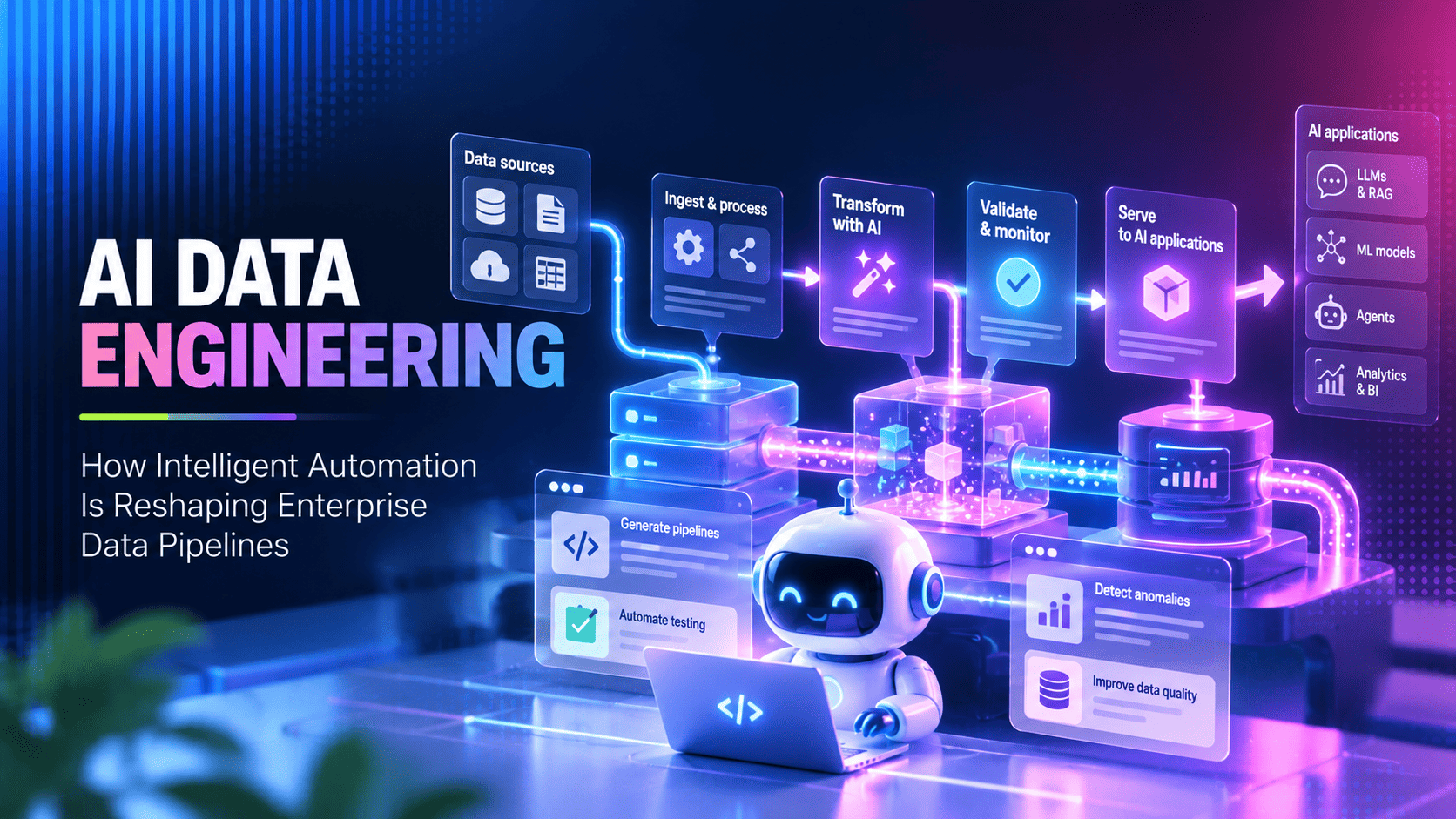
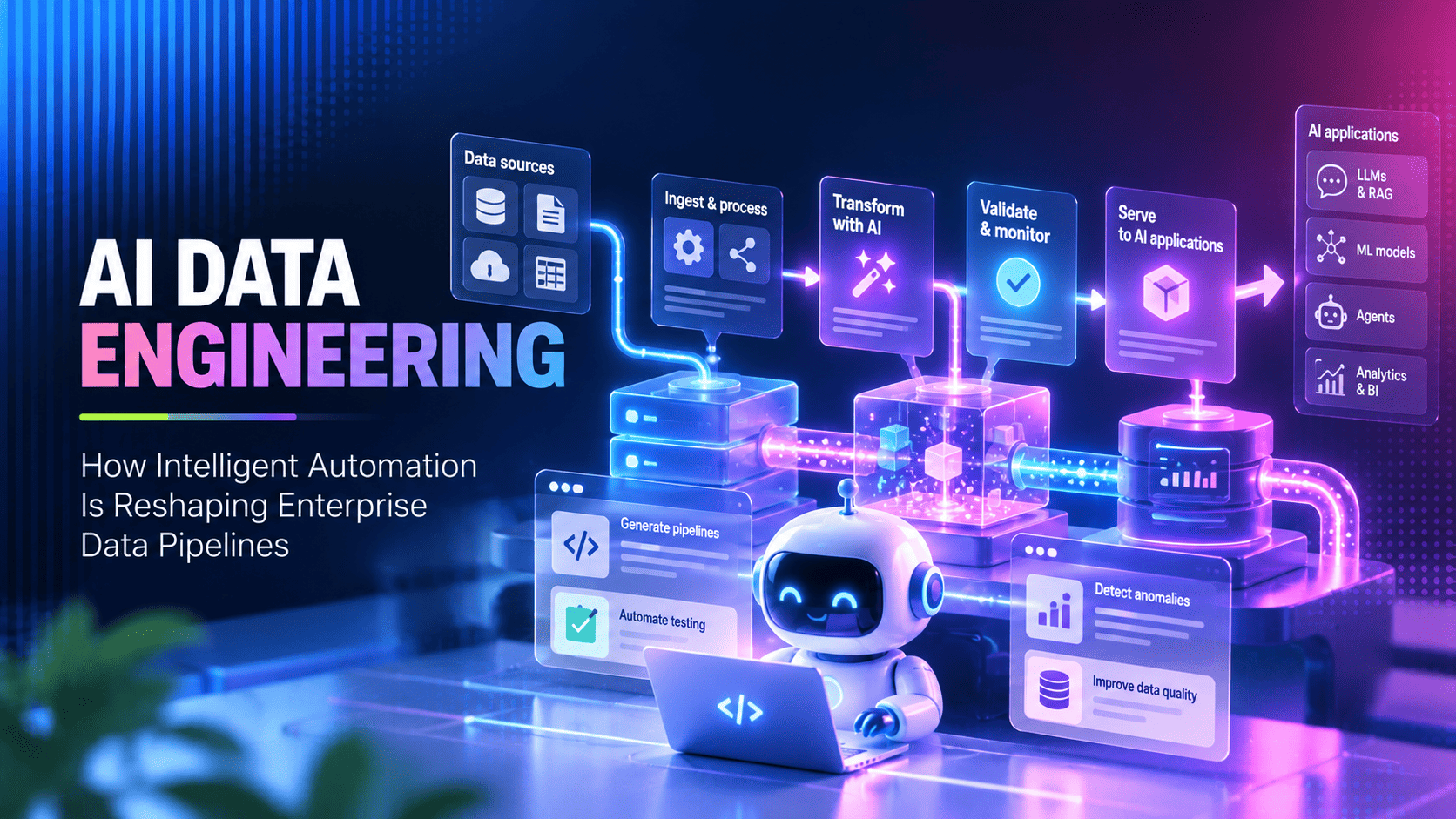
AI data engineering combines traditional data-engineering disciplines—ingestion, transformation, storage, orchestration, quality, and governance—with AI-assisted engineering and the infrastructure required to support machine learning, generative AI, and agentic applications.
The objective is not simply to build more pipelines faster. It is to make data engineering more automated while making the resulting data more trustworthy, timely, observable, and useful to AI systems in production.
What Is AI Data Engineering?
AI data engineering is the practice of designing, building, automating, and operating the data infrastructure required by modern AI systems while using AI itself to accelerate parts of the engineering lifecycle.
That creates two distinct forms of AI involvement.
AI for data engineering uses generative AI and intelligent automation to help engineers write transformations, generate tests, document datasets, investigate incidents, and maintain pipelines.
Data engineering for AI builds the infrastructure AI applications need: reliable ingestion, feature pipelines, streaming data, vector retrieval, unstructured-data processing, lineage, governance, and connections to machine-learning and model-serving systems.
The two increasingly converge.
An engineer may use AI to generate part of a transformation pipeline while simultaneously building that pipeline to feed a recommendation model, a RAG application, or an enterprise agent.
That is why the strongest AI data engineering teams still need deep engineering expertise. Generating SQL or Python is only one step. Someone must understand whether the resulting pipeline represents the business correctly, performs at scale, respects permissions, recovers from failure, and produces data that downstream systems can trust.
AI data consulting can help define what that environment should look like; AI data engineering makes it operational.


Your AI Partner
Build AI-ready data pipelines.
Exadel engineers governed data platforms that support analytics, machine learning, and production AI.
How AI Is Changing the Data Engineer’s Role
The simplest interpretation of AI and data engineering is that engineers will write less code.
That is partly true, but it misses the larger change.
dbt Labs describes AI-assisted development as shifting data engineers away from repetitive creation and maintenance work toward higher-value responsibilities involving platform reliability, automation, governance, and business context.
The result is not the disappearance of data engineering. It is a change in where engineering effort creates the most value.
dbt has compared this effect to Jevon’s Paradox: when a capability becomes faster and cheaper, demand for it can increase rather than disappear. If teams can build individual data products more quickly, organizations are likely to request more of them—and expect more sophisticated platforms underneath them.
From Pipeline Builder to Platform Architect
Traditional data engineers may spend significant time writing ingestion jobs, transformations, orchestration logic, tests, and documentation.
Those responsibilities remain, but increasingly the harder questions sit above the individual pipeline:
- Which patterns should teams reuse?
- How should data products be governed?
- Which workloads need streaming rather than batch?
- How are permissions propagated into AI applications?
- How are structured and unstructured data managed together?
- How should lineage extend into models and retrieval systems?
- How can teams detect the downstream impact of a failed dataset?
- How can platform cost remain predictable as AI demand increases?
The engineer therefore moves closer to platform architecture: establishing the reusable systems within which pipelines can be created safely and quickly.
AI-Assisted Code Generation and Pipeline Authoring
Code generation is the most visible form of data engineering automation.
Tools can already help generate:
- SQL transformations
- Python ingestion logic
- Schema definitions
- YAML configuration
- Data-quality tests
- Documentation
- Mapping logic
- API integrations
- Boilerplate orchestration code
dbt’s current guidance describes AI using contextual information from schemas, existing models, tests, documentation, and metrics to generate first drafts of engineering artifacts.
The important word is contextual.
Generic code generation is much less useful than generation grounded in the organization’s actual data model and standards.
AI can accelerate the first draft. The engineer remains responsible for whether that draft is correct.
The strongest workflow therefore becomes:
Intent → AI-assisted draft → engineer review → automated testing → controlled deployment → production monitoring
rather than:
Prompt → production
Automated Incident Detection and Resolution
Pipeline maintenance is another area where AI can reduce repetitive work.
Traditional observability tools identify symptoms: a job failed, a table arrived late, schema changed, or data volume dropped unexpectedly.
AI-assisted systems can help correlate those signals with:
- Lineage
- Recent code changes
- Orchestration logs
- Schema history
- Downstream dependencies
- Prior incidents
- Metadata and documentation
The system may then propose a likely root cause or generate a candidate fix.
That changes incident response from:
Alert → manual investigation → diagnosis → repair
toward:
Alert → contextual diagnosis → proposed remediation → engineer validation → tested recovery
The important control remains the validation step. An autonomously generated fix that restores a pipeline while silently changing business logic is not a successful incident response.
AI is not removing the data engineer from the lifecycle; it is shifting engineering effort from repetitive pipeline creation toward architecture, validation, automation, governance, and production reliability.
AI is not removing the data engineer from the lifecycle; it is shifting engineering effort from repetitive pipeline creation toward architecture, validation, automation, governance, and production reliability.
Core Components of an AI Data Engineering Stack
There is no universal AI data engineering stack.
The right architecture depends on workload, scale, latency, cost, security, skills, existing platforms, and the AI applications the organization needs to support.
Databricks’ current reference architectures illustrate the broader pattern: source systems feed ingestion and streaming layers, transformation and processing, governed storage, serving, and analytical or AI consumption.
The particular technologies vary, but those architectural functions remain connected.
Ingestion and Streaming Infrastructure
What it is: Ingestion moves data from operational systems, applications, files, sensors, APIs, and external sources into the data platform.
AI broadens the requirement because input may now include documents, images, event streams, telemetry, interaction histories, and other information beyond conventional structured business data.
It also makes freshness more use-case dependent.
A financial report may tolerate daily data. Fraud detection, recommendations, dynamic pricing, or equipment monitoring may need signals within seconds.
Modern options include batch ingestion alongside technologies such as Kafka, Kinesis, and Flink for event-driven workloads.
The correct principle is not “everything must become real time.”
It is:
Data should arrive within the decision window of the AI system consuming it.
Transformation and Feature Engineering
What it is: Transformation turns raw information into consistent, tested, reusable datasets and features.
Tools such as dbt, SQL, Python, and Apache Spark continue to perform this work, but AI changes both how transformations are created and what they produce.
A traditional analytical model may transform sales transactions into weekly revenue.
An AI pipeline may additionally create:
- ML features
- Embeddings
- Chunks from long documents
- Normalized metadata
- Entity relationships
- Vector-search indexes
- AI evaluation datasets
AI can help generate transformations and tests, but semantic accuracy becomes even more important.
If an AI assistant generates syntactically perfect SQL using the wrong definition of “active customer,” the pipeline is still wrong.
Good AI data engineering therefore combines automation with a reliable semantic foundation: business definitions, metadata, tests, contracts, and ownership.
Data Quality and Observability
What it is: Data quality establishes whether information is sufficiently accurate, complete, consistent, and timely; observability monitors whether the system continues behaving as expected.
AI increases the importance of both because flawed information can flow directly into automated recommendations or generated outputs.
dbt’s 2026 research found that 83% of respondents now treat trust in data and data teams as a priority, while 71% were concerned about incorrect or hallucinated data reaching stakeholders.
An AI-ready observability layer may monitor:
- Freshness
- Volume
- Schema
- Validity
- Distribution
- Lineage
- Pipeline failures
- Downstream dependencies
- Model features
- Retrieval quality
- Cost and performance
The aim is not merely to announce that something broke.
It is to know what changed, why it matters, and what downstream AI capability may now be affected.
MLOps and Model Pipeline Integration
What it is: MLOps connects data preparation to model training, evaluation, deployment, monitoring, and controlled updating.
Traditional data pipelines often ended at a warehouse, dashboard, or application.
AI data pipelines may continue into:
Data → features → training → evaluation → model registry → deployment → inference → monitoring → feedback
Generative AI adds other paths:
Documents → processing → chunking → embeddings → retrieval index → model → evaluation → feedback
Tools may include orchestration platforms such as Airflow or Dagster, model and feature infrastructure, cloud ML services, vector databases, and LLM frameworks such as LangChain.
The precise combination is workload-dependent.
What matters is that the data and model lifecycles are engineered together rather than treated as separate environments.
AI Engineering services connect model pipelines, MLOps, integrations, governance, and production operations around that same principle.
Modern AI data engineering connects the data lifecycle to the model lifecycle, creating one production system from ingestion through intelligence, monitoring, and feedback.
Connect data engineering to production AI.
Build the pipelines, controls, and model infrastructure needed to move AI beyond experimentation.
AI Data Engineering vs. Traditional Data Engineering: Key Differences
AI data engineering does not replace traditional data engineering. It extends it.
Primary consumer
BI, reporting, applications
Analytics, ML, GenAI, RAG, agents
Data types
Predominantly structured/semi-structured
Structured + large volumes of unstructured data
Pipeline development
Primarily engineer-authored
Increasingly AI-assisted
Latency
Often batch-oriented
Batch, near-real-time, or streaming according to workload
Transformations
Datasets + features + embeddings + retrieval assets
Quality
Accuracy and reporting consistency
Also model/retrieval reliability and downstream AI behavior
Pipeline + lineage + AI dependency impact
Governance
Access, quality, retention, lineage
Also model access, provenance, retrieval, sensitive AI use
Destination
Warehouse/lake/application
Training, inference, RAG, agents, analytics, applications
Engineer focus
Build and maintain pipelines
Architecture, automation, reliability, governance, AI enablement
The underlying engineering fundamentals do not disappear. If anything, AI makes them more important. The difference is that mistakes can now propagate further and faster.
What AI Data Engineers Actually Do: Skills, Tools, and Responsibilities
Modern AI data engineering requires breadth.
The purpose of the following list is not to suggest that every engineer must be an expert in every platform. It shows the capability mix an enterprise team collectively needs.
Python
Python remains important for ingestion, transformation, APIs, ML integration, data processing, automation, and custom AI workflows.
AI assistants can generate Python quickly; engineers still need to review performance, error handling, security, dependencies, and business logic.
SQL and NoSQL
SQL remains fundamental because much enterprise information lives in relational or analytical platforms.
NoSQL technologies matter where workloads require flexible documents, key-value access, graphs, or specialized operational patterns.
Apache Spark
Spark supports distributed processing across large datasets and remains relevant for batch processing, transformation, feature engineering, and ML-oriented data preparation.
Kafka and Streaming Platforms
Kafka and equivalent cloud-native services enable event-driven data flows.
Engineers need to understand topics, partitions, ordering, schemas, replay, state, reliability, and how streaming changes downstream architecture.
dbt
dbt and similar transformation frameworks bring modular development, testing, documentation, lineage, and reusable models into analytical data workflows.
AI can accelerate artifact creation, but disciplined transformation and semantic consistency remain critical.
Airflow and Dagster
Orchestration tools coordinate dependencies between ingestion, transformation, validation, model, and operational tasks.
As workflows become more dynamic, engineers increasingly need to think about recoverability, observability, event-driven execution, and dependency management rather than simple scheduling.
Vector Databases and Vector Search
Technologies such as Pinecone, Weaviate, and vector capabilities within wider data platforms support semantic retrieval for RAG and other GenAI use cases.
The engineering challenge extends beyond creating embeddings. Teams must manage document permissions, updates, metadata, chunking, retrieval quality, and stale content.
LLM Frameworks
Frameworks such as LangChain can help connect models to retrieval, tools, workflows, and applications.
Data engineers increasingly participate because those systems depend heavily on how enterprise information is retrieved and contextualized.
Cloud Platforms
AWS, Azure, and Google Cloud provide extensive data, streaming, ML, storage, security, and orchestration capabilities.
Platform knowledge matters, but architecture should remain driven by the workload rather than by a predetermined product.
How to Build an AI-Ready Data Engineering Capability
The practical enterprise question is rarely:
Should we have AI data engineering?
It is:
Which parts should we develop internally, which should we automate, and where would specialist engineering accelerate us?
1. Assess the Current Team
Start with capabilities, not job titles.
Map the team’s experience across:
- Data architecture
- Cloud infrastructure
- Batch and streaming
- Transformation
- Platform engineering
- Governance
- Security
- Observability
- ML pipelines
- Unstructured data
- Vector retrieval
- AI application integration
This identifies whether the organization needs new hiring, upskilling, tooling, or external expertise.
2. Automate the Repeatable Work
AI assistance is particularly useful for:
- First-draft transformations
- Documentation
- Test generation
- Mapping
- Boilerplate ingestion
- SQL refactoring
- Incident investigation
- Code explanation
These tasks should become faster.
But automation should sit inside engineering controls: version control, testing, peer review, deployment pipelines, observability, and defined ownership.
3. Keep Domain Meaning and Accountability Close to the Business
Some capabilities are difficult to outsource completely.
Internal teams need to own:
- Business definitions
- Data ownership
- Risk tolerance
- Access decisions
- Regulatory obligations
- Critical workflow knowledge
- Success measures
A specialist partner can help implement the platform. It should not become the only organization that understands what the data means.
4. Decide Where Partnership Shortens Time-to-Production
External engineering makes the most sense where an organization faces a capability or delivery gap that would take too long to fill through hiring alone.
Examples include:
- Large-scale cloud modernization
- Streaming architectures
- Databricks or Snowflake transformation
- ML and MLOps integration
- Complex data migration
- Observability
- RAG infrastructure
- Enterprise governance implementation
The best operating model is often not build or buy, but build with enablement: use specialist expertise to accelerate the difficult engineering while deliberately transferring architecture, patterns, operating knowledge, and ownership into the internal team.
That reflects the wider approach to AI consulting services where consulting, engineering services, and enablement should reinforce one another rather than become separate engagements.
How Exadel Builds and Modernizes Data Engineering Infrastructure
At Exadel, our data strategy and engineering work stay closely connected.
Our Data Engineering & Analytics Practice covers data assessment, cloud-native architecture, ingestion, batch and streaming pipelines, lakehouse and warehouse modernization, quality, governance, analytics infrastructure, and AI-ready data foundations.
Exadel publicly describes certified engineering expertise across AWS, Azure, GCP, Databricks, Snowflake, and other data ecosystems, with architectures designed for data science, machine learning, and generative AI.
That technical ecosystem depth matters because modern AI data engineering rarely lives inside one tool.
It may require cloud infrastructure, transformation frameworks, streaming platforms, orchestration, ML infrastructure, vector retrieval, observability, security, and production application integration.
Our wider partnerships with Cursor, Anthropic, and OpenAI, together with certified practitioners, add another layer of practical expertise around the AI systems consuming those data foundations.
The value for the client is not the logos themselves.
It is being able to work with engineers who understand both sides of the dependency:
What the AI workload requires from data—and what the data platform must do to provide it reliably.
Technology selection remains requirement-driven. Scale, latency, security, governance, cost, integration, skills, and the existing architecture determine which combination is appropriate.
We do not define differentiation as being “vendor-agnostic.”
We define it as having enough depth across leading ecosystems to make informed choices and then engineer them successfully.
That engineering-first model also shapes how we deliver. The people helping determine the architecture remain connected to the teams building pipelines, integrations, controls, and production systems.
For one retail pricing engagement, Exadel designed and engineered a cloud-native data foundation capable of piping, storing, and serving large, diverse datasets for AI-powered pricing, promotion, and assortment applications. Standardized pipelines and warehousing improved the environment supporting ML and application development.
In another public modernization engagement, Exadel created a governed lakehouse foundation combining batch and streaming pipelines, improving data consistency and enabling near-real-time reporting while establishing a scalable base for advanced analytics and machine-learning workloads.
But production delivery is only part of the goal.
Enablement means working with the client’s architects, engineers, platform owners, and governance teams so that reusable patterns, controls, documentation, and operational knowledge become internal capability rather than remaining with an external supplier.
The measure of a successful AI data engineering engagement is therefore not how much code the partner produces.
It is whether the organization ends up with a reliable data platform, faster engineering capability, stronger internal ownership, and an architecture capable of supporting the next AI workload as well as the first one.
Frequently Asked Questions
What Is the Difference Between a Data Engineer and an AI Data Engineer?
A traditional data engineer builds and operates infrastructure that moves, transforms, stores, and serves enterprise data. An AI data engineer performs those same foundational tasks but also designs data systems for machine learning, generative AI, RAG, and agentic workloads.
That may involve feature pipelines, vector retrieval, embeddings, unstructured data, lower-latency ingestion, MLOps integration, and AI-specific governance.
AI data engineers also increasingly use generative AI to accelerate coding, testing, documentation, and maintenance.
The distinction is therefore less about replacing traditional skills than extending them to new consumers and more automated engineering workflows.
Is AI Replacing Data Engineers?
No. AI is automating parts of data-engineering work, but it is also increasing demand for reliable data infrastructure.
AI can generate SQL, Python, documentation, tests, and initial troubleshooting suggestions. Engineers are consequently able to spend less time on repetitive implementation and more time on architecture, platform reliability, governance, automation, semantics, and AI integration.
dbt’s current research reflects this shift: AI-assisted coding is already widely embedded, while reliability, ownership, and governance remain major concerns.
The role is changing more quickly than the need for it is disappearing.
What Tools Does an AI Data Engineer Use?
AI data engineers may use Python, SQL, Spark, Kafka, dbt, Airflow or Dagster, cloud platforms such as AWS, Azure, or GCP, and data platforms such as Databricks or Snowflake.
AI workloads may add feature stores, model infrastructure, vector search or databases such as Pinecone and Weaviate, and LLM frameworks such as LangChain. AI coding assistants are increasingly part of the workflow as well.
No single stack defines AI data engineering. The appropriate technologies depend on data types, latency, workload scale, governance, security, skills, and existing architecture.
How Does AI Improve Data Pipeline Reliability?
AI can improve pipeline reliability by helping engineers detect anomalies, correlate failures with lineage and recent changes, diagnose likely root causes, generate tests, and propose remediation.
For example, an observability system may detect that a downstream dataset has changed unexpectedly and use metadata, schema history, pipeline logs, and dependencies to identify the likely source.
AI should augment rather than bypass engineering controls. Proposed fixes still need appropriate testing, review, deployment controls, and monitoring so that restoring a pipeline does not introduce an unnoticed change in business logic.
Modernize data engineering for AI.
Exadel helps build reliable pipelines and platforms for production AI.