
Tags
Share
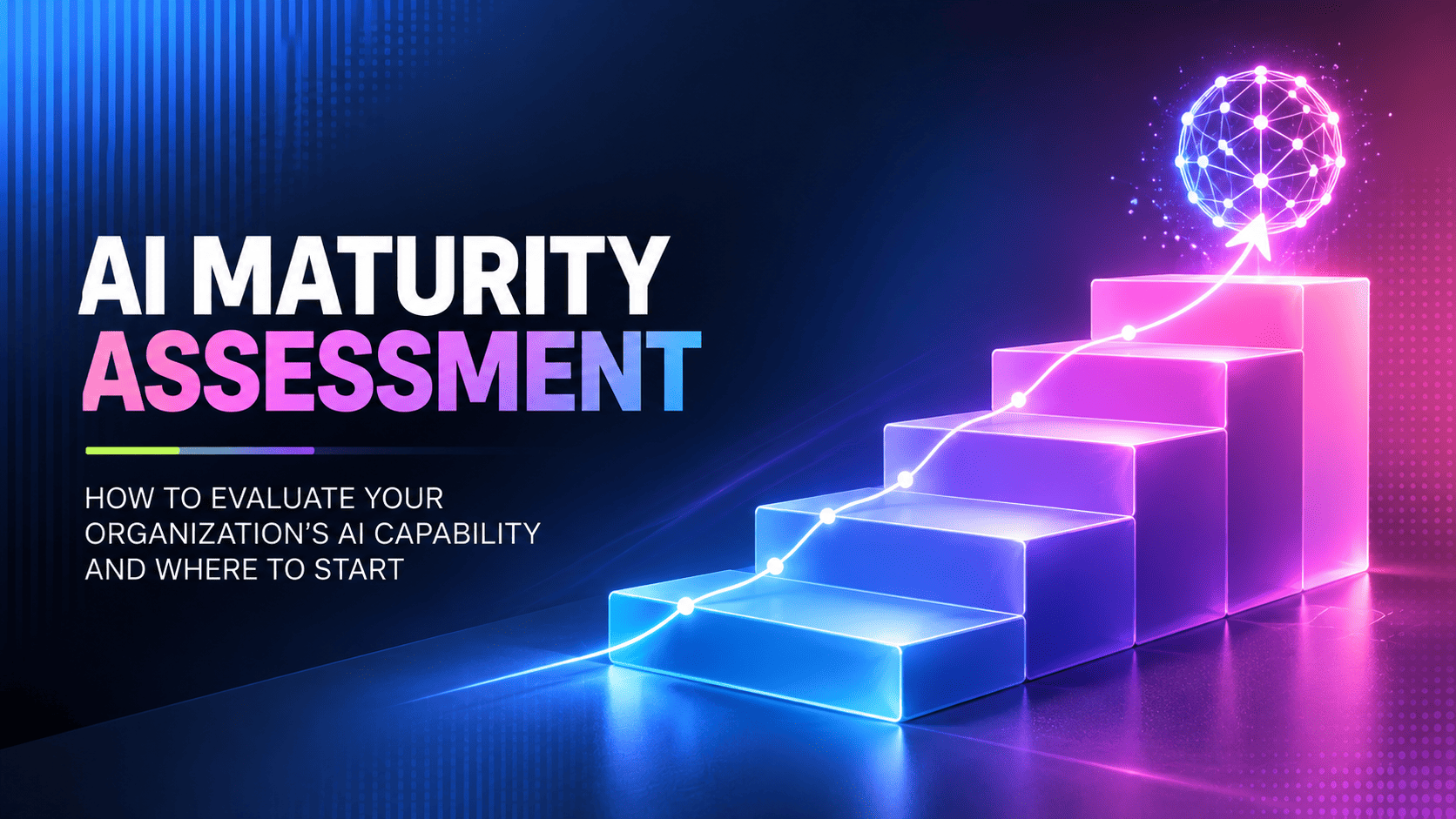
An AI maturity assessment measures how advanced an organization's AI capabilities are across five dimensions: strategy and leadership alignment, data infrastructure and quality, model development and deployment practices, AI governance and ethics, and business integration of AI outputs. Exadel’s published five-stage model describes organizational progress as Aware, Experimenting, Developing, Scaling, and Transformational. Exadel’s AI Maturity & Readiness Assessment then evaluates the organization across six operating-model domains to identify current capability, gaps, risks, and the path forward.
What Is an AI Maturity Assessment?
AI maturity is not a count of pilots, models, tools, or software licenses.
It measures how consistently an organization can turn AI into a repeatable, governed, measurable business capability.
A company may have multiple proofs of concept and still be relatively immature if every initiative depends on a different team, manually prepared data, one-off integrations, informal approvals, or specialist knowledge that cannot easily be reproduced elsewhere.
More mature organizations operate differently. AI use cases are connected to business priorities. Data, technology, governance, ownership, and funding become repeatable rather than improvised. Models can move into production, be monitored after deployment, and demonstrate measurable value.
That makes AI maturity different from AI readiness.
Readiness asks whether the organization has the foundations necessary to take its next step successfully. Maturity asks how far the organization has already progressed, what capability it can demonstrate today, and what prevents it from advancing further.
Exadel treats readiness and maturity as two lenses within the same assessment rather than separate assessments. An organization can be active with AI but unready to scale, or have strong foundations while remaining relatively early in its AI adoption journey.
Exadel’s existing guide to AI readiness vs AI maturity explores that distinction in more detail.
Our more detailed AI readiness assessment article and guide examines the foundations required to execute and scale AI.
The distinction matters because AI adoption is widespread while enterprise-scale execution remains much less common. McKinsey’s 2025 State of AI survey found that 88% of organizations were using AI in at least one business function, but only 7% reported that AI had been fully scaled across the organization.
Along with Oxford Economics, Service Now's Enterprise AI Maturity Index points to a similar gap. In its 2025 survey of just under 4,500 executives, fewer than 1% of respondents scored above 50 on its 100-point AI maturity scale.
The problem, in other words, is increasingly not whether enterprises are doing something with AI. It is whether they can turn that activity into a capability that works repeatedly.
The Five Dimensions of AI Maturity
At a general level, five dimensions provide a practical way to understand whether AI capability is becoming embedded across the enterprise. Exadel’s own assessment methodology, covered later in this guide, operationalizes that evaluation through six broader domains.
Strategy and Leadership Alignment
At low maturity, AI tends to appear as a collection of experiments.
Different teams pursue different tools and use cases, often because the technology is available rather than because the organization has agreed where AI can create the greatest value.
As maturity increases, AI becomes connected to business priorities, investment decisions, ownership, and executive accountability.
Important questions include:
- Which business problems should AI solve?
- Who owns a use case beyond the pilot?
- How are competing AI initiatives prioritized?
- What determines whether an initiative proceeds, pauses, or stops?
- How will value be measured?
A mature organization does not simply possess an AI strategy document. It has mechanisms for turning strategy into repeatable execution.
Data Infrastructure and Quality
AI maturity depends heavily on whether the organization can repeatedly access trusted, governed, usable data.
At lower maturity levels, pilots may survive through manual data preparation, local extracts, spreadsheets, or the expertise of a few people who know where everything lives.
That does not scale.
As maturity increases, data quality, lineage, ownership, accessibility, privacy, observability, and pipeline reliability become part of the operating environment rather than something reconstructed for each use case.
This makes Data Engineering & Analytics central to AI maturity. Models cannot mature faster than the data systems supporting them.
Model Development and Deployment Practices
A prototype demonstrates that an idea may work.
Maturity is demonstrated when an organization can build, test, deploy, monitor, update, and retire AI systems consistently.
That requires production engineering disciplines such as MLOps or LLMOps, version control, automated testing, monitoring, observability, rollback, model-performance tracking, and clear ownership after deployment.
At lower maturity levels, every deployment can feel like a special project. At higher maturity levels, teams reuse platforms, controls, engineering patterns, and deployment practices across multiple use cases.
Exadel’s AI Engineering capabilities focus on this transition from models and pilots to scalable production systems.
AI Governance and Responsible AI
Governance maturity is visible in when risk is considered.
At lower maturity levels, questions about data use, model behavior, security, bias, human oversight, accountability, and regulatory exposure often arrive after a pilot is already close to production.
Higher maturity moves those questions earlier.
Organizations establish responsibilities, review processes, acceptable-use policies, monitoring requirements, escalation routes, and human-control points before AI systems become business-critical.
External frameworks can help organizations structure that work. The NIST AI Risk Management Framework provides a voluntary framework for managing AI-related risks and incorporating trustworthiness considerations across the AI lifecycle.
For organizations operating in the European Union, the EU AI Act establishes a risk-based regulatory framework with obligations that vary according to the type and risk level of an AI system.
These are useful external reference points rather than formal components of Exadel’s proprietary assessment methodology.
Business Integration of AI Outputs
AI becomes more mature when it stops living primarily in laboratories, demonstrations, or isolated applications.
Its outputs become part of actual decisions, workflows, products, services, and customer or employee experiences.
That requires more than technical integration. It requires adoption.
Teams need to understand when to use an AI output, when to challenge it, who remains accountable, how it changes existing roles, and how success will be measured.
The relevant questions therefore move from:
“How many pilots are running?”
to:
“What has changed in cost, revenue, productivity, risk, customer experience, service quality, or decision speed because this capability exists?”
The AI Maturity Scale: What Levels 1 through 5 Mean in Practice
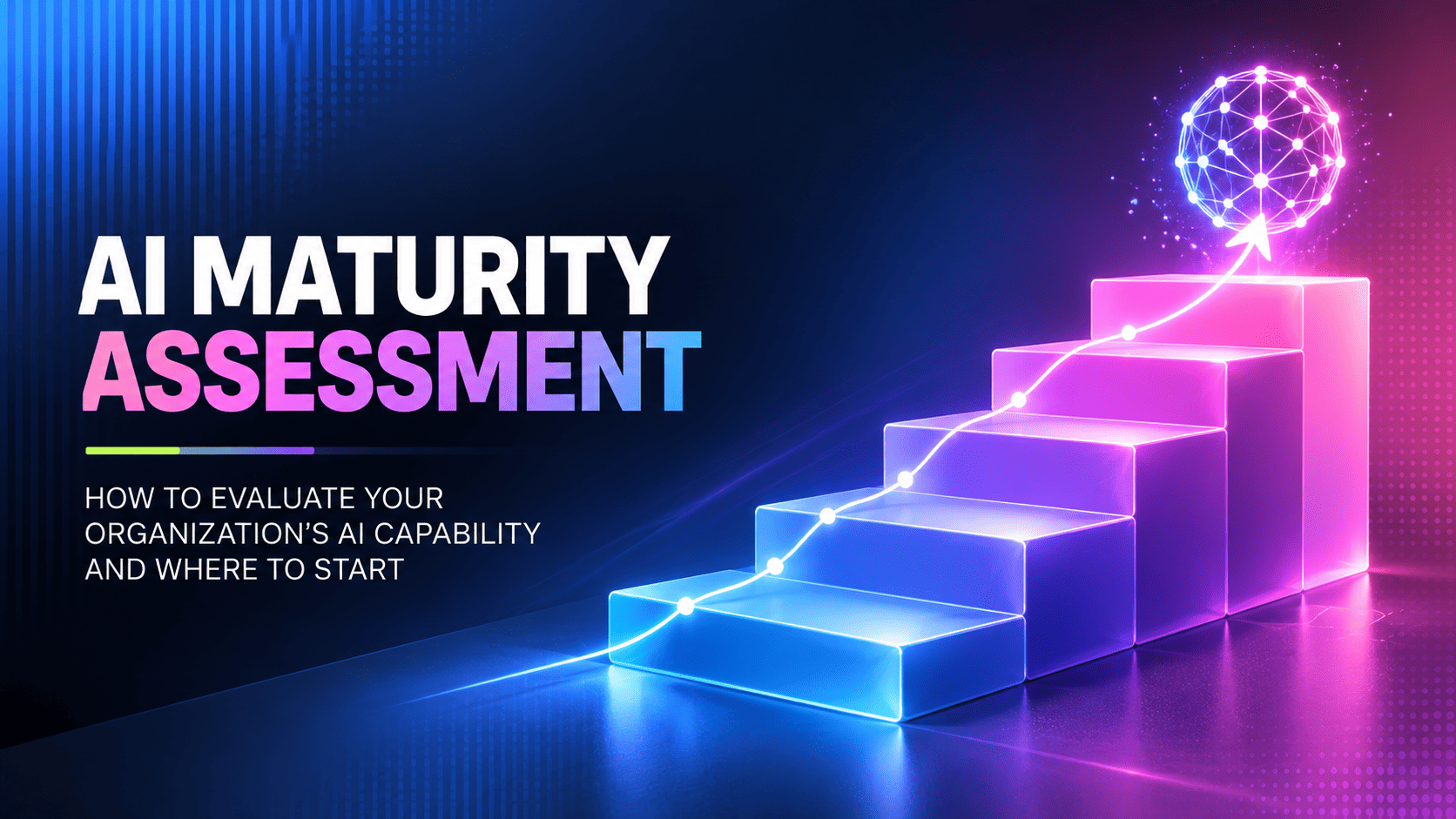
An AI maturity scale describes how an organization progresses from isolated experimentation toward AI capabilities that are integrated, repeatable, measurable, and continuously improved.
This should not be confused with Exadel’s published five stages of AI readiness. The two frameworks describe related aspects of enterprise AI development, but they answer different questions. Readiness focuses on whether the organization has the foundations to move forward, while maturity focuses on how developed and operationalized its AI capability has become.
1. Ad Hoc Experimentation
AI activity is isolated, opportunistic, and often dependent on individual teams or champions.
2. Piloting with Isolated Use Cases
Multiple pilots are underway, but data, governance, engineering practices, and ownership remain fragmented.
3. Scaling AI Across Business Units
AI begins moving beyond isolated use cases into repeatable delivery across teams and functions.
4. AI-Driven Operations
AI is embedded into core workflows and operating processes, with stronger governance, monitoring, and measurement.
5.Optimized and Self-Improving AI Systems
AI capability is deeply integrated, continuously monitored and improved, and tied to strategic business outcomes.
Level 1: Ad Hoc Experimentation
At this level, AI activity is fragmented and opportunistic.
Individual teams may experiment with generative AI, predictive models, copilots, or automation, but there is little consistency in how use cases are selected, developed, governed, or measured.
Success often depends on individual specialists or enthusiastic business teams. Data may be prepared manually, deployment practices differ from project to project, and ownership after a pilot is unclear.
The defining characteristic is experimentation without an enterprise operating model.
Progress requires more deliberate use-case selection, clearer ownership, better data foundations, and agreement on how successful experiments will move beyond the team that created them.
Level 2: Piloting with Isolated Use Cases
At Level 2, experimentation becomes more organized.
The organization may have several proofs of concept or production pilots, and particular teams may already be demonstrating business value from AI.
The problem is that capability remains isolated.
Different projects may use different platforms, data pipelines, governance practices, evaluation methods, or deployment approaches. Lessons from one pilot are not necessarily reusable by another team.
This level can therefore create the impression of greater maturity than actually exists. There may be substantial AI activity without a repeatable way to deliver AI across the enterprise.
Moving forward requires standardizing the foundations around data, engineering, governance, ownership, skills, and value measurement.
Level 3: Scaling AI Across Business Units
At Level 3, AI begins to become an organizational capability rather than a collection of projects.
Successful patterns from earlier pilots are reused across teams. Data access and quality improve. MLOps and LLMOps practices become more consistent. Governance enters the delivery lifecycle earlier, and ownership becomes clearer.
Use cases are increasingly prioritized according to business value rather than technical novelty.
The challenge shifts from proving that AI works to making delivery repeatable across multiple business units without multiplying cost, complexity, or risk.
This is also where weaknesses in legacy architecture, fragmented data, integration, talent, governance, or investment discipline often become more visible.
Level 4: AI-Driven Operations
At Level 4, AI is embedded into important business and operational processes.
Models and AI applications are no longer treated as exceptional projects. They are managed through established engineering, monitoring, governance, and investment practices.
AI outputs may influence workflows, products, customer interactions, operational decisions, or employee activity. Performance is monitored after deployment, and teams have clearer processes for escalation, human review, model updates, and retirement.
Business outcomes also become more important than activity metrics.
The organization asks not simply how many AI systems it has deployed, but what those systems have changed in productivity, cost, risk, revenue, service quality, or customer experience.
Level 5: Optimized and Self-Improving AI Systems
At the highest maturity level, AI capability becomes deeply embedded in how the organization operates and adapts.
AI systems are continuously evaluated against technical and business outcomes. Data pipelines, model monitoring, evaluation, governance, and feedback mechanisms support ongoing improvement.
That does not mean AI systems operate without human accountability.
Optimization still requires defined ownership, controls, review mechanisms, and decisions about when automation is appropriate. The distinguishing feature is that improvement has become systematic rather than episodic.
AI is no longer something the organization periodically implements. It has become a capability the organization can repeatedly operate, evaluate, improve, and extend.
How to Find the Right AI Maturity Assessment Partner
A maturity assessment is useful only if it changes what the organization does next.
That means buyers should look beyond frameworks that provide a single maturity score or generic label.
What Distinguishes a Comprehensive AI Maturity Audit from a Surface-Level Review
A surface-level review often asks whether particular capabilities exist.
- Do you have an AI strategy?
- Do you use MLOps?
- Do you have governance policies?
- Do you employ data scientists?
Those questions are useful, but existence is not the same thing as effectiveness.
A comprehensive assessment asks how those capabilities work in practice.
For example:
- Is AI strategy linked to real investment decisions?
- Can teams repeatedly access trusted data?
- Can models move from prototype to production reliably?
- Are governance and risk controls built into delivery?
- Can successful use cases be reproduced across business units?
- Can leaders demonstrate business value?
- Is ownership clear after deployment?
A credible assessment should therefore combine scores with evidence, gaps, risks, strengths, recommendations, and a path from current state to target state.
Specific Questions to Ask Before Hiring an Assessment Provider
Before selecting a provider, ask:
- What exactly do you assess?
Does the framework cover strategy, data, technology, talent, governance, adoption, and investment? - How is maturity evaluated?
Ask whether the methodology is structured, evidence-based, scored, and benchmarkable. - How do you validate stakeholder input?
Interviews can reproduce internal assumptions unless they are tested against documentation, systems, and operational evidence. - What does the final deliverable contain?
A maturity score without an actionable roadmap has limited value. - Can you connect technology gaps to business outcomes?
The assessment should explain why a weakness matters, not simply identify it. - Can you evaluate production capability?
Data engineering, architecture, MLOps, integration, deployment, and monitoring should be part of the assessment. - How do you address responsible AI and compliance?
The provider should be able to evaluate governance maturity while distinguishing that work from formal legal or regulatory advice. - Can the recommendations lead into implementation?
Findings should be technically realistic and specific enough for teams to act on.
A good provider should also be candid about where an assessment ends.
An AI maturity assessment does not replace a full technology or security audit, legal or privacy review, financial audit, or formal regulatory compliance assessment.
Exadel’s AI Maturity Assessment Methodology
The five maturity levels describe how developed an organization’s AI capability has become. Exadel’s assessment determines what is driving that maturity by evaluating the organization across six operating-model domains.
Those six domains are:
- Strategy, Business Integration & Adoption
- Talent & Organization
- Data Foundation
- Technology Stack & MLOps
- Governance, Ethics & Risk
- Financial Investment & ROI
The same domains are considered across the assessment tiers, with the level of depth changing according to the engagement.
This distinction matters because maturity is rarely uniform.
An organization may be advanced in technology but weak in governance. It may have strong data infrastructure but limited business adoption. Another may have executive support but little production engineering capability.
A single maturity label can hide those differences.
Domain-level assessment makes them visible.
Exadel’s methodology uses a structured, question-based and scored approach. The assessment combines documentation and stakeholder input with analysis, expert review, benchmarking, and recommendations designed to turn findings into decisions rather than simply produce a score.
AI can assist the analysis process, but expert validation remains part of the methodology. The objective is consistency without removing human interpretation of business and technical context.
The goal is not simply to assign a stage.
It is to understand why the organization is there and what would have to change for it to progress.
Why Legacy Infrastructure Can Be a Hidden Bottleneck in AI Maturity
Legacy technology can restrict maturity, but it is only one part of the picture.
Legacy architecture, fragmented data, integration constraints, and platform limitations can make AI difficult to scale. So can unclear strategy, skills gaps, weak governance, poor ownership, and investment decisions that are not connected to measurable value.
That is why Exadel evaluates the whole operating model rather than treating technology modernization as the automatic answer.
Legacy systems can become a maturity constraint when:
- important data is inaccessible or inconsistently defined
- integrations are brittle or heavily manual
- systems cannot support required transaction volumes or latency
- deployment and testing are difficult to automate
- monitoring is insufficient
- identity or security architecture blocks required integration
- changes create unacceptable operational risk
Where those constraints genuinely prevent AI progress, legacy system modernization may become part of the roadmap.
But modernization should follow diagnosis.
An older system that continues to perform its role reliably may not be the priority. The assessment should distinguish genuine blockers from technology that is merely old.
What You Receive at the End of an Exadel AI Maturity Assessment
Exadel currently offers three expert-led assessment tiers, alongside a separate free self-service AI Maturity Snapshot.
The expert-led assessments evaluate the same operating-model domains, with increasing depth.
AI Maturity Snapshot
About 5 minutes
Self-service baseline
Domain-level scores, strengths and gaps, prioritized recommendations, downloadable report
Lite
3 days
Rapid baseline and immediate priorities
Maturity baseline scorecard, quick wins, key gaps and risks, current-state summary, recommended next steps
Standard
4 weeks
Deep-dive capability assessment
Lite outputs plus capability map, maturity assessment report, investment and business-case model, tactical roadmap, use-case prioritization, talent and skills gap report
Full
8 weeks
Enterprise strategy and target-state blueprint
Standard outputs plus enterprise AI strategy, target data and AI architecture, Responsible AI & Compliance Strategy, AI operating model, executive strategy and investment presentation
The current AI Maturity & Readiness Assessment offer confirms the 3-day, 4-week, and 8-week expert-led structure.
Those outputs answer three practical questions.
Where are we now?
The assessment establishes the organization’s current maturity and readiness profile and highlights areas of relative strength and weakness.
What is preventing progress?
Domain analysis identifies gaps, risks, dependencies, and capability weaknesses that prevent AI from becoming more repeatable or valuable.
What should happen next?
The roadmap and supporting deliverables turn diagnosis into priorities, investments, use cases, and practical next steps.
The assessment also connects maturity to financial value. Depending on the engagement depth, investment and business-case modelling can assess implementation costs, expected benefits, ROI, and payback rather than assuming that greater AI adoption automatically creates greater value.
Higher maturity should therefore not simply mean more AI.
It should mean a better ability to decide where AI is worth using.
Frequently Asked Questions About AI Maturity Assessments
What is an AI maturity assessment and how is it different from an AI readiness assessment?
An AI maturity assessment measures how far an organization has progressed in turning AI into a repeatable, governed, measurable capability.
An AI readiness assessment asks whether the organization has the foundations required to move forward successfully. Maturity asks what capability exists today and what is preventing progression to the next stage.
At Exadel, the two are evaluated together across the same six operating-model domains rather than treated as completely separate exercises.
How do I find experts to perform an AI maturity assessment?
Look for providers that combine AI strategy expertise with production engineering, data, architecture, governance, and operating-model capability.
Ask how maturity is assessed, what evidence supports the findings, whether benchmarking is used, and what the final deliverable contains.
A provider should also be able to explain how technical findings connect to investment decisions and business outcomes rather than simply assigning a maturity level.
Which specialists offer comprehensive AI maturity assessments for legacy system modernization?
Consultancies working across enterprise AI, modernization, and transformation include Accenture, Thoughtworks, EPAM, Capgemini, Cognizant, and Exadel.
The important comparison is whether the provider can evaluate AI capability within the organization’s real technology environment.
For enterprises with significant legacy estates, that means understanding data availability, integration, architecture, deployment, governance, security, and modernization requirements alongside AI strategy and business adoption.
Exadel combines its maturity and readiness methodology with data engineering, AI engineering, and legacy modernization capabilities.
What should I expect from an AI maturity assessment that prioritizes responsible AI practices?
A responsible AI-focused assessment should examine whether the organization has clear governance, ownership, oversight, monitoring, documentation, escalation processes, and accountability around AI systems.
Depending on scope, it may also examine explainability, bias and fairness controls, data provenance, human review, cybersecurity, model approval and retirement, and regulatory exposure.
External frameworks such as the NIST AI Risk Management Framework and the EU AI Act can provide useful reference points.
Exadel’s Full assessment includes a Responsible AI & Compliance Strategy, but the assessment itself does not replace formal legal or regulatory compliance review.
What does a typical AI maturity assessment deliverable include?
A comprehensive maturity assessment should provide more than one overall score.
Typical outputs include maturity scores by domain, analysis of strengths and weaknesses, gaps and risks, prioritized opportunities, recommended initiatives, and a roadmap for progressing from the current state toward the target state.
Depending on the depth of the engagement, outputs may also include a capability map, use-case prioritization, investment and business-case modelling, talent-gap analysis, target architecture, governance strategy, and operating-model recommendations.
Exadel’s current expert-led assessment ranges from a 3-day baseline to a 4-week deep dive and an 8-week enterprise strategy and blueprint engagement.
Written by: Alexey Girzhadovich, Chief Enterprise AI and Solutions Officer
September, 2026


Your AI Partner
Turn AI Activity Into Repeatable Capability
Knowing where you stand matters only if it changes what happens next. Exadel’s AI Maturity & Readiness Assessment identifies the gaps, risks, and priorities that can move AI from scattered activity toward repeatable business value.