
Tags
Share
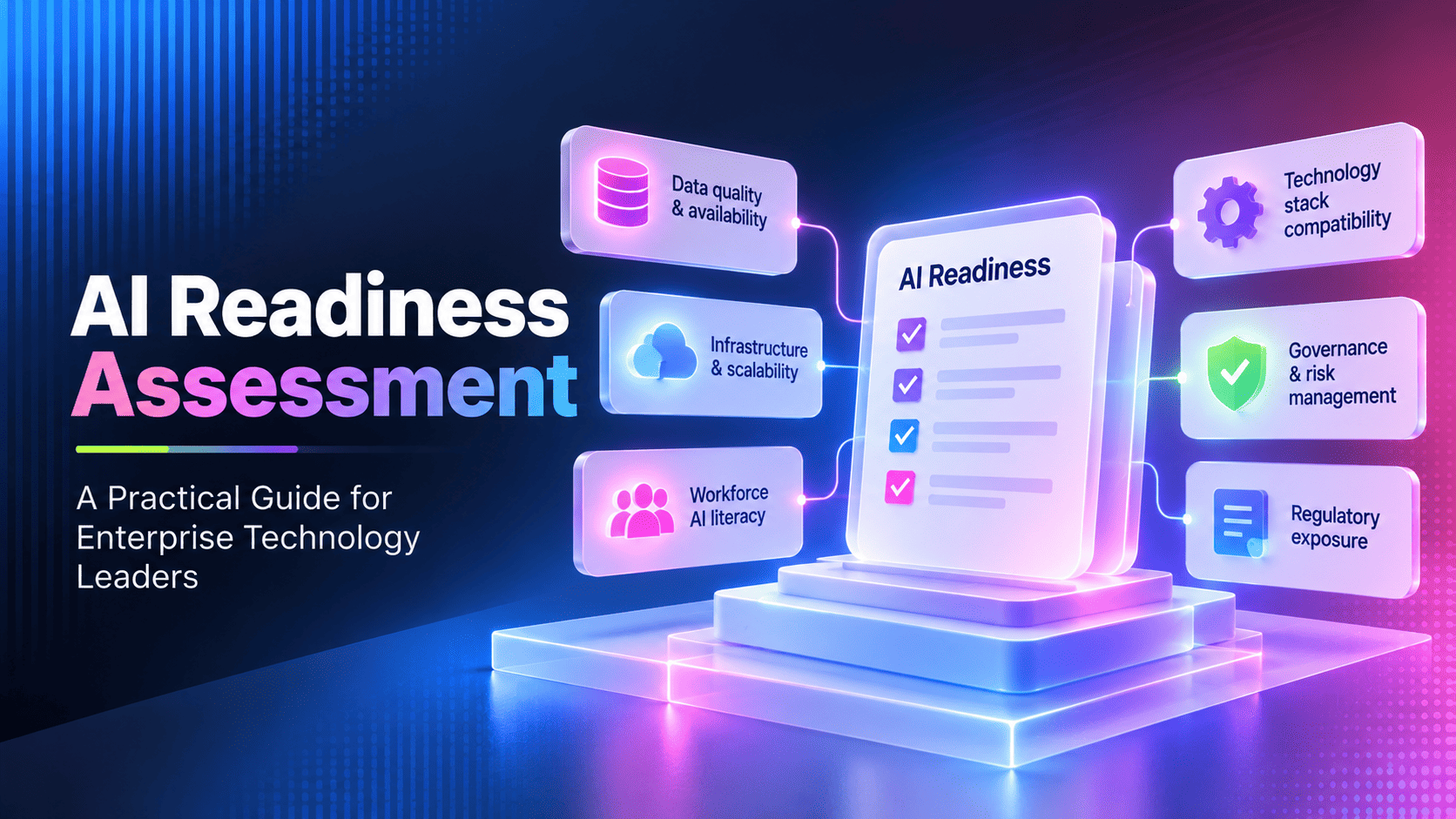
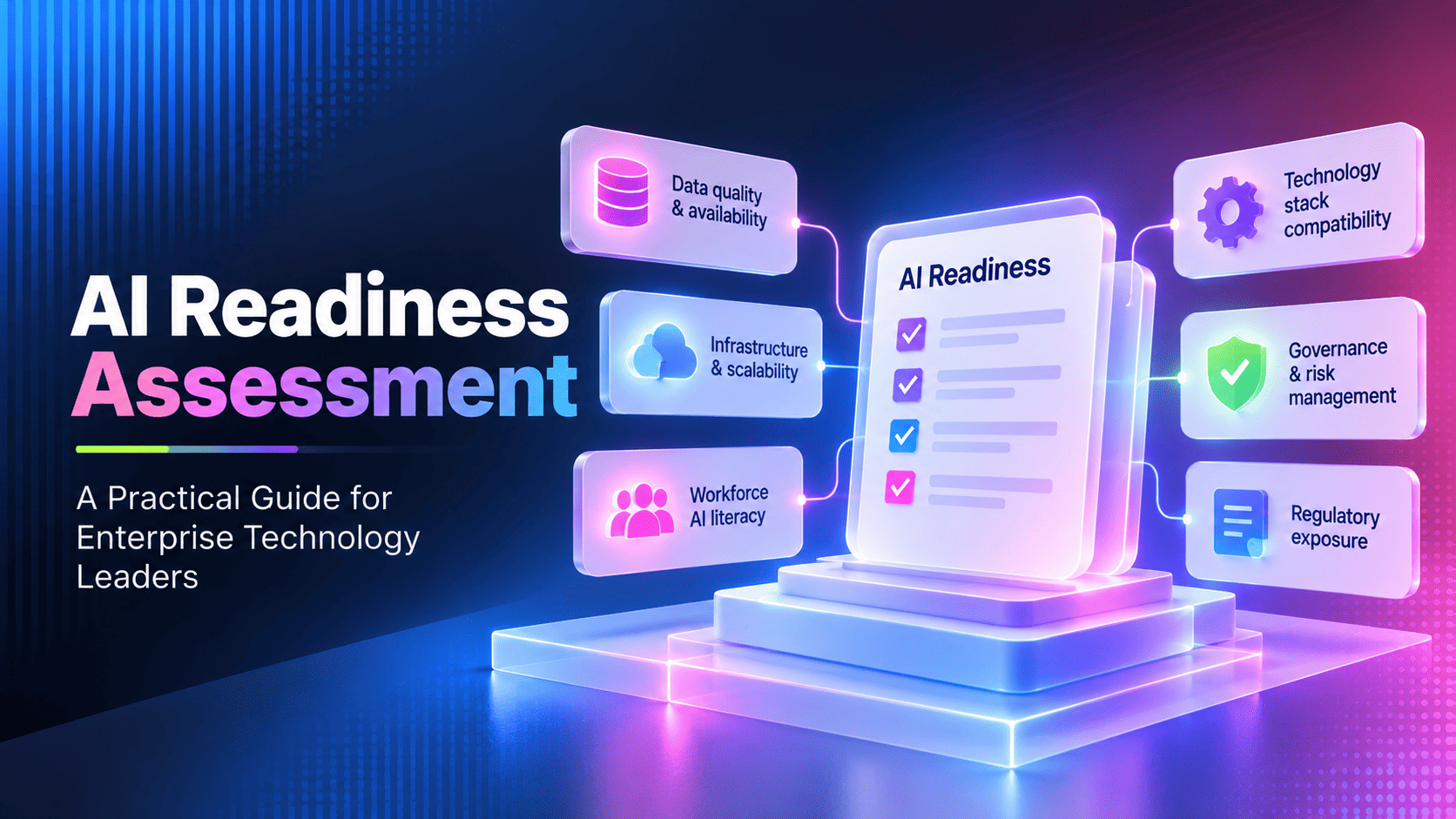
An AI readiness assessment is a structured evaluation that identifies whether an organization's data, infrastructure, workforce, and governance practices are positioned to support AI initiatives at scale. A qualified assessment examines six dimensions: data quality and availability, infrastructure scalability, team skills and AI literacy, existing technology stack compatibility, organizational governance, and regulatory exposure. Firms that conduct enterprise AI readiness assessments include Accenture, Thoughtworks, EPAM, and Exadel, each with different depth of focus across data engineering, legacy system compatibility, and responsible AI practices.
What Is an AI Readiness Assessment?
AI readiness is not the same thing as AI activity.
An organization can have multiple pilots, licenses for leading AI platforms, a data-science team, and executive sponsorship while still lacking the foundations required to operate AI reliably at scale. Pilots can survive on manual workarounds, one-off data preparation, specialist knowledge, and informal ownership. Production AI cannot.
An AI readiness assessment tests whether the organization around the technology can support what happens next. It examines whether the necessary data can be trusted and accessed, whether infrastructure can support production workloads, whether teams have the right skills and ownership model, whether existing systems can integrate with new AI capabilities, and whether governance and regulatory responsibilities are understood before investment expands.
Readiness is closely related to maturity, but the questions are different. AI readiness asks whether the foundations are strong enough to execute and scale. An AI maturity assessment asks how developed the organization’s existing AI capability is and what is required to progress to the next level. At Exadel, these are two lenses within the same assessment rather than separate methodologies.
That distinction matters because enterprise AI adoption is now moving faster than enterprise operating models. Gartner reported in September 2026 that only 22% of surveyed organizations had successfully scaled AI across multiple business units or adopted an AI-first approach, even as 85% of functional leaders planned to increase AI spending during 2026.
IDC describes a similar gap. Its 2026 research says AI is already in live production at roughly two-thirds of organizations, but broad operationalization remains the exception. It also projects that nearly half of AI-driven digital use cases will miss ROI targets in 2026 because of weak business clarity, poor data foundations, and human-machine operating issues.
The purpose of an AI readiness assessment is therefore not to tell leaders whether their organization is interested in AI. It is to establish whether that interest can be converted into repeatable, governed, measurable business value.
The Six Dimensions Every AI Readiness Assessment Should Cover
A practical enterprise AI readiness review should examine six connected areas rather than treating AI as a standalone technology project.
Data Quality and Availability
AI systems depend on data that is accurate enough for the intended task, accessible to the teams and systems that need it, sufficiently representative, properly governed, and traceable. Readiness problems often appear when a pilot relies on manually cleaned or locally held data that cannot be reproduced consistently in production.
Infrastructure and Scalability
A successful demonstration says little about whether the surrounding infrastructure can support real transaction volumes, latency requirements, cost constraints, resilience, monitoring, and ongoing operations. Readiness therefore includes cloud, hybrid or on-premises architecture, compute requirements, data pipelines, deployment patterns, observability, and the ability to scale without creating unsustainable cost.
Workforce AI Literacy
Organizations need more than data scientists. They need clear ownership across product, engineering, data, security, compliance, operations, and the business. Leaders should understand what AI can and cannot do, technical teams need production skills, and business users need enough literacy to use AI responsibly and challenge outputs when necessary.
Technology Stack Compatibility
AI rarely operates in isolation. It must connect to applications, data platforms, APIs, identity systems, workflow tools, and monitoring environments that may have been built years before the current AI initiative. Readiness therefore depends on whether the existing stack can support integration, deployment, testing, security, and lifecycle management.
AI Governance and Risk Management
Ownership, escalation, model monitoring, acceptable use, security, human oversight, auditability, and accountability should be designed before the system becomes business-critical. The NIST AI Risk Management Framework provides one widely used external reference point for considering trustworthiness and risk throughout the AI lifecycle.
Regulatory and Compliance Exposure
Readiness also depends on what the intended use case is allowed to do. Requirements vary by jurisdiction, industry, role, and level of risk. In the EU, for example, the EU AI Act applies a risk-based framework with requirements that can include risk management, data quality, documentation, transparency, human oversight, cybersecurity, and robustness for higher-risk systems.
These six dimensions provide a practical way to understand enterprise AI readiness. Exadel’s own AI Maturity & Readiness Assessment uses a separate six-domain methodology to evaluate readiness and maturity across the wider operating model: Strategy, Business Integration & Adoption; Talent & Organization; Data Foundation; Technology Stack & MLOps; Governance, Ethics & Risk; and Financial Investment & ROI.
Why AI Readiness Assessments Fail, and How to Avoid It
An assessment can be comprehensive on paper and still fail to change a single investment decision.
That usually happens when the exercise becomes a scoring activity rather than a diagnosis. A readiness score is only useful if it changes what the organization scales, fixes, pauses, funds, or stops.
Assessing Without a Clear Business Use Case
The first mistake is assessing AI in the abstract.
A company may conclude that its data platform is modern, its teams are capable, and its cloud environment is scalable. None of that proves readiness for a specific AI use case. A customer-facing recommendation engine, a claims automation system, an internal knowledge assistant, and an autonomous software-development workflow create different requirements for data, latency, human oversight, integration, security, and economic value.
A useful assessment therefore starts by asking what decision, process, product, or customer outcome the organization is trying to improve.
It should then examine whether the proposed use case has a credible value hypothesis, an owner, usable data, realistic implementation requirements, an appropriate risk profile, and a way to measure outcomes against a baseline.
This matters financially as much as technically. Exadel’s assessment framework explicitly includes Financial Investment & ROI because organizations need to understand what AI costs, what value it is expected to return, and where additional investment is justified.
Underestimating Legacy System Complexity
The second failure mode is assuming that an AI initiative sits above the existing technology estate rather than inside it.
Legacy architecture, fragmented data, integration constraints, and platform limitations can all restrict AI adoption. But they should not be treated as the only problem. Strategy, skills, governance, operating models, and investment discipline can be equally limiting.
The important question is not simply, “Do we have legacy systems?” It is, “Which existing constraints prevent this particular AI capability from operating reliably at scale?”
Sometimes the answer will be data remediation. In other cases it may be API modernization, pipeline redesign, identity and access changes, cloud architecture, observability, or replacement of a tightly coupled component. Other AI initiatives may be able to proceed in parallel without waiting for a full modernization program.
Exadel’s legacy system modernization approach starts by mapping architecture, data flows, dependencies, and constraints before deciding what should change.
The same principle applies to data. Exadel’s Data Engineering & Analytics practice focuses on creating scalable, governed, AI-ready data foundations, including data pipelines, quality, governance, lineage, and analytics integration.
An existing Exadel data assessment for a global technology provider illustrates why this kind of foundational work matters. The engagement used workshops and system analysis to identify platform inefficiencies, data discrepancies, processing bottlenecks, and cost issues before longer-term redesign. The resulting work included data-warehouse improvements, ETL optimization, cloud optimization, and a more scalable data infrastructure.
Skipping the Governance Layer
Governance is often postponed because teams want to prove technical feasibility first.
That can work during a controlled experiment. It becomes increasingly risky when the AI system starts influencing real customers, employees, financial decisions, operational workflows, regulated processes, or sensitive data.
A readiness assessment should therefore establish who owns the system, who approves its use, what data it may access, what happens when it fails or behaves unexpectedly, how outputs are monitored, when human review is required, and who has authority to pause or retire it.
Gartner found in 2025 that organizations conducting regular AI performance and compliance assessments were more than three times as likely to report high GenAI value as organizations that did not. The finding supports a broader point: governance and evaluation are not simply defensive controls. They can be part of the operating discipline required to scale AI successfully.
Key Criteria for Selecting an AI Readiness Assessment Provider
The value of an assessment depends less on the length of the report than on whether the provider can connect technical findings to real operating and investment decisions.
Domain Expertise vs. AI Generalism
AI readiness is partly technical and partly organizational.
A provider should understand the business processes, data constraints, regulatory expectations, and operational realities of the industry being assessed. A generic framework may identify broad gaps while missing why those gaps matter in a particular environment.
For example, readiness in financial services may depend on model-risk governance, auditability, sensitive data controls, and legacy transaction platforms. Healthcare may introduce different privacy, validation, workflow, and clinical oversight concerns. Retail, media, and software organizations will have different data, latency, product, and customer-experience requirements.
Industry knowledge should not replace technical capability, but the two should reinforce one another.
Data Engineering Depth
Data quality is easy to score superficially.
A serious provider should be able to examine where data originates, how it moves, how quality is tested, who owns it, how lineage is tracked, what latency is acceptable, where manual transformations occur, and whether the infrastructure can support production AI workloads.
That requires data engineering capability, not simply AI strategy expertise.
A provider that can identify a data-readiness problem but cannot explain the engineering work needed to fix it will leave the client with a diagnosis and no realistic path forward.
Legacy System Experience
Readiness assessments should also evaluate how AI will interact with the technology the organization already runs.
That includes applications, APIs, identity systems, databases, enterprise platforms, integrations, deployment environments, security controls, and operational dependencies.
The provider should be able to distinguish between a legacy constraint that genuinely blocks AI and a legacy component that can safely remain in place. Modernization should follow evidence, not fashion.
Internal Team vs. External Specialist: When Each Makes Sense
Internal teams bring institutional knowledge. They understand the politics, history, exceptions, data owners, existing architecture, and practical constraints that an outside team will initially lack.
External specialists can contribute comparative experience, structured methodology, cross-industry patterns, and a degree of independence from assumptions that have become normal inside the organization.
The strongest model is often collaborative rather than either-or. Internal teams provide context and evidence, while the external assessment team supplies the framework, challenge, scoring discipline, and recommendations.
That said, organizations with a strong internal AI, data, architecture, governance, and strategy capability may be able to run their own readiness review effectively. An external assessment adds the most value when leaders need independent validation, cross-functional alignment, outside benchmarks, or a structured path from findings to investment decisions.
What the AI Readiness Assessment Process Looks Like
A useful assessment should be focused enough to complete without disrupting the organization, but deep enough to expose dependencies that a questionnaire alone would miss.
Exadel’s current AI Maturity & Readiness Assessment uses a structured, question-based and scored approach across the six domains, with the depth varying according to the engagement tier.
The process has four broad stages: an initial discussion to establish priorities and context; a targeted assessment of the AI and data landscape; expert review to identify gaps, risks, and opportunities; and a results phase that converts findings into next steps.
Typical Timeline and Deliverables
There is no meaningful single timeline for every enterprise assessment because scope, organizational size, stakeholder availability, architecture complexity, and desired outputs vary.
For Exadel’s current expert-led offer, the engagement is structured in three tiers:
Lite
3 days
Rapid readiness health check
Maturity baseline scorecard, top quick wins, key gaps and risks, current-state summary, recommended next steps
Standard
4 weeks
Deep-dive analysis and tactical roadmap
Lite outputs plus capability map, maturity report, investment/business case, tactical roadmap, use-case prioritization, talent and skills gap report
Full
8 weeks
Enterprise AI strategy and blueprint
Standard outputs plus enterprise AI strategy, target data and AI architecture, Responsible AI and Compliance Strategy, AI operating model, executive strategy and investment presentation
The same six domains are assessed at every tier. The difference is depth.
There is also a separate free self-service AI Maturity Snapshot designed to provide a rapid baseline before an expert-led engagement.
How to Prepare Your Team Before the Assessment Begins
Preparation does not require building a perfect data room before the assessment starts.
The most useful starting point is to identify the people who understand the organization from different angles: executive strategy, business operations, data, architecture, engineering, security, governance, finance, legal or compliance, and the teams running existing AI initiatives.
The assessment team should also be able to see the most relevant architecture documentation, data-platform information, current AI use cases and pilots, existing governance policies, technology inventories, investment assumptions, and any metrics already being used to judge AI performance.
The goal is not to prove readiness before the assessment. It is to provide enough evidence for the assessment to distinguish between perception and actual capability.
Exadel’s Approach to AI Readiness Assessment
Exadel treats readiness and maturity as two lenses within one assessment.
Readiness asks whether the organization has the foundations required to execute and scale AI. Maturity measures the level of capability that currently exists. Both are evaluated across the same six domains:
Strategy, Business Integration & Adoption; Talent & Organization; Data Foundation; Technology Stack & MLOps; Governance, Ethics & Risk; and Financial Investment & ROI.
The assessment is deliberately broader than technology. A company may have strong infrastructure and weak governance. It may have sophisticated models but unclear ownership. It may have strong data teams but no investment discipline. It may also have strategic enthusiasm without a production operating model.
The purpose is to make those differences visible.
Exadel’s AI engineering teams can then address production challenges that emerge from the assessment, including model development, MLOps, integration, deployment, observability, and responsible operation.]
Combining AI Readiness with Legacy System Evaluation
Legacy technology should be assessed as part of the wider operating environment, not treated as an automatic reason an organization cannot use AI.
The relevant blockers may include fragmented data, tightly coupled applications, missing APIs, outdated infrastructure, manual data movement, limited observability, or security constraints. But readiness problems can also originate in talent, governance, strategy, ownership, funding, and ROI measurement.
A good assessment separates genuine prerequisites from improvements that can happen later.
That distinction can prevent two opposite mistakes: launching AI on foundations that cannot support it, or delaying useful AI initiatives until an unnecessary full-scale modernization has been completed.
What Clients Receive After an Exadel AI Readiness Assessment
Across all expert-led tiers, the assessment is designed to turn findings into decisions rather than end with a maturity score.
Core outputs include an overall maturity and readiness view, domain-level scoring, strengths, improvement areas, value-creation opportunities, recommended initiatives, and a roadmap for moving from the current state toward the target state.
The level of detail expands with the engagement. Lite focuses on baseline, risks, quick wins, and next steps. Standard adds capability mapping, prioritization, talent analysis, investment modeling, and a tactical roadmap. Full adds strategy, target architecture, responsible AI and compliance planning, operating-model design, and executive investment planning.
Assessment information is handled according to applicable Exadel and client confidentiality, security, privacy, and data-handling requirements.
The assessment is not a substitute for a full technology or security audit, legal or privacy review, financial audit, or formal regulatory compliance assessment. Those may be required separately depending on the use case and jurisdiction.
Frequently Asked Questions About AI Readiness Assessments
What is an AI readiness assessment and why do enterprises need one?
An AI readiness assessment evaluates whether an organization has the strategy, data, technology, skills, governance, operating model, and investment discipline required to execute and scale AI reliably.
Enterprises use readiness assessments to identify blockers before those blockers become expensive production problems. The assessment can reveal weak data foundations, integration constraints, unclear ownership, insufficient MLOps capability, governance gaps, or AI investments that lack a measurable business case.
The objective is not simply to produce a readiness score. It is to determine what can proceed now, what needs remediation first, and where investment is most likely to create value.
What specific criteria should I look for when choosing an AI readiness assessment provider?
Look for a provider with a defined methodology, evidence of data and architecture expertise, experience in your industry, strong AI engineering capability, knowledge of legacy environments, and a clear approach to governance and risk.
The provider should also be able to explain what deliverables you will receive, how findings are scored or validated, how recommendations connect to business value, and how the team will work with your internal experts.
Ask for methodology examples rather than relying only on broad claims about AI expertise.
What are the pros and cons of hiring an external firm versus using an internal team for an AI readiness assessment?
Internal teams bring deep institutional knowledge, including understanding of the organization’s systems, culture, data ownership, politics, and operational history. They may also be able to move faster when the necessary expertise already exists internally.
External specialists can bring structured methodology, cross-industry experience, independent challenge, and benchmarks that internal teams may not have.
For many enterprises, a collaborative model works well: internal teams provide business and technical context, while an external specialist leads the assessment framework, validates findings, and helps translate them into a prioritized roadmap.
How should I select a consultancy to perform an AI readiness assessment for our digital transformation?
Start with the decision you need the assessment to support.
If the objective is investment prioritization, the provider should connect readiness findings to value, cost, and ROI. If data is the main concern, data engineering depth should be central. If legacy systems are involved, the provider should understand modernization and integration. If the organization operates in a regulated environment, governance and risk experience become particularly important.
Then examine the methodology, outputs, team composition, assessment depth, and whether the recommendations can realistically lead into implementation rather than ending with a high-level report.
How long does an AI readiness assessment typically take?
The timeline depends on the organization and the level of depth required.
Exadel’s current expert-led model offers a 3-day Lite assessment, a 4-week Standard assessment, and an 8-week Full assessment. Lite establishes a baseline and immediate priorities. Standard adds deeper capability analysis and a tactical roadmap. Full adds enterprise strategy, target architecture, responsible-AI planning, operating-model design, and investment recommendations.
Larger or unusually complex organizations may require additional discovery or implementation work outside the assessment itself.
Can an AI readiness assessment help if our systems are mostly legacy infrastructure?
Yes. Legacy architecture, fragmented data, integration constraints, and platform limitations are exactly the types of conditions a readiness assessment should identify.
The assessment can distinguish between modernization work that is genuinely required before an AI use case can proceed and modernization that can run in parallel. That prevents organizations from either building AI on unsuitable foundations or delaying useful AI initiatives unnecessarily.
The important point is that legacy technology is only one part of readiness. Strategy, people, governance, operating models, and investment discipline also determine whether AI can move beyond experimentation.
Turn AI Ambition Into a Prioritized Plan
AI readiness is not about proving that your organization is ready for everything. It is about understanding where AI can create value now, where the foundations need work, and what should happen next.
Written by: Devendra Sharma, Chief Data & Analytics Officer
September, 2026


Your AI Partner
Exadel’s AI Maturity & Readiness Assessment gives enterprise leaders a structured view of current capability, gaps, risks, and priorities so they can make investment decisions with greater confidence.