
Tags
Share
AI data and analytics services combine traditional data engineering and business intelligence with machine learning and AI capabilities to deliver predictive, prescriptive, and real-time analytics at enterprise scale. The primary components are data infrastructure (pipelines, warehouses, lakes), AI and ML model development and integration, analytics platform management, and ongoing model monitoring and governance. Firms offering enterprise AI data and analytics services include Accenture, Capgemini, Cognizant, Thoughtworks, and Exadel, with differentiation based on depth of data engineering capability, AI model sophistication, and experience integrating AI into legacy analytics environments.
What Are AI Data and Analytics Services?
AI data and analytics services help enterprises move from understanding what has already happened to predicting what may happen next and, increasingly, recommending or automating an appropriate response.
Traditional business intelligence remains important. Dashboards, reports, semantic models, and agreed metrics give an organization a shared view of performance.
AI extends that analytical capability.
Machine learning can forecast demand, identify customers at risk of leaving, detect abnormal transactions, predict equipment failure, classify documents, or identify patterns that analysts would struggle to find manually.
Generative AI can also change how users interact with business information. Instead of navigating a series of sometimes seemingly-conflicting dashboards, a user can ask a question in natural language and receive an explanation, visualization, or recommended next step.
But AI analytics does not begin with the model. It begins with data that can be found, understood, trusted, and delivered quickly enough for the decision being made.
Exadel’s existing guide to how AI and data analytics boost business results explores how data, analytical intelligence, and operational workflows connect around measurable business outcomes.
Gartner’s 2026 Magic Quadrant for Analytics and Business Intelligence Platforms reflects the same evolution in the technology market. It describes analytics and BI platforms increasingly incorporating agentic AI, governed semantics, and AI-augmented decision support while retaining requirements around governance, interoperability, and secure self-service analytics.
The Four Layers of Enterprise AI Analytics
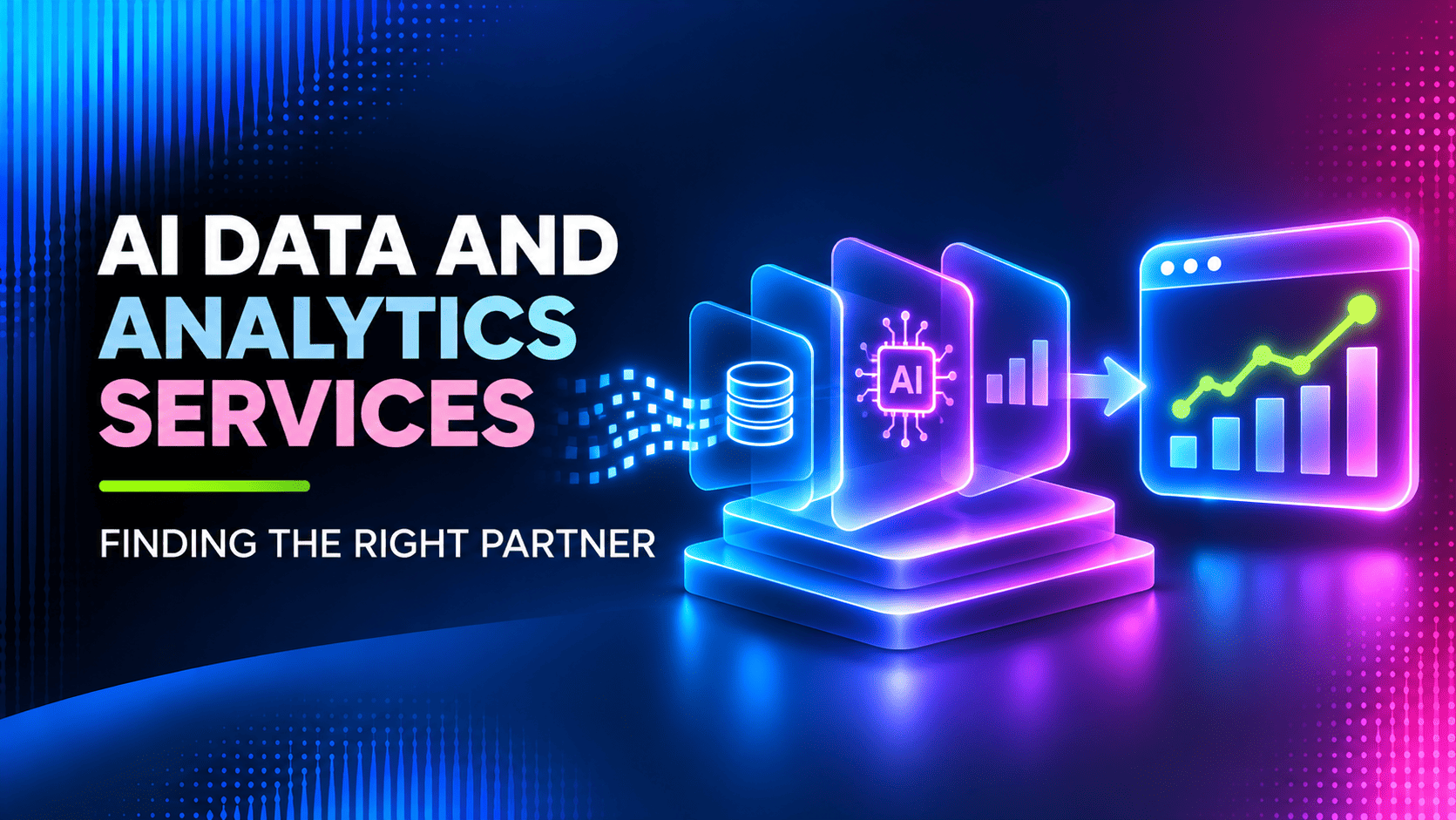
A useful way to understand enterprise AI analytics is as four connected layers.
1. Data Layer
The data layer determines what the analytical system has to work with. This layer will likely include operational databases, cloud warehouses, lakehouses, streaming systems, APIs, SaaS applications, documents, sensor data, and external datasets.
Platforms such as Snowflake and Databricks can support analytical and AI workloads, while technologies such as Apache Spark provide distributed processing and dbt supports transformation, testing, and documentation.
The architecture does not need to use every modern technology. It does need to make the required information sufficiently accurate, consistent, timely, governed, and accessible.
2. Model Layer
The model layer turns information into predictions, classifications, scores, recommendations, or generated outputs. This may involve traditional statistical modelling, machine learning, deep learning, generative AI, or a combination.
The important engineering questions include how features are created, how models are validated, how performance is measured, how new versions are deployed, and how drift is detected after launch.
A predictive model that performed well during development can deteriorate as customer behaviour, market conditions, equipment, or underlying data changes.
Production analytics therefore requires lifecycle management, not simply model training.
3. Analytics Layer
The analytics layer connects technical capability to the people or systems that act on it.
That may mean dashboards in Power BI or Tableau, embedded analytics inside an application, automated alerts, APIs consumed by other software, or conversational interfaces that allow users to ask questions directly.
Exadel’s AI for Business Intelligence capability, for example, is designed to work with existing analytics tools including Power BI, Tableau, and Looker rather than requiring organizations to replace the analytical environment they already use.
The output is valuable only when it reaches someone, or some operational system, able to change what happens next.
4. Governance Layer
Governance sits across every other layer. Organizations need to know where data came from, who owns it, what it means, who is allowed to use it, which model version generated an output, and how the result should be interpreted.
As analytics becomes more automated, those questions become more important rather than less.
Governance may include data lineage, catalogs, access controls, validation rules, model documentation, approval processes, drift monitoring, audit trails, and clear accountability for analytical outputs.
Exadel’s current Data Engineering & Analytics service explicitly includes data quality by design, governance and lineage, and analytics and AI integration as parts of the same data foundation.
Integrating AI into Existing Data Architecture
Most enterprises do not begin with a blank architecture. They already have databases, warehouses, reporting tools, APIs, operational applications, spreadsheets, integration platforms, and years of historical data.
The practical question is therefore not usually: “What would the ideal AI analytics architecture look like if we started again?” It is: “How do we introduce better analytical capability without breaking the systems the business already depends on?”
That may involve adding streaming pipelines alongside existing batch processing, exposing selected legacy data through APIs, moving analytical workloads to a lakehouse, creating a governed semantic layer, or building a new AI capability on top of existing Power BI or Tableau reporting.
The architecture should evolve according to the use case. A company does not need to migrate every historical system before it can use AI. But it does need to identify the parts of the existing environment that genuinely prevent the required analytical outcome.
Legacy Data Systems and AI Compatibility
Legacy does not automatically mean unusable. Older systems may contain decades of valuable transaction history, customer behaviour, operational rules, or industry-specific information.
The problem appears when that information cannot be accessed or trusted at the speed and quality required by the new analytical workload.
Common constraints include:
- data trapped inside tightly coupled applications
- inconsistent identifiers across systems
- undocumented transformations
- slow batch extraction
- poor lineage
- duplicated business definitions
- missing APIs
- limited observability
- weak quality controls
- infrastructure that cannot support required processing volumes
The answer may be modernization, but it should follow diagnosis.
In some cases, only selected pipelines need to change. In others, a warehouse or data lake needs restructuring. Where AI depends on operational data with low latency, broader architectural change may be required.
Our data engineering consulting guide examines how enterprises can evaluate those decisions and select a partner for pipeline and platform modernization.
Data Quality Is a Prerequisite, Not a Cleanup Task
AI does not make unreliable data reliable. It can make bad conclusions arrive faster. A predictive model trained on inconsistent customer records, missing transactions, biased historical decisions, or poorly defined business metrics will reproduce those weaknesses in its output.
Generative AI does not remove this problem either. A conversational analytics assistant grounded in contradictory metrics can produce fluent but misleading answers.
Before scaling AI analytics, organizations should therefore understand data completeness, consistency, timeliness, ownership, lineage, access, and whether definitions are shared across the business.
This is one reason Exadel’s current data service positions automated testing and validation as Data Quality by Design, rather than treating quality as remediation after the platform has been built.
Our AI readiness assessment guide also examines data foundations as part of the wider question of whether an organization is prepared to execute and scale AI.
Real-Time vs. Batch AI Analytics: When Each Applies
Real-time analytics is valuable when the usefulness of an insight declines quickly.
Fraud detection, equipment monitoring, dynamic pricing, recommendation systems, logistics, cybersecurity, and some customer interactions may need decisions within seconds or minutes.
Technologies such as Kafka and streaming frameworks can move events continuously, while systems process and respond as new information arrives.
But real time should not become a default architectural goal. Many important decisions do not require it.
Financial reporting, monthly forecasting, strategic planning, customer segmentation, portfolio analysis, and many model-training workloads may work perfectly well through scheduled batch processing.
Batch systems are often simpler and less expensive to operate. The correct architecture depends on the decision latency.
Ask: How quickly does new information have to influence an action before its value falls materially?
If the answer is tomorrow, building a millisecond streaming architecture may add cost and complexity without business benefit.
If the answer is immediately, yesterday’s batch file is not sufficient.
Predictive Data Modeling: What It Is and What It Delivers
Predictive data modeling uses historical and current information to estimate the probability of a future outcome.
The model learns relationships between variables in historical data and applies those patterns to new observations.
The output might be:
- the probability that a customer will churn
- expected product demand next month
- likelihood that a transaction is fraudulent
- expected failure of a machine component
- probability of a claim requiring investigation
- likely delivery delay
- expected revenue or cash-flow outcome
Predictive analytics differs from descriptive analytics, which explains what has already happened.
It also differs from prescriptive analytics.
A predictive model may say that a customer has an 80% probability of cancelling. A prescriptive system goes further and recommends which intervention is most likely to retain that customer.
Neither creates value merely by generating the prediction.
The result must reach an operational workflow where somebody can act on it.
Common Predictive Analytics Use Cases for Large Enterprises
Demand forecasting helps retailers, manufacturers, transportation businesses, and supply chains anticipate future requirements and make better inventory, capacity, purchasing, and workforce decisions.
Customer churn prediction identifies customers whose behaviour suggests they may leave, allowing retention teams to intervene earlier.
Fraud and anomaly detection examines patterns in transactions or activity and highlights behaviour that differs from expected norms.
Predictive maintenance uses operational and sensor information to detect patterns associated with future equipment failure.
A current Exadel case demonstrates the last of these particularly clearly.
A global life-sciences company relied on specialized laboratory equipment where unexpected failure could interrupt research and put valuable biological samples at risk. Exadel built a predictive-maintenance system that analysed electrical parameters and operational signals, identified patterns associated with potential failures, and connected early warnings to the client’s existing remote-monitoring environment.
The published case reports 90% failure-prediction accuracy, allowing laboratory and service teams to intervene earlier and coordinate maintenance before breakdown.
This is a useful example of the complete analytics chain.
The business outcome depended not only on a predictive model, but on sensor data, pipelines, domain knowledge, operational integration, alerts, and a workflow capable of responding to the prediction.
Finding a Reliable Partner for Scaling AI Data Workflows
A good AI data analytics firm should be able to work across the full path from raw information to production decision support.
That does not mean every engagement requires one provider to build everything.
It does mean the provider should understand how its part of the architecture affects the layers around it.
What to Ask Before Engaging an AI Data Analytics Firm
Ask potential providers:
- What experience do you have with our existing data stack?
Look for practical evidence across platforms such as Snowflake, Databricks, Spark, dbt, Power BI, Tableau, or the equivalent technologies in your environment. - How do you assess data quality before building AI?
A partner that assumes the data will be usable without investigation is creating risk early. - Can you work with our existing architecture?
Ask for examples involving legacy systems, hybrid environments, incremental modernization, and integration rather than greenfield-only development. - How do you manage models after go-live?
The answer should include monitoring, drift, retraining, versioning, observability, and ownership. - How do you choose between batch and real-time processing?
The answer should be based on business latency requirements, not architectural fashion. - How do you measure business value?
Model accuracy matters, but the final measure may be reduced downtime, increased conversion, fewer false positives, lower cost, faster decisions, or improved forecasting. - Can we speak to clients with comparable complexity?
Evidence from similar data volume, industry constraints, integration patterns, and operational scale is more useful than a long generic portfolio.
Exadel’s AI Data and Analytics Approach
Exadel approaches data engineering, analytics, and AI as connected parts of one production system.
The current Data Engineering & Analytics practice covers modern batch and real-time pipelines, trusted data platforms, automated quality, governance, lineage, and integration into downstream analytics and AI workloads. Exadel publicly lists engineering experience across AWS, Azure, GCP, Databricks, Snowflake, and related ecosystems.
The AI layer then extends that foundation through model development, integration, deployment, monitoring, and MLOps.
A second Exadel example shows why these layers need to remain connected.
Nielsen was processing data from millions of devices, but its existing architecture struggled with dataset spikes and still relied on labor-intensive information delivery. Exadel helped create a Media Data Lake as a unified source of truth with reporting and machine learning above it, while refactoring and building hundreds of AWS data pipelines.
Pipeline execution fell from hours to minutes. The published case reports more than 1,000 processing hours saved and more than $100,000 in annual infrastructure cost reduction.
This illustrates an important point about AI data and analytics services. The model, dashboard, or AI assistant is the visible layer. The engineering underneath determines whether it can be trusted and scaled.
Frequently Asked Questions About AI Data and Analytics Services
What are the top firms for AI data analytics services?
Enterprise providers active in AI data and analytics include Accenture, Capgemini, Cognizant, Thoughtworks, and Exadel.
Large firms may be particularly suitable where analytics forms part of a broad global transformation or managed-services program. Engineering-focused providers may be attractive where the central challenge is integration, data modernization, AI engineering, or building analytical capability into an existing software estate.
The right choice depends on the organization’s data maturity, architecture, industry requirements, and scale.
How do I compare the best providers for integrating AI into existing data architecture?
Compare providers on their experience with your technology stack, evidence from legacy and hybrid environments, approach to data quality, ability to modernize incrementally, model-management practices after launch, and references from clients with comparable data complexity.
Ask specifically what the provider would keep as well as what it would replace.
A credible partner should not require a complete rebuild simply because it is easier to design on paper.
What does scaling AI data engineering workflows for a large enterprise involve?
Scaling usually requires repeatable data pipelines, automated data-quality monitoring, stronger observability, clear ownership, and governance around both data and models.
Where low latency matters, batch processing may need to be supplemented with streaming architecture.
Machine-learning teams may also introduce reusable feature pipelines or feature stores, while data contracts can help producer and consumer teams agree on schemas, quality expectations, and changes.
The infrastructure work can be as important as the model development itself because every AI application depends on information reaching it reliably.
What is predictive data modeling and which firms specialize in it for enterprise use?
Predictive data modeling uses historical patterns to estimate future outcomes such as demand, customer churn, fraud, equipment failure, or operational risk.
Enterprise implementation requires more than a data scientist building a model. It also requires reliable pipelines, feature engineering, deployment, monitoring, MLOps, security, and integration with the workflow where the prediction will be used.
Firms with enterprise AI and analytics capabilities include Accenture, Thoughtworks, and Exadel, among others.
How should I find a software engineering firm that excels at predictive data modeling?
Ask for a specific production example.
What did the model predict? Which data did it use? How was performance validated? What happened when the model entered production? How was drift monitored? How did the prediction reach the end user or operational system? And what measurable business outcome changed?
A provider that can answer those questions with a real example is giving you more useful evidence than one that simply lists machine-learning frameworks.
Exadel’s predictive-maintenance system for a global life-sciences company, for example, reached 90% failure-prediction accuracy and integrated model outputs with existing monitoring and maintenance workflows.
Author: Devendra Sharma, Chief Data & Analytics Officer
Last updated: October 2026
Turn Enterprise Data Into Decisions You Can Act On
AI analytics is only as useful as the data, engineering, governance, and workflows behind it. Exadel’s Data Engineering & Analytics teams help enterprises build trusted data foundations and connect them to analytics and AI capabilities that can operate reliably at scale.