
Tags
Share
AI adoption has become ubiquitous. Stanford’s 2026 AI Index reports that 88% of surveyed organizations now use AI, while 70% use generative AI in at least one business function. Yet adoption is not the same as successful implementation. S&P Global found that organizations were scrapping an average of 46% of AI projects between proof of concept and broader adoption.
This is the problem AI consulting services are intended to solve.
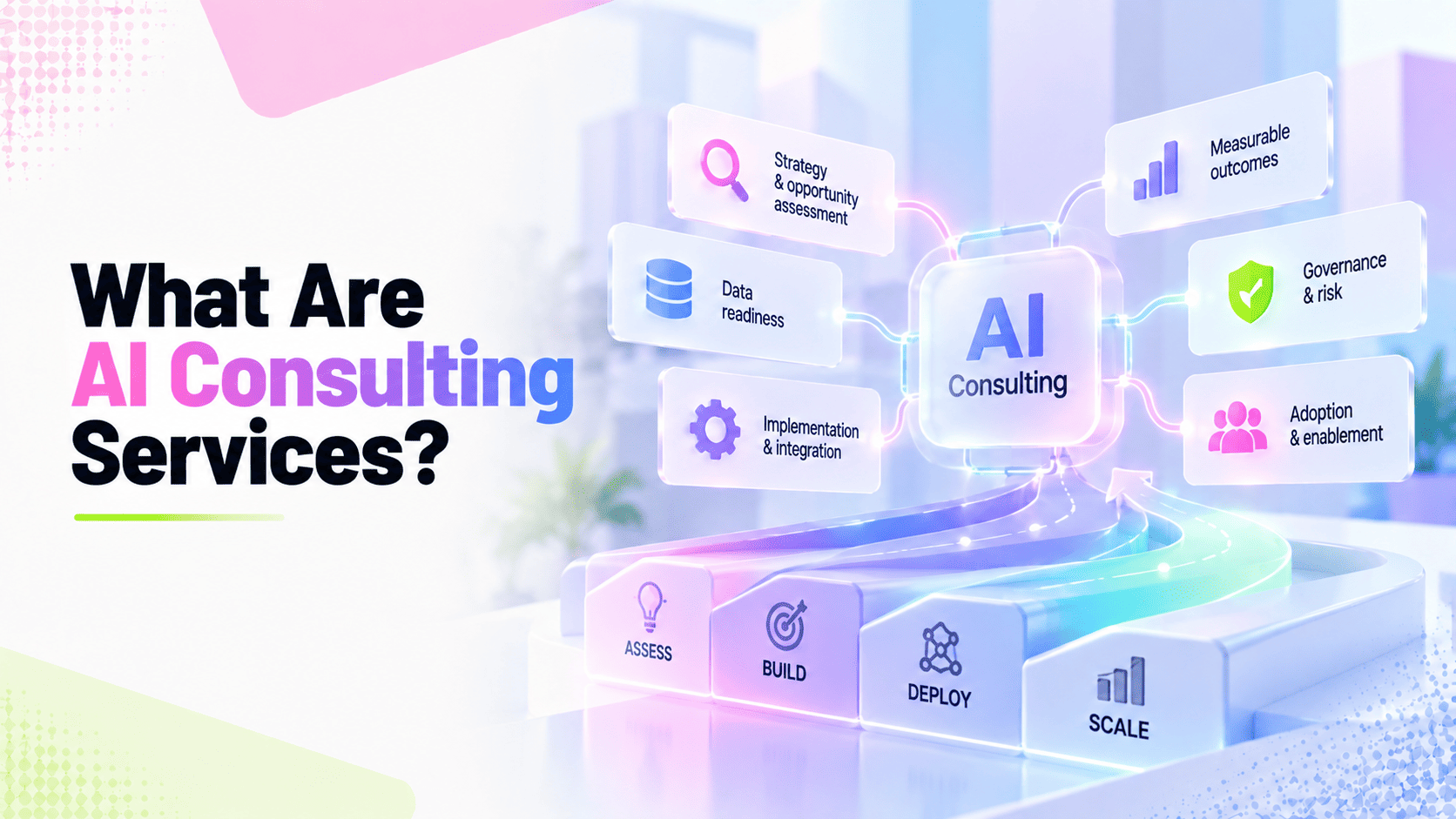
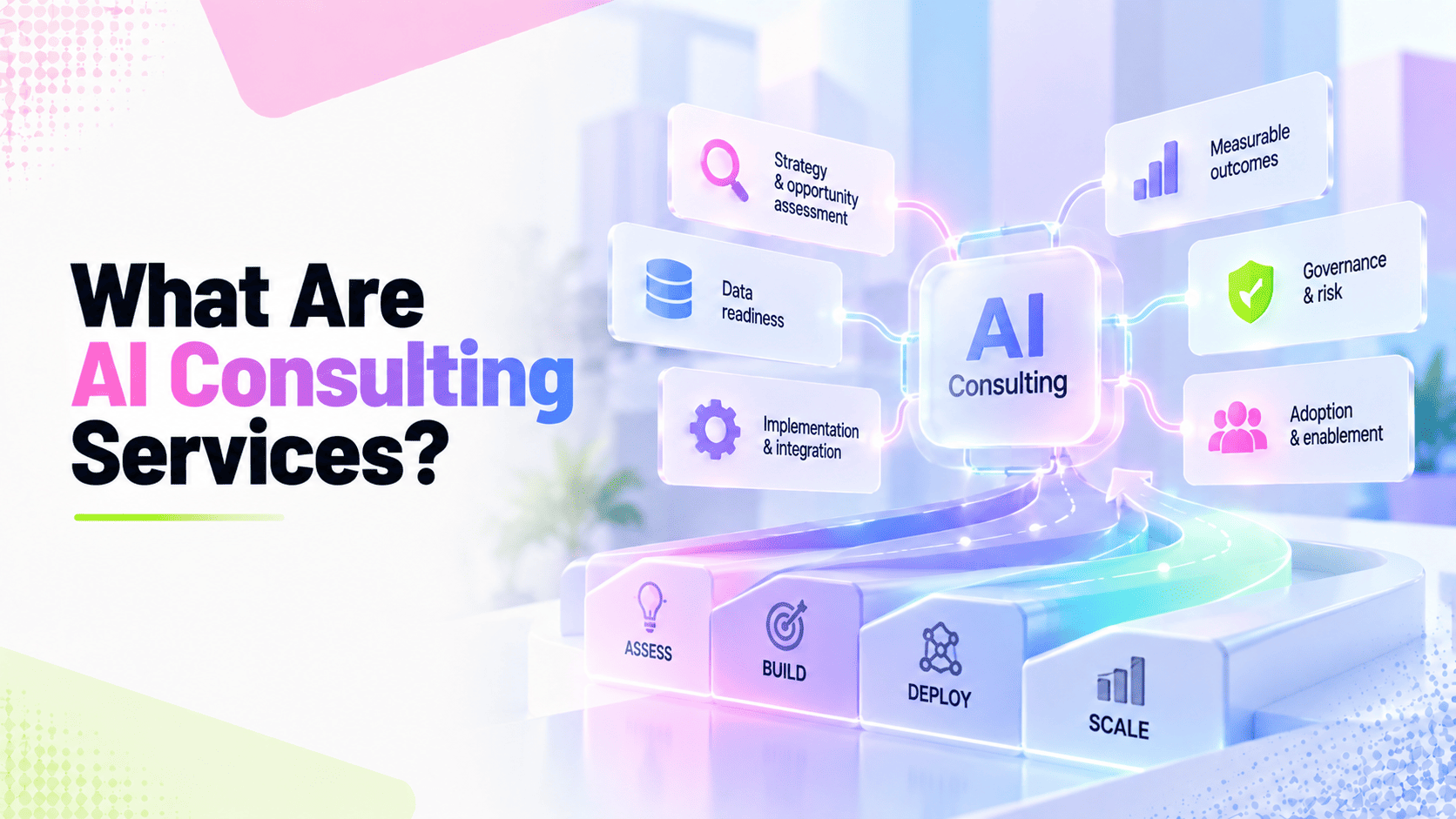
AI consulting services help organizations identify where AI can create measurable value, assess whether their data and operating environment are ready, design and build the appropriate solution, integrate it into real workflows, and establish the governance and operational capabilities needed to run it reliably.
The work may begin with AI strategy consulting, but it should not end with a presentation. Enterprise AI consulting increasingly spans the full path from opportunity assessment to engineering, deployment, adoption, measurement, and continuous improvement.
For enterprise buyers, that increasingly means looking for a partner that can combine strategic advice with hands-on engineering, deep expertise across the leading AI technology ecosystems, and enablement that strengthens the client’s own internal capabilities.
The distinction matters. An AI demonstration can show that something is technically possible. A production AI capability must also be useful, secure, integrated, supportable, economically viable, and trusted by the people expected to use it.
The Business Case for AI Consulting
Many organizations now have several AI initiatives in motion. They may be testing generative AI assistants, adding machine learning to existing products, experimenting with autonomous agents, or using AI tools within software delivery.
What they often lack is a connected path from those experiments to an enterprise outcome.
The obstacles tend to be structural:
- Use cases are selected because the technology is interesting, rather than because the business problem is valuable.
- Data is fragmented, unreliable, inaccessible, or poorly governed.
- A proof of concept is created without a credible production architecture.
- The model works, but it is not integrated into the workflow where employees or customers need it.
- Responsibility for security, validation, monitoring, and long-term ownership remains unclear.
- No baseline was established, making return on investment difficult to prove.
This explains why the market can show rising adoption and high project-abandonment rates at the same time. Starting an AI initiative has become easier. Turning it into a reliable business capability remains difficult.
A capable AI consulting firm provides more than specialist knowledge. It helps connect business strategy, data, architecture, engineering, risk, operations, and organizational change around one outcome. It should also challenge investments that lack a viable route to value rather than encouraging every initial idea to proceed.
As we explore in our guide “How AI and data analytics boost business results”, the value does not come from a model alone. It appears when trusted data, analytical intelligence, business decisions, and operational workflows come together.


Your AI Partner
Find where your AI program is blocked.
Exadel assesses strategy, data, technology, talent, governance, and ROI to identify the practical path to production.
What AI Consulting Services Actually Cover
The term “AI consulting” is used broadly. At one end of the market, it may mean a short strategic assessment. At the other, it may describe an end-to-end program involving data-platform modernization, custom model development, software engineering, organizational change, governance, and managed operations.
A serious enterprise engagement will normally cover some combination of five areas.
AI Strategy and Roadmapping
AI strategy begins with the decisions, constraints, and opportunities that matter to the organization, not with a list of tools.
Consultants work with business and technology leaders to identify potential use cases and evaluate them against criteria such as:
- Business value
- Technical feasibility
- Data availability
- Implementation cost
- Time to value
- Operational complexity
- Security and regulatory risk
- Adoption requirements
- Reusability across the organization
The output should be more than an idea backlog. A useful AI roadmap identifies which opportunities should proceed, which dependencies must be addressed first, how success will be measured, and which initiatives should be stopped or deferred.
Typical deliverables include a prioritized use-case portfolio, business cases, a target operating model, investment sequence, risk assessment, and implementation roadmap.
Data Readiness and Infrastructure Assessment
AI cannot be separated from the data used to train, ground, evaluate, and operate it.
Gartner found that 63% of organizations either lacked, or were unsure whether they had, the right data-management practices to support AI. It also emphasizes that AI-ready data is not a one-time preparation exercise. Pipelines, metadata, observability, quality, governance, and live production feeds must continue to evolve around the use case.
A data-readiness assessment examines questions such as:
- Is the necessary data available and representative?
- Can it be accessed at the speed required?
- Are definitions consistent across systems and business units?
- Is ownership clear?
- Can sensitive data be identified and protected?
- Is lineage available to explain where the data came from?
- Can quality be monitored after deployment?
- Can the platform support the required volume, latency, and cost?
These findings may lead to data remediation, pipeline modernization, platform redesign, governance work, or a narrower initial use case.
For example, Exadel began one engagement for a global fitness-technology provider with a four-week data-platform assessment. The team evaluated architecture, integration, analytics, cost, governance, security, and stakeholder alignment before producing quick-win recommendations, a North Star architecture, and a phased modernization roadmap. The subsequent work included pipeline optimization, data-model consolidation, lineage planning, and the refactoring of more than 30 business-intelligence reports.
Organizations that need an objective view of these dependencies can use an AI readiness and maturity assessment to examine strategy, data, technology, talent, governance, and ROI as one connected picture. Exadel’s current framework provides tiered assessments ranging from a rapid baseline to a full enterprise strategy and architecture blueprint.
Model Development, Fine-Tuning, and Integration
Once the use case and foundations are clear, AI implementation services move into design and engineering.
Depending on the problem, this may involve:
- Selecting an existing commercial or open-source model
- Building a custom machine-learning model
- Fine-tuning a model on approved proprietary data
- Applying retrieval-augmented generation to trusted knowledge
- Designing agentic workflows
- Creating evaluation datasets and quality thresholds
- Building application programming interfaces
- Integrating AI with enterprise applications and data sources
- Designing human-review and escalation steps
- Testing performance, security, latency, and cost
Model selection should follow the business and architectural requirements. The largest or newest model is not automatically the best choice. A smaller model may be faster, less expensive, easier to host privately, or sufficiently accurate for a controlled use case. In other situations, a managed model service may provide the quickest path to a reliable result.
Integration is equally important. An accurate prediction that remains inside a data-science environment does not change a business outcome. It must reach the employee, customer, application, or automated process able to act on it.
In an engagement with a major global telecommunications provider, Exadel built a production intelligence layer that unified operational data, vendor information, performance metrics, and internal documentation. Business users could ask natural-language questions and receive answers grounded in a shared Business Data Dictionary containing the organization’s terminology, KPIs, and operating rules. The solution supported faster decisions, earlier identification of anomalies, and daily adoption across operational teams.
MLOps, Governance, and Post-Launch Management
Deployment is not the end of an AI system’s lifecycle.
Models, data, costs, user behavior, external conditions, and regulatory requirements change. An output that met expectations during testing may deteriorate as production data shifts. A generative application may produce unexpected responses. A third-party model provider may release an update that affects quality, latency, or price.
MLOps—and, for large language model applications, LLMOps—applies repeatable engineering practices to deployment and operation. It can include:
- Automated testing and release pipelines
- Model and prompt versioning
- Performance and quality monitoring
- Data-drift and model-drift detection
- Logging and observability
- Rollback mechanisms
- Cost and latency controls
- Security and access management
- Incident response
- Periodic evaluation and retraining
Governance must also be designed into the lifecycle. The NIST AI Risk Management Framework treats governance, risk mapping, measurement, and management as connected functions. It is intended to help organizations incorporate trustworthiness considerations into the design, development, use, and evaluation of AI systems, not to add a compliance review after the system has already been built.
A consulting engagement should therefore define who owns the system, who validates its outputs, which decisions require human approval, how incidents are escalated, and how performance and business value will be reviewed over time.
AI Enablement and Internal Capability Building
A successful AI engagement should leave the organization with stronger internal capability, not simply a system that only an external provider knows how to operate.
Enablement helps engineering, product, data, security, governance, and business teams understand the technologies and practices required to adopt AI responsibly and continue improving it after the initial engagement. Depending on the organization, this may include hands-on training, paired delivery, governance playbooks, reference architectures, role-specific working sessions, documentation, and structured knowledge transfer.
This is particularly important as AI platforms and practices evolve quickly. The objective is not to make every client team an AI research organization. It is to give the people who will own the capability enough knowledge, tooling, and operational confidence to evaluate, govern, extend, and scale it.
What Should an AI Consulting Engagement Deliver?
The precise outputs depend on scope, but an enterprise buyer should expect tangible artifacts rather than broad recommendations.
Opportunity discovery
Prioritized use cases with value, feasibility, data, and risk criteria
AI strategy
Business case, investment plan, target operating model, and roadmap
Readiness assessment
Findings across data, architecture, skills, governance, and operations
Solution design
Target architecture, model strategy, integration plan, and security requirements
Proof of value
Tested business, technical, cost, and adoption assumptions
Implementation
Integrated, tested, production-ready AI capability
Governance
Decision rights, controls, evaluation standards, documentation, and escalation routes
Operations
Deployment, monitoring, versioning, support, and optimization model
Enablement
Training, documentation, knowledge transfer, and client ownership plan
The exact terminology varies between providers. The more important question is whether the outputs form a credible route from idea to operation.
A strong AI consulting engagement should produce tangible outputs at every stage, from prioritized opportunities and architecture through implementation, governance, operations, and internal enablement.
The 3 Phases of a Successful AI Consulting Engagement
Phase 1: Define — Strategy Before Tools
The Define phase establishes why the initiative should exist.
The consulting team identifies the business problem, intended users, current baseline, target outcome, data requirements, constraints, and risks. It evaluates whether AI is genuinely necessary or whether simpler automation, analytics, or process improvement would solve the problem more effectively.
This phase should answer:
- What decision or workflow are we improving?
- Who owns the business outcome?
- What must change for value to appear?
- Is the required data available?
- How will the result be measured?
- What would make us stop the initiative?
A credible Define phase reduces waste. It can reveal that the organization should repair a data pipeline, clarify a process, narrow the scope, or postpone model development until governance and ownership are established.
Phase 2: Build — Engineering-First Execution
The Build phase turns the selected opportunity into a working system.
This is where the distinction between advisory-led and engineering-led AI consulting becomes visible. Strategy consultants may be able to identify an attractive opportunity. The delivery team must make it operate inside the client’s actual technology environment, data landscape, security model, and workflow.
McKinsey’s 2025 global survey found that AI high performers were nearly three times as likely as other organizations to have fundamentally redesigned workflows. It identified workflow redesign as one of the strongest contributors to meaningful business impact.
At Exadel, our consultants are the same team that writes the code. Data architects, product specialists, AI engineers, software engineers, designers, security specialists, and business stakeholders work together from inception through implementation. That reduces the distance between a strategic recommendation and the engineering decisions required to make it work inside the client’s real architecture, data environment, security model, and operating processes.
The Build phase should include validation throughout, not a technical reveal at the end. Users need to test whether outputs are helpful. Engineers need to confirm reliability and performance. Risk and compliance teams need to assess controls. Business owners need to see whether the proposed workflow can achieve the intended result.
Our AI-enabled product engineering services bring product strategy, applied data science, design, and enterprise engineering together to turn AI concepts into secure, scalable products rather than isolated demonstrations.
Phase 3: Scale — Operationalizing AI for the Long Term
Scaling does not necessarily mean deploying one AI solution across the whole enterprise. It means creating repeatable capabilities that allow successful use cases to expand without multiplying risk, cost, and technical inconsistency.
This may require:
- Reusable architecture and components
- Standard deployment and evaluation pipelines
- Shared access to models and approved data
- Centralized observability and cost controls
- Federated governance across business units
- Adoption and training programs
- Support and incident-management processes
- An operating model for continuous improvement
IBM’s 2026 CEO Study reports that CEOs reshaping the C-suite with an AI-first mindset had scaled 10% more AI initiatives enterprise-wide. The finding does not suggest that changing titles alone produces value. It reinforces a broader point: leadership authority, cross-functional ownership, and the ability to change how work is performed are part of the scaling mechanism.
For a leading U.S. pet medical insurer, Exadel migrated an organically developed machine-learning environment to a production-grade MLOps foundation. Automated training, validation, versioning, deployment, CI/CD, and shadow testing reduced prediction response time by 25%, lowered the response error rate by 2%, and reduced model-deployment time to hours.
The result was not simply a better model. It was a more reliable way to develop, test, release, and operate models over time.
A successful AI consulting engagement moves through three connected phases, from defining the right opportunity to engineering the solution and scaling it responsibly.
Move AI from strategy to production.
Exadel combines consulting and engineering to build, integrate, and scale AI in real enterprise environments.
Which Industries Benefit Most from AI Consulting Services?
Any organization with valuable data, repeatable decisions, complex processes, or digital products may benefit. The priorities differ by industry.
Financial services: Banks, insurers, asset managers, and payments providers may use AI for fraud detection, claims review, risk analysis, customer service, document processing, and software modernization. Consulting must account for explainability, security, model risk, auditability, and human decision authority.
Healthcare and life sciences: Opportunities include clinical decision support, research analytics, operational capacity, laboratory management, patient engagement, and medical-asset identification. The delivery approach must reflect patient safety, privacy, interoperability, validation, and the distinction between administrative and clinical use cases.
Retail and consumer products: AI can support demand forecasting, assortment decisions, personalization, pricing, supply-chain visibility, and customer service. The quality of customer, product, inventory, and transaction data often determines whether these use cases work consistently across channels.
Media and communications: Providers may apply AI to audience intelligence, content discovery, advertising analytics, network operations, and conversational business intelligence. Shared definitions, real-time data, rights information, and reliable content metadata are common foundations.
Private equity: Firms can use AI and analytics in due diligence, portfolio monitoring, value-creation planning, and operational improvement. The consulting challenge often extends across portfolio companies with very different systems, data maturity, and capacity for change.
How to Evaluate an AI Consulting Partner: 7 Questions to Ask
1. How will you connect the proposed use case to a measurable business outcome?
A partner should define the baseline, target result, owner, and measurement method before development begins. “Improved efficiency” is not sufficient without explaining which process, by how much, and how the improvement will be verified.
2. How will you assess our data and infrastructure readiness?
Look for a practical method covering availability, quality, lineage, governance, architecture, integration, security, latency, and cost. Be cautious when a provider is ready to build before understanding the data.
3. Can the same organization take the solution from strategy into production?
Ask who will design the architecture, write the code, integrate the systems, test the outputs, and support deployment. A handoff between unrelated advisory and engineering teams can introduce delay, rework, and lost context.
4. How do you choose between commercial, open-source, and custom models?
The answer should be based on model capability, accuracy, security, deployment constraints, latency, cost, maintainability, governance, and the client’s existing technology environment. Strong technology partnerships can deepen a provider’s expertise, but they should inform the decision rather than predetermine it. Ask how the partner matches different technologies to different enterprise requirements.
5. How will the system be evaluated, governed, and monitored?
Expect a clear explanation of testing, human validation, observability, privacy, security, drift, incident response, documentation, and accountability. Governance should be reflected in architecture and operations, not confined to a policy document.
6. What happens after the pilot or first release?
Ask about production hardening, ownership, support, knowledge transfer, retraining, cost management, and continuous improvement. The provider should be able to explain how the client avoids being left with an unsupported prototype.
7. What comparable results can you demonstrate?
Relevant production experience should sit alongside credible practitioner expertise. Ask which technology ecosystems the provider works with, what training or certifications its practitioners hold, what systems they have actually taken into production, and what obstacles they encountered along the way. Certifications matter most when they are backed by hands-on delivery experience and current knowledge of the technologies being recommended.
Common Pitfalls in AI Consulting Engagements
Choosing a strategy-only provider with no delivery capability
A polished roadmap may still be unusable if it does not reflect production architecture, integration constraints, security requirements, and engineering effort. Establish who will implement the recommendations before commissioning them.
Starting with AI before the data is ready
Teams sometimes create a carefully prepared demonstration dataset that conceals the condition of the live environment. Production requires repeatable access to governed, monitored, and sufficiently current data.
Failing to define KPIs up front
Technical accuracy does not automatically equal business value. Agree on operational, financial, adoption, risk, and quality measures before implementation.
Underestimating change management
AI can alter roles, approvals, workload distribution, and decision authority. Employees need to understand how the system affects their work, when to rely on it, when to challenge it, and where accountability remains human.
Treating AI as a one-time deployment
Models and applications require monitoring, maintenance, evaluation, and adaptation. The engagement should establish who will own that work and how it will be funded.
How Exadel Approaches AI Consulting Differently
At Exadel, we combine consulting with engineering execution.
We help clients define the opportunity, assess readiness, build the data and technical foundations, implement the solution, integrate it into real workflows, and establish the controls required to operate it.
Our model connects three things that enterprise AI programs increasingly need together: consulting, engineering services, and enablement. Our recommendations are shaped by what it takes to make AI work in production—and by how the client’s own teams will ultimately operate and extend that capability.
Within that model, four capabilities distinguish our approach:
Engineering-first delivery. At Exadel, our consultants are the same team that writes the code. Our AI engineering services cover model pipelines, MLOps, real-world integration, governance, and post-launch optimization. Strategy and implementation therefore remain part of the same delivery conversation, reducing handoffs between people recommending a solution and those responsible for making it work.
Partnership-backed expertise. Exadel’s partnerships with Cursor, Anthropic, and OpenAI, together with certified practitioners inside our organization, give clients access to people who work closely with the technologies and practices shaping enterprise AI. The value is not the partner logos themselves. It is more informed architecture and implementation decisions, current knowledge of the capabilities and constraints of leading AI platforms, and practitioners who can translate that expertise into production delivery and client enablement.
Data and industry depth. Our data engineering and analytics services help enterprises connect, standardize, govern, and operationalize the information on which dependable AI relies. We apply that capability within the regulatory, operational, and customer context of each industry.
AI-native product experience. Exadel Colleague demonstrates how we apply our own engineering principles to agentic software delivery. It works on suitable development tickets asynchronously, produces tested pull requests, and keeps engineers responsible for review and approval. Building and operating our own AI-native capabilities gives our teams direct experience with questions around model selection, orchestration, testing, integration, governance, human oversight, cost, and production reliability: the same kinds of decisions our clients need to solve in their own AI programs.
Enablement is part of that delivery model, not an activity reserved for the final week of an engagement. We work alongside client teams so that architecture decisions, engineering practices, governance patterns, evaluation methods, and operational knowledge can be transferred as the capability is built.
The right consulting engagement should therefore leave the client with more than a deployed solution. It should create clearer ownership, stronger foundations, reusable capabilities, stronger internal expertise, and the confidence to make better AI investment decisions in the future.
-
Move from AI Experimentation to Production Value
AI adoption is no longer the difficult part. The harder task is selecting the right opportunities, preparing the foundations, engineering solutions that work inside the enterprise, and operating them responsibly over time.
Exadel combines AI consulting, engineering services, and enablement to help organizations choose the right opportunities, build production-ready capabilities, and strengthen the internal expertise needed to operate and scale them. Explore our AI engineering capabilities and speak with our team about the most practical next step for your organization.
-
Frequently Asked Questions
What might the balance be between AI consulting and AI development?
AI consulting determines where and how AI should be used, while AI development builds the resulting technical solution. In practice, effective enterprise engagements often combine both. Consulting may cover use-case prioritization, readiness, architecture, governance, operating models, and ROI. Development covers models, data pipelines, applications, integrations, testing, and deployment.
The strongest provider is not necessarily one that performs every activity, but one that creates a clear, accountable route from business objective to production operation without losing context between strategy and engineering—and that helps the client develop the skills and operating practices needed to own the capability over time.
How long does an AI consulting engagement take?
An AI consulting engagement can range from a few days for a focused readiness check to several months or longer for implementation and enterprise scaling. Timing depends on the problem, data condition, integration complexity, regulatory environment, and the maturity of the organization’s existing platforms. A useful engagement is often staged: a short discovery or assessment, followed by a proof of value, production implementation, and scaling. Each phase should have clear deliverables and decision points so the organization can proceed, adjust scope, or stop based on evidence.
What does an AI consulting firm typically charge?
AI consulting costs depend on scope, team composition, technical complexity, duration, and commercial model. Common structures include a fixed-price assessment, a defined proof-of-value project, project-based implementation, a dedicated delivery team, or an ongoing managed-service agreement. Buyers should compare the assumptions and deliverables rather than the headline price alone. A lower-cost prototype may become expensive if it excludes data preparation, security, integration, evaluation, production hardening, governance, or post-launch support. A credible proposal should make these boundaries explicit.
How do I know whether my organization is ready for AI consulting?
An organization does not need to be fully AI-ready before seeking consulting support. Uncertainty about readiness is often the reason to begin. Useful indicators include stalled pilots, fragmented data, unclear ownership, pressure to identify viable use cases, difficulty moving models into production, or concern about governance and ROI. The initial engagement should establish a baseline across business strategy, data, technology, talent, operations, risk, and investment. It should then recommend whether to build, remediate foundations, narrow the use case, or pause further spending.
Where capability gaps are part of the problem, that recommendation should also identify what the client’s own teams need to learn, adopt, or own as the program progresses.
Turn AI consulting into production value.
Exadel combines consulting, engineering, and enablement to build reliable AI capabilities your teams can own and scale.