
Tags
Share
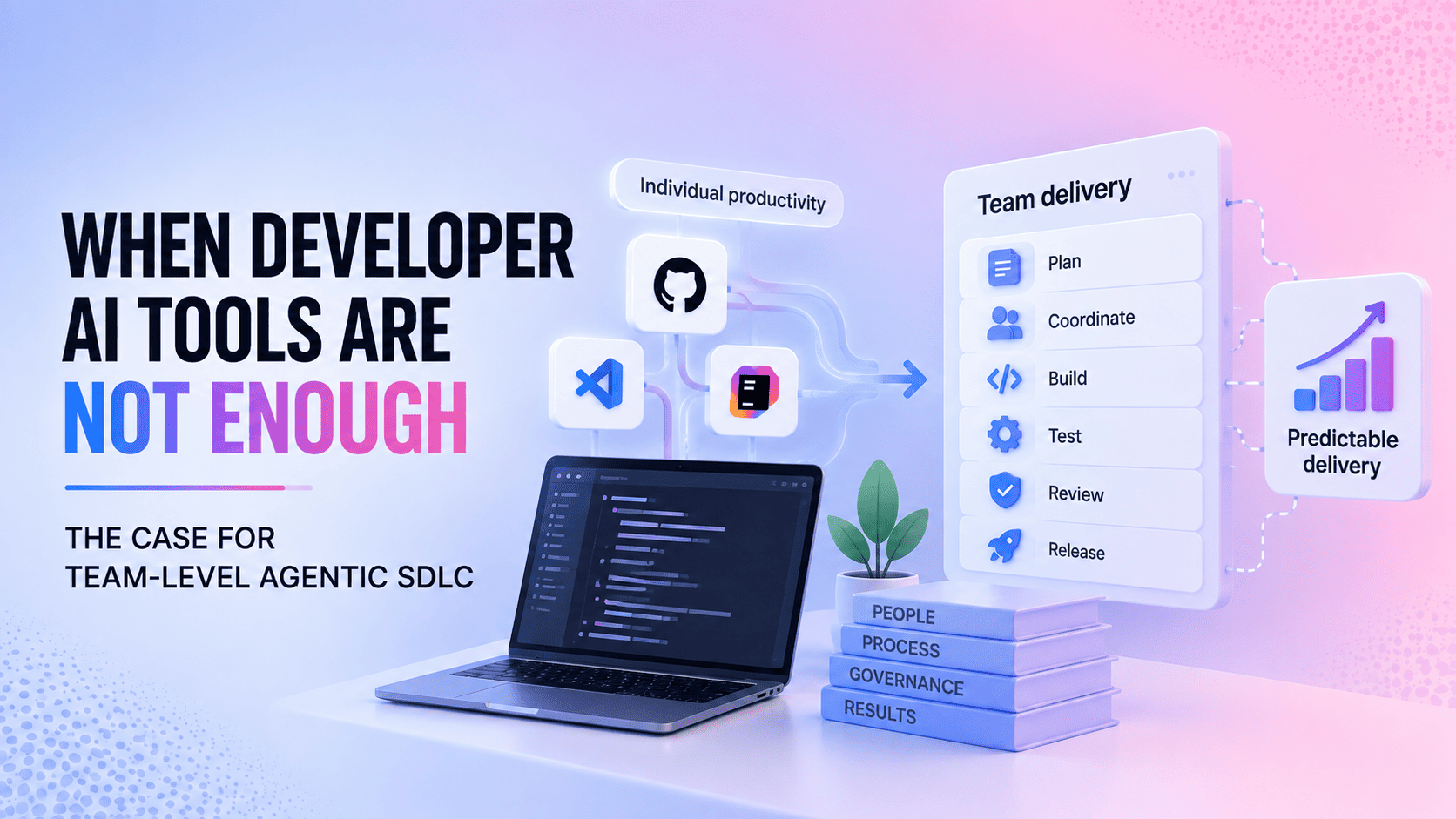
The Case for Team-Level Agentic SDLC
Developer AI tools have quickly become an integral part of enterprise engineering. GitHub Copilot and similar tools can generate code, explain unfamiliar code, and reduce repetitive development tasks. For many developers, these tools are part of the everyday working environment. Research by GitHub and Accenture has shown that AI coding assistants can deliver meaningful productivity gains for individual developers.
That’s real progress. Yet the results are often less visible at the team level.
A company may report high rates of adoption while sprint completion remains unchanged. Developers may feel faster while release schedules continue to slip. Teams may be producing more code, yet the backlog won’t shrink. This raises an uncomfortable question: if almost every developer’s using AI, why isn’t the team delivering more?
The answer is developer AI tools are doing exactly what they were designed for: helping one person complete specific tasks more efficiently. Software delivery isn’t the output of one developer working in one IDE, but the result of a coordinated system involving product managers, engineers, reviewers, QA specialists, security teams, architects, operations teams, and release processes. To create value, work must move through that entire system.
While individual AI tools improve parts of the work, they don’t automatically improve the flow of work across the team. And that’s the distinction between developer-level AI and team-level Agentic SDLC.
Individual vs. Team-Level AI: The Fundamental Distinction
Developer AI tools operate within the limited context of an individual task.
A developer opens an IDE, prompts an AI assistant, and receives code, explanations, tests, or fixes. The interaction is immediate and personal. Team-level delivery is a whole different ballgame. A feature begins as a requirement that may need clarification before actual engineering starts. The work must be prioritized, assigned, implemented, tested, reviewed, approved, integrated, and released. Each stage depends on decisions made by different people, often using different systems.
One developer’s productivity is only one factor in that process. That’s why a simple productivity calculation can be misleading. Suppose ten developers become 20% faster at selected coding tasks. That doesn't mean the organization has gained two developers' worth of delivery capacity. Much of the time saved is still absorbed by reviews, rework, production support, and the same downstream processes that already constrain delivery. A 20% improvement in one developer’s day isn’t the same as a 20% increase in team throughput.
Coding assistants can't compensate for team-level capacity gaps. Teams still lose capacity to leave, production incidents, competing priorities, and delivery spikes. When demand suddenly exceeds available engineering or QA capacity, faster code generation alone doesn't solve the problem.
An individual coding assistant cannot redistribute work when capacity changes. Nor can it examine the backlog, identify suitable tasks, coordinate execution, and move completed work into review. Making individual developers more productive doesn't automatically help the team deliver more software.
This is why engineering leaders need to distinguish between AI adoption and AI-enabled delivery. Adoption can be measured by licenses, active users, prompts, or accepted suggestions. Delivery can only be measured through completed work, quality, lead time, release predictability, and recovered capacity.
This emphasis on delivery outcomes aligns with frameworks such as DORA, which evaluate software delivery performance using engineering-focused operational metrics.
What Happens When Every Dev Has Copilot But Teams Still Miss Sprints
A company rolls out GitHub Copilot across its development teams. Adoption is high: developers use it to generate routine code, create test scaffolding, explain legacy code, and accelerate common implementation tasks. Productivity improves and developers report a better experience. Yet the next sprint looks remarkably familiar.
The team reviews a set of Jira tickets. Some are well defined and ready for implementation; others still contain gaps. Developers and product managers still clarify requirements before work begins. During implementation, developers use Copilot differently depending on their experience, prompting techniques, and familiarity with the codebase. The resulting pull requests vary in quality, test coverage, documentation, and alignment with engineering standards.
Senior engineers still review architecture, quality, security, and merge readiness. The review queue becomes the next constraint. More work reaches QA, but not necessarily in a more predictable or testable condition. Requirements may still be ambiguous, test coverage incomplete, and changes clustered near the end of the sprint.
Capacity constraints haven't disappeared either. One engineer is on leave while another is pulled into a production incident. Developers still have Copilot, but the team has less capacity. QA still receives work late in the sprint. The team still can't clear the backlog.
This isn't a contradiction. Developers may genuinely be completing some tasks faster while the team continues to encounter the same delivery constraints. AI coding assistants improve individual execution. Software delivery depends on coordination across planning, implementation, testing, review, and release.
This helps explain why engineering leaders often struggle to demonstrate a return from developer AI tools. The evidence exists at the activity level but remains difficult to see at the delivery level. AI didn't fail. It solved a different problem. What's missing is a governance layer that connects AI-supported execution to the backlog, quality controls, review process, and delivery goals.
The Missing Governance Layer
As AI moves to enterprise adoption, governance is often discussed in terms of risk. Which models are approved? Where can data be sent? How is generated code reviewed? What security controls are required?
As organizations grow their AI-enabled product engineering capabilities, governance takes on an operational role. A team-level governance layer defines where work begins, which tasks are suitable, which standards must be followed, what evidence must be produced, where human review is required, and how progress becomes visible to the wider team.
Without that layer, AI use remains fragmented. Each developer decides when to use a tool, how to prompt it, what output to trust, how much testing to add, and when the work is ready. The organization may provide broad guidelines, but execution still varies from person to person.
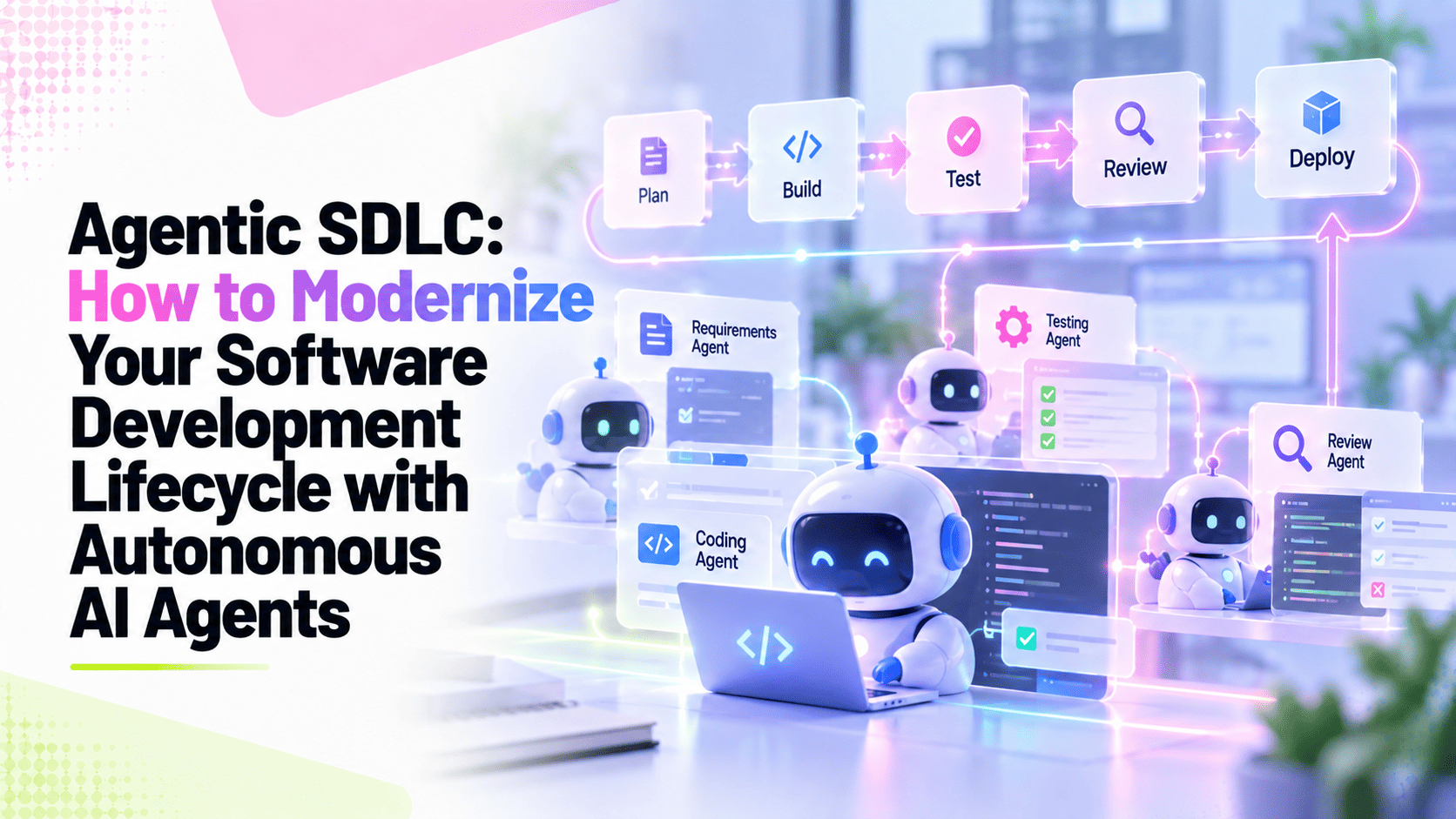
A governed Agentic SDLC introduces a more consistent model. The workflow begins with a ticket in Jira rather than an instruction entered into an IDE. The ticket provides the starting context: what needs to be done, the available acceptance criteria, known dependencies, and the expected result.
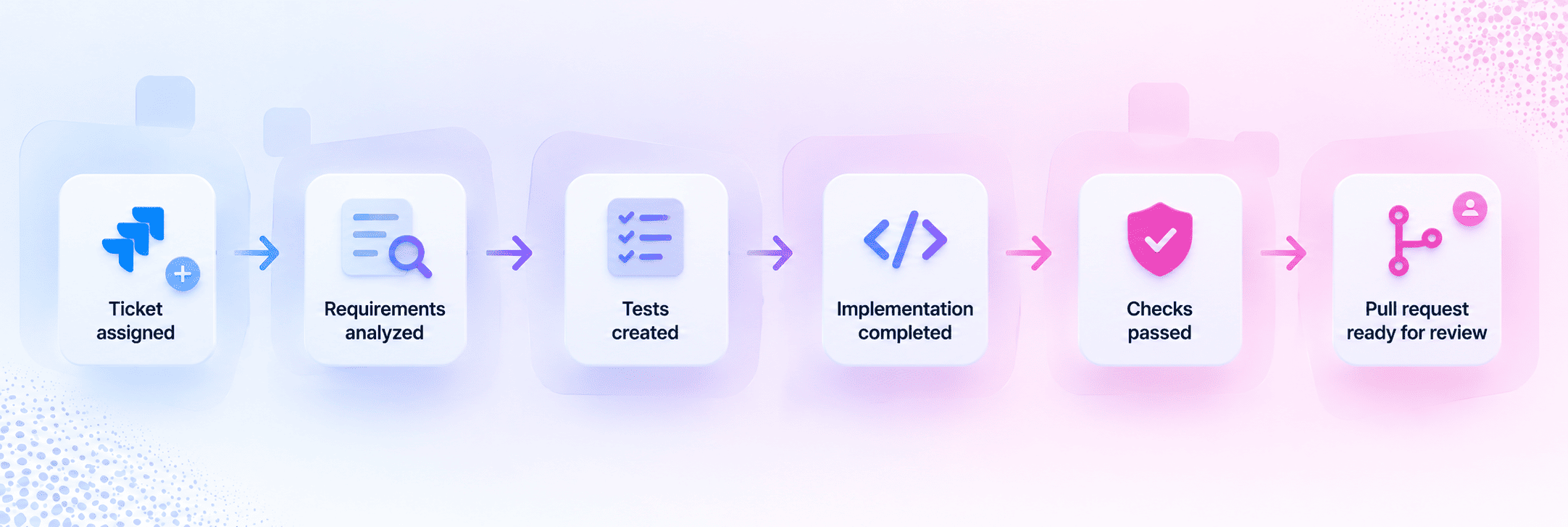
A suitable ticket can then trigger a defined process. The agent analyzes the requirement, identifies the affected code, creates tests, implements the change, runs the required checks, and prepares a pull request. The work doesn’t bypass the engineering team but arrives in the same review workflow the team already uses, with evidence that helps a human reviewer assess it.
The sequence matters:
A team can require test-first execution, code-quality thresholds, security scans, static analysis, documentation standards, and named human approval. It can also restrict AI execution to selected repositories or categories of work. The agent operates within those boundaries.
This addresses one of the central limitations of individual developer AI tools: they can generate useful output, but they don’t create a shared delivery standard by themselves.
A developer using Copilot may know how the tool helped with a task, but the project manager usually sees only the ticket status. QA may not know what tests were generated. Engineering leadership may know that licenses are active, but not how much delivery capacity has been recovered. A governed workflow makes the execution trace visible. The team can see which tickets were handled, what work was completed, what tests were run, what checks passed, which failed, and where human intervention was required. That creates an operational record rather than a private interaction between a developer and an assistant.
The goal is to reserve human judgement for where it has the greatest value. Engineers still review changes. Architects still make consequential design decisions. Product managers still define priorities. QA still validates critical behavior.
The opportunity lies in designing a delivery model in which AI can contribute safely, consistently, and measurably.
What QA and PMs Gain From Team-Level Agentic SDLC
Developer AI tools are usually evaluated from the developer’s perspective. Did the tool reduce typing? Did it help solve a problem or generate a useful suggestion? Team-level Agentic SDLC must be evaluated more broadly because its value depends on what it changes for the entire delivery organization.
QA receives work built around verification
In a traditional workflow, testing can become separated from implementation. A developer completes the code, adds some tests, and sends the work forward. QA then determines whether the change behaves as expected. When requirements are unclear or coverage is incomplete, the work moves back to development. That cycle creates review churn.
A TDD-first approach changes the sequence. Tests are defined before or alongside the implementation. The expected behavior becomes part of the work itself rather than something checked only at the end. TDD-first output gives QA a stronger baseline and reduces avoidable defects entering the review queue.
For QA, this means more consistent test coverage, earlier defect detection, and fewer inadequately validated pull requests. That allows specialists to spend more time on edge cases, integration risks, and user behaviour instead of correcting avoidable gaps.
Product managers see completed work, not activity
Product managers often rely on indirect signals. A ticket may be marked in progress, the implementation nearly complete, and a pull request already open—yet testing hasn’t started. The sprint board shows movement while the outcome remains uncertain. That’s the gap between activity and delivery.
Team-level Agentic SDLC can make ticket completion a stronger signal because the workflow connects implementation to testing, checks, and pull request preparation. Progress is also measured by how far the work has moved through the delivery process.
Product managers also gain much clearer visibility into delivery. They can see which tickets are suitable for agent execution, where work is progressing or blocked, what validation has already been completed, and which items are genuinely ready for human review. That makes sprint planning and forecasting more reliable because progress reflects the state of the delivery process rather than simply developer activity.
Engineering leaders can measure recovered capacity
AI ROI is difficult to defend when it’s based only on usage. The number of licenses only confirms how many people have access, prompt volume indicates activity levels and code acceptance rates show that suggestions are being used. But none of these measures establishes that meaningful capacity has been gained.
Human-Equivalent Hours (HEH) provide a practical way to estimate the engineering work completed by an AI-enabled process in terms comparable with human effort. It does not imply direct payroll savings or assume people can be replaced hour for hour. It simply shows how much delivery capacity has been recovered. And recovered capacity can be applied to reduce backlog, absorb demand spikes, accelerate product delivery, improve test coverage, or give senior engineers more time for architecture and complex problem-solving.
This pivots the ROI discussion away from “How many developers used the tool?” and toward “What additional work could the team complete?” It also establishes a clearer link between engineering and finance. There is no need for finance to interpret coding-assistant telemetry when it can evaluate recovered capacity, avoided delays, reduced delivery overhead, and the business value of work completed earlier.
The Shift From Tool to Platform: What It Means in Practice
In sprint planning, the conversation changes. Instead of asking who is using AI, the team identifies which tickets are suitable for agent execution, which controls apply, where human review is required, and how much additional capacity can be planned into the sprint.
Moving from individual tools to a team-level platform does not mean removing Copilot or asking developers to stop using AI in the IDE. The two models serve different purposes. Developer AI supports people while they work. A platform-level Agentic SDLC supports the delivery system around them.
That difference becomes obvious in day-to-day delivery. With individual AI, a developer decides when to use a tool. With team-level AI, suitable work is identified in the backlog and routed through a governed workflow.
Success is measured differently, too. Individual tools are often assessed through adoption, suggestions, acceptance rates, or developer sentiment. A platform is measured through completed tickets, test-backed pull requests, lead time, delivery predictability, review effort, and recovered engineering capacity.
A Phase 0 assessment reviews the backlog, repositories, governance requirements, and representative tasks to identify where agent execution can create real value. It also reveals an important truth: not every ticket is suitable. Some work is too ambiguous, requires deep product judgement, affects sensitive systems, or demands specialized review. Other repositories lack the test coverage or documentation needed for reliable automation.
Developer AI tools solve the problem they were designed to solve. Enterprise software delivery is a different problem, though. That's why engineering teams looking for measurable delivery gains are beginning to adopt governed, team-level AI operating models.
Exadel Colleague is built around that model. It works within Jira and Git-based engineering workflows, turning suitable tickets into test-backed pull requests for engineers to review and approve. It adds a governed execution layer above individual developer tools rather than trying to replace them.
This also helps address the risks associated with informal or inconsistent AI development practices. As discussed in our analysis of vibe coding and technical debt, faster generation without shared controls can increase downstream quality and maintenance pressure. A platform model brings testing, review, and policy into the workflow from the beginning.
Written by: Alexey Girzhadovich, Chief Enterprise AI and Solutions Officer
July, 2026


Your AI Partner
See the difference between tool-level and platform-level AI delivery in a 30-minute demo.