
Tags
Share
A clear definition of Agentic SDLC, how it works, and why enterprise engineering teams are adopting it.
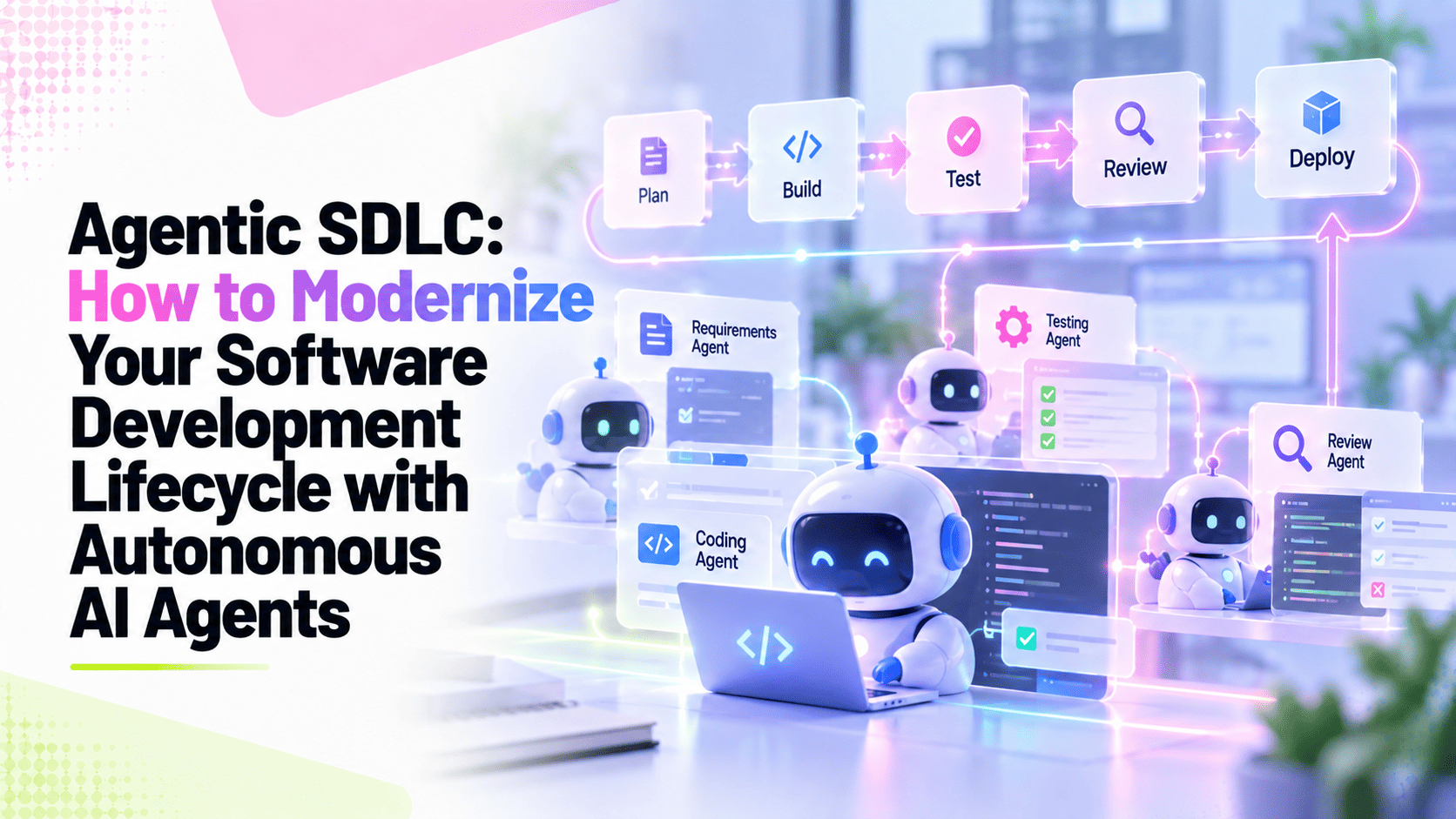
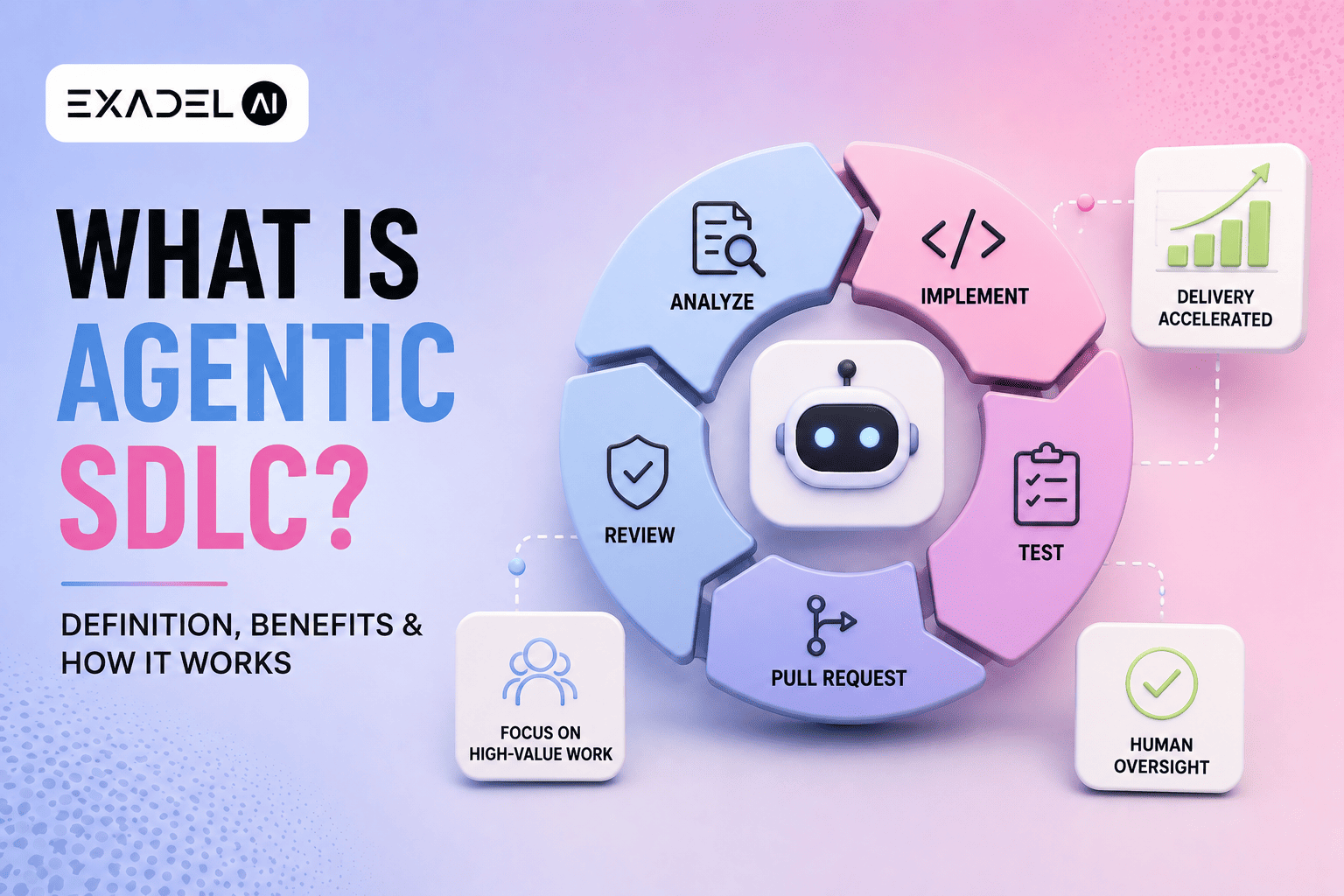
Agentic SDLC is a software development lifecycle approach in which autonomous AI agents execute defined SDLC tasks without requiring continuous developer intervention. These tasks include requirements analysis, test generation, code implementation, and pull request creation, enabling engineering teams to delegate structured work and focus on architecture and high-value decisions.
Agentic SDLC extends software engineering automation beyond code generation. Instead of assisting individual developers, autonomous AI agents execute defined delivery tasks across planning, implementation, testing, and validation under human governance.
The approach builds on earlier advances such as CI/CD, DevOps, and AI coding assistants, but applies automation across the broader software development lifecycle rather than individual activities.
For enterprise engineering teams, this represents a shift from AI that assists developers to AI that helps execute structured software delivery work. The following sections explain how Agentic SDLC differs from traditional development approaches, the capabilities that define an enterprise platform, and what organizations should look for when evaluating one.
How Agentic SDLC Differs From Traditional SDLC
Traditional software development lifecycles rely on engineers to perform nearly every delivery task manually. While modern tooling has improved productivity, planning, implementation, testing, documentation, and pull request preparation still require significant human effort.
Agentic SDLC introduces autonomous execution for defined activities while preserving human governance.
Developers execute most delivery tasks manually.
Autonomous agents execute approved, repeatable SDLC tasks.
Progress depends on developer availability.
Work continues automatically when predefined conditions are met.
Individual productivity improvements.
Team-wide workflow automation across multiple lifecycle stages.
Manual coordination between engineering activities.
Workflow orchestration connects planning, coding, testing, and validation.
Human execution throughout the process.
Human oversight governs autonomous execution and final approval.
This shift changes the role of engineers rather than eliminating it. Developers spend less time performing repetitive implementation work and more time reviewing, refining, designing, and making architectural decisions.
How Agentic SDLC Differs From AI-Assisted Development
The terms are sometimes used interchangeably, but Agentic SDLC and AI-assisted development describe different approaches.
AI-assisted development focuses on increasing the productivity of an individual developer. Tools such as coding assistants generate code suggestions, explain APIs, or complete functions inside an IDE while the developer directs every step.
By contrast, Agentic SDLC operates at the workflow level rather than the developer level. Instead of simply suggesting code, autonomous agents can:
- analyze assigned requirements
- generate implementation plans
- create production-ready code
- write and execute unit tests
- prepare pull requests
- respond to review feedback
- update delivery artifacts
The workflow is initiated by business events rather than continuous human prompting. For example, assigning a Jira ticket may automatically trigger an engineering agent to begin implementation within established governance policies.
This distinction matters because enterprise software delivery extends far beyond writing code. Requirements analysis, validation, testing, documentation, governance, and review often consume more engineering effort than implementation itself. With Agentic SDLC, these activities become part of an integrated delivery process rather than code generation being the primary objective.
Teams looking to understand why autonomous agents address delivery bottlenecks differently from AI coding assistants can explore our article on Background Agents and Software Engineering Bottlenecks.
Key Components of an Agentic SDLC Platform
Not every AI development tool qualifies as an Agentic SDLC platform. Enterprise implementations typically combine several capabilities that work together:
Workflow orchestration
Agents understand delivery workflows and respond to events such as ticket assignment, backlog updates, or pull request reviews rather than waiting for manual prompts.
Autonomous task execution
Agents perform defined engineering activities independently, including requirements analysis, code implementation, testing, documentation, and pull request preparation.
Enterprise integrations
The platform operates inside existing engineering environments by integrating with tools such as Jira, Git repositories, CI/CD systems, and collaboration platforms.
Governance and policy controls
Organizations define which tasks agents may perform, what approvals are required, and which activities always require human review.
Quality validation
Automated testing, policy checks, static analysis, and organizational quality standards are applied before work reaches human reviewers. Combined with test-driven development (TDD), these practices help ensure AI-generated code meets enterprise quality standards before human approval. Learn more in Test-Driven Development in the Age of AI Coding.
Human oversight
Developers remain responsible for reviewing, approving, and merging outputs. Human judgment continues to guide architecture, security, and business-critical decisions. Together, these capabilities enable engineering organizations to automate structured work without sacrificing quality, traceability, or governance.
Business Benefits for Enterprise Engineering Teams
Organizations adopting Agentic SDLC are typically seeking improvements in engineering throughput rather than simply faster code generation.
Increased engineering capacity
Autonomous execution reduces the manual effort required for repetitive development activities, allowing teams to deliver more work without proportionally increasing headcount.
Faster delivery
Agents can begin work immediately when predefined conditions are met, reducing delays between planning, implementation, testing, and review.
Improved software quality
Consistent testing, policy enforcement, and standardized workflows reduce variation across engineering teams and improve delivery predictability.
Better use of engineering expertise
Highly skilled engineers spend more time solving architectural and business problems instead of repeatedly implementing routine tasks.
Stronger governance
Enterprise platforms maintain auditability, approval workflows, and policy enforcement throughout software delivery, making autonomous execution appropriate even in regulated environments.
These are benefits that become increasingly valuable as AI-generated code accelerates software creation which in turn places greater pressure on downstream engineering activities such as testing, validation, and review.
What to Look For When Evaluating an Agentic SDLC Platform
As interest in Agentic SDLC grows, the distinction between standalone AI tools and enterprise delivery platforms become important.
When evaluating vendors, consider these five criteria separate enterprise Agentic SDLC platforms from individual AI productivity tools.
1. Lifecycle coverage
Does the platform automate multiple stages of software delivery or simply assist developers with coding?
2. Governance
Can organizations define policies, approval requirements, audit trails, and human review checkpoints?
3. Workflow integration
Does the platform work inside existing engineering tools such as Jira, Git platforms, CI/CD pipelines, and collaboration systems?
4. Enterprise scalability
Can the platform support multiple engineering teams while maintaining consistent operational standards and governance?
5. Human-centered delivery
Does the platform keep engineers responsible for architectural decisions, quality assurance, and production approval while automating structured work?
Software delivery has steadily evolved from manual processes to increasingly automated workflows. Agentic SDLC represents the next stage of that evolution by extending automation beyond code generation to the broader software development lifecycle while keeping engineers responsible for architecture, governance, and business outcomes.
As organizations move beyond AI coding assistants toward broader engineering automation, Agentic SDLC provides a practical framework for combining autonomous execution with enterprise governance and human oversight.
Frequently Asked Questions
Is Agentic SDLC the same as AI-assisted development?
No. AI-assisted development amplifies an individual developer by providing coding suggestions inside an IDE. Agentic SDLC automates defined workflow stages across the engineering team, allowing autonomous agents to execute structured delivery tasks under human governance.
Does Agentic SDLC replace software engineers?
No. Engineers remain responsible for reviewing, approving, and merging outputs. Agentic SDLC automates repetitive, well-defined work while engineers focus on architecture, complex problem-solving, and technical leadership.
What is the difference between Agentic SDLC and a CI/CD pipeline?
CI/CD pipelines automate the integration, testing, and deployment of code that has already been written. Agentic SDLC begins much earlier by automating activities such as requirements analysis, implementation, testing, documentation, and pull request creation before code reaches the deployment pipeline.
Written by: Alexey Girzhadovich, Chief Enterprise AI and Solutions Officer
July, 2026
See Agentic SDLC in Practice
Discover how Exadel Colleague automates structured software delivery work across Jira and Git-based engineering workflows while keeping developers in control.