
Tags
Share
Enterprise investment in AI is now well and truly beyond the experimentation phase. Now it’s up to engineering teams to prove what this investment can actually return for the business.
Measuring the ROI of AI in enterprise software development can be surprisingly difficult. Metrics such as adoption rates, tokens consumed, or even hours saved tell part of the story. But they don't necessarily answer the question a CFO or board member is likely to ask: What did we spend, what did we get back, and can we prove it?
Exadel Colleague gives us a way to answer that question at the engineering level where the actual work gets done. We can simply look at individual engineering tickets, calculate the AI compute required to complete them, and compare that cost with the engineering value recovered through autonomous resolution.
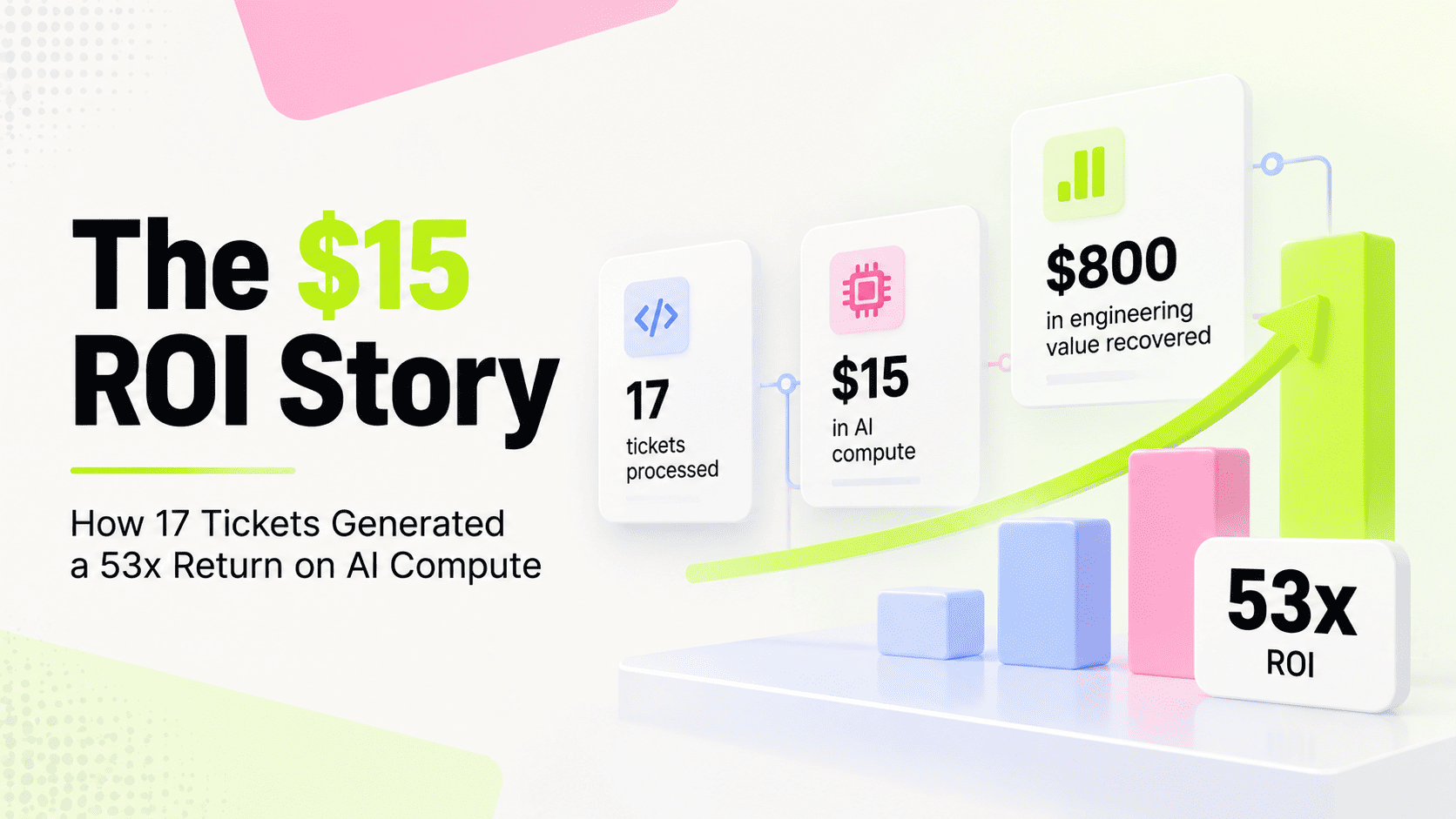
The numbers from one Exadel Colleague pilot confirm this principle in unusually clear terms: 17 eligible tickets processed. Approximately $15 in AI compute. Around $800 in recovered engineering value. That's an AI compute cost ROI of approximately 53 to 1.
It’s more important to understand how we arrived at this number. For this approach to be useful, it needs to be reproducible, auditable, and applicable beyond a single pilot.
H2-1: The 42-Ticket Projection: Setting the Stage
The starting point for measuring AI ROI in engineering is the workload and not the model.
In one recent Exadel Colleague benchmark, we started with 42 engineering tickets that had already been resolved by a delivery team. Of those, 17 had matching Jira and Git data and were therefore eligible for Colleague. All 17 were completed successfully in the benchmark. Fourteen were simple bugs, where the fixes achieved approximately 90% accuracy. The remaining three were more complex tasks, where accuracy was approximately 60%.
This provides us with a far more useful basis for evaluating AI than a blanket claim about developer productivity.
First, it establishes the scope for autonomous execution. The benchmark doesn’t assume that every ticket can or should be handled autonomously. The remaining 25 tickets followed the ineligible route, so the value calculation starts only with the work that met the eligibility criteria. For Finance, that distinction matters. An ROI calculation based on the entire backlog would assign potential value to work the AI may never actually perform.
Second, eligibility tells us something about scale. A high return on autonomous work means more when that work represents a meaningful share of the backlog. Conversely, an impressive per-ticket return has limited enterprise impact if very little of the workload is suitable for autonomous execution. Measuring AI ROI in software development therefore requires two measures: the value generated from eligible work and the proportion of the overall workload where that value can realistically be captured.
The ticket-level approach also makes the calculation easier to test. Rather than starting with a broad productivity estimate, the methodology traces the calculation back to individual tickets, historical engineering effort, and actual AI compute. That makes it reproducible across different backlogs, auditable against the underlying work, and finance-friendly because both the cost and recovered engineering capacity can ultimately be expressed in financial terms.
Most importantly, it changes the question being asked. Instead of asking whether developers feel more productive with AI, an enterprise can ask something much more concrete: Which work can AI perform? How much human effort does that work normally require? What does autonomous execution cost? Once those inputs are known, the ROI calculation becomes considerably less abstract.
Source for benchmark figures: Exadel Colleague pilot deployments, January–April 2026.
H2-2: $15 In, $800 Out: The Math
Now we can put a financial value to the 17 eligible tickets. Across the benchmark, the average AI compute cost was approximately $0.88 per ticket and the average engineering value recovered was approximately $47 per ticket.
That works out to roughly $15 in AI compute and $800 in recovered engineering value. This explains how we arrive at an AI compute cost ROI of approximately 53:1. The calculation itself is straightforward: $800 recovered engineering value ÷ $15 AI compute cost = 53. Or, if we translate it into CFO terms: for every $1 spent on AI compute, approximately $53 was returned in recovered engineering time.
Across those 17 eligible tickets, the benchmark started with 28.5 hours of baseline engineering effort and recovered 20.3 hours through autonomous execution. That represents a 71% reduction in human engineering time on eligible work. This equates to roughly 2.5 working days of engineering capacity returned to the team.
There’s an important distinction to be made here. Recovered engineering value doesn’t mean an equivalent amount immediately disappearing from the payroll. It represents engineering capacity that would otherwise have been spent completing that work. That reclaimed capacity can instead be allocated to higher-value development work, help reduce backlog pressure, or increase throughput without adding engineering effort at the same rate.
This is what makes the 53:1 figure useful when measuring AI ROI in engineering. It connects a measurable input (AI compute cost) with a measurable engineering output. Rather than relying on a broad claim that AI makes developers more productive, we can begin to quantify what the organization receives in return for what it spends.
But to do that consistently, we need a common way to express the engineering capacity being recovered. That brings us to Human-Equivalent Hours (HEH).
H2-3: Human-Equivalent Hours Explained
If compute cost tells us what we spend on AI, Human-Equivalent Hours (HEH) help us understand what we get in return.
HEH translates autonomously completed work into the amount of human engineering effort that would’ve been required to complete it. Instead of measuring AI activity through tokens consumed, it measures the engineering capacity recovered.
The basic formula is:
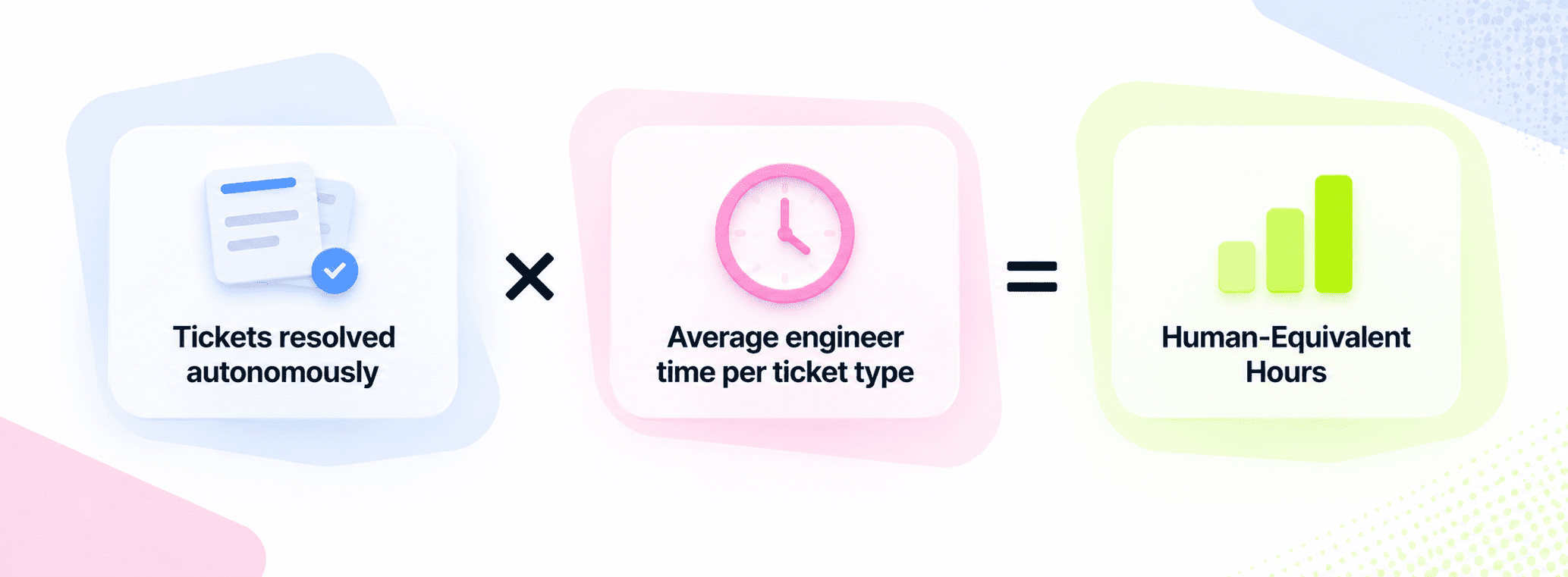
The word equivalent matters here. If Colleague completes work representing five hours of normal engineering effort, it doesn’t mean the AI itself worked for five hours. It means the work completed autonomously would otherwise have required approximately five hours of engineer time. This provides Engineering and Finance with a common unit of measurement.
Tokens remain useful for establishing AI compute cost, but token consumption tells us little about the value created in return. A high token count could represent valuable engineering work, inefficient AI usage, or anything in between. HEH shifts the focus from AI consumption to engineering output.
Across three Exadel Colleague pilot deployments, the benchmarks recorded 123 HEH, 106 HEH, and 82 HEH respectively. Each figure represents the human engineering capacity recovered through work completed autonomously by Colleague. The point is not that 123 HEH is inherently better than 82 HEH. Each benchmark reflects a different engineering workload, so the totals aren't directly comparable. The value of HEH is that it provides a consistent way to express the engineering capacity recovered across those environments.
HEH also provides a consistent measure of AI performance over time. Token consumption can change as models, pricing, and routing strategies evolve. The engineering work itself provides a more durable reference point. If a class of task normally requires a known amount of engineer time, autonomous completion gives the business a measurable unit of recovered capacity regardless of which model performed the work. That makes HEH particularly useful as agentic development evolves: organizations can change models or optimize compute without losing the business metric they use to judge the result.
It also keeps the technical and financial conversations connected. Engineering measures completed work against established effort. Finance can then assign a value to the capacity recovered. Both teams are working from the same underlying unit rather than separate measures of AI activity and business value.
For measuring agentic SDLC ROI, the question shifts from how much AI did we use? to how much engineering work did the AI complete?
Once that work can be expressed in Human-Equivalent Hours, Finance has something it can apply a value to. And that takes us from measuring engineering output to building a CFO-ready ROI model.
Source: Exadel Colleague pilot deployments, January–April 2026.
H2-4: The CFO-Ready Report: What Finance Teams Need to See
The next step is to translate that recovered engineering capacity into financial terms.
Here we use another simple calculation:
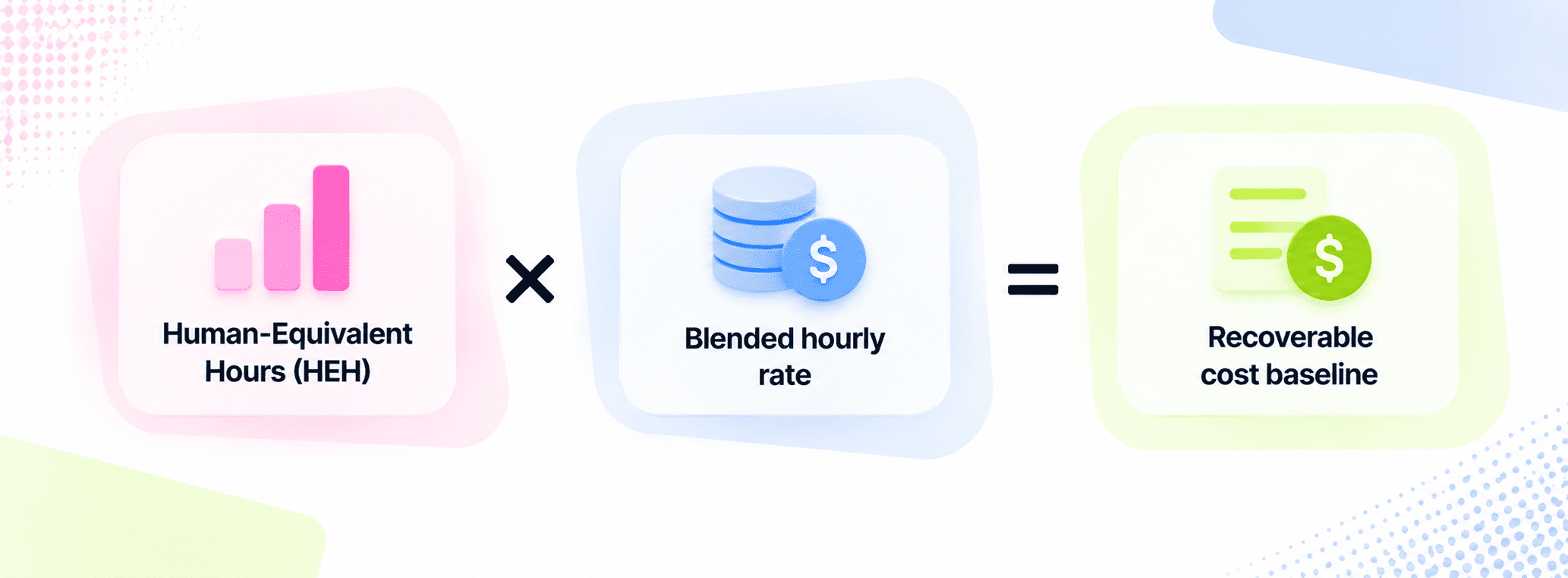
The blended hourly rate reflects the organization's cost of engineering capacity. Applying that rate to the number of Human-Equivalent Hours recovered gives Finance a baseline for calculating the value of the autonomous work.
In reality, HEH is more than an engineering productivity metric. The AI compute cost establishes the investment while HEH determines the engineering output. The blended hourly rate simply puts a financial value to that output. Together, they provide the inputs needed to calculate ROI in terms Finance already understands.
This matters because recovered engineering capacity has value beyond the individual tickets being completed. At sufficient scale, those gains can begin to affect the economics of delivery itself.
At scale, that recovered capacity can also change the economics of an engagement.
From 31% to 36%
That’s how much the projected gross margin increased in one modeled scenario with Colleague.
That doesn’t mean every Colleague deployment will deliver a five-percentage-point margin improvement. Nor is the 31% to 36% figure an observed outcome from the 17-ticket benchmark discussed earlier. But it does illustrate how recovered engineering capacity could improve delivery margins.
For a CFO or board, the business case should answer four questions:
Investment: What did we spend?
Start with the total AI compute cost required to complete the work.
Output: What did we get back?
Measure the engineering capacity recovered in Human-Equivalent Hours.
ROI ratio: What was the value relative to the investment?
Compare the financial value of those recovered hours with the AI compute cost.
Coverage confidence: How much of the workload can this realistically cover?
Show what proportion of the engineering workload is suitable for autonomous execution.
That final measurement is important. A strong ROI ratio means more when it applies to a meaningful share of the engineering workload. Coverage confidence puts the return in context. These four measures give leadership a clearer view of agentic SDLC ROI: what was invested, what engineering capacity was recovered, what that capacity was worth, and how broadly the model can be applied.
This is clearly a much stronger basis for an investment decision than a generic claim that AI improves developer productivity.
Source: Exadel Colleague pilot deployments, January–April 2026.
H2-5: How to Benchmark Your Team Before Committing
The 53:1 return mentioned earlier shows what’s possible. But it doesn’t tell you what Colleague could deliver against your engineering workload. Every backlog is different. So are the types of tickets, the engineering effort required, and the proportion of work suitable for autonomous execution. The strongest business case for agentic AI starts with your own data and not someone else’s ROI.
That is the purpose of Phase 0, Exadel’s two-week backlog benchmark. Phase 0 assesses an organization’s existing backlog to determine what work Colleague can handle, how much engineering capacity it could recover, and the projected ROI. It produces three core measures:
Ticket eligibility score
How much of the backlog is suitable for autonomous execution.
Projected Human-Equivalent Hours
How much engineering capacity could be recovered from that eligible work.
Projected compute cost
How much AI compute would be required to complete it.
Combined, these three measures provide the inputs for a projected ROI: eligible workload → projected HEH → projected engineering value → projected compute cost → projected ROI
The result is useful even when the numbers don't point toward immediate deployment. A backlog may contain fewer eligible tickets than expected, or the recoverable engineering capacity may not yet justify the projected compute. That’s still valuable information. The purpose of benchmarking is not to manufacture a positive ROI case. It is to establish whether one exists.
And if the opportunity is there, the benchmark provides a baseline against which a future deployment can be measured. Projected HEH, compute cost, and ticket eligibility become real numbers that can be compared with actual performance as Colleague moves into production.
This changes the order of the AI investment conversation. Instead of committing first and trying to prove the ROI afterward, Phase 0 gives engineering and Finance an evidence-based view of the opportunity before the contract is signed.
This doesn’t guarantee a particular return. The point is precisely the opposite. Your result may look different from the 53:1 benchmark because it is based on your backlog, your eligible workload, and your engineering economics. The CTO and VP of Engineering gain a clearer view of where autonomous engineering can realistically make an impact. The CFO receives the numbers they need to judge whether that impact is worth the investment.
The decision becomes much simpler when you know the opportunity, the projected cost, and the potential return before you commit.
Written by: Piotr Andrukiewicz, Chief Financial Officer
July, 2026


Your AI Partner