
Tags
Share
The AI Productivity Metric Your Finance Team Can Use
By Michael Boustridge, CEO, Exadel
Artificial intelligence is one of the largest technology investments many enterprises have made in recent years. This prompts finance leaders to ask a simple question:
"We spent millions on AI tools last year. What did we get?"
Surprisingly few organizations can answer that question with any degree of certainty.
Engineering leaders will present dashboards showing prompt volumes, token consumption, code completions, developer adoption, or AI acceptance rates. These metrics demonstrate that AI’s being used, but they don’t explain whether the business has become more productive.
The problem is a more fundamental one. Enterprise AI still lacks an AI productivity metric that translates engineering productivity into business terms that finance teams can understand. This disconnect is getting increasingly difficult to ignore. With AI adoption maturing, boards and CFOs are looking beyond technology activity to measurable business outcomes. They want to understand whether AI is increasing engineering capacity, accelerating delivery, and generating a meaningful return on investment.
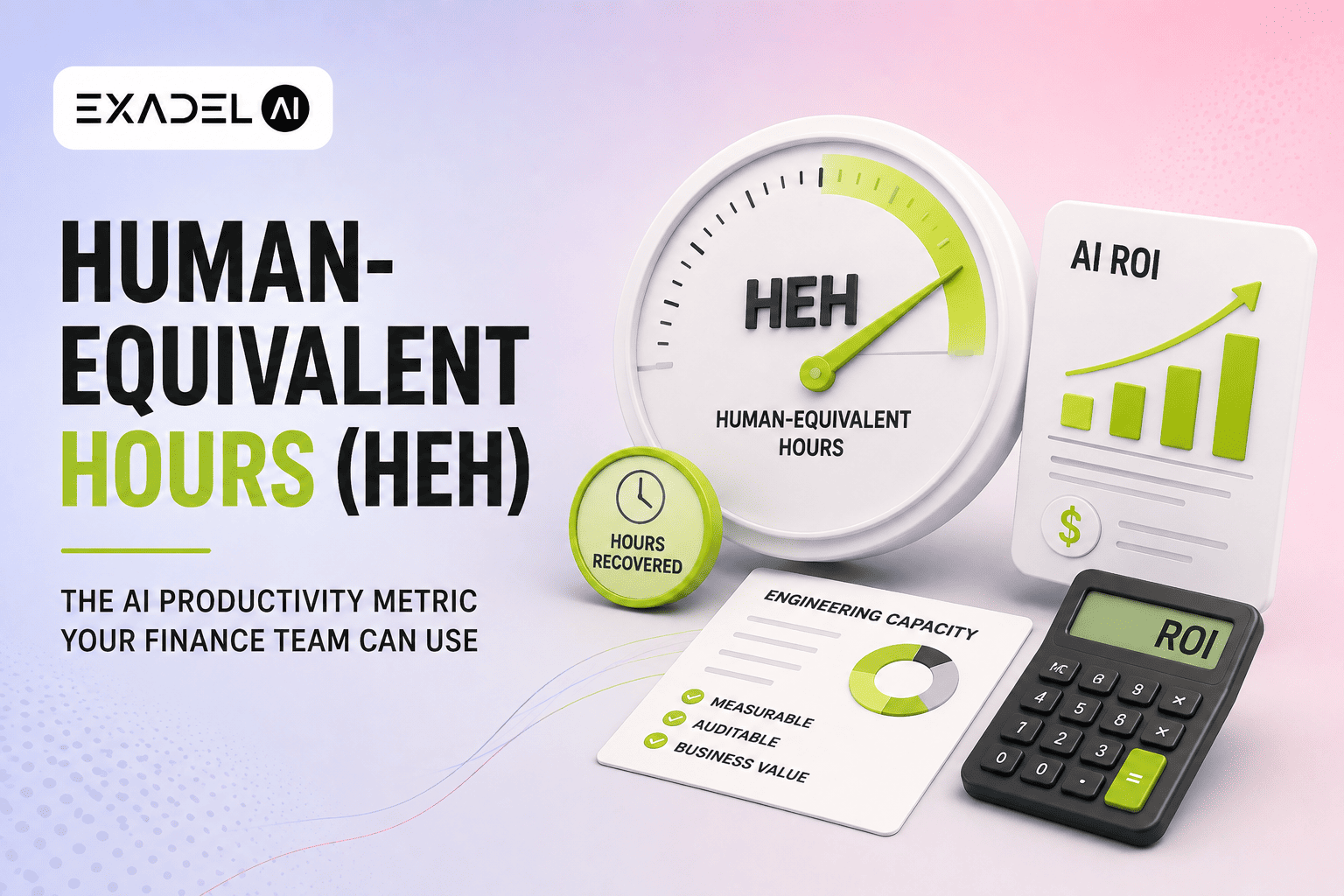
Human-Equivalent Hours (HEH) introduces what we believe should become the standard for AI-assisted engineering productivity. Rather than measuring what AI consumes or generates, HEH quantifies something much more valuable: the amount of productive engineering work AI has completed to a standard that would otherwise have required human effort.
Why Every Current AI Productivity Metric Fails the Finance Test
Every new technology introduces its own vocabulary of performance metrics:
Cloud platforms brought infrastructure utilization and consumption reporting. DevOps introduced deployment frequency, lead time, and recovery metrics. Generative AI has produced a new generation of dashboards filled with token counts, prompt volumes, code suggestions, model utilization, and developer adoption rates.
These metrics all have operational value, but none of them functions as an AI productivity metric that answers the questions finance leaders are asking. Token consumption measures resource usage but not business value. Prompt counts measure interaction rather than productivity. Acceptance rates show whether developers accepted AI suggestions, but not whether those suggestions reduced delivery effort or improved engineering outcomes. More code doesn’t necessarily translate into more value either. In many enterprise environments, additional code also creates additional review, testing, security validation, architectural assessment, and long-term maintenance.
By contrast, a CFO usually wants to understand three things:
- Has productive engineering capacity increased?
- What measurable business value has that created?
- Can the reported outcome be verified?
Finance teams already evaluate investments according to capacity created, costs avoided, and measurable AI ROI. AI reporting should be no different. Until engineering organizations adopt metrics that describe business outcomes rather than AI activity, finance leaders will struggle to determine whether AI investments are delivering meaningful returns.
Introducing Human-Equivalent Hours (HEH)
The formula, inputs, and why it is auditable
HEH is a measurement standard for quantifying engineering work completed by AI that would otherwise have required a human engineer to perform to the same production-ready standard.
The principle is intentionally straightforward. Instead of asking: "How many prompts did AI process?" HEH asks: "How many hours of productive engineering work did AI complete that engineers no longer needed to perform manually?" Unlike many existing AI productivity metrics, HEH is based on completed work rather than AI activity.
At its simplest, the calculation consists of three inputs:
Historical human effort – how long it previously took to deliver comparable work using established delivery data.
Completed AI work – engineering work successfully completed with AI assistance and accepted into the normal delivery process.
Verified production outcome – evidence that the work met organizational quality standards through review, testing, and approval.
Combined, these inputs produce a measure of recovered engineering capacity expressed in hours rather than tokens, prompts, or code suggestions. Just as importantly, HEH is auditable. In fact, most engineering organizations already maintain the evidence required to support the calculation:
- Jira work items
- historical delivery estimates
- Git history
- code review records
- testing evidence
- deployment history
- acceptance criteria
Rather than relying on model-generated estimates or subjective surveys, HEH is grounded in delivery evidence that already exists. That makes it understandable to engineering leaders, credible to finance teams, and defensible during investment reviews. Like any meaningful business metric, its value comes from consistency. By expressing AI-assisted engineering work in Human-Equivalent Hours, organizations gain a standardized unit of measurement that engineering, finance, and executive leadership can all interpret in the same way.
HEH in Three Numbers That Changed Board Conversations
The greatest strength of Human-Equivalent Hours is that it establishes a common measurement standard for AI-assisted engineering work. Once engineering productivity is expressed in HEH, executive conversations become far more meaningful. Here are three hypothetical examples of how HEH can change board conversations:
Engineering capacity
Instead of reporting that AI generated thousands of code suggestions during the quarter, an engineering organisation reports that AI contributed 2,400 Human-Equivalent Hours of completed engineering work. The discussion immediately shifts from AI activity to productive capacity.
That makes sense to a board because they can compare it with hiring plans, delivery forecasts, and investment priorities.
Delivery acceleration
A major delivery programme finishes six weeks earlier than planned. Rather than attributing the outcome to "AI assistance," the programme reports that AI recovered 1,850 Human-Equivalent Hours across requirements refinement, implementation, testing, and documentation.
Leadership can now understand why delivery accelerated rather than simply observing that it did.
Financial performance
Recovered engineering capacity doesn’t automatically translate into workforce reductions, nor should it. More commonly, it helps by absorbing additional work without increasing delivery costs, reducing contractor dependence, improving backlog throughput, or increasing engineering output using existing teams.
Expressing those gains in HEH provides finance leaders with a common unit that connects engineering performance directly to business outcomes.
Anyone Can Start Measuring in HEH With the Data They Already Have
One of the biggest misconceptions surrounding AI productivity reporting is that organizations need entirely new measurement systems. In most cases they don’t because their engineering teams routinely capture the relevant information such as:
- Jira stories and delivery records
- historical estimation data
- Git repositories and commit history
- pull request approvals
- testing results
- deployment records
- release history
These systems already document what work was completed, how it progressed through delivery, and whether it met organizational quality standards. The challenge lies in connecting that engineering evidence to business reporting.
That begins by establishing historical delivery baselines for common categories of engineering work. As AI assumes responsibility for repeatable activities, organisations can compare completed AI-assisted work against historical human effort for equivalent tasks. We’re not talking about a theoretical productivity estimate here. It is a clear, evidence-based measure of recovered engineering capacity.
Because the calculation relies on existing engineering systems, HEH can be introduced without the need to deploy entirely new reporting platforms. Instead, engineering evidence is translated into measurable AI ROI that finance teams, boards, and executive leaders can evaluate. With AI increasingly embedded across software delivery, this kind of common language is essential.
Closing
Enterprise AI is entering a new phase. We now know beyond any doubt that it can generate code faster than humans. But can we clearly demonstrate the business value that this AI capability creates?
Answering this question requires us to leave activity metrics behind and adopt measurements that reflect real engineering outcomes. HEH provides a practical AI productivity metric for measuring AI ROI in engineering organizations. It quantifies productive engineering capacity rather than AI activity, is grounded in evidence organizations already have, and creates a shared language between engineering, finance, and the boardroom.
Exadel Colleague reports engineering outcomes in Human-Equivalent Hours by default, measuring AI contribution using a metric that aligns engineering performance with business value.
Human-Equivalent Hours is how you demonstrate real AI value.
To learn more, visit the Exadel Colleague solution page and the Human-Equivalent Hours glossary, or download the Agentic SDLC Readiness Report template to begin evaluating AI productivity using HEH.