
Tags
Share
How to translate autonomous engineering work into recovered capacity, financial value, and board-ready ROI
Here’s a question that comes up in almost every board meeting these days: "What return are we getting from our AI investment?" And here is where the conversation often starts to unravel.
The CTO talks about what matters most to them: model performance, token consumption, code suggestions, and developer adoption. Engineering leaders present dashboards showing acceptance rates and productivity gains. Meanwhile, finance leaders are looking for a number they can compare against investment, operating costs, and budget forecasts.
Everyone has data but very few have evidence.
This disconnect has become one of the biggest obstacles to scaling enterprise AI. Having invested in AI platforms, coding assistants, and autonomous engineering capabilities, many leadership teams still struggle to explain their value in financial terms. The problem is that results that are often measured using technical metrics that mean little to those outside the engineering team. Finance leaders see AI as a strategic investment. They don’t care how many tokens were processed or how many code suggestions were accepted. They simply want to know whether AI is recovering capacity, reducing delivery costs, improving margins, or accelerating business outcomes.
That calls for a different measurement framework. Instead of asking how much AI was used, leadership needs to ask what measurable business value it created.
This article explains why traditional AI productivity metrics fall short and introduces Human-Equivalent Hours (HEH) as a finance-grade measurement model. It also outlines how organizations can begin reporting AI ROI from the first sprint rather than months after deployment.
Why Token Metrics Fail CFOs
Engineering Metrics Don't Translate Into Financial Outcomes
Modern AI development platforms generate an impressive amount of operational data. Engineering teams can use this to report on a whole array of metrics:
- tokens consumed
- prompts executed
- code suggestions generated
- acceptance rates
- model latency
- inference costs
- autonomous task completion rates
As much as these metrics help engineering teams, they don’t answer the questions the board is asking. A CFO can’t determine the financial return from four million tokens processed any more than they can calculate project profitability from the number of Git commits made during a sprint. Simply put: Activity doesn’t constitute value.
Software engineers have long understood that metrics such as lines of code written or hours spent coding reveal little about business outcomes. AI has introduced new technical measurements, but the underlying problem remains unchanged. As Goodhart's Law puts it, when a measure becomes the target, it often stops being a reliable measure of success.
Without translation into financial terms, engineering metrics remain engineering metrics.
The Translation Problem Between Engineering and Finance
The communication gap between technology and finance is entirely unnecessary. Engineering leaders often know that delivery has improved. Finance leaders only understand that AI investment is increasing. Connecting those two realities is surprisingly difficult.
Consider a quarterly investment review involving the CFO, CTO, and executive leadership. The CTO reports that AI completed hundreds of engineering tasks during the previous quarter. The CFO naturally wants that framed in financial terms: How much did that save, what was the financial return, and can we expect similar results next quarter?
Unfortunately, most AI reporting frameworks stop before those questions are answered. The problem isn't a shortage of data but a lack of translation. Finance teams evaluate investments using concepts such as recovered capacity, cost displacement, forecast accuracy, and operating margin. Technical AI metrics almost never map directly to such financial measurements.
As a result, AI discussions often become debates about technology instead of business performance.
What CFOs Actually Need
Boards seldom approve investment based on technical excellence alone. If they do so, it’s because they expect it to improve business performance. That means AI reporting should be geared toward answering familiar financial questions:
- How much productive engineering capacity has been recovered?
- What work would otherwise have required additional hiring?
- How much value has been created relative to AI operating costs?
- How soon is the investment expected to deliver a positive return?
- Can these results be forecast with confidence?
These measurements are used to evaluate every strategic investment competing for capital. AI is no exception. Once AI performance is expressed in these terms, finance teams can begin treating AI on an equal footing with other investments.
Introducing Human-Equivalent Hours: The Metric That Works
Defining Human-Equivalent Hours
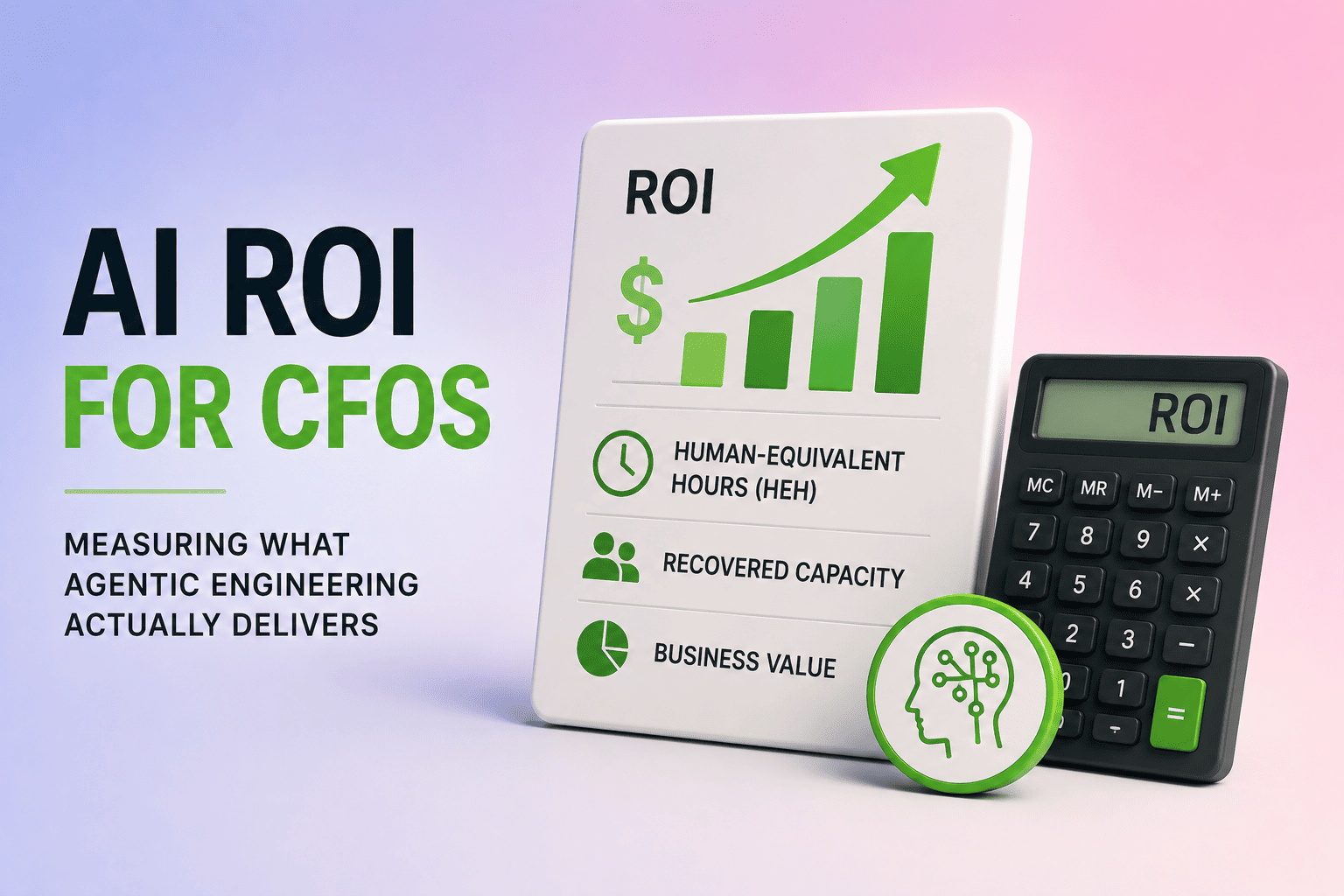
Human-Equivalent Hours (HEH) provides a common language that engineering, finance, and executive leadership can all understand. It goes on to form the foundation of a practical approach to agentic engineering ROI measurement.
Instead of counting AI activity, HEH measures productive engineering capacity recovered through autonomous task completion. It answers a simple question: How many hours of engineering work has AI completed that would otherwise have required human effort?
Unlike many AI productivity measures, HEH focuses on completed outcomes such as a closed ticket, a completed pull request or an autonomous engineering task that’s passed governance checks.
These are measurable business outputs that can be valued consistently across projects and reporting periods.
Calculating Human-Equivalent Hours
The underlying calculation is straightforward.
Human-Equivalent Hours = Autonomous tickets completed × Average engineering time for that ticket type
The formula avoids speculative productivity estimates and relies on historical engineering data that firms already have. Let’s assume an engineering task historically required three hours to complete. If AI autonomously completes one hundred comparable tasks, the organization has recovered approximately three hundred Human-Equivalent Hours.
The focus is on equivalent productive capacity rather than hypothetical time savings. This is an important distinction. Recovered capacity can be applied toward modernization initiatives, product innovation, technical debt reduction, or backlog elimination. These benefits accrue whether or not the organization reduces headcount.
Why HEH Is Auditable
One of the criticisms leveled at AI productivity claims is that they are difficult to verify. HEH addresses this by grounding every reported hour in completed engineering work and delivery evidence. In practical terms, every completed ticket can be traced, every associated pull request can be reviewed, and every governance checkpoint remains visible.
This creates an auditable chain between autonomous execution and reported business value. For finance teams, this matters as much as the metric itself because a measurement framework that can’t be validated is unlikely to survive board scrutiny or financial review.
The Readiness Report: What Exadel Delivers From Sprint 1
Why Measuring AI ROI Starts Before Deployment
Many leadership teams make the same mistake when evaluating AI investments: they deploy the technology first and work out how to measure success later.
This approach makes it difficult to establish a credible baseline. If you don’t understand how engineering teams performed before AI was introduced, you almost certainly won’t be able to quantify the value AI creates afterward.
That's why measurement should begin before autonomous engineering becomes part of the delivery process. At Exadel, this starts with a Phase 0 Agentic SDLC Readiness Assessment. The goal is not to produce another maturity score. Instead of asking whether AI can write code, the assessment examines where autonomous engineering can create measurable business value within the existing delivery model.
This gives you the operational and financial baseline needed to measure ROI from the very first sprint.
What the Phase 0 Benchmark Produces
Every engineering organization has work that can be automated, work that requires human oversight, and everything in between. A good understanding of this distribution is essential.
During Phase 0, Exadel evaluates engineering workflows to identify which classes of work are suitable for autonomous execution within existing governance and quality controls. The assessment produces three outputs that provide the foundation for a finance-grade business case:
Ticket eligibility. Which types of engineering tasks can realistically be completed autonomously without compromising quality, governance, or review processes?
Projected Human-Equivalent Hours. Based on historical ticket data and delivery patterns, how much engineering capacity could be recovered if suitable work were delegated to autonomous agents?
Projected compute costs. What level of AI operating cost is likely needed to support that volume of autonomous work?
Why Sprint-Level Reporting Matters
Engineering teams often report AI progress quarterly, but for finance teams that's too late.
Budget decisions, delivery forecasts, and investment reviews happen continuously. By waiting three months to understand whether an AI initiative is delivering value, an organization severely limits their ability to respond.
Sprint-level reporting provides the solution because HEH can be measured as autonomous work is completed. Each sprint answers practical questions:
- How much engineering capacity was recovered?
- Which categories of work generated the greatest value?
- What compute costs were incurred?
- How does actual performance compare with projected outcomes?
AI reporting becomes a useful operational tool. Engineering leaders get immediate visibility into delivery performance and finance leaders enjoy a continuously updated view of ROI.
Turning Sprint Data Into Financial Decisions
Reporting Human-Equivalent Hours every sprint creates opportunities for leadership teams that go far beyond measuring productivity. Finance can forecast future delivery capacity with greater confidence. Technology leaders can model whether additional AI investment is needed to produce proportionate operational gains. Executive leadership can identify which engineering domains generate the highest financial return from autonomous delivery.
More importantly, investment discussions stop being speculative and become evidence-based. Leadership teams can clearly assess whether recovered engineering capacity is exceeding operating costs and whether those gains are sustainable over time. This creates a continuous measurement framework that supports both delivery management and financial planning.
For organizations scaling agentic engineering across multiple teams, that visibility becomes increasingly valuable.
Board-Ready AI ROI Summary: The Format That Works
Moving From Technical Dashboards to Financial Reporting
Most AI dashboards were designed with engineers in mind. Boards require something different. An effective AI ROI summary for board review should look more like an investment summary that expresses AI performance in terms finance leaders already understand.
The report should lead with investment, value created, and financial impact. The supporting technical metrics can follow behind the headline figures.
The Four Numbers Every Board Wants to See
An effective AI ROI summary can be reduced to four critical measurements.
AI Compute Investment
This one is straightforward. What did the organization spend operating its AI capability during the reporting period? This measures model usage, infrastructure, licensing, and other AI operating costs.
Without a clear investment figure, ROI cannot be assessed.
Human-Equivalent Hours Recovered
The second measurement translates autonomous engineering into productive capacity. Human-Equivalent Hours provide a consistent way to quantify completed engineering work that would otherwise have required human effort. Because every reported hour is backed by completed engineering tasks, the figure remains transparent and auditable.
Finance teams can then translate recovered capacity into dollar value using blended engineering rates already employed for budgeting and forecasting.
Net ROI
Once recovered the value and AI operating costs are known, organizations can calculate the net return. It comes down to a simple business question: Did the value created exceed the cost of generating it?
That provides a far stronger basis for future investment decisions than activity metrics alone.
Gross Margin Impact
Ultimately, boards want to understand how AI affects business performance. Recovered engineering capacity improves more than delivery throughput. Used effectively, it can reduce cost-to-deliver, improve resource utilization, and support higher-margin engineering operations.
The financial impact of agentic engineering extends to the economics of software delivery itself. Internal engagement data from Exadel has demonstrated gross margin improvements ranging from 31% to 36% when autonomous engineering is implemented within an appropriately governed delivery model. While every organization will produce different outcomes, this illustrates an important principle.
A Report Both Finance and Engineering Can Trust
Perhaps the greatest strength of a board-ready AI ROI summary is that it provides a common language for every stakeholder. Instead of competing narratives shaped by different metrics, everyone now works from the same evidence. Engineering continues measuring delivery performance. Finance focuses on investment return. Executive leadership assesses strategic impact.
This alignment makes it much easier to demonstrate measurable progress to the board and justify further AI investment.
How Exadel Reports ROI by Default - From Every Engagement
Finance-Grade Reporting Shouldn't Be an Afterthought
One of the reasons AI ROI remains difficult to measure is that reporting is often treated as a separate project. In practice, the engineering team deploys the technology. Then it’s up to operations to collect usage data before finance attempts to reconstruct business value weeks or months later. By that point, finance only has estimates and assumptions to rely on.
A finance-grade reporting model works differently.
Measurement is built into delivery from the outset. Every autonomous task, governance checkpoint, completed ticket, and Human-Equivalent Hour contributes to a reporting framework that continues to evolve along with the engineering work itself.
This removes much of the manual effort traditionally associated with AI ROI reporting while providing the firm evidence executives need to make investment decisions.
Reporting Without Creating Another Reporting Layer
An unintended consequence of AI adoption has been the proliferation in reporting processes. Organizations frequently introduce separate dashboards, spreadsheets, and governance reviews simply to understand whether AI is delivering value. This creates additional operational overhead.
An effective measurement framework should do the opposite. Because HEH are derived from completed engineering work already tracked within existing delivery systems, reporting becomes part of normal engineering operations.
For engineering teams it’s business as usual. They continue working within the delivery processes they already know. By contrast, finance has new-found access to consistent, auditable business metrics while leadership receives a single version of the truth.
The result is greater visibility without greater complexity. It’s a boon for finance leaders because it produces information they can use in familiar financial processes instead of having to interpret engineering metrics. One finance executive described it as "The first AI tool that produces a finance-grade output.”
See Your AI ROI Before You Scale
If your board is asking for clearer evidence of AI's financial impact, the conversation should begin before deployment—not after it.
Written by: Piotr Andrukiewicz, Chief Financial Officer
July, 2026


Your AI Partner
A Phase 0 Agentic SDLC Readiness Assessment is where that process starts.
See the CFO-ready ROI report Exadel delivers from Sprint 1. Book a Phase 0.