
Tags
Share
“It is a capital mistake to theorize before one has data.”
— Sherlock Holmes, A Scandal in Bohemia
Sherlock Holmes says this to Dr. Watson near the beginning of A Scandal in Bohemia, after Watson asks what Holmes makes of a mysterious note. Holmes refuses to jump ahead. He has no data yet and warns that people who theorize too early start bending facts to fit their theories rather than shaping theories around facts.
Healthcare and pharma AI leaders face a similar danger. And Holmes would agree that the stakes are high.
The theory is compelling: AI can reduce administrative burden, improve operational efficiency, support diagnosis, accelerate research, identify risk, streamline documentation, and help teams make better decisions. But in healthcare and pharma, a compelling theory is not enough. The data may be fragmented. The workflow may be unsuitable. The model may not be clinically validated. The regulatory pathway may be unclear. Clinicians may not trust the output. Patient data may be exposed in ways the organization has not fully assessed.
That is why an AI readiness assessment for healthcare cannot be a generic enterprise checklist.
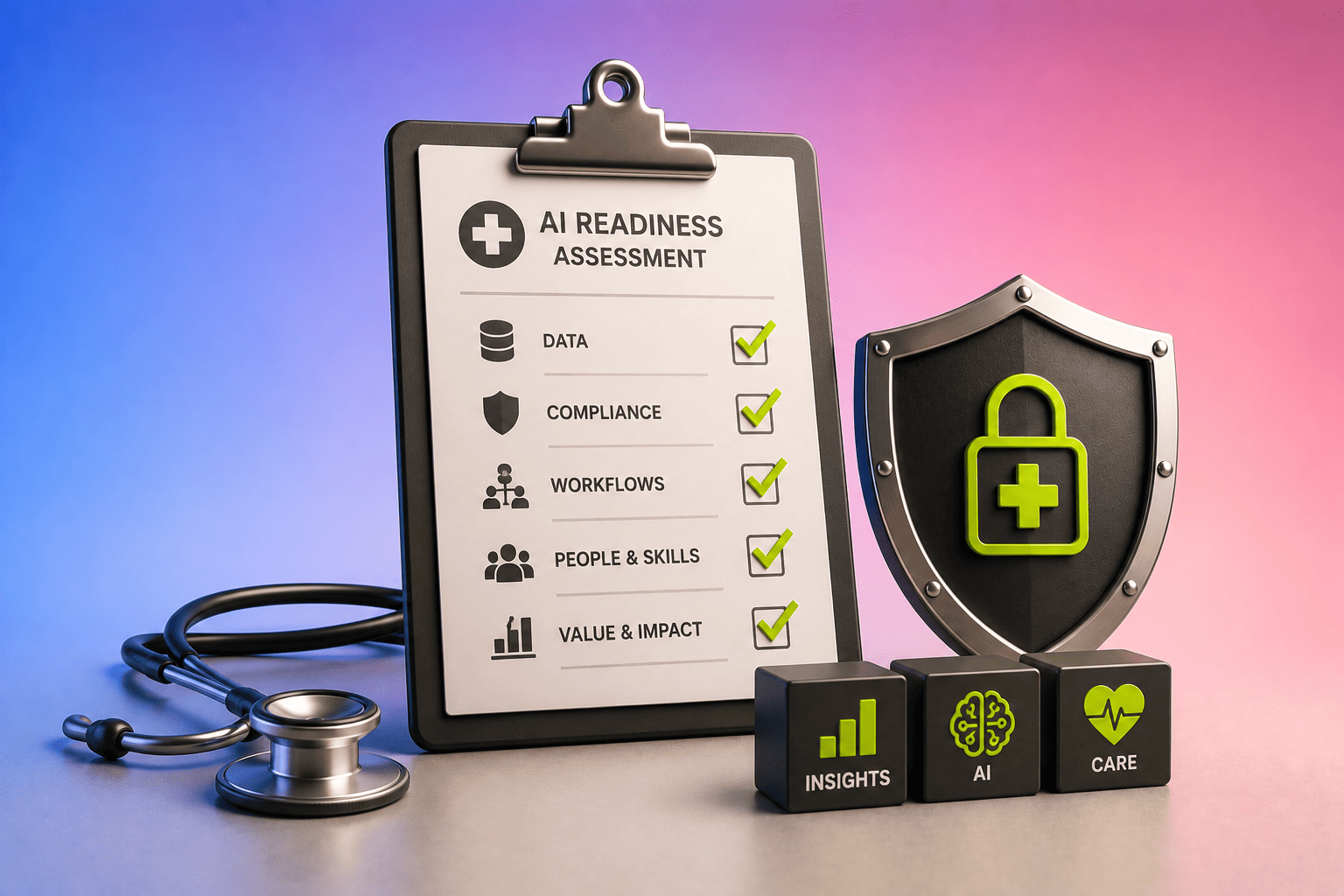
For Healthcare & Pharma organizations, readiness means understanding whether the data, systems, validation, governance, talent, and clinical or operational workflows are strong enough to move AI from promise to safe, measurable use.
The question is not only: “Can AI do this?”
The better question is: “Are we ready to use AI for this purpose, with this data, in this setting, under these controls, with these people affected?”
Why Healthcare and Pharma Face Distinct AI Readiness Challenges
Healthcare and pharma AI is not simply enterprise AI with patient data added.
The sector works in high-trust, high-consequence environments. AI will interact with clinical documentation, diagnosis, triage, treatment support, drug development, clinical trial design, pharmacovigilance, claims, reimbursement, patient engagement, or medical device software. The users may include clinicians, researchers, operations teams, care managers, patients, payers, and regulators.
The data environment is also unusually complex. Clinical, claims, imaging, lab, pharmacy, trial, device, and operational data may sit across disconnected systems, formats, vendors, and standards. Even where organizations have electronic health records, that does not mean the data is clean, accessible, interoperable, or suitable for AI.
The Royal College of Physicians’ 2026 survey captures this tension well. It found broad support for AI among UK physicians, but also major readiness concerns. 79% of doctors said they needed training in clinical AI tools, while 66% said they had no access to such training. The RCP also identified lack of clinical AI expertise, difficulty integrating AI tools with electronic patient record systems, and poor interoperability as major barriers to deployment.
The King’s Fund makes a similar point from a system perspective: scaling AI in health and care requires not only technology, but the right technical and social infrastructure, including workflow integration, information governance, safety, privacy, bias management, and cybersecurity.
In other words, healthcare AI does not usually fail because clinicians dislike technology. It fails when the surrounding system is not ready for it.
That is also why governance matters, although we will not repeat the full governance framework here. For the broader enterprise model, see our guide to building an AI governance framework before scaling AI.
The 5 Primary AI Readiness Blockers in Healthcare and Pharma
1. Clinical Data Interoperability: The Model Cannot Fix the Data Environment
AI depends on usable data. Healthcare data is often anything but simple.
Hospital systems may need to connect EHRs, imaging archives, lab systems, pharmacy data, scheduling platforms, claims data, remote-monitoring feeds, and departmental applications. Pharma companies may need to connect research, clinical trial, manufacturing, pharmacovigilance, real-world evidence, and regulatory data.
HL7 FHIR adoption can help, but adoption alone does not solve every problem. Organizations still need consistent terminology, reliable data quality, data lineage, access controls, integration architecture, and clarity around which data is appropriate for which AI use case.
This is why healthcare data infrastructure is often the first readiness blocker to assess.
A promising model cannot compensate for data that is incomplete, inconsistent, inaccessible, or misaligned with the workflow it is meant to support.
2. FDA and Regulated AI: Clinical AI Needs a Lifecycle, Not a One-Time Approval Mindset
AI-enabled medical technology is no longer a novelty. McKinsey reports that more than 1,000 AI-enabled medical devices were authorized by the FDA between 2015 and 2024, with almost 80% in medical imaging.
That growth changes the readiness question. Healthcare organizations need to know not only whether an AI tool can perform well, but how it will be evaluated, integrated, monitored, updated, and governed in a real clinical environment.
For pharma, the same lifecycle discipline applies in a different way. In 2026, the FDA and EMA published guiding principles for good AI practice in drug development. These include human-centric design, a risk-based approach, clear context of use, multidisciplinary expertise, data governance and documentation, risk-based performance assessment, lifecycle management, and clear essential information.
The common thread is clear: regulated AI depends on context, documentation, evidence, monitoring, and change control. A demo is not enough.
3. Patient Data Privacy: Sensitive Data Makes Every Shortcut Expensive
Healthcare AI often involves protected, sensitive, or identifiable data. That creates immediate questions around HIPAA, GDPR, consent, de-identification, secondary use, access controls, vendor risk, and model-training restrictions.
Even AI tools that appear administrative can become sensitive when they touch patient records or clinical documentation. NHS England’s guidance on ambient scribing is a useful example. These products may be used to convert clinician-patient conversations into structured medical notes, but they also raise questions around information governance, clinical workflow, patient awareness, documentation accuracy, and safe deployment.
The lesson is that “low-risk” AI in healthcare is not always low-risk once patient data, clinical documentation, or professional accountability is involved.
4. Clinical Validation: Accuracy Is Not Enough
A model can perform well in a test environment and still fail in a real clinical workflow.
Clinical AI readiness requires more than a headline accuracy score. It should assess whether the model performs consistently across patient groups, whether its output can be understood and challenged by clinicians, whether it supports the workflow rather than interrupting it, and whether performance is monitored after deployment.
NHS England’s lessons from real-world AI evaluations warn that AI can produce biased outputs and exacerbate health inequalities, especially where training or validation data is missing or inaccurate. The guidance also emphasizes the importance of considering patient characteristics and clinicians’ experience, not only technical performance.
The real readiness question is not, “Is the model accurate?”
It is, “Is it sufficiently reliable, fair, explainable, monitored, and usable for this clinical context?”
5. Organizational Readiness: Clinician Trust Is Part of the System
AI adoption in healthcare depends on people as much as platforms.
Clinicians need to understand what a tool does, where it is limited, how it fits into their workflow, and who remains accountable when it is used. Operational teams need training. Governance teams need clear responsibilities. Leaders need a way to prioritize use cases without overwhelming already pressured staff.
Clinician trust is not a soft extra. It is part of the system.
A tool that adds cognitive load, interrupts the consultation, produces unexplained recommendations, or creates uncertainty around accountability may struggle even if the underlying model is technically strong.


AI Readiness for Healthcare
Unsure which healthcare AI initiatives are ready to scale?
Exadel helps Healthcare & Pharma organizations assess blockers across data, technology, governance, validation, talent, and ROI. Our AI Readiness Assessment for healthcare identifies what can move forward now, what needs remediation, and what requires stronger evidence before deployment.
Where Healthcare Organizations Typically Score on Exadel’s 6 Dimensions
Different healthcare and pharma organizations get stuck in different places. The patterns below are directional, not universal, but they help illustrate why sector-specific assessment matters.
Hospital Systems
Hospital systems often have strong use-case demand. They face pressure to reduce administrative workload, improve throughput, manage patient flow, support clinicians, and improve patient experience.
Their blockers are usually data and workflow related: fragmented EHR environments, integration complexity, inconsistent digital maturity across sites, clinician training gaps, and difficulty turning pilots into standardized deployment.
Pharma Organizations
Pharma companies often have stronger data science capability and clearer research use cases. AI may support discovery, trial design, patient recruitment, evidence generation, safety monitoring, manufacturing, and regulatory preparation.
The blockers tend to be documentation, context of use, data governance, model credibility, lifecycle management, and regulatory-grade evidence. This is where the FDA/EMA principles on good AI practice become especially relevant.
Medtech and Digital Health Companies
Medtech and digital health organizations may score highly on innovation and product ambition. Their challenge is often evidence, safety, monitoring, model updates, regulatory pathway, and real-world clinical adoption.
A product can be technically impressive and still face readiness barriers if the deployment environment, user workflow, post-market monitoring, or update controls are not mature enough.
Payers
Payers often have structured claims data and strong administrative AI opportunities: risk adjustment, fraud detection, prior authorization support, member service, and care management.
Their readiness blockers may include fairness, explainability, member impact, regulatory scrutiny, integration with provider workflows, and trust in automated decision support.
Across these sub-sectors, Exadel’s assessment framework evaluates six dimensions: strategy and integration, talent and organization, data foundation, technology and MLOps, governance and ethics, and investment and ROI.
For a broader explanation of the assessment process, see our guide on how to run an AI readiness assessment.
The Difference Between Administrative AI Readiness and Clinical AI Readiness
Not every healthcare AI use case carries the same risk.
Administrative AI and clinical AI both require readiness assessment, but they should not be assessed against the same evidence threshold.
Administrative AI may include revenue cycle management, scheduling, billing, supply chain optimization, documentation support, contact center assistance, claims workflows, or internal knowledge search. These use cases can still involve sensitive data and operational risk, but they are usually judged primarily by workflow fit, accuracy, privacy, integration, adoption, and measurable ROI.
Clinical AI is different. It may support diagnosis, imaging triage, treatment recommendations, risk scoring, patient deterioration prediction, clinical decision support, or regulated medical-device software. These use cases require a stronger lens around evidence, safety, validation, clinician oversight, patient impact, liability, and post-deployment monitoring.
The American Hospital Association’s 2025 analysis of predictive AI adoption supports this distinction. It notes that mature predictive AI deployments are delivering measurable operational benefits in areas such as billing, scheduling, and outpatient risk stratification. It also shows uneven adoption, with hospitals in multi-hospital systems reporting much higher predictive AI use than independent facilities.
That pattern makes sense. Operational use cases often move faster because the readiness threshold is lower. Clinical and patient-impacting use cases need stronger evidence, clearer oversight, and higher confidence.
Administrative AI readiness asks:
- Can this improve the workflow?
- Is the data accurate enough?
- Does it integrate with existing systems?
- Is patient data protected?
- Is ROI measurable?
- Will staff use it?
Clinical AI readiness also asks:
- What evidence supports safe use?
- Does performance vary across patient groups?
- Who reviews or overrides the output?
- What happens if the model is wrong?
- Is the system regulated?
- How is performance monitored over time?
- How is clinician accountability protected?
Administrative AI can usually be assessed primarily through operational risk. Clinical AI must also pass through the lens of evidence, safety, validation, and trust.
What a Phase 1 AI Readiness Program Looks Like in Healthcare
A Phase 1 healthcare AI readiness program should not try to solve every future AI question at once.
It should create a defensible starting point.
Step 1: Inventory Current AI Activity
Start by identifying what AI is already in use. Include formal systems, vendor-embedded AI, clinical pilots, administrative automation, shadow AI, generative AI tools, research models, and third-party platforms.
The American Medical Association (AMA) in this truly insightful article on AI governance guidance for health systems emphasizes the importance of accountability, oversight, policies, structure, and practical steps for responsible AI implementation, and takes the discussion way beyond the toolkit level.
However, their first readiness question is simple: what exists, who owns it, and what risk does it carry?
Step 2: Separate Administrative, Clinical, Regulated, and Mixed Use Cases
Classify each use case. A claims workflow, ambient documentation tool, imaging triage system, drug-development model, and clinical decision-support tool should not all follow the same assessment track.
The classification determines the evidence, governance, privacy, validation, and monitoring requirements.
Step 3: Assess Data and Interoperability Readiness
Evaluate data quality, EHR integration, HL7 FHIR readiness, terminology consistency, privacy controls, data lineage, access rights, and real-time availability.
If the data foundation is weak, the roadmap may need to begin with remediation rather than model development.
Step 4: Map Regulatory and Validation Requirements
Ask whether the use case may qualify as medical-device software, influence clinical decision-making, support a regulatory submission, use protected health information, or require specific documentation and validation.
This does not mean every AI idea becomes a compliance project. It means the organization knows which path it is on before it invests further.
Step 5: Assess Clinical and Operational Adoption
Identify who will use the system, how it fits the workflow, what training is needed, who remains accountable, and what would cause clinicians or operational teams to reject it.
AI that does not fit the real workflow will struggle, even if it performs well in isolation.
Step 6: Prioritize a Safe First Roadmap
Rank use cases by patient impact, regulatory exposure, data readiness, implementation effort, expected value, adoption complexity, and clinical validation burden.
The output should not be a generic AI wish list. It should be a practical sequence:
- what can move now
- what needs remediation first
- what requires stronger evidence
- what should not progress until the organization is ready
Holmes warned against bending facts to fit theories, especially when the stakes are high.
Healthcare AI leaders need the same discipline; in this field, the consequences involve human lives, highly sensitive data, and strict governance and compliance regulations.
Start with the data, workflow, evidence, regulation, risk, and people affected. Then decide which AI initiatives are ready to move forward.
Healthcare AI readiness is not a generic exercise.
Exadel’s AI Readiness Assessment for healthcare helps Healthcare & Pharma organizations understand which initiatives are ready to scale, which need remediation first, and what must be in place before clinical, regulated, or patient-impacting AI moves forward.