Tags
Share
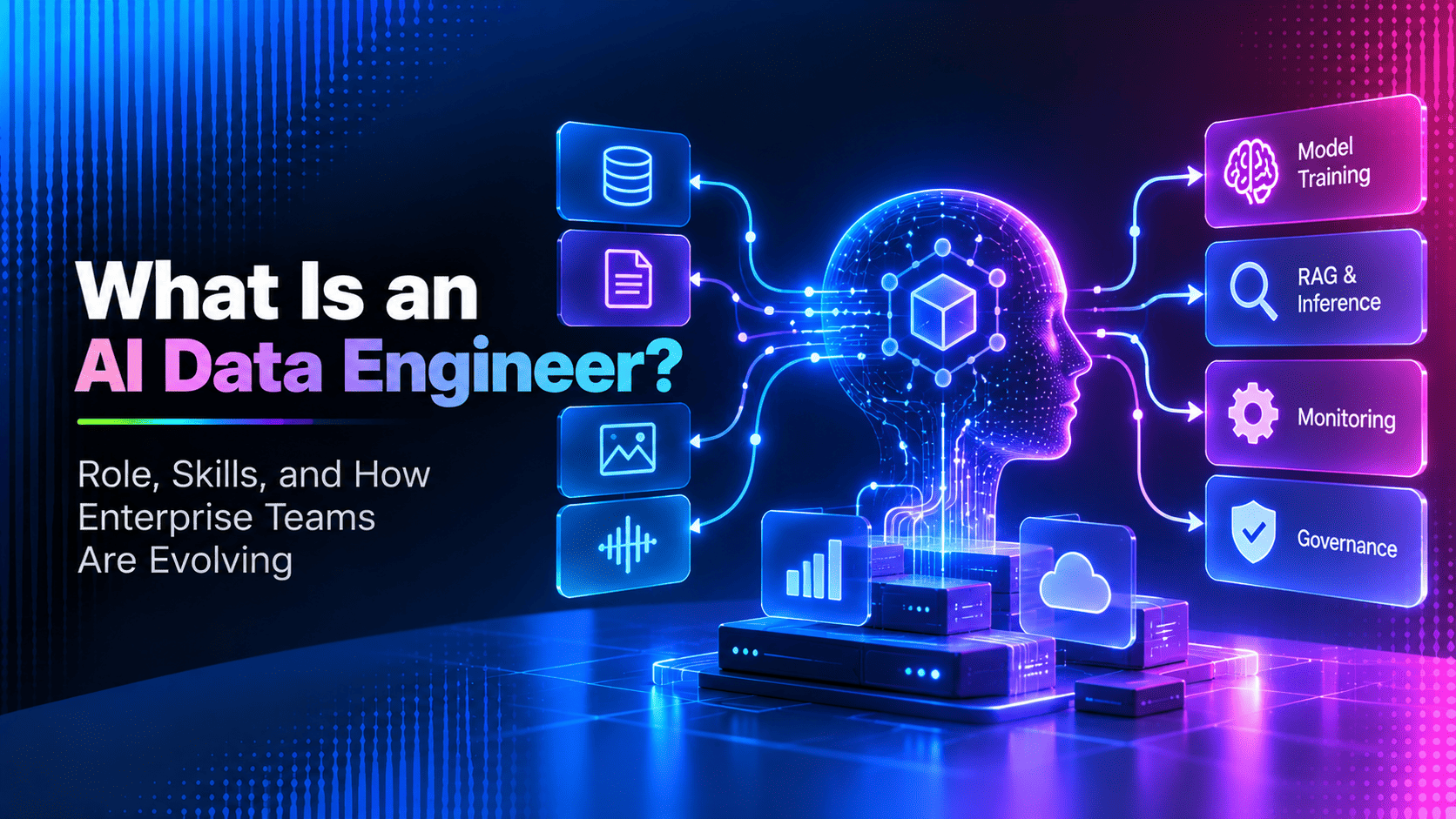
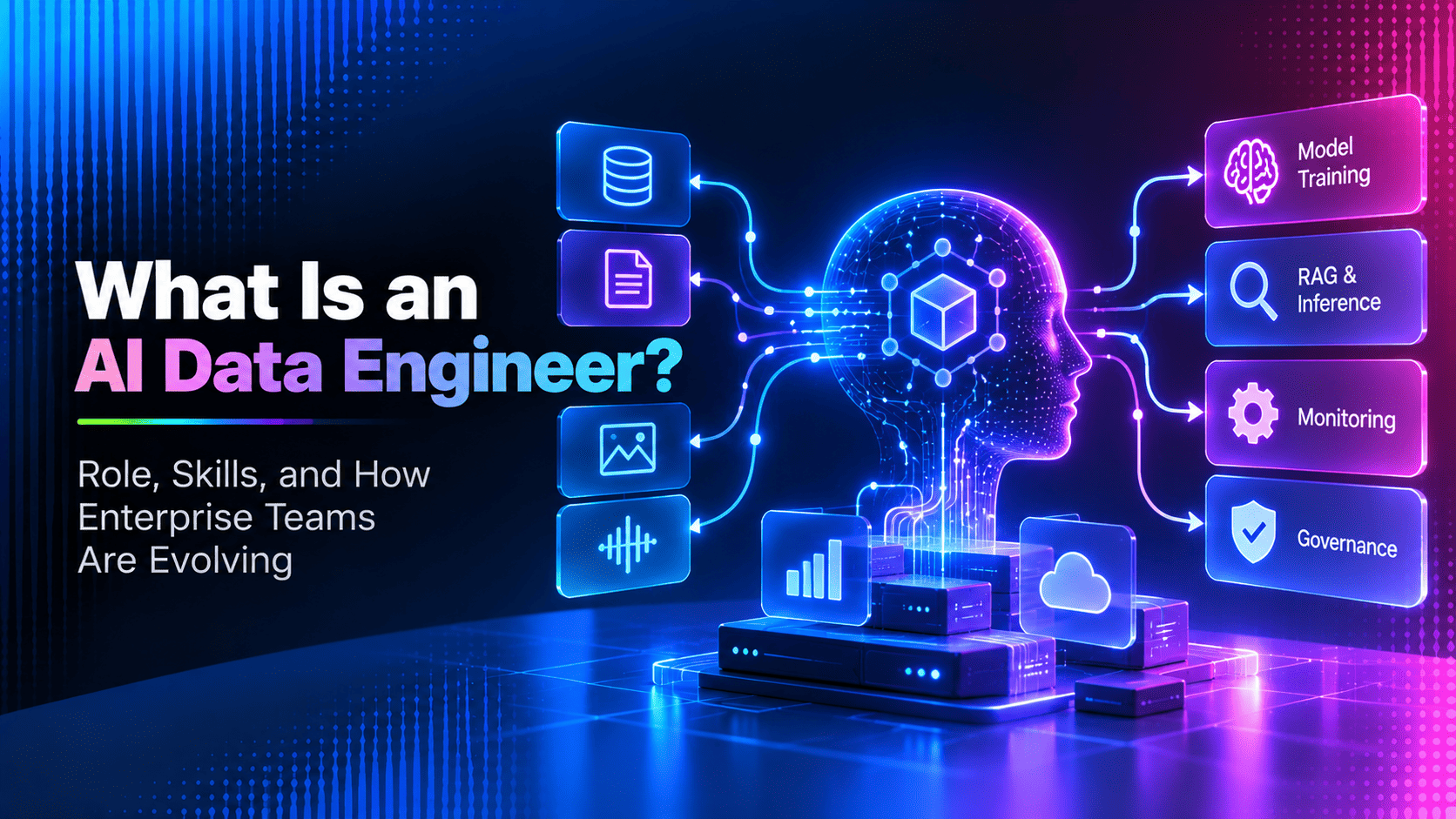
An AI data engineer is a data engineering specialist who builds and operates the pipelines, platforms, and governed data products that power machine learning, generative AI, and agentic systems. Unlike traditional data engineers, who focus mainly on analytics and application data, AI data engineers also prepare data for training, retrieval, inference, evaluation, and monitoring.
The title itself is still evolving. One company may formally employ “AI data engineers,” while another distributes the same responsibilities across data engineers, machine-learning engineers, platform engineers, and AI engineers.
The capability matters more than the job title.
AI systems place new demands on enterprise data. They may need structured transactions alongside documents, images, events, embeddings, model features, metadata, and real-time signals. They also need traceability: teams must be able to understand what data an AI system used, where it came from, whether it is current, and whether the system is permitted to access it.
AI is also changing how engineers perform the work itself. The 2026 State of Analytics Engineering Report found that 72% of respondents now prioritize AI-assisted coding in their development workflows. AI is increasingly helping teams generate SQL, Python, tests, documentation, and transformations—but the resulting systems still need engineering validation, governance, observability, and ownership.
Our broader guide to AI data engineering explains how this shift is changing modern pipelines and platforms. This article focuses more specifically on the people and enterprise capabilities required to build and operate them.
The Definition: What Makes a Data Engineer “AI”?
Traditional data engineering creates the dependable movement and transformation of data between source systems and the applications, analytical tools, and people that consume it.
That work remains essential. What changes in AI data engineering is the number and nature of the consumers.
A business-intelligence pipeline might end with a curated table used by a dashboard. An AI data pipeline may continue into:
Raw data → governed data product → features or embeddings → training or retrieval → model → application or agent → monitoring and feedback
That introduces additional engineering concerns. An AI data engineer may need to ensure that:
- Training and production data use consistent definitions
- Features are generated reliably
- Documents are processed and versioned correctly
- Embeddings and retrieval indexes remain current
- Sensitive data is not exposed through an AI application
- Real-time signals arrive quickly enough for inference
- Model and agent outputs can be traced back to relevant source data
- Data quality changes are detected before they affect production AI
- New model versions can access data without breaking established controls
There is also a second meaning to the “AI” in the role. AI data engineers increasingly use AI to do data engineering: generating code, drafting tests, documenting data assets, investigating incidents, and suggesting pipeline changes.
The modern role therefore combines data engineering for AI with AI-assisted data engineering.
AI Data Engineer vs. Traditional Data Engineer: Key Differences
The roles overlap heavily.
An AI data engineer still needs the fundamentals of conventional data engineering: SQL, data modeling, orchestration, storage, cloud platforms, testing, security, and pipeline reliability.
AI extends the destination and the operating requirements.
Primary consumers
BI, analytics, applications
Analytics, ML, GenAI, RAG, agents
Common data
Structured and semi-structured
Structured + significant unstructured data
Typical outputs
Curated tables, warehouses, data products
Data products + features, embeddings, retrieval assets
Pipeline latency
Frequently batch-based
Batch, near-real-time, or streaming
Model involvement
Usually downstream
Data lifecycle connects directly to model lifecycle
Quality focus
Accuracy, completeness, reporting consistency
Also model reliability, retrieval quality, AI behavior
Observability
Pipelines and data platforms
Pipelines + AI dependencies and downstream impact
AI-assisted work
Increasingly common
Often built into everyday engineering workflows
Governance
Access, lineage, privacy, retention
Also AI access, provenance, model/agent dependencies
This does not mean every traditional data engineer now needs to become a machine-learning specialist. It means enterprises increasingly need someone to own the boundary between the data platform and the AI systems consuming it.
The AI data engineer sits between traditional data engineering and model engineering, extending reliable data foundations into the features, retrieval layers, and model data that AI systems need.


Your AI Partner
Build the data foundation AI needs.
Exadel engineers trusted pipelines and platforms that support machine learning, RAG, and production AI.
Core Responsibilities of an AI Data Engineer
Building and Managing AI Data Pipelines
The first responsibility is still recognizably data engineering: getting reliable information from its sources to wherever it needs to be consumed.
The difference is that AI workloads may combine databases, documents, APIs, sensor streams, images, customer interactions, application events, and third-party information.
An AI data engineer decides how those sources should be ingested, transformed, stored, governed, and delivered.
That can involve:
- Batch ingestion
- Change Data Capture
- Event streaming
- API integration
- Document-processing pipelines
- Data validation
- Orchestration
- Failure recovery
- CI/CD for data
- Monitoring and observability
Latency should follow the business requirement. A forecasting model might work perfectly well with daily data, while fraud detection, recommendations, or operational agents may need information within seconds.
Current reference architectures similarly connect source systems, ingestion, transformation, processing, governed storage, serving, analytics, and AI rather than treating AI as a completely separate technical environment.
Feature Engineering and Model Data Preparation
Machine-learning systems need inputs that represent the real-world patterns the model is trying to learn.
Those inputs are often called features.
An AI data engineer may build processes that turn raw events into features such as:
- Customer purchase frequency
- Account activity
- Equipment utilization
- Average transaction value
- Days since a previous event
- Historical demand
- Behavioral patterns
The challenge is consistency.
A feature calculated during model training should mean the same thing when the model encounters live production data.
Generative AI adds different forms of preparation.
Documents may need to be cleaned, parsed, chunked, enriched with metadata, embedded, indexed, and kept synchronized with their source systems so that retrieval-augmented generation (RAG) applications can access relevant and current enterprise information.
Vector search technologies such as Pinecone, Weaviate, pgvector, or vector capabilities within broader data platforms may support this retrieval layer.
The tool matters less than the engineering questions surrounding it:
Which information belongs in the index? Who may retrieve it? How do we update it? How do we identify stale content? Can we trace the generated answer back to the source?
Ensuring Data Quality for AI Model Reliability
Bad data has always produced bad analysis.
AI can magnify the consequence because data may now influence recommendations, generated responses, automated actions, or customer-facing decisions.
AI data engineers therefore need to monitor more than whether a pipeline technically completed.
They may examine:
- Freshness
- Completeness
- Validity
- Schema change
- Distribution
- Duplicates
- Feature drift
- Retrieval quality
- Source-document versions
- Downstream dependencies
Observability helps answer a crucial production question:
If this data asset changes or fails, which model, agent, application, or business workflow could be affected?
AI does not reduce the need for those controls. Faster code and pipeline creation can make them more important.
Collaborating with Data Scientists and ML Engineers
AI data engineering is inherently cross-functional.
Data scientists may determine which signals are useful for a model. ML engineers may own model training, serving, or performance. Application engineers integrate the capability into a product. Security and governance teams define controls.
The AI data engineer connects much of that work to the data estate.
A useful division of responsibility looks something like this:
Data scientist: What information improves the model?
AI data engineer: How do we deliver that information reliably and govern it?
ML / AI engineer: How do we train, deploy, evaluate, and operate the model?
The exact boundary varies by organization. What matters is that someone owns every part of the path from source data to production behavior.
Essential Skills: What AI Data Engineers Need to Know
No individual needs expert-level knowledge of every tool below.
For enterprise leaders, the more useful question is whether the team collectively covers the required capability.
Programming and Frameworks
SQL remains foundational. Much enterprise data still lives in relational systems, warehouses, and lakehouses.
Python is important for ingestion, transformation, automation, APIs, ML integration, document processing, and custom data workflows.
Apache Spark and similar distributed-processing technologies matter where data scale or computational requirements exceed what simpler workloads can handle.
dbt and related transformation frameworks provide modular transformation, testing, lineage, documentation, and reusable data models.
AI assistants can increasingly draft all of these artifacts. Engineers still need to understand what the generated code does and whether it represents the business correctly.
Cloud and Infrastructure
Most AI data environments span several infrastructure concerns:
- Object storage
- Warehouses and lakehouses
- Compute
- Containers
- Networking
- IAM and security
- Batch processing
- Streaming
- Orchestration
- Monitoring
Platforms commonly include AWS, Microsoft Azure, Google Cloud, Databricks, and Snowflake, depending on the existing enterprise environment and workload.
Streaming technologies such as Kafka, Kinesis, and Flink become relevant where AI must operate on continuously changing events.
Orchestration systems such as Airflow and Dagster coordinate dependencies across ingestion, transformations, model workflows, and operational jobs.
An AI data engineer does not need allegiance to one stack.
They need enough architectural understanding to select appropriate patterns for the workload.
ML Pipeline and LLM-Specific Tools
AI workloads introduce additional infrastructure.
Useful areas of knowledge include:
Feature stores: maintaining reusable and consistent machine-learning inputs.
ML lifecycle tooling: connecting datasets to model training, evaluation, registries, deployment, and monitoring.
Vector search: retrieving semantically relevant information from documents and other unstructured content.
Embeddings: numerical representations that allow systems to compare semantic similarity.
RAG pipelines: connecting LLMs with governed enterprise information.
Evaluation datasets: testing whether AI applications continue producing acceptable outputs.
LLM frameworks: technologies such as LangChain or LlamaIndex can help coordinate retrieval, models, tools, and application logic.
The goal is not to collect tools.
It is to understand where each component belongs in a dependable production architecture.
Data Governance and Observability
AI data engineers increasingly need to think about policy and risk as engineering requirements.
That includes:
- Access control
- Data classification
- Privacy
- Metadata
- Lineage
- Data contracts
- Auditability
- Quality thresholds
- Retention
- Monitoring
- Incident response
NIST’s AI Risk Management Framework treats governance as a cross-cutting activity across the AI lifecycle rather than a final compliance exercise. Its current guidance also emphasizes continuous risk management as AI systems are designed, developed, deployed, and monitored.
For AI data engineers, that means governance frequently needs to become part of the pipeline itself.
The role is defined less by one tool than by a layered skill set spanning programming, cloud and data platforms, ML and RAG infrastructure, and governance.
Should You Build This Capability In-House or Partner?
For enterprise leaders, this is often the more useful question than whether to create a job title called “AI Data Engineer.”
Some organizations already have most of the required capability.
A mature data-platform team may be able to extend existing engineers into AI workloads through focused upskilling and new platform components.
Building internally makes particular sense when:
- Data engineering is already a strategic organizational strength
- The organization has experienced platform architects
- AI use cases will be continuous rather than occasional
- Internal teams already own mature governance and data operations
- The organization has enough time to recruit and develop specialist skills
A partner becomes more useful when the challenge involves expertise that the existing team does not yet have, or when time-to-production matters.
Examples include:
- Large-scale data-platform modernization
- Complex batch-to-streaming transformation
- Databricks or Snowflake modernization
- MLOps integration
- Feature-store architecture
- Enterprise RAG and vector retrieval
- Unstructured-data pipelines
- Data observability
- Governance implementation
- Migration from legacy platforms
- Production engineering across multiple clouds or environments
The underlying point remains valid: recruiting specialists, redesigning platforms, introducing new operational controls, and training existing teams can take substantial time. The strongest answer is often hybrid:
A specialist partner accelerates architecture and implementation while internal engineers work alongside the delivery team and absorb the patterns, documentation, governance practices, and operating knowledge needed to take ownership.
That is where enablement matters.
The aim should not be permanent dependence on external AI data engineers. It should be faster production delivery and stronger internal capability at the end of the engagement.
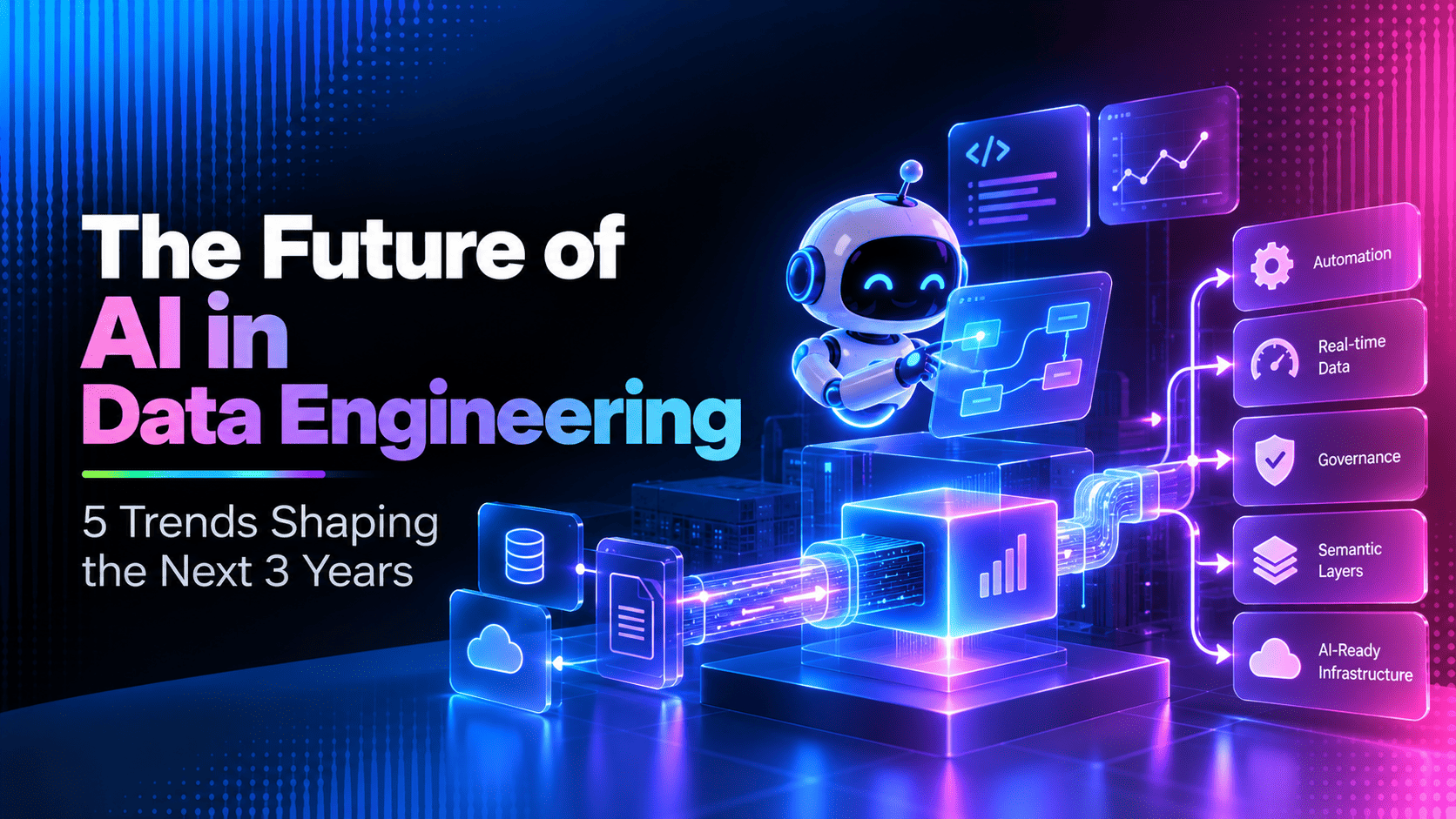
The role is likely to continue changing as pipeline creation becomes more automated. Our article on the future of AI in data engineering looks more closely at agentic pipelines, real-time systems, semantic infrastructure, and how engineering responsibilities may evolve over the next several years.
Close AI data engineering gaps faster.
Exadel combines data, AI, and production engineering to accelerate delivery while strengthening internal capability.
How Exadel Provides AI Data Engineering Capability at Enterprise Scale
At Exadel, AI data engineering sits at the intersection of our data-platform and AI-engineering capabilities.
Our Data Engineering & Analytics services cover modern data pipelines, trusted platforms, automated data-quality controls, governance and lineage, and integration between enterprise data and downstream analytics and AI workloads.
Exadel’s current practice includes certified engineers across AWS, Azure, GCP, Databricks, Snowflake, and other data ecosystems, alongside architectures designed to support machine learning and generative AI.
That matters because AI data engineering rarely requires one technology in isolation.
A production environment may combine cloud infrastructure, ingestion, transformation, streaming, orchestration, security, metadata, ML pipelines, vector retrieval, monitoring, and application integration.
Our approach is therefore requirement-driven.
The right architecture depends on the workload: scale, latency, security, governance, deployment environment, existing systems, internal skills, and cost.
Our engineering capability is also supported by Exadel’s current relationships with Cursor, OpenAI, and Anthropic. Exadel is publicly listed as a Cursor Transformation Partner, an OpenAI Select Partner, and a member of the Claude Partner Network. These relationships complement our platform expertise by keeping practitioners close to the AI technologies increasingly consuming enterprise data.
The client value is not the partner logos.
It is having engineers who understand both sides of the architecture:
what an AI workload needs from data, and what the data environment must do to provide it reliably.
That is also why delivery and enablement stay connected.
We work alongside client architects, data engineers, platform owners, AI teams, security specialists, and governance teams so that reusable patterns and operational knowledge become part of the client organization as the platform is built.
AI data engineering capability should therefore be measured by more than the number of specialists hired.
A strong enterprise capability means the organization can reliably provide AI with the right data, understand how that data is being used, detect when something changes, and continue evolving the system without rebuilding the foundation for every new AI use case.
Frequently Asked Questions
What Does an AI Data Engineer Do?
An AI data engineer builds and operates the data infrastructure used by machine-learning, generative-AI, and agentic systems.
Their work may include ingestion, transformation, streaming, feature pipelines, unstructured-data processing, embeddings, vector retrieval, quality controls, lineage, governance, observability, and integration with model pipelines.
They also work with data scientists, ML engineers, application teams, and governance specialists to ensure that production AI receives sufficiently reliable, current, secure, and understandable data.
Is the AI Data Engineer Replacing the Traditional Data Engineer?
No. The AI data engineer is better understood as an extension of the traditional data-engineering role.
Core skills such as SQL, Python, data modeling, pipeline design, cloud platforms, orchestration, testing, and reliability remain essential.
AI adds new consumers and responsibilities: model features, embeddings, vector retrieval, unstructured data, MLOps integration, AI-specific observability, and greater use of AI-assisted engineering tools.
Some companies will create a separate AI data-engineer title. Others will evolve the responsibilities of their existing data teams.
What Is the Difference Between a Data Engineer and an AI/ML Engineer?
A data engineer primarily builds the infrastructure that moves, transforms, stores, and governs data.
An AI or ML engineer typically focuses more directly on model development, evaluation, deployment, inference, and model performance.
The AI data engineer sits between the two. They specialize in making enterprise data usable by AI systems—building feature, retrieval, streaming, and model-data pipelines while maintaining the quality, governance, and reliability expected of production data engineering.
The exact boundaries vary by organization.
What Tools Does an AI Data Engineer Use?
AI data engineers commonly work with SQL and Python; processing technologies such as Spark; transformation frameworks such as dbt; orchestration tools such as Airflow or Dagster; and streaming technologies such as Kafka or Flink.
They may also use AWS, Azure, GCP, Databricks, or Snowflake, together with feature stores, ML lifecycle tooling, vector-search technologies such as Pinecone, Weaviate, or pgvector, and LLM frameworks such as LangChain or LlamaIndex.
The appropriate stack depends on the workload rather than the job title.
Build AI data engineering capability that lasts.
Exadel helps teams design, deliver, and own reliable data foundations for production AI.