Tags
Share
What does it mean to be a leader in a world where technology never stops evolving? Is it about mastering new tools, making difficult decisions, or helping people navigate change?
As part of our Women@Exadel initiative, we're bringing together three different perspectives from across the company to explore what leadership looks like in practice, how AI is reshaping our work, and why human connection matters more than ever.
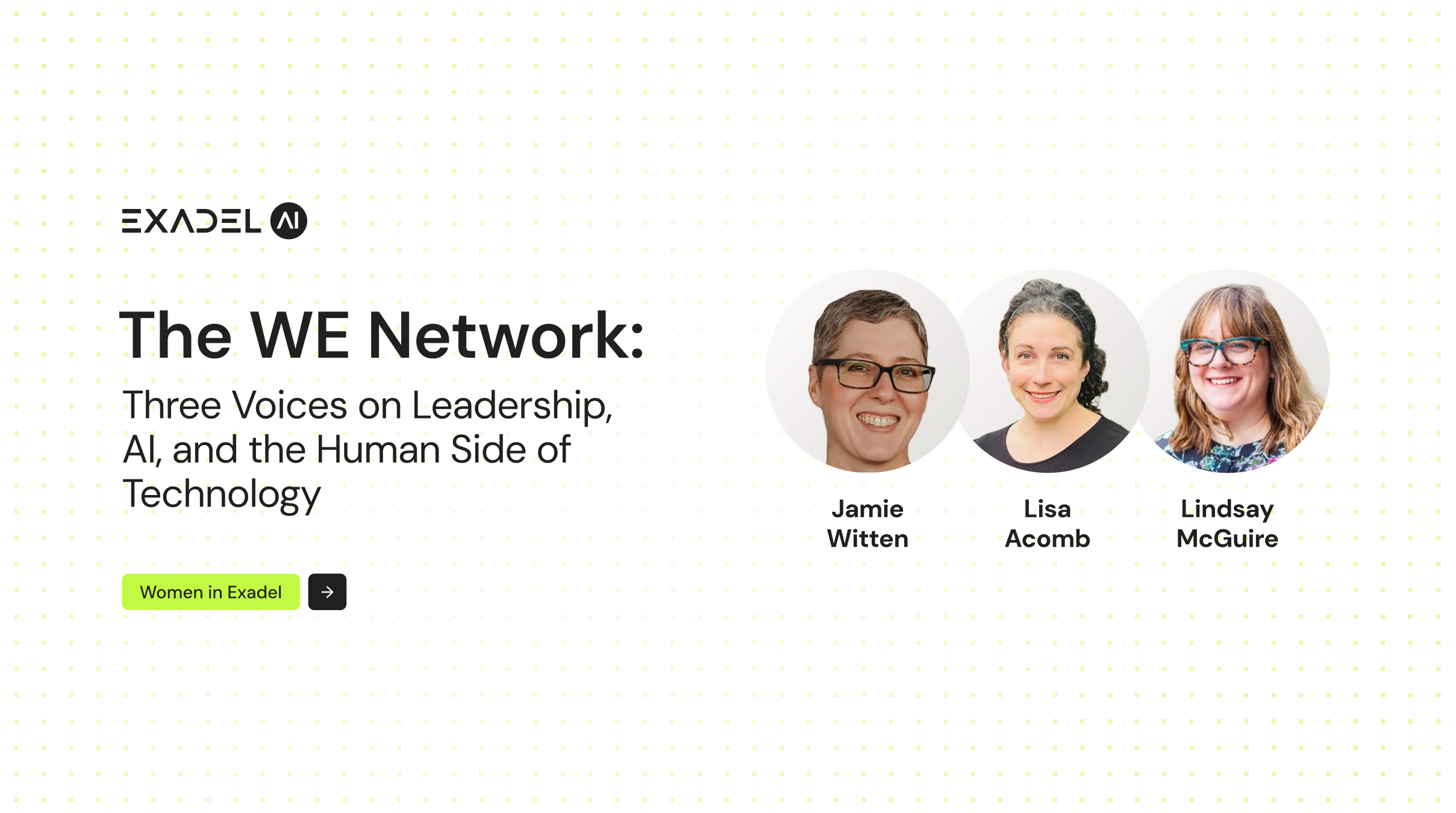
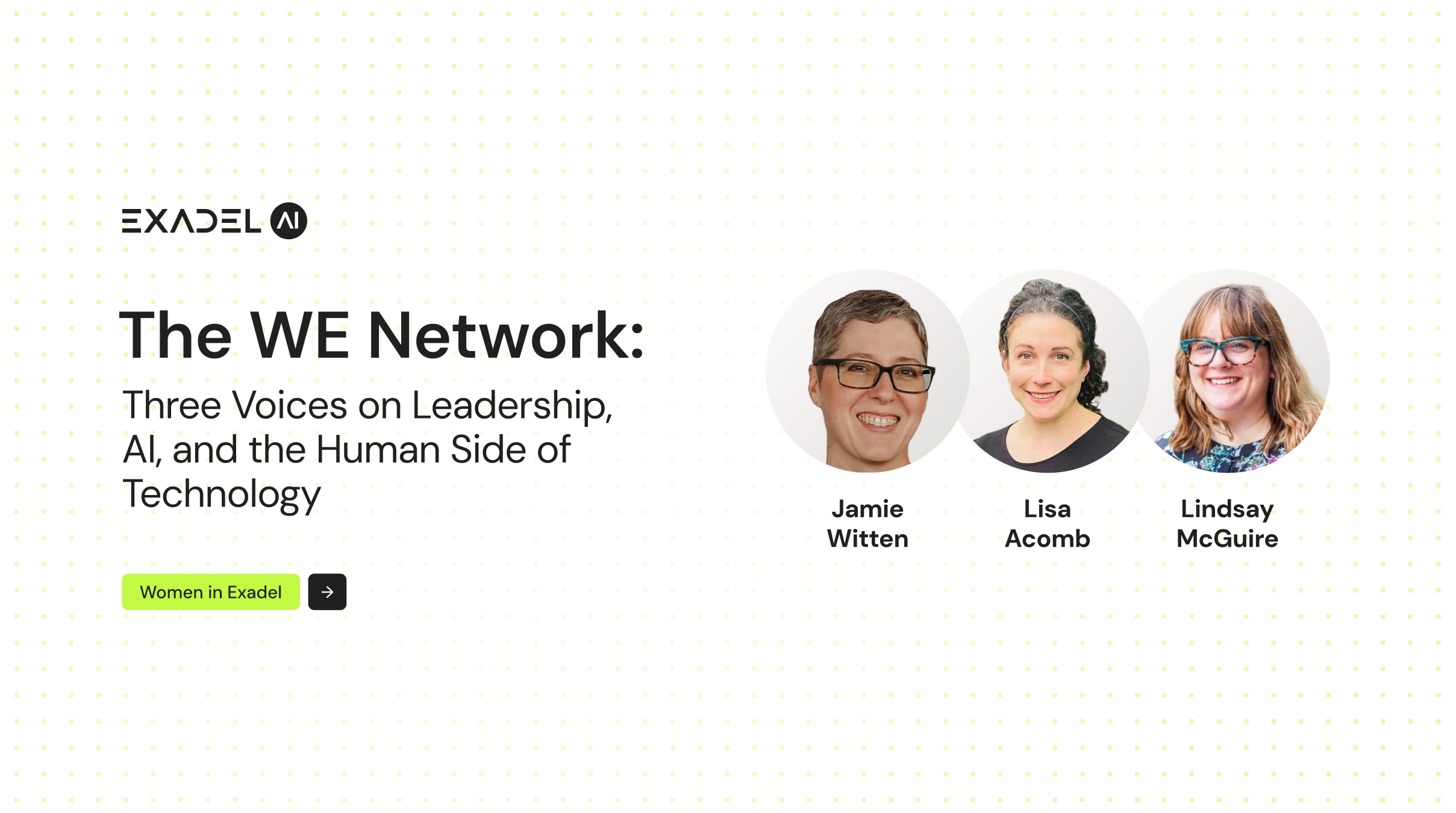
In this conversation, we hear from Jamie Witten, Senior Data & Analytics Program Management Consultant; Lisa Acomb, Senior Data & Insights Consulting Manager; and Lindsay McGuire, Senior UX Consultant at Exadel. Drawing on their experiences, they share what they've learned, the challenges they've faced, and what motivates them in their work.
AI is moving fast. What opportunities are you most excited about?
Jamie: What excites me most is the speed at which AI operates. Rather than being afraid of it, I see it as another tool in my toolbox. It frees up time for the complex thinking that often doesn't get enough attention. But using AI well requires intent, preparation, organization, and context. I spend a lot of time reading and learning so I can confidently evaluate its outputs and distinguish valuable insights from hallucinations. AI is powerful, but that also means we need to be thoughtful about how we use it.
Lisa: That ability to think more deeply is what excites me, too. From a data and analytics perspective, AI can uncover value hidden within massive, complex datasets at a speed we couldn't achieve before. We're moving beyond descriptive reporting toward predictive insights and strategic decision-making. I find myself asking more questions than ever and using AI as a thought partner. But my human brain is still responsible for checking the facts, evaluating feasibility, and deciding what will actually make an impact.
Lindsay: I see something similar happening in UX design. AI gives us a work partner that speeds things up so much that we finally have more time to think creatively.
We're no longer as constrained by how long something will take to build. We have more time to think about what would make the experience more accessible and interesting for the people using it. Here's a fun example. My friends and I play Dungeons & Dragons, and we needed a way to manage a cooperative campaign. I asked them to share their wildest ideas, and within 30 minutes, we had a fully editable website for a department of magic.
If AI can help us do that for a game, imagine what it can unlock for a client project.
Innovation is exciting, but what about responsibility?
Jamie: Absolutely. My background in data analytics, data management, and data governance has helped me understand the foundations required for responsible AI. I find it exciting to apply that experience to technology that's fundamentally changing how we work. Establishing practical checks, balances, and governance principles gives me greater confidence in the integrity and quality of AI-generated outcomes. It's not just about adopting new technology. It's about making sure we can trust what it produces.
Lindsay: And there's another side to responsible adoption: helping people learn how to use these tools. I've been exploring ways to incorporate AI into UX workflows, from wireframing and mapping complex systems to generating requirements and creating translation tools. But I'm equally interested in helping people learn how to use AI in a fun, engaging way. That's why I created Curiosity Grove. After all, if nobody is using AI, there's nothing to govern.
Behind every successful project is a team. What makes yours work?
Lisa: I completely agree with the importance of creating an environment where people feel comfortable asking for help. My approach is built around transparent communication, shared goals, and data-informed decisions. I want people to feel comfortable questioning assumptions, challenging directives, and speaking up when something doesn't seem right.
In every team meeting, I ask where people need help, and I expect everyone to be open about it. Being vulnerable in a trusted environment helps us move forward together. No one has all the answers, especially in the AI era.
Lindsay: I think about teamwork the same way I think about UX design: the experience should work well for everyone involved. That includes our team and the client's team. I try to identify gaps, build bridges, and remove obstacles so people can focus on what they're good at. Sometimes that means improving communication. Other times, it means changing a process that isn't working. Ultimately, I want everyone involved in a project to have a better experience, not just the people using the final product.
Career Paths Aren't Always Straight. What Have the Detours Taught You?
Jamie: For me, one of the biggest challenges has been overcoming imposter syndrome, particularly in male-dominated environments. There have been moments when I've felt that I didn't belong or needed to justify my place at the table. Over time, I've learned that confidence doesn't mean knowing everything. Sometimes the strongest response is simply, "I'm not sure, but I'll get back to you." There's power in recognizing what you know, being honest about what you don't, and taking the initiative to close that knowledge gap.
Lisa: I think that ability to embrace uncertainty is incredibly important, especially when you're leading people through change. One of the toughest challenges I've faced has been navigating organizational transformations, particularly when colleagues are nervous about new technologies, processes, or data-driven ways of working. I've learned that technical expertise alone isn't enough. You also need empathy, humor, and persistence. I often think of transformation as creating an abstract painting. The process may seem uncertain, but when all the elements come together, the result can be remarkable. We have to go through the journey to see what's possible.
Is there a right way to take risks and challenge the status quo?
Lindsay: My artistic background has shaped how I approach problems. In art school, you're encouraged to put ideas on the canvas, experiment, and see what happens. I've carried that mindset into my career. I prefer to explore several ideas quickly, identify what works, and involve clients and developers early so they can help shape the direction. I'm comfortable letting go of ideas that aren't working because I haven't become too attached to them. I don't spend much time thinking about risk in the traditional sense. I'm usually focused on finding the best solution.
Jamie: I approach it by distinguishing between real risks and manufactured ones.
Real risks might involve fixed deadlines, external events, or genuine dependencies. Manufactured risks often come from arbitrary timelines or unnecessary urgency. Both need attention, but understanding the difference helps teams prioritize effectively and avoid burnout. Managing risk is also about maintaining perspective and staying composed under pressure without losing sight of the bigger picture.
Lisa: My approach is more quantitative. I rely on a combination of risk assessment and scenario planning. In data consulting, risks often involve data quality, security, or a disconnect between technical work and business objectives. I believe in identifying potential issues early, establishing clear validation standards, and creating practical mitigation plans. The goal isn't to eliminate every possible risk. It's to manage uncertainty without slowing down progress or limiting innovation.
What's your approach to improving processes and making everyday collaboration easier?
Lindsay: I love solving puzzles, and process improvement feels like solving a big puzzle.
I look at the entire project, identify where things are working and where people are frustrated, and then figure out what needs to change. Sometimes the solution is surprisingly simple. It's just that everyone has been too close to the problem to notice it. I'm not afraid to suggest that we stop doing something a certain way. But the best part comes afterward, when the improvement works and the team can finally focus on the work that matters.
Jamie: That's where I think looking at the relationship between people, processes, and technology becomes important. Technology provides the tools, people bring the expertise and needs, and processes determine how everything comes together. Improvement often means breaking down silos, eliminating bottlenecks, or moving away from outdated ways of working. Sometimes the most valuable change is finding a simpler way to do something we've been doing the same way for years.
Lisa: And I think feedback is essential to making those improvements sustainable.
I regularly evaluate workflows to identify bottlenecks, unnecessary steps, and opportunities for optimization. But I also believe in involving the team in designing improvements. A process is only effective if it works for the people who use it. And, of course, I now use AI to help identify opportunities to make those processes even better!