Tags
Share
Senior engineers are right to be skeptical of AI tooling. But experience can also harden into assumptions that no longer hold.
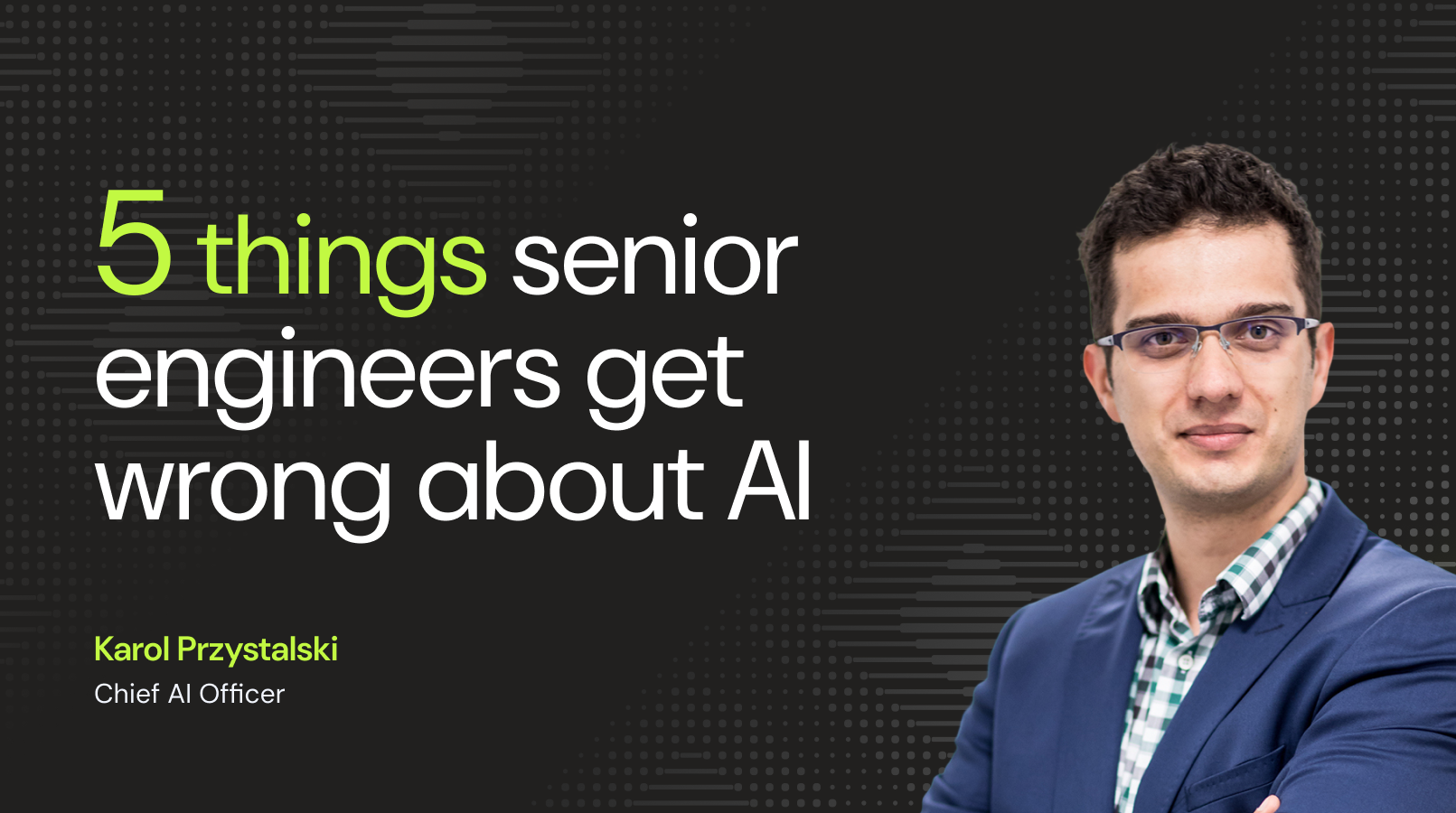
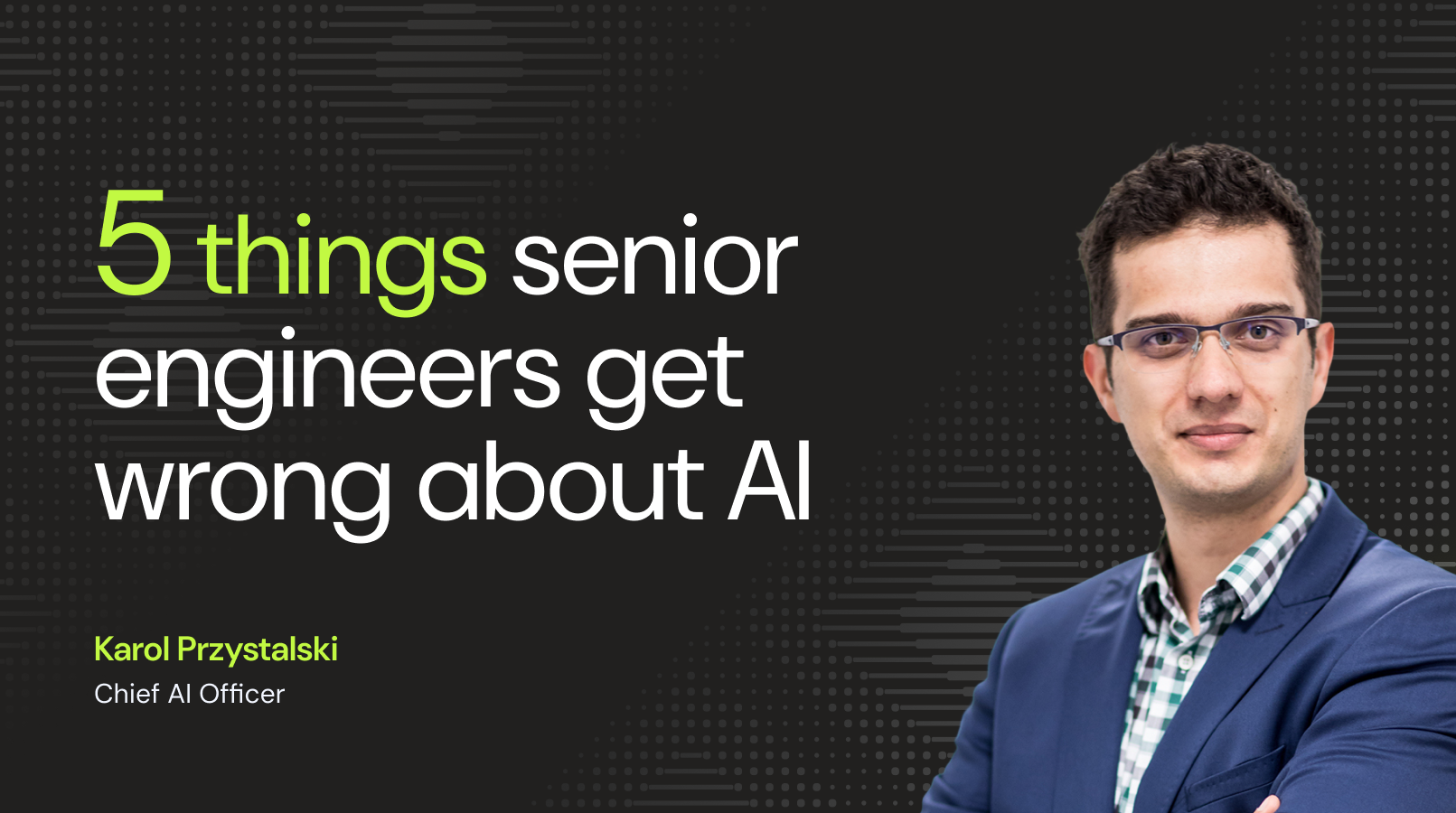
Karol Przystalski, Chief AI Officer at Exadel, challenges five common misconceptions about AI in software engineering, from model selection and data control to testing and workflow integration.
1. “AI generates code fast, so testing can wait.”
AI shifts the bottleneck from writing code to verifying it. A model can produce hundreds of lines in seconds, but it has no guarantee of correctness, and it can’t see your implicit business rules, edge cases, or integration contracts. Skipping tests means you accumulate unreviewed logic at machine speed: faster technical debt.
The fix is to make tests the specification.
Have the AI peer write tests first, derived from the ticket’s acceptance criteria, then generate code until they pass. Layer in property-based tests for invariants, contract tests at service boundaries, and mutation testing to check that the tests catch real defects rather than just inflating coverage. Run it all in CI as a hard gate. Tests are the only reliable way to keep AI output production-grade.
2. “One LLM is enough. Just pick the best one.”
Model leadership changes every few months, and no single model wins on every task. Large frontier models excel at complex reasoning and refactoring. Smaller, cheaper ones handle classification, summarization, and boilerplate faster and at a fraction of the cost. Locking into one vendor also exposes you to outages, deprecations, pricing changes, and regressions after silent model updates.
A well-designed agentic system is model-agnostic. It puts an abstraction layer between workflows and providers, routes each task by complexity, cost, latency, and data sensitivity, and falls back automatically on failure.
3. “Enterprise AI means giving up control of your data.”
This is true only if the architecture forces it. Sending proprietary source code to a shared multi-tenant API is a legitimate risk, but it isn’t the only deployment model.
Treat these as baseline requirements:
- Private cloud or VPC deployment, so traffic never crosses the public internet
- On-prem or air-gapped options for regulated environments
- Bring-your-own-key (BYOK) with customer-managed encryption keys
- Zero data retention and no training on your code
- Audit logging and role-based access control for every agent action
Your code should not leave your infrastructure. Sovereignty is a baseline, not a premium feature.
4. “You need an IDE or CLI to work with AI coding tools.”
Tools that live in the IDE assume a developer is present for every step: prompting, reviewing diffs, re-prompting. That makes the tool an autocomplete layer, not an autonomous contributor, and it limits who on the team can benefit.
Mature agentic tools run asynchronously and integrate with the systems where work already happens. An agent picks up a Jira ticket, reads the repository and linked context, works in an isolated environment, and opens a pull request with tests and a summary. Your team reviews it through the same code review process, CI checks, and branch protections they already use. The developer shifts from babysitting to reviewing, and nobody has to change how they work.
5. “More AI tools = more productivity.”
Every additional tool adds a context switch, another login, another permission model, and another place where context gets lost. A tool that generates code, another that writes tests, and a third that reviews PRs can’t share state. You end up copying context between them by hand, with no traceability from requirement to commit.
The real gains come from a single system that owns the full cycle: ticket, plan, implementation, tests, PR. A unified pipeline preserves context end to end, enforces the same quality gates at every step, and gives you one audit trail and one place to measure results. That beats six tools duct-taped together.