
Tags
Share
Choosing an enterprise AI delivery platform means evaluating its AI capabilities and how those capabilities are delivered.
Compare Exadel Colleague and Deloitte Sidekick across the engineering, deployment, governance, and operational considerations that matter most when evaluating an enterprise AI delivery platform.
Book a Demo.
2 - 4 hour Jira integration. Results in Sprint 1.
What to Look for in an Enterprise Agentic Delivery Platform
Delivery Matters as Much as the Technology
Most enterprise AI platforms promise similar capabilities. The bigger difference often lies in how those capabilities are integrated into day-to-day engineering work.
Some solutions are delivered as part of a consulting engagement. Others are embedded directly into the software delivery lifecycle, allowing engineering teams to adopt AI within the workflows they already use.
When evaluating an enterprise AI delivery platform, look beyond model performance. Consider activation time, workflow integration, deployment flexibility, governance, measurable business outcomes, and how easily the platform can evolve alongside future AI models.
Enterprise adoption also depends on how quickly teams can begin using AI without disrupting their established delivery practices. Introducing new interfaces, approval processes, or specialist tooling slows adoption, even when the underlying AI capabilities are strong. Platforms that integrate naturally into existing engineering workflows generally reach production sooner and encounter fewer barriers.
It's also important to decide how success will be measured. Activity metrics such as prompts, code generation, or model usage provide useful operational insight, but they are poor indicators of platform success. Instead, AI initiatives should demonstrate measurable improvements in engineering capacity, delivery predictability, software quality, and operational efficiency.
One objective: two approaches
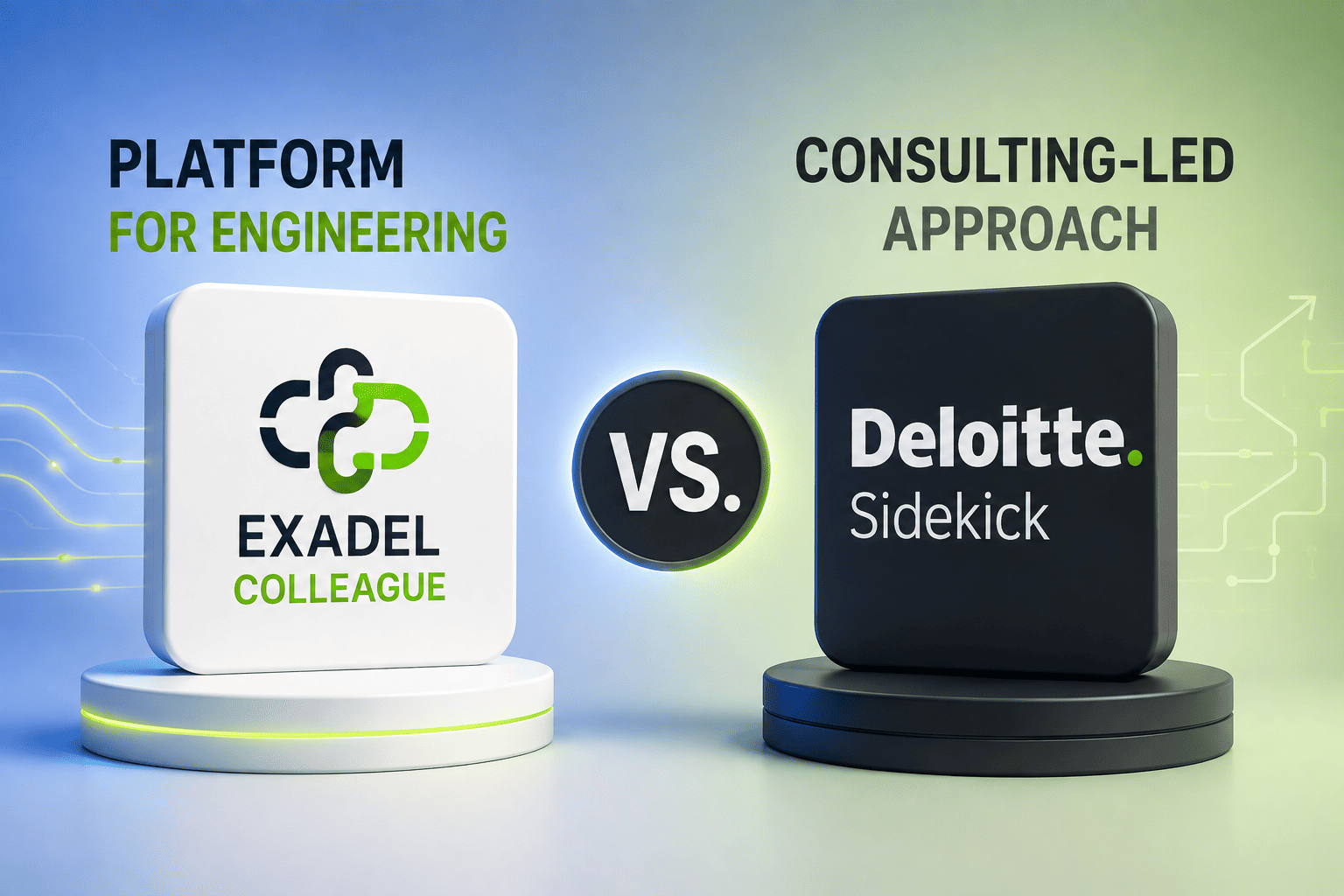
Deloitte Sidekick represents a consulting-led AI delivery approach, while Exadel Colleague embeds AI directly into engineering delivery.
This comparison examines both approaches to enterprise AI delivery and explains the practical differences between them, helping organizations evaluate whether Exadel Colleague is the right alternative to Deloitte Sidekick.
It compares how each solution approaches the capabilities that matter most to enterprise engineering organizations, including delivery model, software quality, workflow integration, deployment flexibility, governance, and measurable engineering outcomes.
At a Glance
Deloitte Sidekick vs. Exadel Colleague on the capabilities that matter most to enterprise engineering teams.
Requires active Deloitte consulting engagement
Embedded in every Exadel engineering engagement—no consulting dependency
Depends on team practice within Deloitte delivery framework
Built-in by design. Tests before code. Always.
Aligned to Deloitte project onboarding timeline
2-4 hours via standard Jira integration
Custom integration required
Native Jira trigger. Standard setup, no new tools.
Cloud-first; BYOK case-by-case
Private cloud, on-prem, BYOK standard offering
Varies by engagement configuration
Full model-agnostic routing from Day 1
Consulting engagement-level reporting
Human-Equivalent Hours. Ticket-level. From Sprint 1.
Part of broader discovery engagement
Standalone 2-week backlog benchmark available
Methodology: Comparison data sourced from public documentation and live Exadel deployment experience.
Last verified: July 2026.
What These Differences Mean in Practice
1. Platform-Embedded Delivery
How AI is delivered can be just as important as what it delivers.
Many organizations begin their AI journey with consulting support to define strategy, architecture, and implementation. As adoption matures, however, engineering leaders also need a delivery model that integrates AI into everyday software engineering rather than treating it as a separate initiative.
Deloitte Sidekick is delivered as part of a Deloitte consulting engagement. Exadel Colleague is embedded into every Exadel engineering engagement by default.
Standard Jira integration typically takes 2–4 hours, and teams start using AI within their current workflows rather than new and unfamiliar delivery processes. That means engineering value accumulates from the first sprint instead of waiting for a broader transformation programme to conclude.
Embedding AI into software delivery changes the ownership model. Engineering teams don’t have to rely on a separate consulting engagement for ongoing execution. Instead, they continue working within their existing delivery processes while AI becomes another contributor to the SDLC. Product owners continue prioritizing Jira backlogs. Engineers review pull requests. Existing governance, security reviews, and release controls remain in place.
This continuity helps organizations expand AI adoption incrementally which reduces implementation risk. Delivery teams build their confidence through achieving measurable outcomes rather than large-scale organizational change.
2. Engineering Workflows Built Around Quality
Enterprise AI should strengthen engineering discipline, not bypass it.
Generating code is only one step in software delivery. Every change still has to meet engineering standards before it reaches production, particularly in regulated or business-critical environments.
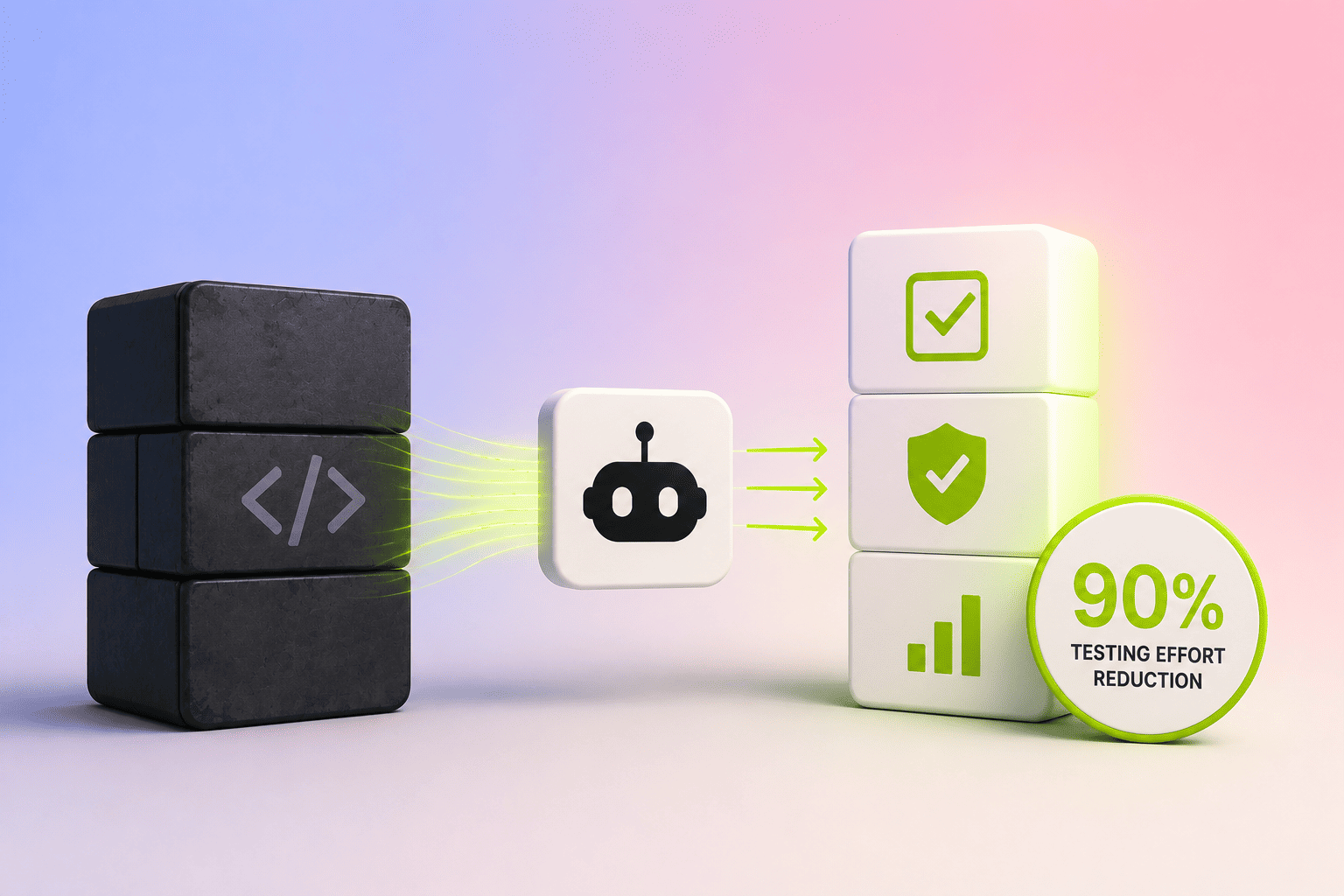
Exadel Colleague applies a test-first (TDD/BDD) approach as part of its delivery model. Tests are generated and validated before production code is written, making software quality an integral part of the development process. Engineers continue reviewing every pull request before it is merged, preserving existing governance and quality controls.
Because Exadel Colleague operates directly from Jira tickets, engineering teams continue using the same planning, review, and approval workflows they already trust. This approach helps engineering organizations balance Run-the-Business (RTB) and Change-the-Business (CTB) initiatives. Routine delivery work is increasingly done through governed agentic execution, while experienced engineers focus on higher-value priorities such as modernization, architecture, and complex implementation work.
Because AI operates inside existing workflows, teams avoid the burden of duplicate planning, reviewing, or reporting processes. Governance remains consistent regardless of whether work is completed by engineers or by agentic contributors.
3. Enterprise Deployment Without Technology Lock-In
Your AI strategy should evolve as quickly as the technology itself.
Enterprise AI platforms need to support changing business requirements, security policies, and rapidly evolving language models. Flexibility is increasingly becoming a strategic requirement rather than a technical preference.
Exadel Colleague supports private cloud, on-premises deployment, and Bring Your Own Key (BYOK) as standard. Its model-agnostic architecture allows organizations to adopt approved language models without becoming dependent on a single provider.
As enterprise AI continues to evolve, engineering teams retain the flexibility to evaluate new models while maintaining the same delivery platform, governance model, and engineering workflows.
Deployment flexibility also determines how easily AI can operate within existing enterprise controls. Regulated businesses may need to keep source code, credentials, model access, and development data within approved environments. Supporting private cloud, on-premises deployment, and BYOK as standard allows organizations to introduce agentic delivery without creating a separate exception to their security architecture. The platform adapts to established requirements rather than forcing those requirements to adapt to the platform.
4. Measuring Engineering Outcomes
AI activity is only valuable when it improves software delivery.
Engineering leaders need evidence that AI is reducing delivery effort, increasing engineering capacity, and improving software outcomes. Metrics such as prompt volume or generated code provide limited insight into business value.
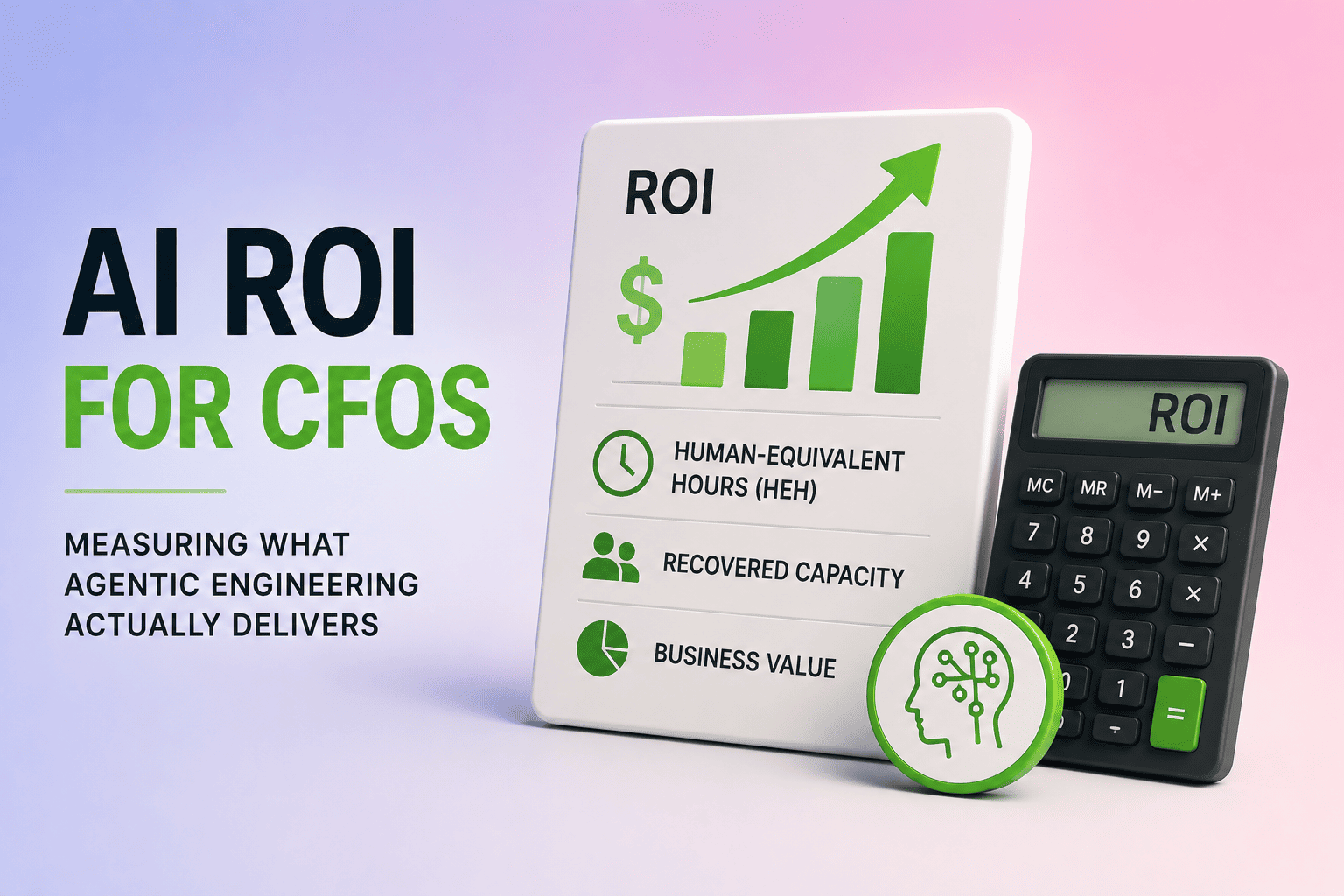
Exadel Colleague reports Human-Equivalent Hours (HEH) recovered alongside ticket-level delivery outcomes from the earliest stages of deployment. An organization can now measure how AI contributes to engineering performance using delivery metrics that already exist within their software development lifecycle.
For teams evaluating adoption, Exadel also offers a standalone two-week Phase 0 benchmark that establishes a measurable baseline before broader deployment begins.
Ticket-level measurement also gives leaders a clearer view of where agentic execution creates the most value. They can compare the effort recovered across different work types, identify which tickets are suitable for autonomous completion, and make better decisions about where to expand adoption. This turns AI measurement into an ongoing management discipline rather than a retrospective report produced at the end of an engineering engagement.


Your AI Partner
See the difference in practice.
Discover how Exadel Colleague brings governed AI directly into your engineering workflow.
The Architecture Behind the Delivery Model
Today's AI model won't necessarily be tomorrow's standard.
Exadel Colleague is a model-agnostic orchestration layer that coordinates specialized agents across the SDLC while supporting approved language models, including Claude, Gemini, Codex, and others. Organizations can adopt new models without changing their delivery platform or engineering workflows.
Private cloud, on-premises, and Bring Your Own Key (BYOK) deployments are supported as standard, helping organizations meet existing security, compliance, and governance requirements.
Rather than being tied to a single language model, Exadel Colleague coordinates specialized agents that perform different engineering activities throughout the software development lifecycle. This orchestration layer allows organizations to introduce new AI models as they become available while maintaining consistent governance, workflow integration, and operational controls.
That separation between orchestration and model selection reduces long-term technology risk. As enterprise AI continues to evolve, organizations retain the flexibility to adopt new capabilities without redesigning their delivery processes or replacing their AI platform.
Why Engineering Teams Choose Exadel Colleague
The best AI platforms fit the way engineering teams already work.
Exadel Colleague combines test-first development, Jira-native workflows, model-agnostic architecture, enterprise deployment options, and measurable engineering outcomes into a governed agentic delivery platform.
Teams gain engineering capacity while maintaining full control over software quality, governance, and security. AI becomes part of the software delivery process rather than another layer of operational complexity. This matters because enterprise adoption rarely fails on AI capability alone. It slows when teams must change tools, create parallel governance processes, or wait too long to demonstrate value. Exadel Colleague reduces those barriers by fitting into established delivery operations and producing evidence from real engineering work. Teams can begin with a defined backlog, validate the results, and expand usage as confidence grows.
See Exadel Colleague in Your Workflow
Reading about agentic delivery is one thing. Seeing it operate inside your own Jira workflow is another.
If you're evaluating an alternative to Deloitte's AI delivery platform , a live demonstration is the quickest way to see how Exadel Colleague fits into your existing engineering workflow.
Written by: Karol Przystalski, Chief AI Officer
July, 2026
Ready to put agentic delivery to work?
See how Exadel Colleague fits into your existing Jira workflow.
.png)